Knee Osteoarthritis Insights and Trends
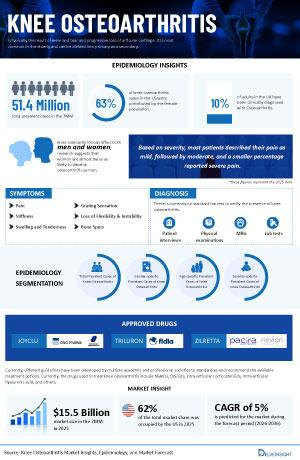
- Knee osteoarthritis can affect both men and women; research suggests that women are almost twice as likely to develop osteoarthritis as men. About 63% of knee osteoarthritis cases in the US were contributed by the female population.
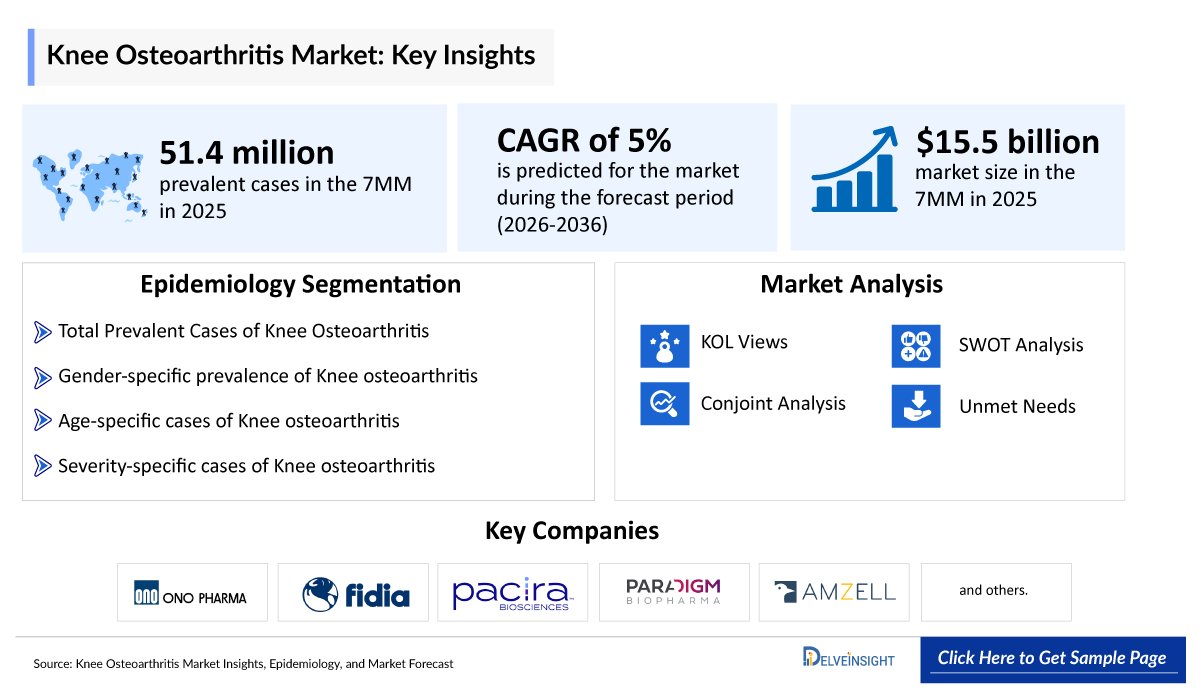
- According to DelveInsight’s analysis, the knee osteoarthritis market size was found to be ~USD 15,500 million in the leading markets (the United States, the EU4 (Germany, France, Italy, and Spain), the United Kingdom, and Japan) in 2025.
- Based on severity, most patients described their pain as mild, followed by moderate, and a smaller percentage reported severe pain.
- Almost 10% of adults in the UK have been clinically diagnosed with Osteoarthritis. This is comparable to about 11.5% in the US and a slightly higher global prevalence of about 16%. The total number of cases of Osteoarthritis in the UK has increased over the years.
- Those with multiple joints affected by synovial inflammation are more likely to have significant symptoms like higher levels of hand pain and stiffness.
- In knee osteoarthritis, approved intra-articular therapies such as JOYCLU, TRILURON, and ZILRETTA anchor the current market landscape, supported by localized and sustained pain control, and their role as effective non-surgical options.
- According to the estimates, the US accounted for around 19,37,600 diagnosed prevalent cases of knee osteoarthritis in 2025.
- Emerging pharmaceutical companies developing therapies to treat knee osteoarthritis include Paradigm Biopharma (ZILOSUL), Amzell (AMZ001), and CellSeed (CLS2901C).
Knee Osteoarthritis Market Size and Forecast in the 7MM
- 2025 Knee Osteoarthritis Market Size: ~USD 15,500 million
- 2036 Projected Knee Osteoarthritis Market Size: ~USD 26,000 million
- Knee Osteoarthritis Growth Rate (2026–2036): 5% CAGR
DelveInsight's ‘Knee Osteoarthritis – Market Insights, Epidemiology and Market Forecast – 2036’ report delivers an in-depth understanding of the knee osteoarthritis, historical and forecasted epidemiology, as well as the knee osteoarthritis market trends in the United States, EU4 (Germany, Spain, Italy, and France) and the United Kingdom, and Japan.
The Knee Osteoarthritis market report delivers a comprehensive analysis of the current treatment landscape, including standards of care, clinical practices, and evolving therapeutic algorithms. It evaluates knee osteoarthritis patient burden trends, revenue & market share dynamics, peak patient share & therapy uptake analysis, and provides an in-depth market size assessment, and growth rate projections (Historical & Forecast 2022–2036) across global regions. The report highlights key unmet medical needs in knee osteoarthritis and maps the competitive and clinical landscape to uncover high‑value opportunities, providing a clear outlook on future market growth potential.
|
Study Period |
2022–2036 |
|
Historical Year |
2022–2025 |
|
Forecast Period |
2026–2036 |
|
Base Year |
2026 |
|
Geographies Covered |
|
|
Knee Osteoarthritis Market CAGR (Forecast period) |
5% (2026–2036) |
|
Knee Osteoarthritis Epidemiology Segmentation Analysis |
Patient Burden Assessment
|
|
Knee Osteoarthritis Companies |
|
|
Knee Osteoarthritis Therapies |
|
|
Knee Osteoarthritis Market |
Segmented by
|
|
Analysis
|
|
Key Factors Driving the Knee Osteoarthritis Market
Rising Prevalence of Knee Osteoarthritis and Aging Population
Knee osteoarthritis is highly prevalent among individuals over 50. As global life expectancy increases, the burden of joint degeneration rises correspondingly.
Shift Toward Minimally Invasive & Non-Surgical Procedures
There is a high preference for non-surgical alternatives to relieve pain, such as hyaluronic acid injections (viscosupplementation) and platelet-rich plasma (PRP), over traditional oral medication.
Emerging Knee Osteoarthritis Competitive Landscape
The competitive landscape for emerging knee osteoarthritis therapies is driven by key drugs in clinical trials, including ZILOSUL (Paradigm Biopharma), AMZ001 (Amzell), CLS2901C (CellSeed), and others.
Knee Osteoarthritis Understanding and Treatment Algorithm
Knee Osteoarthritis Overview and Diagnosis
Knee Osteoarthritis, also known as degenerative joint disease, is typically the result of wear and tear and progressive loss of articular cartilage. It is most common in the elderly and can be divided into primary and secondary. Primary osteoarthritis is articular degeneration without any apparent underlying reason. Secondary osteoarthritis is the consequence of either an abnormal concentration of force across the joint, as with post-traumatic causes, or abnormal articular cartilage, such as rheumatoid arthritis. The symptoms of knee osteoarthritis develop gradually because it takes time for the cartilage to wear down and change how the joints work.
There is currently no standard lab test to verify the presence of knee osteoarthritis. Instead of a single lab test, physicians commonly use five diagnostic tools to determine if a patient has knee osteoarthritis or another medical condition. These tools are patient interviews, physical examinations, x-rays, MRIs, and lab tests for other conditions.
Further details are provided in the report….
Knee Osteoarthritis Treatment Landscape
Osteoarthritis is a progressive and degenerative condition with unlikely regression and restoration of damaged structures. Currently, different guidelines have been developed by multiple academic and professional societies to standardize and recommend the available treatment options. Currently, the drugs used to treat knee osteoarthritis include NSAIDs, Opioids, Intra-articular corticosteroids, Intra-articular hyaluronic acid, and others. The approved therapies include JOYCLU (Ono Pharmaceutical/Seikagaku Corporation), TRILURON (Fidia Farmaceutici), ZILRETTA (Pacira BioSciences/Flexion Therapeutics), and others. ZILRETTA delivers a corticosteroid via PLGA microspheres, allowing for sustained intra-articular release that minimizes systemic exposure while controlling inflammation and pain over several months.
Further details related to country-based variations are provided in the report…
Knee Osteoarthritis Unmet Needs
The section “unmet needs of knee osteoarthritis” outlines the critical gaps between the current state of patient care, diagnosis, and the ideal & effective management of the disease. It highlights the obstacles experienced by patients, clinicians, and researchers and identifies potential solutions for future progress.
- Need for developing the ability to phenotype and stratify patients for inclusion in clinical trials
- Impact of knee osteoarthritis on patients’ quality of life
- Insufficient knowledge regarding the disease paradigm
- Need for treatment therapies with fewer side effects, and others…..
Note: Comprehensive unmet needs insights in knee osteoarthritis and their strategic implications are provided in the full report…
Knee Osteoarthritis Epidemiology
Key Findings from Knee Osteoarthritis Epidemiological Analysis and Forecast
- Amongst EU4 and the UK, in 2025, the highest proportion of age-specific cases was observed in those aged 70 years and above, followed by the age groups of 60–69 and 50–59 years.
- Among EU4 and the UK, Germany had the highest prevalence of cases of knee osteoarthritis, followed by France. In contrast, Italy had the lowest number of cases.
- In Japan, the age group of 70 years and above accounted for the highest cases. In contrast, the fewest cases were found in the age group of 18–39 years.
- In 2025, Germany had nearly 6,972,862 diagnosed prevalent cases of knee osteoarthritis.
Knee Osteoarthritis Drug Analysis & Competitive Landscape
The knee osteoarthritis drug chapter provides a detailed, market-focused review of approved therapies and the emerging pipeline across Phase I-III clinical trials. It covers the mechanism of action, clinical trial data, regulatory approvals, patents, collaborations, and strategic partnerships for each therapy, along with their advantages, limitations, and recent developments. This section offers critical insights into the knee osteoarthritis treatment landscape, supporting market assessment, competitive analysis, and growth forecasting for the knee osteoarthritis therapeutics market.
Approved Therapies for Knee Osteoarthritis
JOYCLU: Ono Pharmaceutical/Seikagaku
Joyclu is a formulation in which hyaluronic acid and diclofenac (an anti-inflammatory drug) are chemically bound using Seikagaku’s proprietary technology. It is designed to release diclofenac by hydrolysis in the joint. JOYCLU is approved for treating osteoarthritis (knee joint and hip joint) and is expected to improve osteoarthritis symptoms by the intra-articular injection once every 4 weeks. JOYCLU is the first ethical drug indicating osteoarthritis of the hip joint in Japan among the joint function improvement agents. Seikagaku is involved in the manufacturing and marketing of the product, and Ono is responsible for distribution.
TRILURON: Fidia Farmaceutici
TRILURON is a high‑molecular‑weight hyaluronic acid (500,000–730,000 Da) viscosupplement composed of purified sodium hyaluronate in buffered saline (pH 6.8–7.5), derived from rooster combs. It is administered as a 3‑injection intra‑articular regimen to relieve pain in knee osteoarthritis. Hyaluronic acid is a natural glycosaminoglycan consisting of repeating disaccharide units of N‑acetylglucosamine and glucuronate. TRILURON is approved for patients whose knee OA pain remains inadequately controlled with conservative measures and simple analgesics.
Note: Detailed marketed therapies assessment will be provided in the final report…
Knee Osteoarthritis Marketed/Approved Therapies | ||||||
|
Drug/Therapy |
Company |
Indication |
Molecule Type |
MoA |
RoA |
Marketed Region |
|
JOYCLU |
Ono Pharmaceutical/Seikagaku Corporation |
Osteoarthritis (knee joint and hip joint) |
Small molecule |
Cyclooxygenase inhibitor |
Intra-articular |
JP: 2021 |
|
TRILURON |
Fidia Farmaceutici |
Knee Osteoarthritis |
Glycosaminoglycans |
Hyaluronic acid modulators |
Intra-articular |
US: 2019 |
|
ZILRETTA |
Pacira BioSciences/Flexion Therapeutics |
Mild to Moderate Knee Osteoarthritis |
Small molecule |
Glucocorticoid receptor agonists |
Intra-articular |
Information is available in the full report |
Knee Osteoarthritis Pipeline Analysis
Pentosan polysulfate sodium (ZILOSUL): Paradigm Biopharma
ZILOSUL, or pentosan polysulfate sodium (PPS), is a semi-synthetic drug manufactured from the wood chips of European beech trees. Key features of the activity of PPS are its anti-inflammatory and tissue regenerative properties, as well as its mild anti-thrombotic activity. Due to PPS having multiple mechanisms of action, Paradigm’s broader focus is exploring the use of PPS in treating a wide spectrum of conditions that begin with and are sustained by inflammation, such as osteoarthritis.
Paradigm has a longstanding relationship with Bene PharmaChem, the only FDA-approved manufacturer/supplier of PPS. Through the extensive interaction and collaboration with Bene PharmaChem and Paradigm’s European manufacturers of the injectable formulation of PPS (iPPS), Paradigm has been able to develop its clinical product for trials.
Competitive Landscape of Pipeline Drugs | ||||||
|
Drug Name |
Company |
Highest Phase |
Indication |
RoA |
MoA |
Anticipated Launch in the US |
|
Pentosan polysulfate sodium (ZILOSUL) |
Paradigm Biopharma |
III |
Moderate to severe Knee osteoarthritis |
Subcutaneous |
Non-nucleoside reverse transcriptase inhibitors |
Information is available in the full report |
|
AMZ001 |
Amzell |
III |
Knee osteoarthritis |
Topical gel |
COX Inhibitor |
Information is available in the full report |
|
CLS2901C |
CellSeed |
III |
Knee Osteoarthritis |
Injectable |
Regenerative cell-based therapy |
Information is available in the full report |
|
Note: Launch insights are provisional and may change with future report updates or the occurrence of major key catalysts. | ||||||
Note: Detailed emerging therapies assessment will be provided in the final report.
Knee Osteoarthritis Key Players, Market Leaders and Emerging Companies
- Ono Pharmaceutical
- Fidia Farmaceutici
- Pacira BioSciences
- Paradigm Biopharma
- CellSeed, and others
Knee Osteoarthritis Drug Updates
- In January 2026, Biosplice submitted an NDA to the FDA for lorecivivint (LOR), the first disease-modifying candidate for knee osteoarthritis. It showed statistically and clinically significant improvements in pain, function, and medial joint space width versus placebo, with an excellent safety profile.
- In July 2025, Genascence announced that the US FDA granted Regenerative Medicine Advanced Therapy (RMAT) designation to GNSC‑001 for the treatment of knee osteoarthritis.
- In March 2023, Paradigm received parallel European regulatory and ethics approvals for the pivotal PARA_OA_002 global clinical trial.
- In July 2023, UnicoCell Biomed successfully enrolled the first Phase III clinical trial participant to treat knee osteoarthritis. The trial received approval from the US FDA in March 2023.
Drug Class Insights
Knee Osteoarthritis Market Outlook
The common pharmacologic interventions used to help alleviate the symptoms of knee osteoarthritis include nonsteroidal anti-inflammatory drugs (NSAIDs), intra-articular corticosteroids, intra-articular hyaluronic acid, and opioids. A systematic review of meta-analyses comparing IAHA treatment with other IA therapies and oral NSAIDs concluded HA to be a viable treatment option for knee osteoarthritis, producing improvements in pain and function that can persist for up to 26 weeks and demonstrating a good safety profile.
The current standard of care is anchored by intra-articular therapies such as JOYCLU, which provides localized anti-inflammatory pain relief, TRILURON, which restores joint lubrication and viscoelasticity, and ZILRETTA, offering sustained corticosteroid delivery for prolonged symptom management. Beyond these approved options, emerging therapies are shifting the landscape toward disease-modifying and regenerative approaches. Pipeline candidates include ZILOSUL, which is being investigated for its potential to reduce cartilage degradation and joint inflammation; ELIXCYTE, aiming to promote cartilage repair and improve joint function. The entry of candidates such as ZILOSUL (pentosan polysulfate sodium) is expected to intensify competition in the knee osteoarthritis treatment landscape during the latter half of the forecast period.
- Among the 7MM, the US accounted for the largest market size of knee osteoarthritis. i.e., USD ~9,600 million in 2025.
- Among EU4, the UK and Germany account for the largest knee osteoarthritis market size, followed by France.
- Late-stage candidates like Lorecivivint and AMZ001 will ramp up competition in the knee osteoarthritis treatment market over the forecast period.
Further details will be provided in the report….
Drug Class/Insights into Leading Emerging and Marketed Therapies in Knee Osteoarthritis (2022–2036 Forecast)
The knee osteoarthritis market comprises Glycosaminoglycans and small molecules, each targeting different aspects of knee osteoarthritis.
- Glycosaminoglycans: TRILURON functions as a glycosaminoglycan-based viscosupplement. It restores the viscoelastic properties of synovial fluid, improving lubrication and shock absorption within the joint while also exerting mild anti-inflammatory and chondroprotective effects.
- Small molecules: Approved therapies such as JOYCLU and ZILRETTA are small molecules. ZILRETTA contains the small-molecule corticosteroid triamcinolone acetonide formulated in PLGA microspheres for sustained intra-articular release.
Knee Osteoarthritis Drug Uptake
This section focuses on the uptake rate of potential drugs expected to be launched in the market during the forecast period (2026–2036). The analysis covers the uptake of the knee osteoarthritis drug, performance at peak, factors affecting performance during prime years of growth, patient uptake by therapy, and anticipated sales generated by each drug.
The uptake of therapies in knee osteoarthritis is expected to vary based on clinical positioning, mechanism of action, and stage of development. Approved therapies JOYCLU and ZILRETTA are projected to demonstrate relatively faster uptake in knee osteoarthritis, driven by their ability to provide sustained pain relief through localized delivery, reduced systemic exposure, and strong clinical demand for non-surgical treatment options.
In contrast, pipeline candidate TRILURON is expected to maintain steady adoption, supported by established use in improving joint lubrication and function, although variability in clinical response may moderate widespread preference across patient subgroups.
Detailed insights of emerging therapies' drug uptake are included in the report
Market Access and Reimbursement of Approved Therapies in Knee Osteoarthritis
The United States
|
US Reimbursement of Therapies Approved for Knee Osteoarthritis | |
|
Drug/Therapy |
Access Program |
|
ZILRETTA |
ZILRETTA copay assistance program |
Reimbursement is a crucial factor that affects the drug’s access to the market. Often, the decision to reimburse comes down to the price of the drug relative to the benefit it produces in treated patients. To reduce the healthcare burden of these high-cost therapies, many payment models are being considered by payers and other industry insiders.
NOTE: Further Details are provided in the final report….
Knee Osteoarthritis Therapies Price Scenario & Trends
Pricing and analogue assessment of knee osteoarthritis therapies highlights evolving price dynamics structures. This section summarizes the cost of approved treatments, the closest and most appropriate analogue selection for emerging therapies, and understanding of how pricing influences market access, adherence, and long-term uptake.
- Pricing of Knee Osteoarthritis Approved Drugs
The cost of ZILRETTA therapy, administered as a single intra-articular extended-release injection delivering 32 mg of triamcinolone acetonide (ZILRETTA intra-articular powder for injection, extended release), is 692 USD.
Industry Experts and Physician Views for Knee Osteoarthritis
To keep up with knee osteoarthritis market trends, we take Key Opinion Leaders (KOLs) and Subject Matter Experts (SMEs) opinions working in the domain through primary research to fill the data gaps and validate our secondary research. Industry experts were contacted for insights on the knee osteoarthritis emerging therapies, evolving treatment landscape, patient adherence to conventional therapies, therapy switching trends, drug adoption and uptake, accessibility challenges, and epidemiology and real-world prescription patterns in knee osteoarthritis, including MD, PhD, Instructor, Postdoctoral Researcher, Professor, Researcher, and others.
DelveInsight’s analysts connected with 10+ KOLs to gather insights; however, interviews were conducted with 6+ KOLs in the 7MM. Centers such as the University of New Mexico Health Sciences Center, University Medical Center Mainz, and Boston Medical Center, etc. were contacted. Their opinion helps understand and validate current and emerging knee osteoarthritis therapies, highlight unmet medical needs, provide epidemiological context, and support strategic decisions for market access, therapy adoption, and pipeline prioritization in knee osteoarthritis.
|
Region |
Key Opinion Leaders (KOLs) and Subject Matter Experts (SMEs) |
|
United States |
“Millions of patients suffering from knee osteoarthritis are waiting for additional treatment options. Resiniferatoxin targets one of the most common and severe symptoms of this currently incurable disease: pain. We are hopeful that the Breakthrough Therapy Designation will help us to bring this non-opioid therapy option more quickly to patients” |
|
Germany |
“Those with multiple joints affected by synovial inflammation are more likely to have significant symptoms like higher levels of hand pain and stiffness. They are also more likely to get progressive damage or ‘erosive’ osteoarthritis, which is linked to deteriorating hand function over time.” |
Qualitative Analysis: SWOT and Conjoint Analysis
We perform qualitative and market Intelligence analysis using various approaches, such as SWOT analysis and conjoint analysis.
In the SWOT analysis of knee osteoarthritis, strengths, weaknesses, opportunities, and threats in terms of disease diagnosis, patient awareness, patient burden, competitive landscape, cost-effectiveness, and geographical accessibility of therapies are provided.
Conjoint analysis analyzes emerging therapies based on relevant attributes such as safety, efficacy, frequency of administration, route of administration, and order of entry. Scoring is given based on these parameters to analyze the effectiveness of therapy.
The team of analysts analyzes promising emerging therapies based on relevant attributes such as safety, efficacy, frequency of administration, route of administration, and order of entry. In efficacy, the trial’s primary and secondary outcome measures are evaluated, whereas the therapies’ safety is evaluated, wherein the acceptability, tolerability, and adverse events are mainly observed. In addition, the scoring is also based on the route of administration, order of entry, probability of success, and the addressable patient pool for each therapy. According to these parameters, the final weightage score and the ranking of the emerging therapies are decided.
Scope of the Report
- The report covers a segment of key events, an executive summary, a descriptive overview of knee osteoarthritis, explaining its causes, signs and symptoms, pathogenesis, and currently available treatments.
- Comprehensive insight has been provided into the epidemiology segments and forecasts, the future growth potential of the diagnosis rate, and disease progression along treatment guidelines.
- Additionally, an all-inclusive account of both the current and emerging treatments, along with the elaborative profiles of late-stage and prominent therapies, will have an impact on the current treatment landscape.
- A detailed review of the knee osteoarthritis market, historical and forecasted market size, market share by therapies, detailed assumptions, and rationale behind our approach is included in the report, covering the 7MM drug outreach.
- The report provides an edge while developing business strategies by understanding trends through SWOT analysis and expert insights/KOL views, patient journey, and treatment preferences that help in shaping and driving the 7MM knee osteoarthritis market.
Report Insights
- Knee Osteoarthritis Patient Population Forecast
- Knee Osteoarthritis Therapeutics Market Size
- Knee Osteoarthritis Pipeline Analysis
- Knee Osteoarthritis Market Size and Trends
- Knee Osteoarthritis Market Opportunity (Current and forecasted)
Report Key Strengths
- Epidemiology‑based (Epi‑based) Bottom‑up Forecasting
- Artificial Intelligence (AI)-Enabled Market Research Report
- 11-Year Forecast
- Knee Osteoarthritis Market Outlook (North America, Europe, Asia-Pacific)
- Patient Burden Trends (By Geography)
- Knee Osteoarthritis Treatment Addressable Market (TAM)
- Knee Osteoarthritis Competitive Landscape
- Knee Osteoarthritis) Major Companies Insights
- Knee Osteoarthritis Price Trends and Analogue Assessment
- Knee Osteoarthritis Therapies Drug Adoption/Uptake
- Knee Osteoarthritis Therapies Peak Patient Share Analysis
Report Assessment
- Knee Osteoarthritis Current Treatment Practices
- Knee Osteoarthritis Unmet Needs
- Knee Osteoarthritis Clinical Development Analysis
- Knee Osteoarthritis Emerging Drugs Product Profiles
- Knee Osteoarthritis Market Attractiveness
- Knee Osteoarthritis Qualitative Analysis (SWOT and conjoint analysis)
FAQs
Market Insights
- What was the knee osteoarthritis market size, the market size by therapies, market share (%) distribution in 2025, and what would it look like by 2036? What are the contributing factors for this growth?
- What are the anticipated pricing variations among different geographies for the emerging therapies in the future?
- What can be the future treatment paradigm of knee osteoarthritis?
- What are the disease risks, burdens, and unmet needs of knee osteoarthritis? What will be the growth opportunities across the 7MM concerning the patient population with knee osteoarthritis?
- Who is the major future competitor in the market, and how will the competitors affect their market share?
- What are the current options for the treatment of knee osteoarthritis? What are the current guidelines for treating knee osteoarthritis in the US, Europe, and Japan?
Reasons to Buy
- The report will help in developing business strategies by understanding the latest trends and changing treatment dynamics driving the knee osteoarthritis market.
- Bottom‑up forecasting builds from the affected population to product forecasts, delivering a robust, data‑driven approach ideal for new therapies and novel classes.
- Insights on patient burden/disease incidence, evolution in diagnosis, and factors contributing to the change in the epidemiology of the disease during the forecast years.
- Understand the existing market opportunities in varying geographies and the growth potential over the coming years.
- Identifying strong upcoming players in the market will help devise strategies to help get ahead of competitors.
- Detailed analysis and ranking of class-wise potential current and emerging therapies under the conjoint analysis section to provide visibility around leading classes.
- To understand KOLs’ perspectives on the accessibility, acceptability, and compliance-related challenges of existing treatment to overcome barriers in the future.
- Detailed insights into the unmet needs of the existing market so that the upcoming players can strengthen their development and launch strategy.
- This Artificial Intelligence (AI)‑enabled report summarize and simplify complex datasets with in the report into clear, actionable insights for stakeholders, investors, and healthcare providers, enabling faster, data‑driven decisions.