
Liposarcoma Market
Key Highlights
- The most common treatment for a liposarcoma is surgical removal of the tumor. Retroperitoneal liposarcomas are arguably much more challenging to treat from a surgical standpoint than are extremity liposarcomas.
- Complete resection of the tumor is the standard of care and obvious tumor invasion of adjacent organs or structures mandates resection.
- Radiation therapy may be a valuable adjunct to surgery, especially in the myxoid subtypes. For esophageal liposarcoma, surgery can be either a minimally invasive endoscopic submucosal resection or an aggressive partial or total esophagectomy.
- Currently, YONDELIS (trabectedin) and HALAVEN (eribulin mesylate) are the approved treatment options for patients with unresectable or metastatic liposarcoma who have previously received an anthracycline-containing regimen, with regulatory approval in the United States, Europe, and Japan.
- Pharmaceutical companies developing therapies for treating Liposarcoma include Intensity Therapeutics (INT230-6), Ascentage Pharma (Alrizomadlin [APG-115]), Sotio (BOXR1030), CEBIOTEX (CEB-01), Edgewood Oncology (BTX-A51), Adaptimmune (Letetresgene Autoleucel [lete-cel]), and others with their candidates in different stages of clinical development.
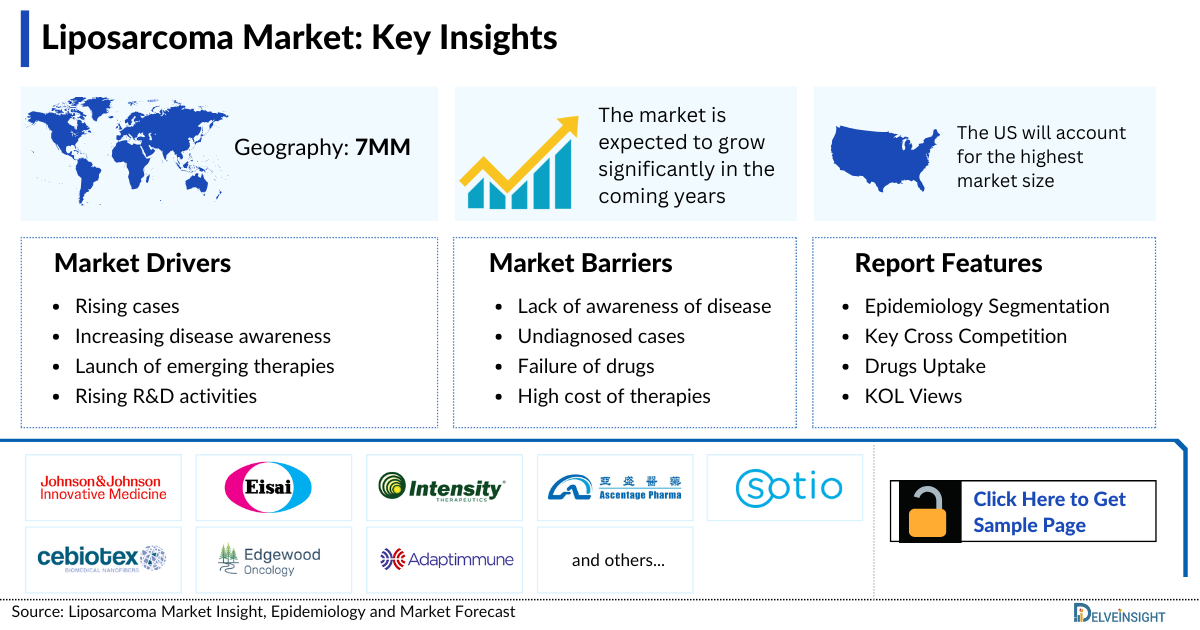
DelveInsight's “Liposarcoma – Market Insight, Epidemiology and Market Forecast – 2034” report delivers an in-depth analysis of Liposarcoma epidemiology, market, and clinical development in Liposarcoma. In addition to this, the report provides historical and forecasted epidemiology and market data as well as a detailed analysis of the Liposarcoma market trends in the United States, EU4 (Germany, France, Italy, and Spain ), the United Kingdom, and Japan.
The Liposarcoma market report provides real-world prescription pattern analysis, emerging drugs assessment, market share, and uptake/adoption pattern of individual therapies, as well as historical and forecasted Liposarcoma market size from 2020 to 2034 in 7MM. The report also covers current Liposarcoma treatment practices/algorithms and unmet medical needs to curate the best opportunities and assess the market’s underlying potential.
Geography Covered
- The United States
- EU4 (Germany, France, Italy, and Spain) and the United Kingdom
- Japan
|
Study Period |
2020–2034 |
|
Forecast Period |
2025–2034 |
|
Geographies Covered |
US, EU4 (Germany, France, Italy, and Spain) and the UK, and Japan |
|
Liposarcoma Epidemiology |
Segmented by:
|
|
Liposarcoma Key Companies |
|
|
Liposarcoma Key Therapies |
|
|
Liposarcoma Market |
Segmented by:
|
|
Analysis |
|
Liposarcoma Understanding and Treatment Algorithm
Liposarcoma Overview
Liposarcoma, a tumor of lipoblasts, is a rare mesenchymal neoplasm that involves deep soft tissues, including the esophagus, retroperitoneum, and popliteal fossa. The relative frequency of liposarcoma at various body sites is dependent on the tumor subtypes. For example, dedifferentiated liposarcoma is much more common in retroperitoneal locations, while myxoid liposarcoma occurs in the lower extremities. Liposarcoma is exceedingly rare in the esophagus. Esophageal liposarcoma typically behaves as a slow-growing tumor and involves the upper part of the throat. Most of them are of a well-differentiated type, confined to the esophagus with a low risk of metastasis, and have a high local recurrence rate (10%), even up to 25 years after the resection.
Liposarcoma Diagnosis
Different radiology diagnostic modalities, such as barium swallow, Computed Tomography (CT) scan, Magnetic Resonance Imaging (MRI), and esophagogastroduodenoscopy, can be used to diagnose liposarcoma. Although none of these techniques is specific, CT scan and MRI can help narrow down the differential diagnosis as both modalities can detect the percentage of a lipomatous component of the tumor. Higher fat content is associated with benign lipoma, while less fat is consistent with atypical lipoma or sarcoma. A definitive diagnosis can only be achieved by tissue examination. In the majority of cases, complete resection of the tumor is needed for a correct diagnosis.
Further details related to country-based variations in diagnosis are provided in the report
Liposarcoma Treatment
Surgical excision is the mainstay of treatment. Wide and deep surgical excision, adjuvant radiation, and/or chemotherapy may be necessary for high-grade lesions. However, liposarcoma response to chemotherapy is not well documented. Therefore, chemotherapy in liposarcomas remains experimental. Radiation therapy may be a valuable adjunct to surgery, especially in the myxoid subtypes. For esophageal liposarcoma, surgery can be either a minimally invasive endoscopic submucosal resection or an aggressive partial or total esophagectomy. There are some case reports of using adjuvant radiation therapy to decrease the rate of recurrence. However, the role of adjuvant chemo and radiation therapy is controversial, and long-term follow-up is recommended due to the high rate of recurrence.
Liposarcoma Epidemiology
The Liposarcoma epidemiology chapter in the report provides historical as well as forecasted epidemiology segmented as total incident cases of soft tissue sarcomas, total incident cases of liposarcoma, sub-type incident cases of liposarcoma, gender-specific incident cases of liposarcoma, age-specific incident cases of Liposarcoma, stage-specific incident cases of liposarcoma, total treatable cases of liposarcoma in the 7MM covering the United States, EU4 (Germany, France, Italy, and Spain) and the United Kingdom, and Japan from 2020 to 2034.
- Total incidence of soft tissue sarcomas in the United States accounts for approximately 14,000 cases in 2024.
- Overall liposarcoma occurrence in the United States is less than 20% of all soft tissue sarcomas.
- The average age of diagnosis is 50 years of age, although case reports of childhood-onset have been noted. Liposarcoma is more common in people aged 20 to 40 years old and is rarely seen in children under 10 years old.
- Atypical Lipomatous Tumor (ALT) and Well-differentiated Liposarcoma (WDLS), which are locally aggressive tumors with no metastatic potential, constitute the most common subtype of liposarcoma, accounting for approximately 40% of cases. Myxoid Round Cell Liposarcoma (MRCL) is the second most common variant, representing about 20% of all lipogenic sarcomas, while pleomorphic liposarcoma, a high-grade subtype, is relatively rare, comprising only about 5% of cases.
Liposarcoma Drug Chapters
The drug chapter segment of the Liposarcoma report encloses a detailed analysis of Liposarcoma -marketed drugs and late-stage (Phase III, Phase I/II, and Phase I) pipeline drugs. It also deep dives into Liposarcoma’s pivotal clinical trial details, recent and expected market approvals, patent details, the latest news, and recent deals and collaborations.
Marketed Drugs
YONDELIS (trabectedin): Johnson & Johnson Innovative Medicine
YONDELIS is a cancer medicine that contains the active substance trabectedin, which is a synthetic version of a substance that was originally extracted from a species of tunicate or ‘sea squirt’ (a marine animal).
- In October 2015, the US Food and Drug Administration (FDA) approved YONDELIS for the treatment of patients with unresectable (unable to be removed with surgery) or metastatic Liposarcoma or leiomyosarcoma who received a prior anthracycline-containing regimen.
- Earlier in 2007, the European Commission granted a marketing authorisation valid throughout Europe.
- The patent for YONDELIS remains valid until January 7, 2028.
HALAVEN (eribulin mesylate): Eisai
HALAVEN is a halichondrin class microtubule dynamics inhibitor with a distinct binding profile.
- In January 2016, the US FDA approved HALAVEN for the treatment of patients with unresectable or metastatic liposarcoma who have received a prior anthracycline-containing regimen.
- Later in May 2016, Eisai received approval from the European Commission approval the same indication.
- The patent for HALAVEN, identified by Patent Number RE46965, remains valid until January 8, 2027.
|
Comparison of Key Marketed Drugs | |||||
|
Drug Name |
Company |
MoA |
RoA |
Molecule Type |
Approval |
|
YONDELIS (trabectedin) |
Johnson & Johnson Innovative Medicine |
Involving DNA binding, transcription regulation, and modulation of the tumor microenvironment |
IV infusion |
Small molecule (Tetrahydroisoquinoline alkaloid molecule) |
US: 2015 EU: 2007 JP: 2015 |
|
HALAVEN (eribulin mesylate) |
Eisai |
Inhibits the growth phase of microtubules |
IV infusion |
Synthetic macrocyclic ketone |
US: 2016 EU: 2016 JP: 2016 |
Note: Detailed current therapies assessment will be provided in the full report of Liposarcoma….
Emerging Drugs
INT230-6: Intensity Therapeutics
INT230-6, Intensity's lead proprietary investigational product candidate, is designed for direct intratumoral injection. INT230-6 was discovered using Intensity's proprietary DfuseRx technology platform. Additionally, the drug holds orphan drug designation for the sarcoma INT230-6 components.
According to a press release issued in November 2024, Intensity Therapeutics’ INVINCIBLE-3 study is currently recruiting and aims to enroll 333 patients with leiomyosarcoma, liposarcoma, and undifferentiated pleomorphic sarcoma, with regulatory authorizations obtained in the United States, Canada, Europe, and Australia.
Notably, according to Intensity Therapeutics’ latest Q2 2025 presentation, the INVINCIBLE-3 study of INT230-6 was paused in March 2025 (Q1 2025) due to pending funding, with the company anticipating funding to resume the study by 2026.
BOXR1030: Sotio
BOXR1030 is a next-generation CAR T cell therapy that benefits from its enhanced T cell metabolism in the solid tumor microenvironment.
Initial indications for BOXR1030 include hepatocellular carcinoma, squamous cell carcinoma of the lung, and myxoid/round cell liposarcoma.
|
Table 2: Comparison of Emerging Drugs Under Development | ||||||
|
Drug Name |
Company |
Highest Phase |
Indication |
RoA |
MoA |
Molecule Type |
|
INT230-6 |
Intensity Therapeutics |
III |
Unresectable, locally advanced, or metastatic soft tissue sarcoma (liposarcoma [dedifferentiated, myxoid, round cell or pleomorphic]) |
Intratumoral |
Tumor cytoreduction and immune stimulation |
Small molecule |
|
Alrizomadlin (APG-115) |
Ascentage Pharma |
I/II |
Liposarcoma |
Oral |
MDM2 inhibitor |
Small molecule |
|
BOXR1030 |
Sotio |
I/II |
Myxoid/Round cell liposarcoma |
IV infusion |
GPC3-targeting |
CAR T-cell therapy |
|
BTX-A51 |
Edgewood Oncology |
I |
Myxoid Liposarcoma |
Oral |
Casein Kinase 1α (CK1α) and Cyclin-dependent Kinase 7 and 9 Inhibitor |
Small molecule |
Note: Detailed emerging therapies assessment will be provided in the final report.
Drug Class Insights
MDM2 inhibitor
MDM2 inhibitors treat liposarcoma by blocking the MDM2–p53 interaction, which is often driven by MDM2 gene amplification in well-differentiated and dedifferentiated subtypes. Alrizomadlin is a MDM2 inhibitor. Overexpressed MDM2 suppresses p53’s tumor-blocking function; inhibition restores p53 activity, triggering cell cycle arrest or apoptosis in tumors with wild-type p53. While preclinical data show strong p53 reactivation, clinical responses have been modest, with some partial responses or stable disease, and toxicity remains a challenge. Research continues to enhance efficacy, including via combination approaches.
Liposarcoma Market Outlook
The increasing opportunities for new therapies are based on the activation/suppression of the tumor–host immune response. Additionally, immune response stimulation utilizing the cancer-testis antigen NY-ESO-1 as a vaccine target may have a role in MRCL 60.
Recent research has revealed significant findings and trends in the treatment and prognosis of liposarcoma. Various treatment modalities. Overall, liposarcoma treatment and prognosis are influenced by various factors, including the tumor type, grade, histological characteristics, and the immune environment. Surgical resection remains the primary treatment modality for tumors such as retroperitoneal liposarcoma and retroperitoneal sarcoma, although the risk of local recurrence after surgery is high. Advances in medical technology are expected to enhance minimally invasive surgery and precision radiotherapy, reducing treatment-related complications and side effects, and thus improving patient quality of life.
Adjuvant radiotherapy before and after surgery, along with novel immunotherapy, may become integral parts of treatment strategies. Preoperative radiotherapy has shown efficacy in lowering the risk of local recurrence, but the effectiveness of perioperative radiotherapy remains uncertain. Immunotherapy has exhibited potential efficacy in some studies, particularly for patients with high PD-L1 and PD-L2 expression. Future research may delve deeper into the mechanisms and efficacy of immunotherapy and identify more precise prognostic markers to personalize treatment regimens, ultimately increasing patient survival rates and quality of life.
Further research in patients with retroperitoneal liposarcoma and retroperitoneal sarcoma suggests that peripheral blood inflammatory markers and specific biomarkers in tumor tissue may aid in predicting early recurrence and survival rates for postoperative patients. Additionally, with a deeper understanding of tumor immunology and genomics, coupled with the ongoing development of immunotherapy and targeted therapy, personalized treatment, tailored to specific tumor subtypes, is poised to become a future trend.
Key players, such as Intensity Therapeutics, Ascentage Pharma, Sotio, CEBIOTEX, Edgewood Oncology, Adaptimmune, and others, are evaluating their lead candidates in different stages of clinical development. They aim to investigate their products for the treatment of Liposarcoma.
Key Findings
- In January 2025, Adaptimmune Therapeutics’ letetresgene autoleucel (lete-cel) has been granted breakthrough therapy designation by the US FDA for the treatment of patients with unresectable or metastatic myxoid/round cell liposarcoma who have received prior anthracycline-based chemotherapy, are positive for HLA-A*02:01, HLA-A*02:05, or HLA-A*02:06, and whose tumor expresses the NY-ESO-1 antigen.
- According to Intensity Therapeutics’ latest Q2 2025 presentation, the INVINCIBLE-3 study of INT230-6 was paused in March 2025 (Q1 2025) due to pending funding, with the company anticipating funding to resume the study by 2026.
Liposarcoma Drug Uptake
This section focuses on the uptake rate of potential drugs expected to be launched in the market during 2020–2034, which depends on the competitive landscape, safety, and efficacy data, along with the order of entry. It is important to understand that the key players evaluating their novel therapies in the pivotal and confirmatory trials should remain vigilant when selecting appropriate comparators to stand the greatest chance of a positive opinion from regulatory bodies, leading to approval, smooth launch, and rapid uptake.
Further detailed analysis of emerging therapies drug uptake in the report…
Liposarcoma Pipeline Development Activities
The report provides insights into different therapeutic candidates in the Phase III, Phase I/II, and Phase I stages. It also analyzes key players involved in developing targeted therapeutics.
Pipeline Development Activities
The report covers information on collaborations, acquisitions and mergers, licensing, and patent details for Liposarcoma therapies.
KOL Views
To keep up with the real-world scenario in current and emerging market trends, we take opinions from Key Industry leaders working in the domain through primary research to fill the data gaps and validate our secondary research. Industry Experts were contacted for insights on the evolving treatment landscape, patient reliance on conventional therapies, patient therapy switching acceptability, and drug uptake, along with challenges related to accessibility, including the Director of Sarcoma Oncology, a Researcher, Medical/Scientific Writers, Professors, and Others.
DelveInsight’s analysts connected with 20+ KOLs to gather insights; however, interviews were conducted with 10+ KOLs in the 7MM. Centers such as Fox Chase Cancer Center, Fred Hutchinson Cancer Center, UNC Lineberger Comprehensive Cancer Center, UT Southwestern Medical Center in Dallas, Cancer Research UK Barts Centre in London, LUNGevity Foundation, etc., were contacted. Their opinion helps understand and validate current and emerging therapy treatment patterns or Liposarcoma market trends.
|
KOL Views |
|
“Understanding of the molecular characteristics of liposarcoma subtypes has led to testing of several targeted therapies, including inhibitors of amplified gene products (CDK4 and MDM2) and upregulated proteins (XPO1). Immuno-oncology has played an increasing role in the treatment of liposarcomas, with checkpoint inhibition showing promise in dedifferentiated liposarcomas, and immune therapies targeting cancer testis antigens NY-ESO-1 and MAGE family proteins poised to become an option for myxoid/round cell liposarcomas.” Director of Sarcoma Oncology, Fox Chase Cancer Center, US |
Qualitative Analysis
We perform Qualitative and market Intelligence analysis using various approaches, such as SWOT Analysis and Conjoint Analysis. In the SWOT analysis, strengths, weaknesses, opportunities, and threats in terms of gaps in disease diagnosis, patient awareness, physician acceptability, competitive landscape, cost-effectiveness, and geographical accessibility of therapies are provided.
Conjoint Analysis analyzes multiple approved and emerging therapies based on relevant attributes such as safety, efficacy, frequency of administration, route of administration, and order of entry. Scoring is given based on these parameters to analyze the effectiveness of therapy.
In efficacy, the trial’s primary and secondary outcome measures are evaluated; for instance, in event-free survival, one of the most important primary outcome measures is event-free survival and overall survival.
Further, the therapies’ safety is evaluated, wherein the acceptability, tolerability, and adverse events are majorly observed, and it sets a clear understanding of the side effects posed by the drug in the trials. In addition, the scoring is also based on the probability of success and the addressable patient pool for each therapy. According to these parameters, the final weightage score and the ranking of the emerging therapies are decided.
Market Access and Reimbursement
Reimbursement may be referred to as the negotiation of a price between a manufacturer and a payer that allows the manufacturer access to the market. It is provided to reduce the high costs and make the essential drugs affordable. Health technology assessment (HTA) plays an important role in reimbursement decision-making and recommending the use of a drug. These recommendations vary widely throughout the seven major markets, even for the same drug. In the US healthcare system, both Public and Private health insurance coverage are included. Also, Medicare and Medicaid are the largest government-funded programs in the US. The major healthcare programs, including Medicare, Medicaid, Health Insurance Program (CHIP), and the state and federal health insurance marketplaces, are overseen by the Centers for Medicare & Medicaid Services (CMS). Other than these, Pharmacy Benefit Managers (PBMs) and third-party organizations that provide services and educational programs to aid patients are also present.
The report further provides detailed insights on the country-wise accessibility and reimbursement scenarios, cost-effectiveness scenario of currently used therapies, programs making accessibility easier and out-of-pocket costs more affordable, insights on patients insured under federal or state government prescription drug programs, etc.
Scope of the Report
- The report covers a segment of key events, an executive summary, a descriptive overview of Liposarcoma, explaining its causes, signs and symptoms, pathogenesis, and currently available therapies.
- Comprehensive insight has been provided into the epidemiology segments and forecasts, the future growth potential of the diagnosis rate, and disease progression along treatment guidelines.
- Additionally, an all-inclusive account of both the current and emerging therapies, along with the elaborative profiles of late-stage and prominent therapies, will have an impact on the current treatment landscape.
- A detailed review of the Liposarcoma market, historical and forecasted market size, market share by therapies, detailed assumptions, and rationale behind our approach is included in the report, covering the 7MM drug outreach.
- The report provides an edge while developing business strategies, by understanding trends, through SWOT analysis and expert insights/KOL views, patient journey, and treatment preferences that help in shaping and driving the 7MM Liposarcoma market.
Liposarcoma Report Insights
- Patient Population
- Therapeutic Approaches
- Liposarcoma Pipeline Analysis
- Liposarcoma Market Size and Trends
- Existing and future Market Opportunity
Liposarcoma Report Key Strengths
- Ten-Years Forecast
- 7MM Coverage
- Liposarcoma Epidemiology Segmentation
- Key Cross Competition
- Conjoint analysis
- Drugs Uptake and Key Market Forecast Assumptions
Liposarcoma Report Assessment
- Current Treatment Practices
- Unmet Needs
- Pipeline Product Profiles
- Market Attractiveness
- Qualitative Analysis (SWOT and Conjoint Analysis)
FAQs
- What is the historical and forecasted Liposarcoma patient pool/patient burden in the United States, EU4 (Germany, France, Italy, and Spain), the United Kingdom, and Japan?
- Which combination of treatment approaches will have a significant impact on the Liposarcoma drug treatment market size?
- How would the market drivers, barriers, and future opportunities affect the market dynamics and subsequent analysis of the associated trends?
- What are the current and emerging options for the treatment of Liposarcoma?
- What are the recent novel therapies, targets, mechanisms of action, and technologies developed to overcome the limitations of existing therapies?
- Patient acceptability in terms of preferred treatment options as per real-world scenarios?
- What are the country-specific accessibility issues of expensive, recently approved therapies?
- How many key players are developing therapies for Liposarcoma?
- Which drug is the major contributor to the Liposarcoma market by 2034?
Reasons to buy
- The report will help in developing business strategies by understanding the latest trends and changing treatment dynamics driving the Liposarcoma market.
- Insights on patient burden/disease Incidence, evolution in diagnosis, and factors contributing to the change in the epidemiology of the disease during the forecast years.
- Understand the existing market opportunities in varying geographies and the growth potential over the coming years.
- Distribution of historical and current patient share based on real-world prescription data along with reported sales of approved products in the US, EU4 (Germany, France, Italy, and Spain), the United Kingdom, and Japan.
- Identifying strong upcoming players in the market will help devise strategies to help get ahead of competitors.
- Detailed analysis and ranking of class-wise potential current and emerging therapies under the conjoint analysis section to provide visibility around leading classes.
- Highlights of access and reimbursement policies of approved therapies, barriers to accessibility of expensive off-label therapies, and patient assistance programs.
- To understand Key Opinion Leaders’ perspectives around the accessibility, acceptability, and compliance-related challenges of existing treatment to overcome barriers in the future.
- Detailed insights on the unmet needs of the existing market so that the upcoming players can strengthen their development and launch strategy.