
LUXTURNA Market Sales
Key Factors Driving LUXTURNA Growth
1) First-in-class gene therapy with curative intent
LUXTURNA is a one-time AAV-based gene therapy that delivers a functional RPE65 gene, addressing the root cause of disease
It treats:
- Leber congenital amaurosis (LCA)
- Retinitis pigmentosa due to biallelic RPE65 mutations
Unlike chronic therapies, it offers:
- Durable vision improvement
- Potential functional cure
Clinical durability:
- Sustained visual improvement maintained ≥3 years post-treatment
- This “one-and-done” profile is the primary value driver, especially in rare genetic diseases.
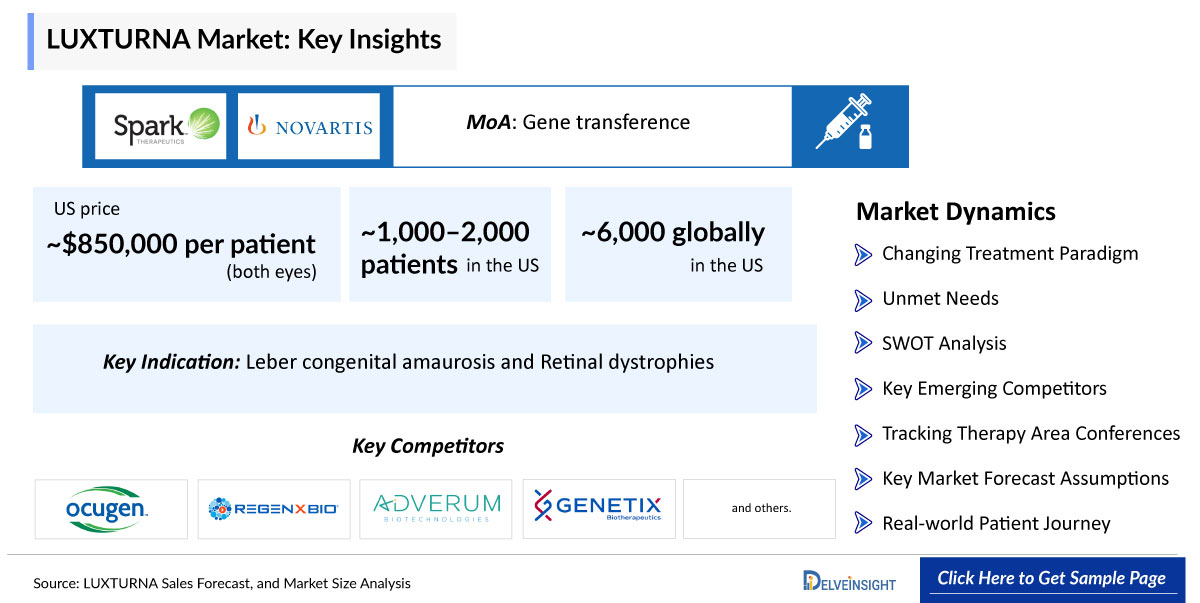
2) Premium pricing model (ultra-high revenue per patient)
US price: ~$850,000 per patient (both eyes)
Even with a small patient pool:
- High per-patient revenue drives meaningful total sales
- Enables strong ROI despite ultra-rare indication
3) Strong unmet need in ultra-rare retinal diseases
No alternative disease-modifying therapies available at launch
Target population:
- ~1,000–2,000 patients in the US
- ~6,000 globally
These patients face:
- Progressive blindness
- Severe quality-of-life impact
High unmet need supports:
- Rapid adoption in eligible patients
- Favorable reimbursement discussions
4) Favorable reimbursement & innovative payment models
Spark introduced:
- Outcome-based reimbursement
- Installment-based payment models
Impact:
- Reduces payer resistance to high upfront cost
- Improves access to therapy
This model became a benchmark for gene therapy commercialization
5) Global commercialization partnerships
- Spark Therapeutics (US commercialization)
- Novartis (ex-US rights)
LUXTURNA Recent Developments
- Recent pharmacovigilance reports (spanning 2018–2025) confirm durable vision improvements, with approximately 70% of patients maintaining visual gains up to 4 years post-treatment.
“LUXTURNA Sales Forecast, and Market Size Analysis – 2034” report provides comprehensive insights of LUXTURNA for approved indication like Leber congenital amaurosis and Retinal dystrophies in the 7MM. A detailed picture of LUXTURNA’s existing usage in anticipated entry and performance in approved indications in the 7MM, i.e., the United States, EU4 (Germany, France, Italy, and Spain) and the United Kingdom, and Japan for the study period 2020 –2034 is provided in this report along with a detailed description of the LUXTURNA for approved indications. The LUXTURNA market report provides insights about LUXTURNA’s sales forecast, mechanism of action (MoA), dosage and administration, as well as research and development including regulatory milestones, along with other developmental activities. Further, it also consists of historical and current LUXTURNA performance, future market assessments inclusive of the LUXTURNA market forecast analysis for approved indications in the 7MM, SWOT, analysts’ views, comprehensive overview of market competitors, and brief about other emerging therapies in respective indications. It also provides analysis of LUXTURNA sales forecasts, along with factors driving its market.
LUXTURNA Drug Summary
LUXTURNA (voretigene neparvovec) is an FDA-approved (2017) adeno-associated virus (AAV2) vector-based gene therapy developed by Spark Therapeutics (now Roche) for the one-time subretinal treatment of patients with confirmed biallelic RPE65 mutation-associated retinal dystrophy, such as Leber congenital amaurosis or retinitis pigmentosa, who have sufficient viable retinal cells. Delivered at a dose of 1.5 × 10¹¹ vector genomes (vg) per eye in 0.3 mL volume via vitrectomy-assisted subretinal injection (one eye per surgical session, ≥6 days apart), it delivers a functional copy of the RPE65 gene to retinal pigment epithelium cells, restoring the visual cycle by enabling isomerohydrolase production for 11-cis-retinal regeneration and improving functional vision (e.g., multi-luminance mobility testing gains in Phase III trials). Administered only at certified Authorized Treatment Centers, it carries risks including intraocular inflammation, retinal tears, cataracts, and endophthalmitis, managed with corticosteroids, with long-term data showing sustained efficacy and a tolerable profile. The report provides LUXTURNA’s sales, growth barriers and drivers, post usage and approvals in multiple indications.
Scope of the LUXTURNA Market Report
The report provides insights into:
- A comprehensive product overview including the LUXTURNA MoA, description, dosage and administration, research and development activities in approved indication like Leber congenital amaurosis and Retinal dystrophies.
- Elaborated details on LUXTURNA regulatory milestones and other development activities have been provided in LUXTURNA market report.
- The report also highlights LUXTURNA‘s cost estimates and regional variations, reported and estimated sales performance, research and development activities in approved indications across the United States, Europe, and Japan.
- The LUXTURNA market report also covers the patents information, generic entry and impact on cost cut.
- The LUXTURNA market report contains current and forecasted LUXTURNA sales for approved indications till 2034.
- Comprehensive coverage of the late-stage emerging therapies for respective indications.
- The LUXTURNA market report also features the SWOT analysis with analyst views for LUXTURNA in approved indications.
Methodology
The LUXTURNA market report is built using data and information sourced primarily from internal databases, primary and secondary research and in-house analysis by DelveInsight’s team of industry experts. Information and data from the secondary sources have been obtained from various printable and nonprintable sources like search engines, news websites, global regulatory authorities websites, trade journals, white papers, magazines, books, trade associations, industry associations, industry portals and access to available databases.
LUXTURNA Analytical Perspective by DelveInsight
In-depth LUXTURNA Market Assessment
This LUXTURNA sales market forecast report provides a detailed market assessment of LUXTURNA for approved indication like Leber congenital amaurosis and Retinal dystrophies in the seven major markets, i.e., the United States, EU4 (Germany, France, Italy, and Spain) and the United Kingdom, and Japan. This segment of the report provides current and forecasted LUXTURNA sales data uptil 2034.
LUXTURNA Clinical Assessment
The LUXTURNA market report provides the clinical trials information of LUXTURNA for approved indications covering trial interventions, trial conditions, trial status, start and completion dates.
LUXTURNA Competitive Landscape
The report provides Insights on competitors and marketed products within the domain, along with a summary of emerging products and their respective launch dates, posing significant competition in the market.
LUXTURNA Market Potential & Revenue Forecast
- Projected market size for the LUXTURNA and its key indications
- Estimated LUXTURNA sales potential (LUXTURNA peak sales forecasts)
- LUXTURNA Pricing strategies and reimbursement landscape
LUXTURNA Competitive Intelligence
- Number of competing drugs in development (pipeline analysis)
- LUXTURNA Market positioning compared to existing treatments
- LUXTURNA Strengths & weaknesses relative to competitors
LUXTURNA Regulatory & Commercial Milestones
- LUXTURNA Key regulatory approvals & expected launch timelines
- Commercial partnerships, licensing deals, and M&A activity
LUXTURNA Clinical Differentiation
- LUXTURNA Efficacy & safety advantages over existing drugs
- LUXTURNA Unique selling points
LUXTURNA Market Report Highlights
- In the coming years, the LUXTURNA market scenario is set to change due to strong adoption, increased prescriptions and broader uptake in multiple immunological indications; which would expand the size of the market.
- The LUXTURNA companies are developing therapies that focus on novel approaches to treat/improve the disease condition, assess challenges, and seek opportunities that could influence LUXTURNA’s dominance.
- Other emerging products for Leber congenital amaurosis and Retinal dystrophies are expected to give tough market competition to LUXTURNA and launch of late-stage emerging therapies in the near future will significantly impact the market.
- A detailed description of regulatory milestones, and developmental activities, provide the current development scenario of LUXTURNA in approved indications.
- Analyse LUXTURNA cost, pricing trends and market positioning to support strategic decision-making in the immunology landscape.
- Our in-depth analysis of the forecasted LUXTURNA sales data uptil 2034 will support the clients in decision-making process regarding their therapeutic portfolio by identifying the overall scenario of LUXTURNA in approved indications.
Key Questions Answered In The LUXTURNA Market Report
- What is the class of therapy, route of administration and mechanism of action of LUXTURNA? How strong is LUXTURNA’s clinical and commercial performance?
- What is LUXTURNA’s clinical trial status in each individual indications such as Leber congenital amaurosis and Retinal dystrophies and study completion date?
- What are the key collaborations, mergers and acquisitions, licensing and other activities related to the LUXTURNA Manufacturers?
- What are the key designations that have been granted to LUXTURNA for approved indications? How are they going to impact LUXTURNA’s penetration in various geographies?
- What is the current and forecasted LUXTURNA market scenario for approved indications? What are the key assumptions behind the forecast?
- What are the current and forecasted sales of LUXTURNA in the seven major countries, including the United States, Europe (Germany, France, Italy, Spain) and the United Kingdom, and Japan?
- What are the other emerging products available and how are these giving competition to LUXTURNA for approved indications?
- Which are the late-stage emerging therapies under development for the treatment of approved indications?
- How cost-effective is LUXTURNA? What is the duration of therapy and what are the geographical variations in cost per patient?

