
Medical Device Cleaning Market Summary
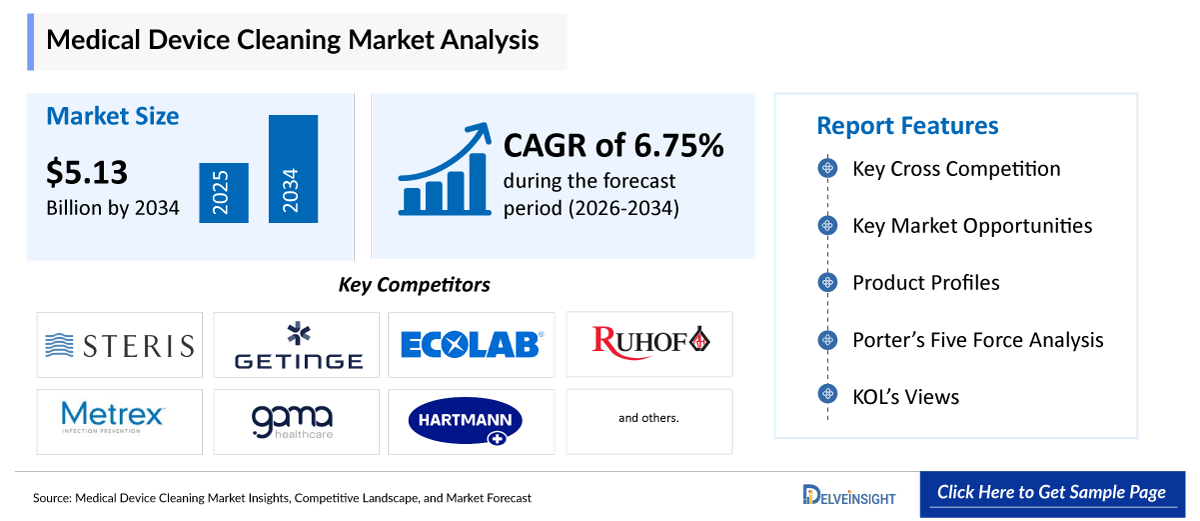
- The global medical device cleaning market size was valued at USD 2.85 billion in 2025 and is projected to reach USD 5.13 billion by 2034.
- The market is expected to expand at a CAGR of 6.75% during the forecast period 2026-2034, supported by the rising number of surgical procedures, the increasing burden of healthcare-associated infections, and higher hospital admissions leading to large-scale utilization of medical devices across the globe.
- By detergent type, the enzymatic segment dominated the medical device cleaning market with a 62% share in 2025.
- By process, the automatic cleaning segment dominated the medical device cleaning market with a 34% share in 2025.
- By application, the surgical instruments segment dominated the medical device cleaning market with a 48% share in 2025.
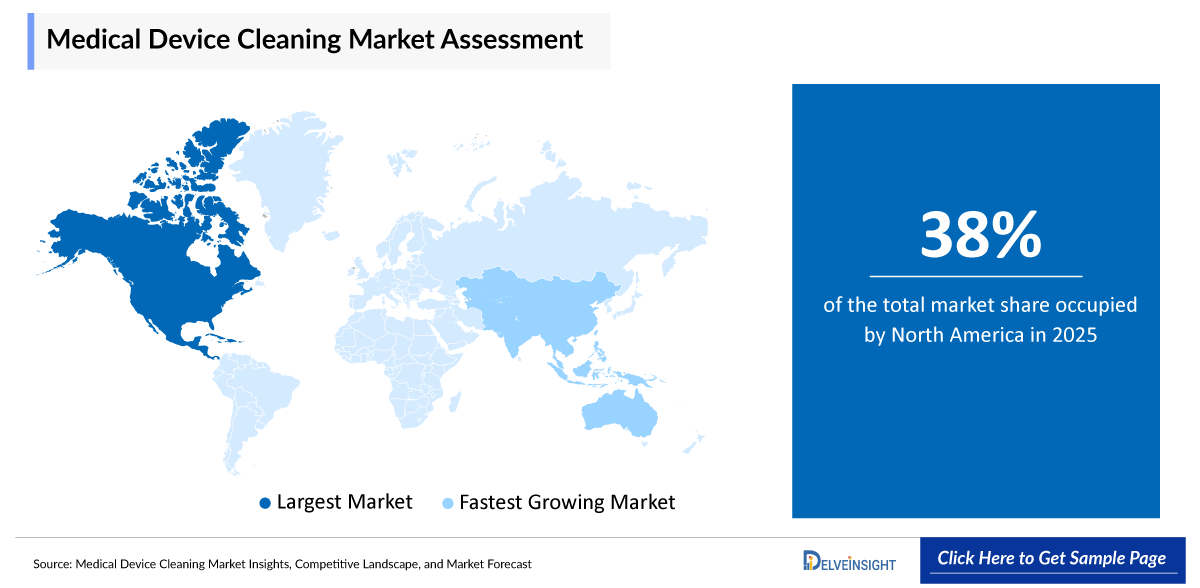
- North America accounted for the largest share of the medical device cleaning market at 38% in 2025, while Asia-Pacific is anticipated to register the fastest growth through 2034.
Medical device cleaning refers to the process of removing blood, tissue, microorganisms, and other contaminants from medical instruments and devices before sterilization or reuse. Proper cleaning is essential to prevent infection, ensure patient safety, and maintain the functionality and longevity of medical equipment, and it is the critical first step in infection control and in compliance with healthcare regulations, since no sterilization process can reliably act upon an instrument whose surfaces remain obscured by organic soil.
The market is organized upon the chemistry applied, the process by which it is applied, and the device to which it is applied. By detergent type, it divides between enzymatic formulations, which employ proteases, lipases, and amylases to break down the proteinaceous and lipid soils characteristic of surgical bioburden, and non-enzymatic formulations, which rely upon alkaline, neutral, or surfactant chemistry. By process, it spans the cleaning stage, comprising pre-cleaning at the point of use, manual cleaning by brushing and immersion, and automatic cleaning through ultrasonic cleaners, automated washer-disinfectors, and robotic systems, followed by the disinfection stage, comprising high-level, intermediate-level, and low-level disinfection according to the Spaulding classification of the device. By application, it spans endoscopes, whose narrow channels and heat sensitivity make them the most demanding reprocessing challenge, surgical instruments, and other devices including ultrasound probes and dental instruments. The contemporary market is defined by the movement toward automation, traceability, and single-use alternatives.
Medical Device Cleaning Market Key Growth Drivers
- A rising number of surgical procedures worldwide, with World Bank Group data indicating that Germany performed some 19,124 surgical procedures per 100,000 population in 2022 and Finland some 15,870 per 100,000 in the same year.
- A very high burden of healthcare-associated infections, with the World Health Organization reporting that 7 of every 100 patients in high-income countries and 15 of every 100 in low- and middle-income countries acquire at least one such infection in acute care hospitals.
- A substantial regional infection burden, with the World Health Organization reporting 8.9 million healthcare-associated infections occurring each year in acute and long-term care facilities across the European Union and European Economic Area.
- High procedural volumes in the United States, with the American Heart Association reporting some 500,000 open-heart surgeries performed annually and the American Academy of Orthopaedic Surgeons reporting over 1 million total joint replacements in 2022.
- Growing elective and aesthetic procedure volumes, with ISAPS reporting over 6.1 million cosmetic surgeries performed in the United States in 2023.
- Increased hospital admissions driven by chronic conditions and aging populations, leading to large-scale utilization of medical devices requiring reprocessing.
- The growing role of automation in medical device cleaning and the integration of robot-assisted technology, which improve consistency, traceability, and regulatory compliance.
Key Companies in Medical Device Cleaning Market
The leading participants in the medical device cleaning market include the following:
- STERIS plc
- Getinge AB
- Ecolab Inc.
- Advanced Sterilization Products (Fortive Corporation)
- Ruhof Corporation
- Metrex Research LLC (Envista Holdings)
- GAMA Healthcare Ltd.
- PAUL HARTMANN AG
- Alconox Inc.
- Case Medical Inc., and others
For illustrative purposes, only the top 10 companies are listed in the Table of Contents. The report may include analysis and references to additional companies relevant to the market assessment.
Medical Device Cleaning Market Size
The following table summarizes the headline market metrics for the global medical device cleaning market across the base year and the forecast horizon.
|
Report Metrics |
Details |
|
2025 Market Size |
USD 2.85 billion |
|
2034 Projected Market Size |
USD 5.13 billion |
|
Growth Rate (2026-2034) |
6.75% CAGR |
|
Largest Market |
North America (38% share in 2025) |
|
Fastest Growing Market |
Asia-Pacific |
|
Market Structure |
Fragmented |
All market values are expressed in USD and represent DelveInsight estimates synthesized from primary and secondary research.
Factors Contributing to the Growth of the Medical Device Cleaning Market
Medical Device Cleaning Market Drivers
- Rising Number of Surgical Procedures: The foundational driver of the medical device cleaning market is the rising global volume of surgical procedures, which determines directly how many instrument sets must be reprocessed and therefore how much cleaning chemistry and equipment capacity is consumed. According to recent data from the World Bank Group, Germany performed some 19,124 surgical procedures per 100,000 population in 2022 and Finland some 15,870 per 100,000 in the same year, while Hong Kong, China recorded 1,735 per 100,000 in 2023, a disparity that illustrates both the scale of activity in mature systems and the magnitude of the expansion available as access broadens elsewhere. As more surgeries are performed, particularly complex and minimally invasive procedures, the demand for a wide range of surgical instruments and devices rises, and these devices require meticulous cleaning, disinfection, and sterilization to ensure patient safety and prevent healthcare-associated infections. The relationship is mechanical rather than discretionary, since every reusable instrument that enters a sterile field must be reprocessed before it can be used again, and minimally invasive instrumentation intensifies the requirement because narrow lumens, hinges, and articulating mechanisms retain soil that open instruments do not. Improperly cleaned devices lead to infection, complication, and longer hospital stays, which makes cleaning protocols mandatory rather than optional. With advancements in surgical technique and the continued use of reusable instruments, the need for effective cleaning solutions grows in step with procedural volume.
- Rising Burden of Healthcare-Associated Infections: The rising burden of healthcare-associated infections is a powerful driver of the medical device cleaning market, because contaminated devices are a recognized transmission route and because infection prevention has become a regulatory and financial priority for health systems. According to World Health Organization data, healthcare-associated infections affect hundreds of millions of patients annually, with 7 of every 100 patients in high-income countries and 15 of every 100 in low- and middle-income countries acquiring at least one such infection during acute care hospitalization, and in the European Union and European Economic Area, 8.9 million such infections occur each year across acute and long-term care facilities. These infections occur in patients during their stay in a healthcare facility and are often caused by the use of contaminated medical devices, which makes effective cleaning and sterilization crucial. The rising incidence has heightened awareness among healthcare providers of the need for stringent infection control practices, and hospitals and clinics are consequently investing in advanced cleaning solutions and technologies to ensure that devices are thoroughly disinfected and sterilized before reuse. The financial dimension reinforces the clinical one, since payers in several jurisdictions withhold reimbursement for the treatment of certain hospital-acquired conditions, converting infection prevention from a quality aspiration into a direct economic imperative. Because the burden is large, well-documented, and directly linked to reprocessing quality, it drives sustained investment across the entire cleaning portfolio.
- Increased Hospital Admissions and Device Utilization: The global increase in hospital admissions, driven by chronic conditions and aging populations, is a significant driver of the medical device cleaning market because it expands the volume of devices in circulation and therefore the reprocessing workload. The surge in admissions has led to large-scale utilization of medical devices, further boosting demand for cleaning products to maintain hygiene and patient safety, and the effect extends well beyond the operating room to encompass the endoscopes, ultrasound probes, respiratory equipment, and diagnostic instruments used throughout the admission. Older patients admitted with multiple comorbidities undergo more diagnostic and interventional procedures per admission than younger patients, and they remain in hospital longer, so demographic aging increases device utilization disproportionately to the rise in admission numbers. The concentration of procedures in high-volume specialties illustrates the scale involved, with the American Heart Association reporting some 500,000 open-heart surgeries performed annually in the United States and the American Academy of Orthopaedic Surgeons reporting over 1 million total joint replacements in 2022, each requiring extensive instrument sets. Elective and aesthetic activity adds further volume, with ISAPS reporting over 6.1 million cosmetic surgeries performed in the United States in 2023. Because admissions and the device utilization they generate rise steadily with demographic and epidemiological trends, this driver provides a stable and expanding demand base.
- Growing Role of Automation and Robot-Assisted Technology: The growing role of automation in medical device cleaning and the integration of robot-assisted technology constitute a central driver of the market, improving efficiency, consistency, and effectiveness in cleaning processes. As healthcare facilities strive to minimize the risk of healthcare-associated infections and ensure patient safety, the adoption of automated solutions has become increasingly important, and these systems, which include ultrasonic cleaners, automated washer-disinfectors, and robotic cleaning, streamline the process by reducing human error and variability, leading to more reliable outcomes. Automated technology not only ensures thorough cleaning of complex devices, which often have intricate designs difficult to clean manually, but also saves valuable time and labor resources in busy healthcare settings, a consideration of growing weight given persistent staffing shortages in sterile processing departments. These systems can be programmed to adhere to specific cleaning protocols and cycles, ensuring compliance with regulatory standards for infection control, and advancements in technology have produced intelligent systems that monitor and log cleaning processes, providing the traceability and accountability that accreditation bodies increasingly require. The regulatory clearance of automated platforms reinforces adoption, exemplified by the clearance of an automated ultrasound probe cleaner disinfector that became the first device in North America providing both cleaning and high-level disinfection of endocavity and surface probes.
- Stringent Regulatory Guidelines and Reprocessing Standards: Tightening regulatory guidance and reprocessing standards are an important driver of the medical device cleaning market, because they convert best practice into mandatory practice and compel facilities to upgrade chemistry, equipment, and documentation. Regulatory authorities and standards bodies have progressively raised expectations for the validation of cleaning efficacy, the qualification of reprocessing equipment, the competency of sterile processing personnel, and the traceability of each instrument through the reprocessing cycle, and accreditation surveys examine these elements directly. Guidance addressing flexible endoscope processing has been strengthened considerably following documented transmission of resistant organisms through inadequately reprocessed duodenoscopes, prompting requirements for enhanced cleaning verification, borescope inspection, drying and storage protocols, and in some settings a transition toward disposable end-cap components or fully single-use designs. Manufacturers of reusable devices are required to validate and publish reprocessing instructions, and facilities must demonstrate adherence to them, which drives demand for the specific chemistries and cycles those instructions specify. Because non-compliance carries the risk of citation, reputational harm, and litigation, and because the documentation burden favors automated systems that log their own cycles, regulatory pressure translates directly into procurement of validated chemistry, automated equipment, and monitoring products. Source: U.S. Food and Drug Administration; professional standards bodies.
- Rising Complexity of Reusable Devices and Endoscope Reprocessing: The rising complexity of reusable medical devices is a significant driver of the market, because complexity increases both the difficulty and the value of the cleaning required. Contemporary instrumentation incorporates narrow lumens, hinged and articulating mechanisms, insulated shafts, and heat-sensitive electronics and optics, each of which retains organic soil that simple immersion cannot reach and none of which tolerates the conditions that would most readily remove it. Flexible endoscopes represent the extreme case, combining multiple narrow internal channels, elevator mechanisms, and heat sensitivity that precludes steam sterilization, which is why they require multi-stage reprocessing comprising point-of-use pre-cleaning, meticulous manual channel brushing, enzymatic detergent immersion, and high-level disinfection in an automated endoscope reprocessor, followed by controlled drying and storage. This intensity of process consumes substantially more chemistry, equipment time, and labor per device than a simple surgical instrument, and it commands correspondingly higher-value products including channel-specific cleaning implements, cleaning verification tests, borescopes for visual inspection, and specialized high-level disinfectants. As minimally invasive and robotic surgery expand the population of complex reusable instrumentation, and as endoscopic procedure volumes rise with screening programs and therapeutic indications, the mix of the market shifts toward these higher-value reprocessing requirements. Source: professional standards bodies; peer-reviewed literature.
- Expanding Healthcare Infrastructure in Emerging Markets: The expansion of healthcare infrastructure across emerging markets is a significant driver of the medical device cleaning market, converting a large and historically underserved reprocessing need into formal demand. Governments across Asia-Pacific and other developing regions are investing in new hospitals, operating theatres, and central sterile services departments, and the World Health Organization reports that the healthcare-associated infection burden is markedly higher in low- and middle-income countries, at 15 of every 100 acute care patients compared with 7 in high-income countries, which identifies both the scale of the problem and the opportunity for improvement. As these systems modernize, they are transitioning from ad hoc manual reprocessing toward standardized protocols, validated chemistry, and automated washer-disinfectors, a transition that generates demand for both capital equipment and the recurring consumables that follow it. Rising surgical volumes, the growth of private hospital networks, expanding medical tourism in several markets that compete on international accreditation standards, and the gradual adoption of international reprocessing guidance all accelerate this shift. Regional manufacturers offering cost-appropriate detergents and disinfectants broaden access further. Because these markets combine large populations, rapidly growing procedural volumes, a high infection burden, and a low current base of formal reprocessing infrastructure, they are expected to grow faster than the developed markets over the forecast period. Source: World Health Organization; national health authorities.
Medical Device Cleaning Market Restraints
Despite a broad and regulation-supported demand base, the medical device cleaning market faces material constraints. The most significant is persistent concern regarding the safety of reprocessed instruments, which has undermined confidence in reuse itself and has driven a structural shift toward single-use alternatives that displaces cleaning demand entirely. Documented transmission of multidrug-resistant organisms through inadequately reprocessed duodenoscopes demonstrated that validated protocols can fail in practice, and the regulatory response has encouraged migration toward disposable components and fully single-use designs in endoscopy, bronchoscopy, ureteroscopy, and cystoscopy; each such conversion permanently removes a reprocessing workload from the market, and this substitution represents the most serious long-term structural threat to the category.
The second constraint is the genuine difficulty associated with cleaning and disinfecting complex medical devices, since narrow lumens, hinges, elevator mechanisms, and insulated shafts retain soil that cannot be visually inspected and may not be reliably removed even by validated cycles, and the resulting uncertainty complicates both clinical confidence and the demonstration of efficacy required for new products.
Additional constraints include chronic staffing shortages and high turnover in sterile processing departments, which limit the capacity of facilities to execute demanding protocols regardless of the chemistry available and which have been implicated in reprocessing failures; the capital cost of automated washer-disinfectors and endoscope reprocessors, which constrains adoption in smaller facilities and in cost-sensitive markets where manual cleaning consequently persists; the commoditized and heavily contested nature of basic detergent chemistry, which exerts continuous pricing pressure; the regulatory burden of registering disinfectant products, which vary in classification and requirement across jurisdictions; and growing environmental and occupational scrutiny of the aldehyde and oxidizing chemistries used in high-level disinfection, alongside water and energy consumption in automated reprocessing. Together these factors ensure that growth, while supported by regulation and procedural volume, proceeds against genuine substitution and margin pressure. Source: U.S. Food and Drug Administration; professional standards bodies; company disclosures.
Medical Device Cleaning Market Segment Analysis
The global medical device cleaning market is segmented by detergent type (enzymatic and non-enzymatic), by process (cleaning, comprising pre-cleaning, manual cleaning, and automatic cleaning, and disinfection, comprising high-level, intermediate-level, and low-level disinfection), by application (endoscopes, surgical instruments, and others), and by geography (North America, Europe, Asia-Pacific, and the Rest of the World).
By Detergent Type
Dominant Subsegment: Enzymatic.
Dominant: Enzymatic ~ 62%
The enzymatic segment accounted for a 62% share of the medical device cleaning market in 2025. Enzymatic detergents dominate the detergent-type structure because the soil they are formulated to remove is precisely the soil that medical device reprocessing encounters. Surgical bioburden consists principally of blood, tissue, fat, and mucus, all of which are proteinaceous and lipid in composition, and enzymatic formulations employ proteases, lipases, amylases, and in multi-enzyme products a combination of these to catalytically break these macromolecules into smaller fragments that rinse away readily, achieving in minutes at moderate temperature what mechanical action alone would not accomplish. This matters critically for devices with narrow lumens and hinged mechanisms where brushing cannot reach, since chemical action must substitute for mechanical action, and it matters equally for heat-sensitive instruments that cannot tolerate the elevated temperatures at which alkaline chemistry works best. Enzymatic products are specified in the validated reprocessing instructions issued by device manufacturers for the great majority of complex reusable instruments and are mandated within endoscope reprocessing protocols, which secures their position irrespective of price. Their neutral pH additionally protects the delicate materials, adhesives, and optical components that alkaline chemistry can degrade over repeated cycles. Non-enzymatic detergents constitute the second category, employing alkaline, neutral, or surfactant chemistry, and they retain an important role in automated washer-disinfector cycles where high temperature and strong mechanical action are available and where their lower cost and longer shelf stability are advantageous. Enzymatic detergents are expected to retain their leading share throughout the forecast period.
By Process
Dominant Subsegment: Automatic Cleaning.
Dominant: Automatic Cleaning ~ 34%
The automatic cleaning segment accounted for a 34% share of the medical device cleaning market in 2025. Automatic cleaning dominates the process structure because it enhances efficiency, consistency, and effectiveness in a way that manual techniques cannot match, and because healthcare facilities striving to minimize healthcare-associated infection risk have made automation a priority. These systems, which include ultrasonic cleaners, automated washer-disinfectors, and robotic cleaning, streamline the process by reducing human error and variability, leading to more reliable outcomes, and they ensure thorough cleaning of complex devices whose intricate designs are difficult to clean manually while saving time and labor in busy settings where sterile processing staffing is chronically constrained. Decisively, these systems can be programmed to adhere to specific protocols and cycles, ensuring compliance with regulatory standards, and advances in technology have produced intelligent systems that monitor and log cleaning processes to provide the traceability and accountability that accreditation increasingly demands, a capability manual cleaning cannot furnish at all. Regulatory clearances continue to expand the category, exemplified by the clearance of an automated ultrasound probe cleaner disinfector that became the first device in North America providing both cleaning and high-level disinfection of endocavity and surface probes. Pre-cleaning at the point of use and manual cleaning remain indispensable preceding stages, particularly for lumened devices requiring brushing, and the disinfection stage divides into high-level disinfection for semi-critical devices such as endoscopes, intermediate-level, and low-level disinfection according to the Spaulding classification. Automatic cleaning is expected to retain its leading share and to grow fastest throughout the forecast period.
By Application
Dominant Subsegment: Surgical Instruments.
Dominant: Surgical Instruments ~ 48%
The surgical instruments segment accounted for a 48% share of the medical device cleaning market in 2025. Surgical instruments dominate the application structure by volume because they constitute by far the largest population of reusable devices in circulation, with a single procedure frequently requiring a tray of dozens of instruments and a large hospital reprocessing many thousands of items each day, and because every one of them must pass through the full cleaning and sterilization cycle before reuse. The scale of the underlying activity sustains this position, with the American Heart Association reporting some 500,000 open-heart surgeries performed annually in the United States and the American Academy of Orthopaedic Surgeons reporting over 1 million total joint replacements in 2022, each consuming extensive instrument sets, while World Bank Group data indicate surgical rates of some 19,124 procedures per 100,000 population in Germany in 2022. The growing complexity of instrumentation, encompassing hinged, lumened, insulated, and robotic instruments, has raised the chemistry and process intensity required per item. Endoscopes constitute the second application and the most demanding, since narrow internal channels, elevator mechanisms, and heat sensitivity preclude steam sterilization and mandate a multi-stage protocol of point-of-use pre-cleaning, manual channel brushing, enzymatic immersion, and high-level disinfection, which consumes substantially more chemistry, equipment time, and labor per device and commands premium-priced products; it is the fastest-growing application. Other applications include ultrasound probes, dental instruments, and respiratory equipment. Surgical instruments are expected to retain their leading share throughout the forecast period.
Medical Device Cleaning Market Region Analysis
Dominant Region: North America
North America accounted for a 38% share of the global medical device cleaning market in 2025. The region is expected to account for the highest proportion of the global market, and this can be ascribed to the increasing number of surgical procedures, an increased patient population suffering from multiple diseases, increased hospital-acquired infections, a growing geriatric population, the availability of high-technology healthcare facilities, government support, a highly potent market in terms of product development and launches, and the local presence of the key market participants. The scale of procedural activity underpins regional demand, with the American Heart Association reporting some 500,000 open-heart surgeries performed annually in the United States and the American Academy of Orthopaedic Surgeons reporting over 1 million total joint replacements in 2022, while ISAPS reported over 6.1 million cosmetic surgeries performed in the United States in 2023. This heightened focus on infection control, combined with the rising number of surgeries across hospitals and clinics, drives demand for cleaning products including detergents, disinfectants, sterilization equipment, and advanced cleaning technologies across the region. The regulatory environment reinforces adoption, since accreditation surveys examine reprocessing practices directly and payers withhold reimbursement for certain hospital-acquired conditions. Product development activity further accelerates growth, exemplified by the introduction of an advanced cleaning system tailored for healthcare environments designed to enhance the efficiency and reliability of device sterilization processes. The region is expected to retain its leading position throughout the forecast period.
Fastest Growing Region: Asia-Pacific
Asia-Pacific is projected to register the fastest compound annual growth rate in the medical device cleaning market through 2034. The region is emerging as the principal growth engine of the market, propelled by rapidly rising surgical volumes, a very high burden of healthcare-associated infection, and the modernization of sterile processing infrastructure across densely populated nations including China, India, and Japan. The World Health Organization reports that 15 of every 100 acute care patients in low- and middle-income countries acquire at least one healthcare-associated infection, compared with 7 in high-income countries, which identifies both the scale of the regional problem and the magnitude of the improvement opportunity, and it has prompted governments and hospital networks to prioritize infection prevention investment. Healthcare infrastructure expansion is adding operating theatres and central sterile services departments at pace, and the transition from ad hoc manual reprocessing toward standardized protocols, validated chemistry, and automated washer-disinfectors generates demand for both capital equipment and the recurring consumables that follow it. The growth of private hospital networks competing on international accreditation standards, and of medical tourism in several markets where accreditation is a commercial prerequisite, accelerates the adoption of formal reprocessing practice. Rising procedural volumes across surgery and endoscopy, an aging population in Japan, China, and South Korea, and increasing government healthcare expenditure reinforce the trend, while regional manufacturers offering cost-appropriate detergents and disinfectants broaden access. Regional growth is expected to exceed the global average across every segment.
Medical Device Cleaning Market Regional Commentary
North America
North America leads on value and adoption, holding a 38% share in 2025. The region combines very high procedural volumes, with some 500,000 annual open-heart surgeries and over 1 million total joint replacements reported in the United States, with high-technology healthcare facilities, government support, strong product development and launch activity, and the local presence of the leading participants. Accreditation surveys examine reprocessing practice directly, and payers withhold reimbursement for certain hospital-acquired conditions, which converts infection prevention into an economic imperative. Near-term dynamics are shaped by automation and traceability in sterile processing, tightened endoscope reprocessing guidance, the shift toward single-use alternatives in endoscopy, and staffing shortages in sterile processing departments.
Europe
Europe is a large and standards-driven market, supported by high surgical rates, with World Bank Group data indicating some 19,124 procedures per 100,000 population in Germany and 15,870 in Finland in 2022, and by a substantial infection burden, with the World Health Organization reporting 8.9 million healthcare-associated infections annually across acute and long-term care facilities in the European Union and European Economic Area. The region hosts several of the leading chemistry and equipment manufacturers, and European standards for washer-disinfector performance and endoscope reprocessing are among the most prescriptive globally, driving validated equipment and documented cycles. The European Union Medical Device Regulation and biocidal product requirements raise the registration burden for disinfectant chemistries, favoring manufacturers with regulatory scale, while public procurement exerts continuous pricing pressure.
Asia-Pacific
Asia-Pacific is the fastest-growing region, propelled by rapidly rising surgical volumes, a very high infection burden with the World Health Organization reporting 15 of every 100 acute care patients affected in low- and middle-income countries, and the modernization of sterile processing infrastructure across China, India, and Japan. The transition from manual reprocessing toward standardized protocols, validated chemistry, and automated washer-disinfectors generates demand for both capital equipment and recurring consumables. Private hospital networks competing on international accreditation, medical tourism, aging populations in Japan, China, and South Korea, and rising government healthcare expenditure reinforce the trend, while regional manufacturers offering cost-appropriate chemistry broaden access. Growth exceeds the global average across every segment.
Rest of World
The Rest of the World comprises the Middle East, Africa, and South America. Access is highly stratified. The Gulf Cooperation Council states have invested heavily in internationally accredited hospitals with contemporary central sterile services capability, and the larger South American markets, particularly Brazil, support established hospital networks with formal reprocessing practice, together representing steady growth. Much of Africa faces severe constraints in water quality, reliable power, sterile processing infrastructure, and trained personnel, which limit the feasibility of automated reprocessing and leave a very high infection burden inadequately addressed. Regional growth will be driven by hospital construction, infection prevention initiatives supported by international health agencies, accreditation programs, and the availability of cost-appropriate chemistry from regional and Asian manufacturers.
Medical Device Cleaning Market Competitive Landscape
The global medical device cleaning market is classified as Fragmented. The market is structured upon three overlapping groups: the infection prevention majors that supply both cleaning chemistry and the washer-disinfector and endoscope reprocessor equipment upon which it is used, the specialty chemical formulators that focus exclusively upon enzymatic and instrument-grade detergents, and the diversified hygiene, materials, and enzyme companies whose healthcare divisions serve the same customers. Competition centers upon validated efficacy against manufacturer reprocessing instructions, material compatibility, the breadth of the chemistry and equipment portfolio, regulatory registration across jurisdictions, and increasingly upon traceability and documentation capability.
The competitive landscape is evaluated across the following dimensions:
- Market concentration: Fragmented, since basic detergent chemistry presents modest technical and capital barriers and many regional formulators compete locally, though the automated washer-disinfector and endoscope reprocessor equipment segment is considerably more concentrated among a small group of infection prevention majors.
- Leading players: STERIS and Getinge lead through integrated chemistry and equipment portfolios spanning washer-disinfectors, endoscope reprocessors, and consumables; Ecolab and Advanced Sterilization Products hold strong positions in healthcare cleaning and disinfection chemistry, and Ruhof, Metrex Research, Alconox, Case Medical, GAMA Healthcare, and PAUL HARTMANN contest specialty detergent, wipe, and disinfectant segments.
- Geographic reach: The leading participants maintain global commercial and technical service organizations, which matter because installed washer-disinfectors require validation, servicing, and cycle qualification, while specialty formulators reach broader geographies through distribution and regional manufacturers serve domestic markets on cost.
- Product portfolio strength: Competitive advantage rests upon supplying the complete reprocessing pathway, spanning point-of-use pre-cleaning products, enzymatic and non-enzymatic detergents, high-level disinfectants, cleaning verification tests, and the automated equipment itself, since sterile processing departments prefer a single validated system and supplier accountability across the cycle.
- Pipeline strength: Development is concentrated in automated and robot-assisted cleaning, intelligent systems that monitor and log cycles for traceability, cleaning verification and residual soil detection, improved multi-enzyme chemistry, and disinfectant formulations balancing efficacy against material compatibility and occupational exposure.
- Strategic partnerships: Collaboration spans manufacturing and distribution agreements extending disinfectant brands into new geographies, exemplified by the partnership under which a United States manufacturer produced and distributed a United Kingdom-developed disinfecting foam for medical surfaces including ultrasound transducers, alongside alliances between chemistry and equipment suppliers to validate combined systems.
- M&A activity: Consolidation has reshaped the field through the reorganization of large diversified groups, including the separation of healthcare businesses into focused independent companies and the combination of enzyme suppliers, alongside continued acquisition of specialty infection prevention brands by the majors.
- Innovation focus: Innovation is shifting toward automation and robot-assisted cleaning, digital traceability of each instrument through the reprocessing cycle, objective cleaning verification replacing visual inspection, sustainable chemistry with reduced water and energy consumption, and formulations addressing the material compatibility demands of increasingly complex instrumentation.
- Regulatory standing: Registration of disinfectant products under the applicable chemical and biocidal frameworks, clearance of automated reprocessing equipment, and demonstrated conformity with recognized reprocessing standards are decisive competitive credentials, and the jurisdictional variation in these requirements favors participants with regulatory scale.
Medical Device Cleaning Market Recent Developmental Activities
- In May 2024, Diversey, a Solenis company, a global leader in healthcare and infection prevention solutions, launched the new Oxivir Three 64 Next-Generation AHP Concentrate Disinfectant Cleaner, an accelerated hydrogen peroxide formulation for healthcare surface cleaning and disinfection. Strategic significance: an accelerated hydrogen peroxide concentrate addressed the growing demand for disinfectant chemistry that balances rapid efficacy against material compatibility and reduced occupational and environmental exposure, positioning the product against the aldehyde and quaternary chemistries facing tightening scrutiny.
- In June 2023, Parker Laboratories Inc. announced United States Food and Drug Administration approval for Tristel ULT as a high-level disinfectant for ultrasound applications, extending its infection prevention range into probe reprocessing. Strategic significance: clearance of a dedicated high-level disinfectant for ultrasound probes addressed the reprocessing of semi-critical devices whose cleaning has historically been inconsistent, and it deepened a commercial relationship that had already brought United Kingdom-developed chemistry into the United States market.
- In June 2023, CS Medical LLC announced United States Food and Drug Administration clearance of a new Class II medical device, the Ethos Automated Ultrasound Probe Cleaner Disinfector, which became the first device cleared in North America to provide both cleaning and high-level disinfection of endocavity and surface ultrasound probes. Strategic significance: combining cleaning and high-level disinfection of ultrasound probes in a single automated device addressed a workflow long dependent upon manual technique, and it exemplified the regulatory clearances that continue to expand the automated cleaning category.
- In September 2022, Parker Laboratories Inc. entered a commercial partnership with the United Kingdom infection prevention company Tristel to manufacture and distribute its disinfectant foams in the United States, including Tristel DUO, a disinfecting foam approved for cleaning and disinfecting general medical surfaces including ultrasound transducers. Strategic significance: the exclusive manufacturing and distribution agreement illustrated the cross-border partnership model through which specialty disinfectant chemistry reaches new geographies, allowing a developer to access the United States market through an established domestic manufacturer.
- In February 2023, Ecolab Inc. introduced Ecolab Scientific Clean, an advanced cleaning system tailored for healthcare environments and designed to enhance the efficiency and reliability of medical device sterilization processes and thereby improve patient safety. Strategic significance: the launch reinforced the position of a diversified hygiene major in healthcare device reprocessing and reflected the competitive emphasis upon systems that improve the consistency and documentation of cleaning rather than upon chemistry alone.
- In 2023 and 2024, STERIS plc continued to expand its integrated infection prevention portfolio spanning washer-disinfectors, endoscope reprocessors, chemistries, and consumables through product development and acquisition. Strategic significance: the continued build-out of an end-to-end reprocessing portfolio by the market leader reinforced the competitive advantage of supplying the complete cleaning pathway under a single validated and accountable system, which sterile processing departments increasingly prefer.
- In 2023 and 2024, Getinge AB advanced its sterile reprocessing equipment range, including washer-disinfectors and endoscope reprocessors with enhanced cycle documentation and traceability capability. Strategic significance: the emphasis upon documentation and traceability responded directly to accreditation requirements that each instrument be tracked through the reprocessing cycle, positioning automated equipment as the means of compliance that manual cleaning cannot furnish.
- In 2023 and 2024, the transition toward single-use endoscopes accelerated across bronchoscopy, ureteroscopy, and cystoscopy, led by disposable device manufacturers responding to documented reprocessing failures. Strategic significance: the shift toward single-use designs represents the principal structural threat to the cleaning market, since each conversion permanently removes a reprocessing workload, and it compelled chemistry and equipment suppliers to concentrate upon the complex reusable devices where reprocessing remains unavoidable.
- In 2023 and 2024, sterile processing traceability and instrument tracking systems were adopted more widely, integrating barcode and radiofrequency identification tracking with automated cleaning documentation. Strategic significance: digital traceability addressed both the accreditation requirement to document reprocessing and the operational need to manage instrument inventory, and it positioned software and data capability as an increasingly important axis of competition alongside chemistry and equipment.
- In 2023 and 2024, regulatory guidance on flexible endoscope reprocessing was strengthened following continued scrutiny of duodenoscope-associated infection transmission, prompting enhanced cleaning verification, borescope inspection, and drying and storage requirements. Strategic significance: tightened guidance increased the chemistry, verification products, and documented process required per endoscope, raising the value of endoscope reprocessing even as it accelerated the parallel shift toward disposable designs.
- In 2024 and 2025, sterile processing workforce shortages prompted increased investment in automation and workflow technology intended to reduce dependence upon scarce trained technicians. Strategic significance: chronic staffing shortages in sterile processing departments limit reprocessing capacity independently of demand, and the resulting investment in automation reinforced the structural shift from manual toward automatic cleaning that defines the process segment.
- In 2024 and 2025, sustainability initiatives in sterile processing advanced across the industry, targeting reduced water and energy consumption in automated reprocessing and disinfectant chemistries with lower occupational and environmental impact. Strategic significance: environmental and occupational scrutiny of traditional high-level disinfection chemistry and of the resource intensity of automated reprocessing established sustainability as a competitive axis, favoring participants able to demonstrate reduced consumption and safer chemistry.
Medical Device Cleaning Market Segmentation
- Medical Device Cleaning Market Assessment by Detergent Type
- Enzymatic
- Non-Enzymatic
- Medical Device Cleaning Market Assessment by Process
- Cleaning
- Pre-Cleaning
- Manual Cleaning
- Automatic Cleaning
- Disinfection
- High-Level Disinfection
- Intermediate-Level Disinfection
- Low-Level Disinfection
- Medical Device Cleaning Market Assessment by Application
- Endoscopes
- Surgical Instruments
- Others
Medical Device Cleaning Market Assessment by Geography
- North America Medical Device Cleaning Market Assessment
- United States Medical Device Cleaning Market Size in USD million (2023-2034)
- Canada Medical Device Cleaning Market Size in USD million (2023-2034)
- Mexico Medical Device Cleaning Market Size in USD million (2023-2034)
- Europe Medical Device Cleaning Market Assessment
- France Medical Device Cleaning Market Size in USD million (2023-2034)
- Germany Medical Device Cleaning Market Size in USD million (2023-2034)
- United Kingdom Medical Device Cleaning Market Size in USD million (2023-2034)
- Italy Medical Device Cleaning Market Size in USD million (2023-2034)
- Spain Medical Device Cleaning Market Size in USD million (2023-2034)
- Rest of Europe Medical Device Cleaning Market Size in USD million (2023-2034)
- Asia-Pacific Medical Device Cleaning Market Assessment
- China Medical Device Cleaning Market Size in USD million (2023-2034)
- Japan Medical Device Cleaning Market Size in USD million (2023-2034)
- India Medical Device Cleaning Market Size in USD million (2023-2034)
- Australia Medical Device Cleaning Market Size in USD million (2023-2034)
- South Korea Medical Device Cleaning Market Size in USD million (2023-2034)
- Rest of Asia-Pacific Medical Device Cleaning Market Size in USD million (2023-2034)
- Rest of the World Medical Device Cleaning Market Assessment
- Middle East Medical Device Cleaning Market Size in USD million (2023-2034)
- Africa Medical Device Cleaning Market Size in USD million (2023-2034)
- South America Medical Device Cleaning Market Size in USD million (2023-2034)
Medical Device Cleaning Market Recent Industry Trends and Milestones (2023-2026):
|
Category |
Key Developments |
|
Medical Device Cleaning Market Product Approval |
Regulatory activity concentrated upon automated cleaning and disinfection devices and upon high-level disinfectant chemistry. CS Medical received United States Food and Drug Administration clearance in June 2023 for the Ethos Automated Ultrasound Probe Cleaner Disinfector, the first device cleared in North America to provide both cleaning and high-level disinfection of endocavity and surface ultrasound probes, and Parker Laboratories received approval in June 2023 for Tristel ULT as a high-level disinfectant for ultrasound applications. Diversey launched the Oxivir Three 64 accelerated hydrogen peroxide concentrate in May 2024, and Ecolab introduced the Scientific Clean healthcare cleaning system in February 2023. Across these, market entry turned upon demonstrated efficacy, material compatibility, and conformity with recognized reprocessing standards rather than upon device approval alone. |
|
Medical Device Cleaning Market Product Expansion |
Product expansion advanced along three axes. The first is automation, as ultrasonic cleaners, automated washer-disinfectors, endoscope reprocessors, and probe cleaner disinfectors extended the population of devices that can be reprocessed with programmed, documented cycles rather than manual technique. The second is traceability, as intelligent systems that monitor and log cleaning processes, integrated with barcode and radiofrequency instrument tracking, addressed the accreditation requirement to document each instrument through the cycle. The third is chemistry, as accelerated hydrogen peroxide and other formulations balanced rapid efficacy against material compatibility and reduced occupational and environmental exposure, while multi-enzyme detergents advanced for complex lumened instrumentation. Cleaning verification products and borescope inspection expanded in response to strengthened endoscope guidance. |
|
Medical Device Cleaning Market Investment |
Investment concentrated upon integrated reprocessing systems and upon the automation that addresses workforce constraints. STERIS continued to build an end-to-end portfolio spanning washer-disinfectors, endoscope reprocessors, chemistry, and consumables through development and acquisition, and Getinge advanced sterile reprocessing equipment with enhanced documentation and traceability. Diversified groups reorganized to sharpen healthcare focus, exemplified by the separation of healthcare businesses into focused independent companies and by the combination of enzyme suppliers. Capital also flowed into sterile processing traceability and instrument tracking systems, into sustainability initiatives targeting reduced water and energy consumption, and into the single-use endoscope platforms that compete against reprocessing altogether. Cross-border partnership, exemplified by the Parker Laboratories and Tristel agreement, remained a favored route to geographic expansion for specialty chemistry. |
|
Company Strategy |
The unifying strategic theme is the pursuit of the complete, validated, and documented reprocessing pathway rather than competition on chemistry alone. STERIS and Getinge are defending integrated positions spanning equipment, chemistry, and consumables, using the accountability of a single validated system as a competitive advantage. Ecolab and Advanced Sterilization Products compete on healthcare cleaning and disinfection chemistry backed by global scale and regulatory registration. Specialty formulators including Ruhof, Alconox, and Case Medical compete on instrument-grade enzymatic chemistry and material compatibility, GAMA Healthcare and PAUL HARTMANN on wipes and surface disinfection, and CS Medical and Tristel on dedicated probe reprocessing. Across the field, participants are investing in automation and traceability to address accreditation and staffing pressures, while positioning against the structural shift toward single-use devices by concentrating upon the complex reusable instrumentation where reprocessing remains unavoidable. |
|
Emerging Technologies |
The defining emerging technologies are automation and robot-assisted cleaning, encompassing ultrasonic systems, automated washer-disinfectors, endoscope reprocessors, and probe cleaner disinfectors that reduce human error and furnish programmed, documented cycles; digital traceability, in which intelligent systems monitor and log each cleaning cycle and integrate with barcode and radiofrequency instrument tracking to satisfy accreditation and manage inventory; and objective cleaning verification, in which residual soil detection and borescope inspection replace subjective visual assessment, particularly for lumened endoscopes. Complementing these are sustainable chemistry and equipment with reduced water, energy, and occupational exposure, accelerated hydrogen peroxide and other material-compatible disinfectants, advanced multi-enzyme detergents for complex instrumentation, and the single-use device designs that eliminate reprocessing for the most difficult endoscopic applications. Across these, the trajectory is toward cleaning that is automated, documented, verified, and increasingly sustainable. |
Medical Device Cleaning Market Startup Funding and Investment Trends
Investment in the medical device cleaning field concentrates upon the areas where a new entrant can create value beyond commodity chemistry, principally objective cleaning verification that replaces subjective visual inspection, automation and robotics that address the sterile processing staffing shortage, digital traceability that satisfies tightening accreditation requirements, and the single-use device platforms that sidestep reprocessing altogether. Because basic detergent chemistry is commoditized and dominated by established formulators with regulatory scale, innovators enter through technology and workflow rather than through chemistry alone. The table below summarizes representative companies advancing the next generation of reprocessing technology.
|
Company |
Total Funding |
Funding Stage |
Main Product/Offering |
Core Technology |
|
Ambu A/S |
Publicly listed |
Commercial stage |
Single-use endoscopes |
Disposable visualization platforms |
|
Nanosonics |
Publicly listed |
Commercial stage |
Trophon probe disinfection |
Automated ultrasound reprocessing |
|
Request for unlocking the report of the @ Medical Devices Cleaning Market Insights | ||||
Capital formation in this field is shaped by the commoditized economics of detergent chemistry, where established formulators hold regulatory registration and material-compatibility validation that a new entrant cannot readily replicate, with the consequence that investment has flowed toward the technologies that create value beyond the chemistry itself. Automated probe and endoscope reprocessing is a clear thesis, converting a manual, variable, and poorly documented workflow into a programmed and traceable one, and it has produced durable independent businesses in ultrasound probe disinfection. Instrument tracking and reprocessing traceability constitute a second thesis, addressing the accreditation requirement to document each instrument through the cycle and the operational need to manage inventory, and the archetypal outcome has been acquisition by a sterile processing or surgical major. The single-use device platform represents the most consequential and most heavily capitalized thesis, since it does not improve reprocessing but eliminates it, and its progress in bronchoscopy, ureteroscopy, and cystoscopy directly displaces cleaning demand. Objective cleaning verification and sustainable chemistry complete the principal categories. The archetypal outcome for a chemistry or workflow innovator is acquisition by one of the infection prevention majors seeking to complete an integrated reprocessing system. The principal risks are the commoditization of chemistry, the capital intensity of automated equipment, the regulatory registration burden, and the structural threat that single-use conversion poses to the reprocessing market as a whole.

