Melanoma Pipeline
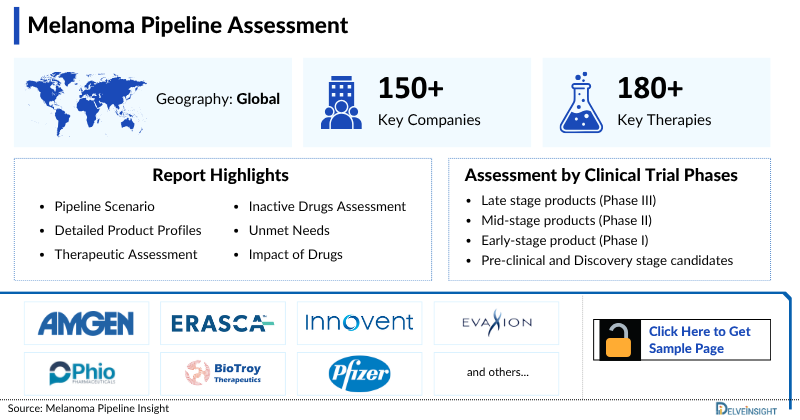
DelveInsight’s, “Melanoma Pipeline Insight, 2026” report provides comprehensive insights about 150+ companies and 180+ pipeline drugs in Melanoma pipeline landscape. It covers the pipeline drug profiles, including clinical and nonclinical stage products. It also covers the therapeutics assessment by product type, stage, route of administration, and molecule type. It further highlights the inactive pipeline products in this space.
Geography Covered
- Global coverage
Melanoma Understanding
Melanoma Overview
Melanoma is a malignant tumour arising from melanocytes. It is among the most common forms of cancer in young adults and typically presents as a new or changing pigmented (brown or black) skin lesion, but there are other presentations (amelanotic or desmoplastic) with a different clinical picture. When melanoma starts in the skin, the disease is called cutaneous melanoma. Melanoma is more aggressive than basal cell skin cancer or squamous cell skin cancer. Melanoma of the skin can occur anywhere on the body. Unusual moles, exposure to natural sunlight or artificial sunlight (such as from tanning beds) over long periods of time, and family history can affect the risk of melanoma. Melanoma may also occur in mucous membranes thin, moist layers of tissue that cover surfaces such as the lips.
Common signs and symptoms of melanoma include:
- A new or unusual mole, blemish, or sore
- A spot that looks different from others on your skin (""the ugly duckling"")
- Changes in the size, shape, or color of a mole
- Itching, tenderness, or pain in a mole or lesion
- Bleeding, oozing, or crusting
- Discoloration on the palms, soles, or mucous membranes
Melanoma starts when melanocytes develop changes in their DNA. A cell's DNA holds the instructions that tell a cell what to do. In healthy cells, DNA gives instructions to grow and multiply at a set rate. The instructions tell the cells to die at a set time. In cancer cells, the DNA changes give different instructions. The changes tell the cancer cells to make many more cells quickly. Cancer cells can keep living when healthy cells would die. This causes too many cells.
Melanoma is commonly diagnosed through tests that examine the skin for abnormal moles or pigmented areas. Doctors first review a patient’s personal and family medical history and perform a physical skin examination. If a suspicious area is found, a biopsy is done to remove cells or tissue so they can be examined under a microscope for signs of cancer. Biopsies also help determine whether the cancer has spread, a process known as staging, which is important for planning treatment. There are several types of skin biopsies, including shave biopsy, punch biopsy, incisional biopsy, and excisional biopsy. The choice of biopsy depends on the size and location of the abnormal skin growth.
Melanoma can be treated using several approaches depending on the stage of the disease. Surgery is the primary treatment and involves removing the tumor along with some surrounding healthy tissue, and sometimes nearby lymph nodes to check if the cancer has spread. Chemotherapy may be given after surgery to destroy any remaining cancer cells and reduce the chance of recurrence. Radiation therapy uses high-energy rays to kill cancer cells or relieve symptoms in advanced stages. Immunotherapy helps the immune system fight cancer and includes drugs such as atezolizumab, nivolumab, and pembrolizumab. Targeted therapy focuses on specific genetic mutations in melanoma cells and uses drugs like dabrafenib, trametinib, and vemurafenib. In addition, new treatments such as vaccine therapy are being studied in clinical trials to further improve melanoma treatment options.
"Melanoma Pipeline Insight, 2026" report by DelveInsight outlays comprehensive insights of present scenario and growth prospects across the indication. A detailed picture of the Melanoma pipeline landscape is provided which includes the disease overview and Melanoma treatment guidelines. The assessment part of the report embraces, in depth Melanoma commercial assessment and clinical assessment of the pipeline products under development. In the report, detailed description of the drug is given which includes mechanism of action of the drug, clinical studies, NDA approvals (if any), and product development activities comprising the technology, Melanoma collaborations, licensing, mergers and acquisition, funding, designations and other product related details.
Unlock comprehensive insights into melanoma market trends, epidemiology, and forecasts through 2034 to drive strategic decisions and stay competitive today.
Melanoma Report Highlights
The companies and academics are working to assess challenges and seek opportunities that could influence Melanoma R&D. The therapies under development are focused on novel approaches to treat/improve Melanoma.
Melanoma Emerging Drugs Chapters
This segment of the Melanoma report encloses its detailed analysis of various drugs in different stages of clinical development, including Phase III, II, I, Preclinical and Discovery. It also helps to understand clinical trial details, expressive pharmacological action, agreements and collaborations, and the latest news and press releases.
Melanoma Emerging Drugs
- ABP-206: Amgen
ABP-206 is an investigational biologic being developed by Amgen for the treatment of melanoma. It is designed as a biosimilar candidate to target immune checkpoint pathways involved in tumor growth. By modulating the immune system, ABP-206 aims to enhance anti-tumor responses in patients with advanced or metastatic melanoma. The drug is currently in clinical development, with ongoing studies evaluating its safety, efficacy, and comparability to the reference therapy. The drug is currently is in Phase III for the treatment of Melanoma.
- IBI363: Innovent Biologics
IBI363 is the world's first PD-1/IL-2α-bias bispecific fusion protein independently developed by Innovent Biologics. It integrates two key functions: blockade of the PD-1/PD-L1 pathway and activation of the IL-2 signaling pathway. The IL-2 arm of IBI363 has been engineered to retain affinity for IL-2 Rα while reducing binding to IL-2Rβ and IL-2Rγ, thereby minimizing toxicity. The PD-1 binding arm enables simultaneous PD-1 blockage and selective delivery of IL-2. This differential targeting strategy exploits the fact that newly activated tumor-specific T cells co-express PD-1 and IL-2α, which allows for more precise and efficient targeting and activation of this T cell subset. Currently, the drug is in Phase II stage of its development for the treatment of Melanoma.
- EVX-01: Evaxion Biotech A/S
EVX-01 is an investigational cancer immunotherapy developed by Evaxion Biotech A/S for the treatment of melanoma. It is a personalized peptide-based vaccine designed using AI to identify tumor-specific neoantigens unique to each patient. By stimulating a targeted T-cell immune response, EVX-01 aims to improve tumor recognition and destruction. The therapy is currently in clinical development, with studies assessing its safety, immunogenicity, and efficacy in melanoma patients. Currently, the drug is in Phase III for the treatment of Melanoma.
- PF-08046031: Pfizer
PF-08046031 is an investigational antibody–drug conjugate (ADC) developed by Pfizer for the treatment of advanced melanoma and other solid tumors. It targets the CD228 antigen, enabling selective delivery of a cytotoxic agent to tumor cells. This mechanism is designed to enhance tumor cell killing while minimizing systemic exposure. The drug is currently in early-phase clinical development, with studies evaluating its safety, tolerability, and preliminary efficacy in melanoma patients.
- BT02: Biotroy Therapeutics
BT02 is an investigational oncology therapy being developed by Biotroy Therapeutics for the treatment of melanoma. It is designed to target tumor-specific pathways involved in cancer cell growth and survival, aiming to inhibit disease progression. The therapy is being explored for its potential to enhance anti-tumor immune responses or directly suppress tumor activity. BT02 is currently in early-stage development, with ongoing research focused on evaluating its safety and therapeutic potential in melanoma.
Currently the drug is in Phase I of development for melanoma.
- ADP-600: Adaptimmune
ADP-600 is an investigational engineered T-cell receptor (TCR) therapy developed by Adaptimmune for the treatment of melanoma and other solid tumors. It targets the PRAME antigen, which is commonly expressed in melanoma cells, enabling precise recognition and killing of cancer cells by engineered T-cells. The therapy is designed to enhance T-cell potency and persistence to improve anti-tumor responses. ADP-600 is currently in preclinical development, with plans to advance into early-phase clinical trials evaluating its safety and efficacy.
Further product details are provided in the report……..
Comparison of Emerging Drugs under Development | |||||
|
Drug Name |
Company name |
MoA |
RoA |
Phase |
Indication |
|
Fianlimab + Cemiplimab |
Regeneron Pharmaceuticals |
LAG-3 inhibitor |
IV |
III |
Advanced melanoma |
|
IO102-IO103 |
IO Biotech |
IDO1 & PD-1 inhibitor |
Subcutaneous |
III |
First-line treatment for patients with previously untreated unresectable or metastatic (advanced) melanoma |
|
BS001 |
Binhui Biopharmaceutical |
Oncolysis |
Intratumoral |
I |
Melanoma with αPD-1 failure |
|
SGN-BB228 |
Pfizer |
CD228 inhibitor |
IV |
I |
Advanced melanoma |
Unlock actionable insights with Melanoma Epidemiology Forecast 2034 - analyze trends, patient populations, and growth opportunities shaping future oncology strategies worldwide.
Melanoma Therapeutic Assessment
This segment of the report provides insights about the different Melanoma drugs segregated based on following parameters that define the scope of the report, such as:
Major Players in Melanoma
- There are approx. 150+ key companies which are developing the therapies for Melanoma. The companies which have their Melanoma drug candidates in the most advanced stage, i.e. Phase III include, Amgen.
Melanoma Phases
DelveInsight’s report covers around 180+ products under different phases of clinical development like
- Late stage products (Phase III)
- Mid-stage products (Phase II)
- Early-stage product (Phase I) along with the details of
- Pre-clinical and Discovery stage candidates
- Discontinued & Inactive candidates
Route of Administration
Melanoma pipeline report provides the therapeutic assessment of the pipeline drugs by the Route of Administration. Products have been categorized under various ROAs such as
- Oral
- Intravenous
- Subcutaneous
- Parenteral
- Topical
Melanoma Molecule Type
Products have been categorized under various Molecule types such as
- Recombinant fusion proteins
- Small molecule
- Monoclonal antibody
- Peptide
- Polymer
- Gene therapy
Product Type
Drugs have been categorized under various product types like Mono, Combination and Mono/Combination.
Melanoma Clinical Trial Activities
The report provides insights into different therapeutic candidates in Phase III, II, I, preclinical and discovery stage. It also analyses Melanoma therapeutic drugs key players involved in developing key drugs.
Melanoma Pipeline Development Activities
The report covers the detailed information of collaborations, acquisition and merger, licensing along with a thorough therapeutic assessment of emerging Melanoma drugs.
Melanoma Report Insights
- Melanoma Pipeline Analysis
- Therapeutic Assessment
- Unmet Needs
- Impact of Drugs
Melanoma Report Assessment
- Pipeline Product Profiles
- Therapeutic Assessment
- Pipeline Assessment
- Inactive drugs assessment
- Unmet Needs
Key Questions Answered In The Melanoma Pipeline Report :
Current Treatment Scenario and Emerging Therapies:
- How many companies are developing Melanoma drugs?
- How many Melanoma drugs are developed by each company?
- How many emerging drugs are in mid-stage, and late-stage of development for the treatment of Melanoma?
- What are the key collaborations (Industry–Industry, Industry–Academia), Mergers and acquisitions, licensing activities related to the Melanoma therapeutics?
- What are the recent trends, drug types and novel technologies developed to overcome the limitation of existing therapies?
- What are the clinical studies going on for Melanoma and their status?
- What are the key designations that have been granted to the emerging drugs?
Key Players
- Amgen
- Erasca, Inc
- Innovent Biologics (Suzhou) Co. Ltd.
- Evaxion Biotech A/S
- Phio Pharmaceuticals Inc.
- Biotroy Therapeutics
- Pfizer
- Adaptimmune
- Servier and IDEAYA Biosciences, Inc.
- Rapa Therapeutics LLC
- Merck Sharp & Dohme LLC
- Idera Pharmaceuticals, Inc.
- Iovance Biotherapeutics, Inc.
- Celldex Therapeutics
- Immatics US, Inc.
Key Products
- ABP-206
- Naporafenib
- IBI-363
- EVX-01
- PH-762
- BT02
- PF-08046031
- ADP-600
- Darovasertib
- RAPA-201
- V940
- Tilsotolimod
- Lifileucel plus Pembrolizumab
- CDX-301
- IOV-3001
- IMA203