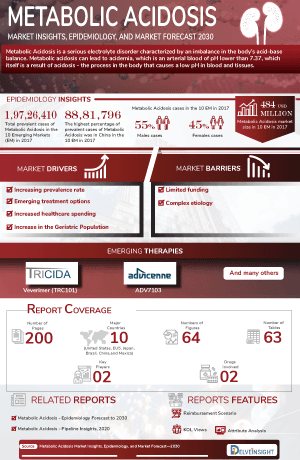
Metabolic Acidosis Market
- In 2023, the US market for metabolic acidosis therapies reached approximately USD 117.6 million, capturing about 70% of the total market across the seven major markets (7MM).
- Metabolic acidosis is a condition characterized by a decrease in blood pH due to an excess of acid in the body or a loss of bicarbonate, leading to an imbalance in the body's acid-base regulation. This condition can result from various underlying causes, including kidney failure, diabetic ketoacidosis, lactic acidosis, and prolonged diarrhea, which depletes bicarbonate levels.
- In 2023, approximately 1.7 million prevalent cases of metabolic acidosis were diagnosed across the seven major markets (7MM). Of these, around 850,000 cases in the United States were linked to metabolic acidosis in patients with chronic kidney disease (CKD) stages 3 to 5, while the remaining cases were associated with diagnosed cases of distal renal tubular acidosis (dRTA), both inherited and acquired.
- A significant number of metabolic acidosis cases were observed in males, accounting for approximately 55% of the total cases. This higher prevalence in males is due to a greater incidence of underlying conditions such as chronic kidney disease and diabetes, which are more common in men and are major contributors to the development of metabolic acidosis.
- In 2023, treated cases of distal renal tubular acidosis (dRTA), both inherited and acquired, represented less than 1.5% of all treated metabolic acidosis cases in the United States. This is attributed to the relative rarity of dRTA as a cause of metabolic acidosis, especially when compared to more prevalent conditions such as diabetic ketoacidosis and lactic acidosis.
- No drugs have been directly approved by the FDA specifically for the indication of metabolic acidosis. However, several drugs have been approved to manage the symptoms and underlying causes associated with the condition, providing indirect treatment options for patients.
- The pipeline for metabolic acidosis remains relatively sparse, with only a few companies advancing their candidates through various stages of clinical trials. A notable candidate is Zagociguat by Tisento Therapeutics, which is currently in Phase II clinical trials.
DelveInsight's “Metabolic Acidosis Market Insights, Epidemiology and Market Forecast – 2034” report delivers an in-depth understanding of the indication metabolic acidosis, historical and forecasted epidemiology as well as the metabolic acidosis therapeutics market trends in the United States, EU4 (Germany, Spain, Italy, and France) and the United Kingdom, and Japan.
The metabolic acidosis market report provides real-world prescription pattern analysis, approved drugs, market share of individual therapies, and historical and forecasted 7MM metabolic acidosis market size from 2020 to 2034. The report also covers current metabolic acidosis treatment practices/algorithms and unmet medical needs to curate the best opportunities and assess the market’s underlying potential.
|
Study Period |
2020 to 2034 |
|
Forecast Period |
2024-2034 |
|
Geographies Covered |
|
|
Metabolic Acidosis Market |
|
|
Metabolic Acidosiss Market Size | |
|
Metabolic Acidosis Companies |
Tisento Therapeutics, Tricida, Advicenne Pharma, and others. |
|
Metabolic Acidosis Epidemiology Segmentation |
|
Metabolic Acidosis Treatment Market
Metabolic Acidosis Overview, Country-Specific Treatment Guidelines and Diagnosis
Metabolic acidosis is a condition characterized by a decrease in blood pH due to an excess of acid in the body or a loss of bicarbonate, leading to an imbalance in the body's acid-base regulation. This condition can result from various underlying causes, including kidney failure, diabetic ketoacidosis, lactic acidosis, and prolonged diarrhea, which depletes bicarbonate levels. When metabolic acidosis occurs, the body’s buffering systems become overwhelmed, and the blood pH drops below the normal range (7.35-7.45), leading to a more acidic environment. The condition can be classified as high anion gap acidosis or normal anion gap acidosis, depending on the underlying cause and biochemical findings.
-01.png)
Diagnosis of metabolic acidosis begins with clinical suspicion, especially in patients with risk factors like kidney disease, diabetes, or significant fluid loss. Blood tests are central to diagnosing this condition. An arterial blood gas (ABG) test measures the pH, partial pressure of carbon dioxide (PaCO2), and bicarbonate (HCO3-) levels in the blood. The anion gap, calculated from serum electrolyte levels (Na+, Cl-, HCO3-), is used to help determine the cause of the acidosis. A high anion gap suggests the presence of unmeasured anions, often seen in conditions like diabetic ketoacidosis or lactic acidosis, while a normal anion gap indicates a loss of bicarbonate, as seen in conditions like diarrhea or renal tubular acidosis.
Further details related to country-based variations in diagnosis are provided in the report
Metabolic Acidosis Treatment
Treatment of metabolic acidosis focuses on addressing the underlying cause of the acidosis and restoring normal acid-base balance. In cases of diabetic ketoacidosis, insulin therapy is essential to manage blood glucose levels and correct the acidosis. For lactic acidosis, improving tissue oxygenation and addressing the cause of hypoxia is crucial. Bicarbonate therapy may be administered in severe cases of acidosis, especially when the pH drops below 7.1, but its use is debated and typically reserved for life-threatening situations.
Chronic metabolic acidosis, such as that seen in kidney disease, may be managed with oral bicarbonate supplements or other alkalinizing agents. Close monitoring of blood pH, electrolytes, and the patient’s overall clinical status is critical throughout treatment to ensure the resolution of acidosis and prevention of complications.
Metabolic Acidosis Epidemiology
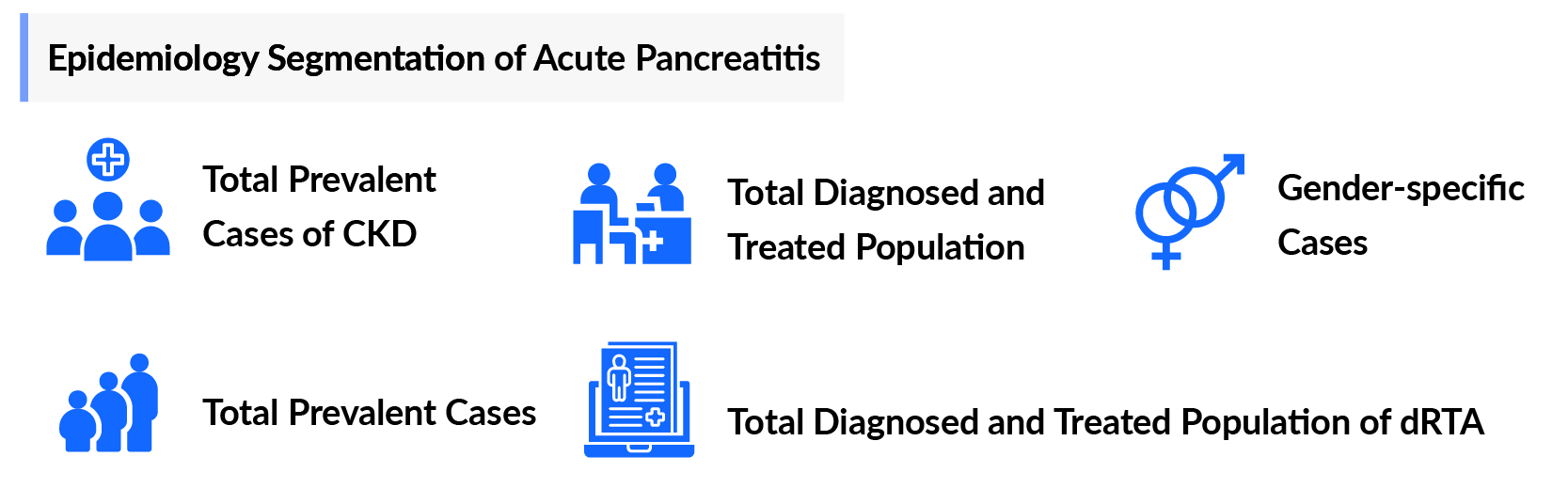
The metabolic acidosis epidemiology chapter in the report provides historical as well as forecasted prevalence in the 7MM covering the United States, EU4 countries (Germany, France, Italy, and Spain), the United Kingdom, and Japan from 2024 to 2034. The metabolic acidosis epidemiology is segmented with detailed insights into:
- Total Prevalence of Chronic Kidney Disorder Patients in the 7MM [2020-2034]
- Total Prevalence of Metabolic Acidosis in Chronic Kidney Disorder Patients in the 7MM [2020-2034]
- Total Prevalent Cases of Metabolic Acidosis in the 7MM [2020-2034]
- Total Prevalent Population of Distal Renal Tubular Acidosis in the 7MM [2020-2034]
- Total Diagnosed Population of Metabolic Acidosis in the 7MM [2020-2034]
- Gender-specific diagnosed cases of Metabolic Acidosis in the 7MM[2020-2034]
-01.png)
Key Epidemiological Highlights
- In 2023, approximately 1.7 million prevalent cases of metabolic acidosis were diagnosed across the seven major markets (7MM). Of these, around 850,000 cases in the United States were linked to metabolic acidosis in patients with chronic kidney disease (CKD) stages 3 to 5, while the remaining cases were associated with diagnosed cases of distal renal tubular acidosis (dRTA), both inherited and acquired.
- A significant number of metabolic acidosis cases were observed in males, accounting for approximately 55% of the total cases. This higher prevalence in males is due to a greater incidence of underlying conditions such as chronic kidney disease and diabetes, which are more common in men and are major contributors to the development of metabolic acidosis.
- In 2023, treated cases of distal renal tubular acidosis (dRTA), both inherited and acquired, represented less than 1.5% of all treated metabolic acidosis cases in the United States. This is attributed to the relative rarity of dRTA as a cause of metabolic acidosis, especially when compared to more prevalent conditions such as diabetic ketoacidosis and lactic acidosis.
Metabolic Acidosis Recent Developments
- In February 2025, Milla Pharmaceuticals, through its U.S. subsidiary, received FDA approval for a generic version of Hospira's THAM Solution Tromethamine Injection 18GM/500ml, which is indicated for the prevention and correction of metabolic acidosis.
Metabolic Acidosis Drug Chapters
The drug chapter segment of the metabolic acidosis report encloses a detailed analysis of metabolic acidosis emerging candidates. It also deep dives into the metabolic acidosis pivotal clinical trial details, recent and expected market approvals, patent details, the latest news, and recent deals and collaborations.
Metabolic Acidosis Emerging Drugs
Zagociguat: Tisento Therapeutics
Zagociguat is an investigational medicine that is taken as a once-a-day oral tablet. Zagociguat has been studied in 5 clinical trials, including a Phase IIa trial in participants with MELAS. It acts as a potent stimulator of sGC, enhancing the production of cyclic GMP (cGMP) in response to nitric oxide. This pathway plays a crucial role in regulating vascular tone and reducing inflammation.
Metabolic Acidosis Market Outlook
The metabolic acidosis market presents a diverse landscape across the major global markets, reflecting varying levels of demand and healthcare infrastructure. In 2023, the market for metabolic acidosis therapies exhibited significant disparities in size and growth potential among the seven major markets (7MM). In 2023, The United States emerged as the largest market by far, capturing approximately USD 117.6 million, while Europe, including Germany, France, Italy, Spain, and the UK, showcased a range of market sizes.
- In 2023, the US market for metabolic acidosis therapies reached approximately USD 117.6 million, capturing about 70% of the total market across the seven major markets (7MM). This significant share underscores the United States as the dominant market, driven by advanced healthcare infrastructure and high demand for effective treatments.
- Among the EU4 countries and the UK, Germany had the largest market size for metabolic acidosis, valued at USD 9.1 million. This positions Germany as a key player in the European market, reflecting its strong healthcare system and investment in innovative treatment options.
Metabolic Acidosis Drug Uptake
This section focuses on the uptake rate of potential drugs expected to be launched in the market during 2024–2034, which depends on the competitive landscape, safety, and efficacy data along with order of entry. It is important to understand that the key players evaluating their novel therapies in the pivotal and confirmatory trials should remain vigilant when selecting appropriate comparators to stand the greatest chance of a positive opinion from regulatory bodies, leading to approval, smooth launch, and rapid uptake.
Metabolic acidosis Activities
This section provides insights into Metabolic Acidosis clinical trials within phase II and phase III. It also analyzes key players involved in developing targeted therapeutics.
Pipeline Development Activities
This section covers information on collaborations, acquisitions and mergers, licensing, and patent details for emerging therapies.
KOL Views
To keep up with the real-world scenario in current market trends, we take opinions from Key Industry leaders working in the domain through primary research to fill the data gaps and validate our secondary research. Industry Experts were contacted for insights on the evolving treatment landscape, patient reliance on conventional therapies, patient therapy switching acceptability, and drug uptake along with challenges related to accessibility.
DelveInsight’s analysts connected with 10+ KOLs to gather insights; however, interviews were conducted with 5+ KOLs in the 7MM. Their opinion helps understand and validate current treatment patterns of metabolic acidosis. This will support the clients in potential upcoming novel treatments by identifying the overall scenario of the market and the unmet needs.
Qualitative Analysis
We perform Qualitative and market Intelligence analysis using various approaches, such as SWOT analysis and Conjoint Analysis. In the SWOT analysis, strengths, weaknesses, opportunities, and threats in terms of gaps in disease diagnosis, patient awareness, physician acceptability, competitive landscape, cost-effectiveness, and geographical accessibility of therapies are provided.
Conjoint Analysis analyzes multiple approved therapies based on relevant attributes such as safety, efficacy, frequency of administration, route of administration, and order of entry. Scoring is given based on these parameters to analyze the effectiveness of therapy.
In efficacy, the trial’s primary and secondary outcome measures are evaluated; for instance, in event-free survival, one of the most important primary outcome measures is event-free survival and overall survival.
Further, the therapies’ safety is evaluated wherein the acceptability, tolerability, and adverse events are majorly observed, and it sets a clear understanding of the side effects posed by the drug in the trials. In addition, the scoring is also based on the probability of success, and the addressable patient pool for each therapy.
Market Access and Reimbursement
The section provides detailed insights on the country-wise accessibility and reimbursement scenarios, cost-effectiveness scenarios of currently used therapies, programs making accessibility easier and out-of-pocket costs more affordable, insights on patients insured under federal or state government prescription drug programs, etc.
Scope of the Metabolic Acidosis Market Report
- The report covers a segment of key events, an executive summary, descriptive overview of metabolic acidosis, explaining its causes, signs and symptoms, pathogenesis, and currently available therapies.
- Comprehensive insight has been provided into the epidemiology segments and forecasts, the future growth potential of diagnosis rate, and disease progression along with country-specific treatment guidelines.
- Additionally, an all-inclusive account of the current therapies, along with the elaborative profiles of late-stage and prominent therapies, will have an impact on the current treatment landscape.
- A detailed review of the metabolic acidosis market, historical and forecasted market size, market share by therapies, detailed assumptions, and rationale behind our approach is included in the report, covering the 7MM drug outreach.
- The report provides an edge while developing business strategies, by understanding trends, through SWOT analysis and expert insights/KOL views, patient journey, and treatment preferences that help in shaping and driving the 7MM metabolic acidosis.
Metabolic Acidosis Report Insights
- Metabolic Acidosis Patient Population
- Metabolic Acidosis Therapeutic Approaches
- Metabolic Acidosis Pipeline Analysis
- Metabolic Acidosis Market Size and Trends
- Existing and future Market Opportunity
Metabolic Acidosis Report Key Strengths
- Eleven Years Forecast
- 7MM Coverage
- Metabolic Acidosis Epidemiology Segmentation
- Inclusion of Country specific treatment guidelines
- KOL’s feedback on approved therapies
- Key Cross Competition
- Conjoint analysis
- Metabolic Acidosis Drugs Uptake
- Key Metabolic Acidosis Market Forecast Assumptions
Metabolic Acidosis Report Assessment
- Current Metabolic Acidosis Treatment Practices
- Metabolic Acidosis Unmet Needs
- Metabolic Acidosis Pipeline Product Profiles
- Metabolic Acidosis Market Attractiveness
- Qualitative Analysis (SWOT and Conjoint Analysis)
- Metabolic Acidosis Market Drivers
- Metabolic Acidosis Market Barriers
FAQs
- What is the growth rate of the 7MM metabolic acidosis treatment market?
- What was the metabolic acidosis total market size, the market size by therapies, and market share (%) distribution in 2020, and what would it look like in 2034? What are the contributing factors/key catalysts for this growth?
- Is there any unexplored patient setting that can open the window for growth in the future?
- What are the pricing variations among different geographies for approved and off-label therapies?
- How would the market drivers, barriers, and future opportunities affect the market dynamics and subsequent analysis of the associated trends?
- What are the current options for the treatment of metabolic acidosis?
- What are the recent novel therapies, targets, mechanisms of action, and technologies developed to overcome the limitations of existing therapies?
- Patient acceptability in terms of preferred treatment options as per real-world scenarios?
- What are the country-specific accessibility issues of expensive, recently approved therapies?
Reasons to buy Metabolic Acidosis Market Forecast Report:
- The report will help in developing business strategies by understanding the latest trends and changing treatment dynamics driving the Metabolic Acidosis Market.
- Insights on patient burden/disease prevalence, evolution in diagnosis, and factors contributing to the change in the epidemiology of the disease during the forecast years
- Understand the existing market opportunities in varying geographies and the growth potential over the coming years.
- Distribution of historical and current patient share based on real-world prescription data along with reported sales of approved products in the US, EU4 (Germany, France, Italy, and Spain), the United Kingdom, and Japan.
- Detailed analysis and ranking of class-wise potential current therapies under the conjoint analysis section to provide visibility around leading classes.
- Highlights of access and reimbursement policies of approved therapies, barriers to accessibility of expensive off-label therapies, and patient assistance programs.
- To understand Key Opinion Leaders’ perspectives around the accessibility, acceptability, and compliance-related challenges of existing treatment to overcome barriers in the future.
- Detailed insights on the unmet needs of the existing market so that the upcoming players can strengthen their development and launch strategy.