Molecular Glues Competitive landscape
- The Molecular Glues Competitive Landscape is rapidly evolving, with several biotechnology and pharmaceutical companies actively advancing novel candidates across preclinical and clinical stages.
- The leading Molecular Glues Companies include Bristol Myers Squibb, Revolution Medicines, Inc., Eisai Co Ltd, Gluetacs Therapeutics (Shanghai) Co., Ltd., Captor Therapeutics, GluBio Therapeutics, Nurix Therapeutics, Inc., SEED Therapeutics, Inc., MindRank Ltd, Monte Rosa Therapeutics, Beijing InnoCare Pharma Tech Co., Ltd., C4 Therapeutics, Inc., Erasca, Inc., Plexium, Inc., Novartis AG, Salarius Pharmaceuticals, Inc., Orionis Biosciences, and Rapafusyn Pharmaceuticals and others.
Request for unlocking the sample page of "Molecular Glues Competitive Landscape"
DelveInsight’s, “Molecular Glues Competitive landscape, 2026” report provides comprehensive insights about 80+ companies and 90+ drugs in Molecular Glues Competitive landscape. It covers the therapeutics assessment by product type, stage, route of administration, and molecule type. It further highlights the inactive pipeline products in this space.
Geography Covered
- Global coverage
Molecular Glues: Understanding
Molecular Glues: Overview
Molecular glues (MGs) are a distinct class of small, typically monovalent molecules that modulate protein-protein interactions by stabilizing or inducing novel complexes between proteins. Most notably, they function by recruiting target proteins often previously considered “undruggable” to E3 ubiquitin ligases, leading to their ubiquitination and subsequent degradation via the proteasome. Unlike traditional inhibitors that block enzymatic function, MGs act through proximity-induced mechanisms, enabling the modulation of non-enzymatic or scaffolding proteins and reshaping cellular protein networks.
Initially discovered in plants, MGs have since been repurposed for therapeutic use across oncology, neurodegeneration, immunology, and antiviral applications. Clinically validated examples, such as thalidomide and its derivatives (lenalidomide, pomalidomide), reprogram the CRBN E3 ligase to degrade transcription factors like IKZF1/3 in multiple myeloma, showcasing their therapeutic potential. Their small size and ligand efficiency allow them to cross the blood–brain barrier and achieve favorable pharmacokinetics, making them particularly attractive for central nervous system (CNS) disorders.
MGs can target a single protein via multiple scaffolds or, conversely, influence multiple targets with a single compound, offering high mechanistic versatility. Structural studies have revealed that MGs bind shallow pockets or induce conformational changes that enable new protein-protein interactions. This often involves cooperative binding, where interaction with one protein enhances affinity for the second, significantly increasing complex stability, potency, and selectivity. Beyond degradation, MGs can also inactivate, stabilize, or sequester proteins, depending on the nature of the ternary complex formed.
Their modularity and ability to target disease-specific proteins position them as key tools in precision medicine, particularly for stratified patient populations defined by genetic mutations or biomarkers. They are also valuable in research settings as probes to dissect protein function and interaction networks.
While challenges remain, such as off-target effects, limited diversity of E3 ligases, and a discovery process still largely driven by serendipity, advances in high-throughput screening, DNA-encoded libraries, structural biology, and AI-based modeling are accelerating MGD discovery and optimization. As a result, molecular glues represent a transformative modality within the targeted protein degradation (TPD) field, poised to reshape drug discovery and expand the therapeutic landscape for complex and refractory diseases.
For detailed market dynamics, growth drivers, and future forecasts, explore our comprehensive Molecular Glues Market Report
Molecular Glues Market Report Highlights
- In August 2025, Plexium has raised USD 60.1 million in a recent funding round, marking a significant milestone for the company following a period of restructuring. This cash infusion comes as Plexium continues to advance its pipeline of innovative protein degraders. The USD 60.1 million raised by Plexium provides a crucial financial boost for the company.
- In August 2025, Seed Therapeutics, Inc. announced that the US Food and Drug Administration (FDA) has cleared its Investigational New Drug (IND) application for ST-01156. The clearance enabled initiation of a first-in-human Phase 1 clinical trial in patients with advanced solid tumor and hematological malignances, prioritizing multiple cancers with convincing preclinical evidence of RBM39 dependency. First patient dosing is expected in the first quarter of 2026.
- In August 2025, Zennova announced a strategic collaboration with Rapafusyn Pharmaceuticals, a US-based biotech company, to jointly advance the development of innovative non-degrading molecular glue medicines.
- In June 2025, Revolution Medicines, announced that it has partnered with Royalty Pharma on USD 2 billion in flexible funding to support Revolution Medicines’ independent global development and commercialization strategy and operations. Revolution Medicines retains full strategic and executional control of product development and commercialization for its portfolio of RAS(ON) inhibitors in the US and internationally.
- In June 2025, Revolution Medicines, announced that the US Food and Drug Administration (FDA) has granted Breakthrough Therapy Designation to Daraxonrasib, the company’s RAS (ON) multi-selective inhibitor, for previously treated metastatic PDAC in patients with KRAS G12 mutations.
- In May 2025, Captor Therapeutics S.A. announced that it has commenced a clinical trial that could revolutionize the treatment of hepatocellular carcinoma (HCC). The Phase I trial has begun in 19 European clinics across Spain, Germany, and France. It is being conducted in collaboration with the global company ICON. The first patient has been dosed with the CT-01 drug candidate at the renowned Barcelona Clinic Liver Cancer (BCLC).
- In May 2025, Erasca, Inc. announced clearance of an investigational new drug (IND) application by the United States Food and Drug Administration (FDA) for ERAS-0015, a pan-RAS molecular glue with best-in-class potential for patients with RAS-mutant (RASm) solid tumors.
- In January 2025, Salarius Pharmaceuticals, Inc. and Decoy Therapeutics, Inc., announced the signing of a definitive agreement under which Decoy Therapeutics will merge with a wholly-owned subsidiary of Salarius Pharmaceuticals, subject to the closing conditions set forth in the definitive agreement. The newly formed company will be named Decoy Therapeutics.
- In July 2024, MindRank, announced that its molecular glue project, MRANK-103, targeting the MYC signaling pathway and designed to regulate eukaryotic translation and transcription factors, has completed the nomination of preclinical candidate (PCC) and begun the IND-Enabling studies.
- In May 2024, Gluetacs Therapeutics announced that it has secured Series A Funding, led by Huangpu Biopharmaceutical Fund and followed by Gortune Investment, Nanwan Baiao, and Synlinx. This round of financing will be primarily used to advance the clinical Phase I trial of Gluetacs’ product pipelines GT919 and GT929 and the development of pre-clinical projects.
- In May 2024, Erasca, Inc. announced it has entered into exclusive license agreements for two preclinical RAS programs, a potential best-in-class pan-RAS molecular glue (ERAS-0015) and a potential first-in-class pan-KRAS inhibitor (ERAS-4001).
- In March 2024, Gluetacs Therapeutics was approved to carry out Phase I clinical trial of GT919 combining with dexamethasone.
Molecular Glues: Company and Product Profiles (Marketed Therapies)
1. Company Overview: Bristol Myers Squibb
Bristol Myers Squibb is a global biopharmaceutical company that focuses on discovering, developing, and delivering innovative medicines to patients with serious diseases. Headquartered in New York City, the company specializes in areas such as oncology, immunology, cardiovascular diseases, and fibrosis. Through extensive research and development efforts, Bristol Myers Squibb aims to address unmet medical needs and improve the quality of life for patients around the world. The company collaborates with various partners and employs advanced scientific methods to advance its pipeline of therapeutics.
Product Description: POMALYST
POMALYST is a prescription medicine used to treat adults with Multiple myeloma, taken along with the medicine dexamethasone, in patients who have previously received at least 2 medicines to treat multiple myeloma, including a proteasome inhibitor and lenalidomide, and whose disease has become worse during treatment or within 60 days of finishing the last treatment. It is not known if POMALYST is safe and effective in children.
2. Company Overview: Bristol Myers Squibb
Bristol Myers Squibb is a global biopharmaceutical company that focuses on discovering, developing, and delivering innovative medicines to patients with serious diseases. Headquartered in New York City, the company specializes in areas such as oncology, immunology, cardiovascular diseases, and fibrosis. Through extensive research and development efforts, Bristol Myers Squibb aims to address unmet medical needs and improve the quality of life for patients around the world. The company collaborates with various partners and employs advanced scientific methods to advance its pipeline of therapeutics.
Product Description: REVLIMID
REVLIMID® (lenalidomide) is a prescription medicine, used to treat adults with multiple myeloma (MM) in combination with the medicine dexamethasone, or as maintenance treatment after autologous hematopoietic stem cell transplantation (a type of stem cell transplant that uses your own stem cells). REVLIMID should not be used to treat people who have chronic lymphocytic leukemia (CLL) unless they are participants in a controlled clinical trial.
It is not known if REVLIMID is safe and effective in children. The therapy is also being approved for Follicular lymphoma, Mantle-cell lymphoma, Marginal zone B-cell lymphoma, Multiple myeloma, and Myelodysplastic syndromes.
Molecular Glues: Company and Product Profiles (Pipeline Therapies)
1. Company Overview: Revolution Medicines, Inc
Revolution Medicines is a clinical-stage oncology company dedicated to developing targeted therapies for cancers driven by RAS mutations, often referred to as RAS-addicted cancers. The company's research and development efforts focus on advancing a robust pipeline of RAS (ON) inhibitors, which are designed to directly suppress active RAS proteins across a broad spectrum of oncogenic variants.
These include both multi-selective and mutation-specific approaches aimed at disrupting RAS signaling and halting tumor progression. In addition to its core RAS (ON) inhibitor programs, the company is also developing companion inhibitors to enhance therapeutic efficacy. Revolution Medicines is driven by a commitment to scientific excellence and innovation, challenging conventional approaches to cancer treatment.
Product Description: Daraxonrasib
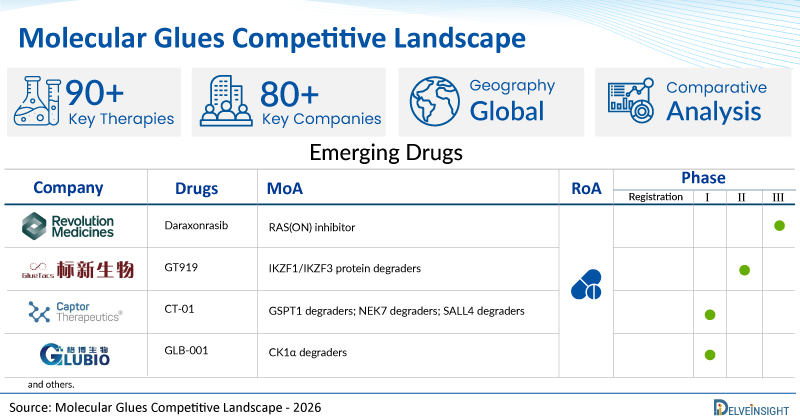
Daraxonrasib (RMC-6236) is an investigational, oral RAS (ON) multi-selective inhibitor developed by Revolution Medicines. It is designed to target a broad range of oncogenic RAS mutations, including G12X, G13X, and Q61X. Unlike covalent inhibitors, RMC-6236 is non-covalent and works by blocking the interaction between active RAS and its downstream effectors.
This suppression of RAS signaling may inhibit tumor growth in RAS-driven cancers. The therapy shows promise in treating pancreatic ductal adenocarcinoma (PDAC), non-small cell lung cancer (NSCLC), and advanced solid tumors. Daraxonrasib is currently being evaluated in a Phase III stage of clinical trial for the treatment of Pancreatic Ductal Adenocarcinoma.
2. Company Overview: Eisai Co., Ltd.
Eisai Co., Ltd. is a leading Japan-based global pharmaceutical company focused on oncology, neurology, and specialty care. The company is committed to its human health care (hhc) mission, emphasizing patient-centric innovation and access to medicines worldwide. Eisai has a strong portfolio that includes novel therapies for cancer, dementia-related diseases, and rare conditions, supported by robust R&D capabilities and strategic collaborations. With operations spanning more than 60 countries, Eisai maintains a significant global presence while continuing to expand its pipeline through research partnerships and in-house development.
Product Description: E 7820
E 7820 is an investigational small-molecule drug developed by Eisai Co., Ltd. that functions as an oral integrin α2 antagonist with anti-angiogenic and immunomodulatory properties. It is designed to inhibit tumor angiogenesis and modulate the tumor microenvironment, thereby suppressing cancer progression. E 7820 has been evaluated in clinical studies for solid tumors, including colorectal and non-small cell lung cancers, as part of Eisai’s oncology pipeline. Currently, the drug is in Phase II stage of its clinical study for the treatment of Relapsed/Refractory Myeloid Malignancies.
3. Company Overview: Gluetacs Therapeutics
Gluetacs Therapeutics is the first biotech company incubated by ShanghaiTech University, specializing in the development of small molecule oral protein degraders. The company is led by a team of experienced scientists in the field of targeted protein degradation. Gluetacs owns proprietary platforms for molecular glue (GLUE) and bifunctional degrader (GLUETAC) development, with over 100 patents granted globally.
Its fully integrated R&D infrastructure includes AI-driven virtual screening, in vitro and in vivo pharmacology, proteomics, and pharmacokinetics platforms. The GlueTacs® platform has successfully advanced two drug candidates into clinical trials. Gluetacs also serves as a training base for advanced degrees in collaboration with ShanghaiTech University and global academic partners. Guided by innovation and patient-centricity, the company is advancing a differentiated pipeline targeting unmet medical needs.
Product Description: GT919
GT919, a molecular glue, directly binds to the substrate receptor Cereblon (CRBN) in CRL4CRBN E3 ubiquitin ligase complex, and then recruits substrate proteins such as the transcription factors IKZF1 and IKZF3 to induce their ubiquitination and further degradation of the substrate proteins, driving to display anti-tumor effects and immune regulations.
GT919 is a new generation of immunomodulatory drug in clinical trial, aiming to overcome resistance of existing drugs such as Lenalidomide and Pomalidomide. According to the company’s pipeline, GT919 is currently being evaluated in a Phase II stage of clinical trial for the treatment of Relapsed or refractory multiple myeloma.
4. Company Overview: Captor Therapeutics
Captor Therapeutics is a biopharmaceutical company based in Basel, Switzerland and Wroclaw, Poland, dedicated to developing breakthrough therapeutics for severe and underserved diseases using Targeted Protein Degradation (TPD) technology.
Leveraging its proprietary Optigrade™ discovery platform, which integrates protein engineering, structural biology, molecular modeling, CRISPR-based target validation, and proteomics, the company expedites the identification of both molecular glues and bifunctional degraders to address “undruggable” molecular targets across oncology and autoimmune conditions.
Product Description: CT-01
CT-01 is a first-in-class triple degrader that targets the proteins GSPT-1, NEK7, and SALL4, key drivers in cancer biology. Designed as a prodrug with enhanced tissue specificity for the liver and lungs, CT-01 has shown high efficacy in both cell line-derived and patient-derived xenograft models of hepatocellular carcinoma (HCC).
In addition, it demonstrates strong synergy with everolimus, highlighting its potential as a novel therapeutic option for hard-to-treat liver and lung cancers. Currently, the drug is in Phase I stage of its clinical development for the treatment of Hepatocellular carcinoma, Lung cancer and NET tumors.
5. Company Overview: GluBio Therapeutics
GluBio Therapeutics, headquartered in San Diego, with research operations in both the US and Shanghai, specializes in discovering and developing innovative small-molecule therapies through Targeted Protein Degradation (TPD) technology. Combining deep expertise in drug development with a proprietary TPD discovery platform and advanced screening capabilities, the company is advancing a diverse pipeline of highly selective molecular glue and bifunctional degraders across therapeutic areas including oncology and immunology, with the goal of creating transformative treatments for patients with unmet medical needs.
Product Description: GLB-001
GLB-001 is an orally administered molecular glue degrader developed by GluBio Therapeutics that targets casein kinase 1 alpha (CK1α). By promoting the recruitment of CK1α to cellular E3 ubiquitin ligases, GLB-001 induces its ubiquitination and subsequent proteasomal degradation, effectively reducing CK1α protein levels.
This mechanism is designed to disrupt oncogenic pathways in diseases such as acute myeloid leukemia and myelodysplastic syndromes. Currently, the drug is in Phase I stage of its clinical development for the treatment of Acute Myeloid Leukemia, Myelodysplastic Syndromes, Polycythemia Vera, and Myelofibrosis.
6. Company Overview: Nurix Therapeutics
Nurix Therapeutics is a clinical-stage biopharmaceutical company pioneering the discovery and development of targeted protein degradation therapies for cancer and inflammatory diseases. The company’s wholly owned pipeline includes Bruton’s tyrosine kinase (BTK) degraders and Casitas B-lineage lymphoma proto-oncogene B (CBL-B) inhibitors.
Nurix is also advancing first- and best-in-class degraders and degrader antibody conjugates (DACs) in preclinical development. Its partnered pipeline features IRAK4 and STAT6 degraders and additional programs with Gilead Sciences, Sanofi, and Pfizer, with select rights for co-development and commercialization.
Nurix leverages a fully AI-integrated discovery engine and deep expertise in E3 ligase biology to drive innovation. With a focus on translating cutting-edge science into impactful medicines, the company aims to redefine standards of care.
Product Description: Zelebrudomide
Zelebrudomide (NX-2127) is an oral dual degrader targeting both Bruton’s tyrosine kinase (BTK) and cereblon neosubstrates IKZF1 (Ikaros) and IKZF3 (Aiolos), key regulators of B- and T-cell function. It is being evaluated in patients with B-cell malignancies, particularly aggressive non-Hodgkin lymphoma (NHL).
By degrading BTK, zelebrudomide disrupts malignant B-cell signaling, while degradation of IKZF1/3 enhances immunomodulatory effects through T-cell activation. This dual mechanism addresses multiple oncogenic pathways, offering the potential for improved efficacy in resistant or relapsed disease.
Zelebrudomide’s combined anti-tumor and immune-enhancing activity supports its promise as a next-generation therapy. Zelebrudomide is currently being evaluated in a Phase I stage of clinical trial for the treatment of Relapsed/Refractory B-cell Malignancies.
7. Company Overview: Seed Therapeutics
Seed Therapeutics is a global research-focused biotech company and a subsidiary of BeyondSpring, Inc. The company specializes in creating molecular glue degraders to target disease-driving proteins deemed undruggable by traditional methods.
Utilizing its proprietary RITE3™ platform, Seed leverages deep expertise in ubiquitin–proteasome biology to discover and engineer small molecules that induce targeted protein degradation across oncology, neurodegeneration, immunology, and infectious disease areas. It has built a growing pipeline of novel drug candidates and collaborates strategically with partners such as Eli Lilly and Eisai to advance its mission of developing transformative therapies.
Product Description: ST-00937
ST-00937 is an oral molecular glue degrader discovered by SEED Therapeutics that targets the RNA-binding protein RBM39, a pathogenic factor in various cancers. In preclinical studies, it drove RBM39 down to undetectable levels in Ewing sarcoma cells both in vitro and in vivo, producing complete regression of established tumors within two weeks, while also impairing homologous recombination DNA repair pathways.
Currently, the drug is in Preclinical stage of its clinical development for the treatment of Ewing sarcoma.
8. Company Overview: MindRank
MindRank is a clinical stage AI powered drug discovery company founded in 2020 that focuses on hard to drug molecular targets. The company has developed three proprietary technology platforms, Molecule Pro, Molecule Dance, and the PharmKG biomedical knowledge graph, to accelerate small molecule drug design and optimization, spanning discovery through IND enabling stages.
Product Description: MRANK-103
MRANK-103 is a discovery-stage molecular glue degrader crafted using MindRank’s AI-powered ProtaG™ design platform, targeting the MYC signaling pathway to modulate eukaryotic translation and transcription factors in oncology. This asset has advanced to the IND-enabling stage following nomination as a preclinical candidate.
Preclinical data demonstrated nearly complete target degradation (close to 100% efficiency), picomolar-level DC₅₀ potency, strong efficacy across cell models, excellent blood–brain barrier penetration, and promising pharmacokinetics and safety, particularly in MYC-high cancers such as breast, non-small cell lung, and small cell lung cancer, including Brain Metastases. Currently, the drug is in Preclinical stage of its clinical development for the treatment of breast cancer, colorectal cancer, lung cancer, and gastric cancer.
Further product details are provided in the report……..
Molecular Glues Analytical Perspective by DelveInsight
-
In-depth Commercial Assessment: Molecular Glues Collaboration Analysis by Companies
The Molecular Glues Report provides in-depth commercial assessment of drugs that have been included, which comprises collaboration, agreement, licensing and acquisition – deals values trends. The sub-segmentation is described in the report which provide company-company collaboration (licensing/partnering), company academic collaboration and acquisition analysis in tabulated form.
-
Molecular Glues Competitive Landscape
The Molecular Glues Report comprises of comparative assessment of Companies (by therapy, development stage, and technology).
Molecular Glues Competitive Landscape Report Assessment
- Company Analysis
- Therapeutic Assessment
- Pipeline Assessment
- Inactive drugs assessment
- Unmet Needs
Key Questions Answered in the Molecular Glues Competitive Landscape Report
Current Molecular Glues Treatment Scenario and Emerging Therapies:
- How many companies are developing Molecular Glues drugs?
- How many Molecular Glues drugs are developed by each company?
- How many emerging drugs are in mid-stage, and late-stage of development for the treatment of Molecular Glues?
- What are the key collaborations (Industry–Industry, Industry–Academia), Mergers and acquisitions, licensing activities related to the Bispecific antibody therapeutics?
- What are the recent trends, drug types and novel technologies developed to overcome the limitation of existing therapies?
- What are the clinical studies going on for Bispecific antibody and their status?
- What are the key designations that have been granted to the emerging and approved drugs?
Stay updated with us for Recent Articles @ New DelveInsight Blogs