Netherton Syndrome Pipeline Summary
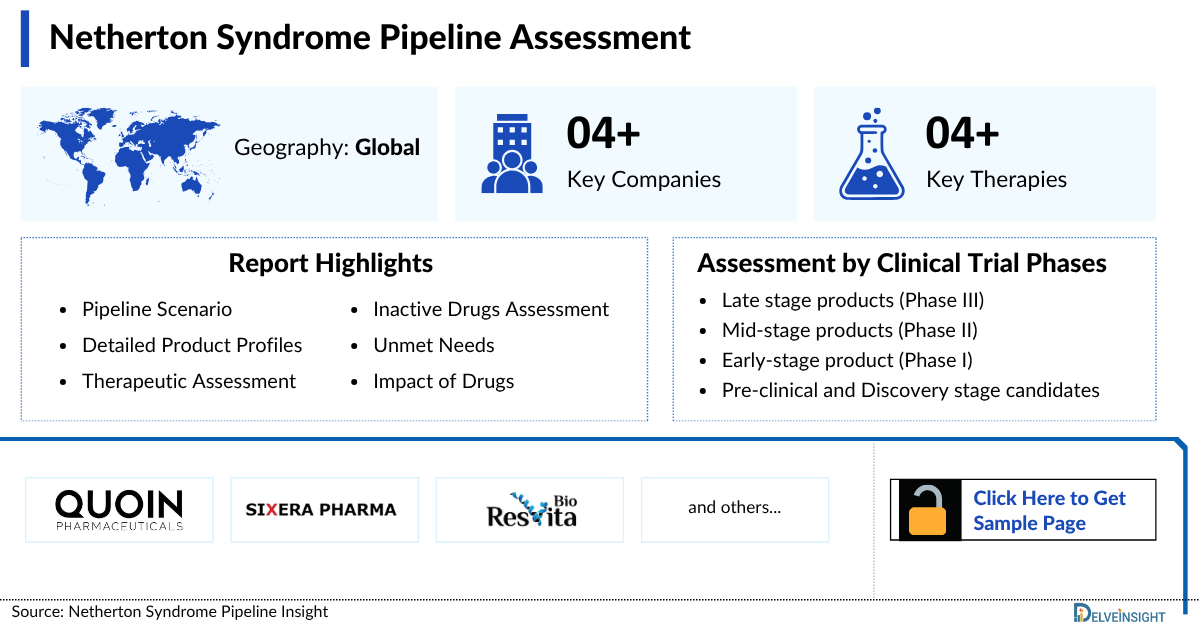
DelveInsight’s, “Netherton Syndrome Pipeline Insight, 2026” report provides comprehensive insights about 4+ companies and 4+ pipeline drugs in Netherton Syndrome pipeline landscape. It covers the pipeline drug profiles, including clinical and nonclinical stage products. It also covers the therapeutics assessment by product type, stage, route of administration, and molecule type. It further highlights the inactive pipeline products in this space.
Geography Covered
- Global coverage
Netherton Syndrome: Understanding
Netherton Syndrome: Overview
Netherton syndrome is a rare, severe autosomal recessive genodermatosis characterized by impaired skin barrier function, chronic inflammation, and atopic manifestations. It is caused by pathogenic variants in the SPINK5 gene, which encodes the serine protease inhibitor lymphoepithelial Kazal-type-related inhibitor (LEKTI). The disorder typically presents at birth or during early infancy with generalized erythroderma, recurrent skin infections, and failure to thrive.
Affected individuals often exhibit a lifelong predisposition to allergic diseases, including asthma, food allergies, allergic rhinitis, and elevated serum IgE levels. Although uncommon, the disease imposes significant morbidity due to persistent skin inflammation, infections, nutritional deficiencies, and reduced quality of life.
The hallmark clinical features include ichthyosis linearis circumflexa, diffuse scaling, severe pruritus, xerosis, and characteristic trichorrhexis invaginata ("bamboo hair"), which is highly suggestive of the diagnosis. Loss of LEKTI activity results in excessive activation of epidermal kallikrein proteases, leading to premature degradation of corneodesmosomes, defective epidermal differentiation, and disruption of the skin barrier. This protease imbalance also activates inflammatory pathways, including PAR-2 and Th2-mediated immune responses, promoting chronic cutaneous inflammation and increased susceptibility to allergens and microbial colonization. Diagnosis is based on clinical findings, microscopic hair shaft examination, histopathology when required, immunohistochemical assessment of LEKTI expression, and confirmation by SPINK5 genetic testing.
Management is primarily supportive and multidisciplinary because no universally approved curative therapy currently exists. Treatment focuses on restoring skin barrier function using intensive emollients, topical corticosteroids or calcineurin inhibitors, antiseptic measures, prompt treatment of infections, nutritional support, and careful management of allergic comorbidities. Selected patients with severe disease may benefit from systemic therapies such as intravenous immunoglobulin, retinoids, or biologic agents targeting type 2 inflammation, including dupilumab, although clinical responses remain variable. Emerging therapeutic strategies including topical recombinant LEKTI replacement, gene-based therapies, RNA-targeted approaches, and kallikrein protease inhibitors are under clinical investigation and aim to correct the underlying molecular defect rather than provide symptomatic relief alone.
"Netherton Syndrome- Pipeline Insight, 2026" report by DelveInsight outlays comprehensive insights of present scenario and growth prospects across the indication. A detailed picture of the Netherton Syndrome pipeline landscape is provided which includes the disease overview and Netherton Syndrome treatment guidelines. The assessment part of the report embraces, in depth Netherton Syndrome commercial assessment and clinical assessment of the pipeline products under development. In the report, detailed description of the drug is given which includes mechanism of action of the drug, clinical studies, NDA approvals (if any), and product development activities comprising the technology, Netherton Syndrome collaborations, licensing, mergers and acquisition, funding, designations and other product related details.
Report Highlights
- The companies and academics are working to assess challenges and seek opportunities that could influence Netherton Syndrome R&D. The therapies under development are focused on novel approaches to treat/improve Netherton Syndrome.
Netherton Syndrome Emerging Drugs Chapters
This segment of the Netherton Syndrome report encloses its detailed analysis of various drugs in different stages of clinical development, including Phase III, II, I, Preclinical and Discovery. It also helps to understand clinical trial details, expressive pharmacological action, agreements and collaborations, and the latest news and press releases.
Netherton Syndrome Emerging Drugs
QRX003: Quoin Pharmaceuticals
QRX003 (proposed brand name: QYLEKI™) is an investigational 4% topical lotion being developed by Quoin Pharmaceuticals for the treatment of Netherton syndrome, a rare genetic skin disorder caused by SPINK5 mutations. The therapy is designed to restore skin barrier function by locally inhibiting excessive serine protease activity, thereby reducing inflammation, skin scaling, erythema, pruritus, and transepidermal water loss. QRX003 is administered twice daily over affected skin and has demonstrated encouraging safety and clinical improvements in ongoing studies, including pediatric patients. The product has received Orphan Drug Designation (US, EU, Japan), as well as FDA Fast Track and Rare Pediatric Disease designations. Quoin's pivotal Phase III study is expected to initiate in the second half of 2026 and a potential NDA filing is anticipated in 2027. Currently, the drug is being studies in a Phase II/III clinical trial for the treatment of Netherton syndrome.
Further product details are provided in the report……..
Netherton Syndrome: Therapeutic Assessment
This segment of the report provides insights about the different Netherton Syndrome drugs segregated based on following parameters that define the scope of the report, such as:
- Major Players in Netherton Syndrome
- There are approx. 4+ key companies which are developing the therapies for Netherton Syndrome. The companies which have their Netherton Syndrome drug candidates in the mid stage, i.e. Phase II/III include, Quoin Pharmaceuticals.
- Phases
DelveInsight’s report covers around 4+ products under different phases of clinical development like
- Late stage products (Phase III)
- Mid-stage products (Phase II)
- Early-stage product (Phase I) along with the details of
- Pre-clinical and Discovery stage candidates
- Discontinued & Inactive candidates
- Route of Administration
Netherton Syndrome pipeline report provides the therapeutic assessment of the pipeline drugs by the Route of Administration. Products have been categorized under various ROAs such as
- Oral
- Intravenous
- Subcutaneous
- Parenteral
- Topical
- Molecule Type
Products have been categorized under various Molecule types such as
- Recombinant fusion proteins
- Small molecule
- Monoclonal antibody
- Peptide
- Polymer
- Gene therapy
- Product Type
Drugs have been categorized under various product types like Mono, Combination and Mono/Combination.
Netherton Syndrome: Pipeline Development Activities
The report provides insights into different therapeutic candidates in Phase III, II, I, preclinical and discovery stage. It also analyses Netherton Syndrome therapeutic drugs key players involved in developing key drugs.
Pipeline Development Activities
The report covers the detailed information of collaborations, acquisition and merger, licensing along with a thorough therapeutic assessment of emerging Netherton Syndrome drugs.
Netherton Syndrome Report Insights
- Netherton Syndrome Pipeline Analysis
- Therapeutic Assessment
- Unmet Needs
- Impact of Drugs
Netherton Syndrome Report Assessment
- Pipeline Product Profiles
- Therapeutic Assessment
- Pipeline Assessment
- Inactive drugs assessment
- Unmet Needs
Key Questions
Current Treatment Scenario and Emerging Therapies:
- How many companies are developing Netherton Syndrome drugs?
- How many Netherton Syndrome drugs are developed by each company?
- How many emerging drugs are in mid-stage, and late-stage of development for the treatment of Netherton Syndrome?
- What are the key collaborations (Industry–Industry, Industry–Academia), Mergers and acquisitions, licensing activities related to the Netherton Syndrome therapeutics?
- What are the recent trends, drug types and novel technologies developed to overcome the limitation of existing therapies?
- What are the clinical studies going on for Netherton Syndrome and their status?
- What are the key designations that have been granted to the emerging drugs?
Key Players
- Quoin Pharmaceuticals
- Sixera Pharma
- ResVita Bio
Key Products
- QRX003
- SXR1096
- RVB-003