
NurOwn Market Summary
Key Factors Driving NurOwn Growth
Market Share Gains and New Patient Starts
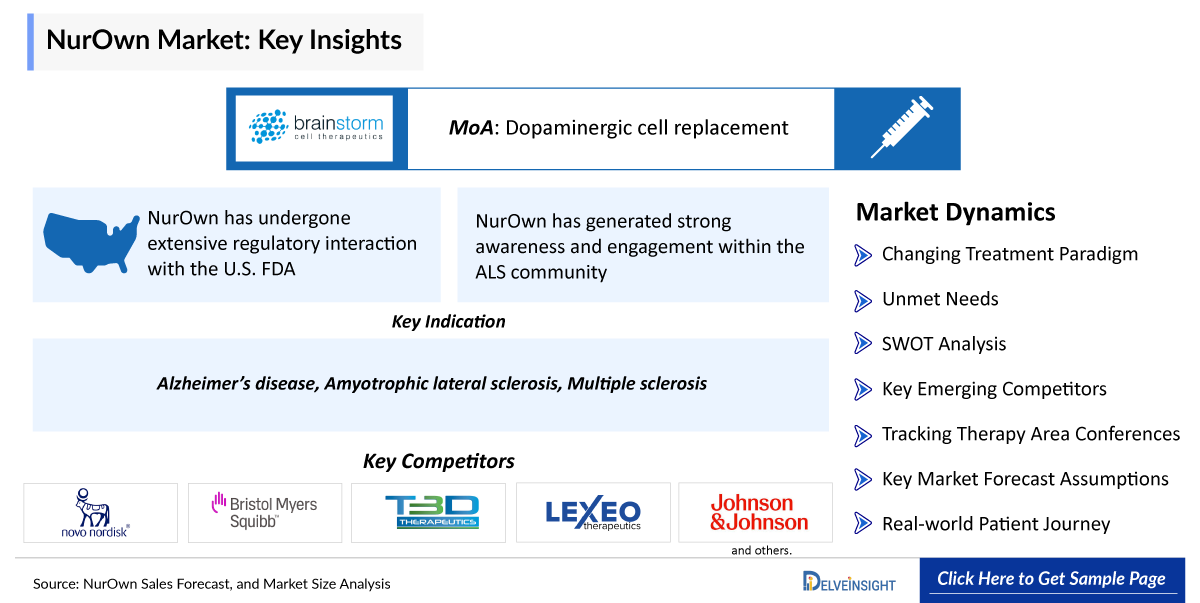
- NurOwn has generated strong awareness and engagement within the ALS community, driven by its novel autologous cell therapy approach and extensive clinical trial exposure.
- While not commercially launched, patient demand and trial participation have remained robust, reflecting high unmet need and willingness to pursue innovative therapies.
- Physician familiarity has increased, particularly among neuromuscular specialists and academic ALS centers involved in clinical studies and expanded-access discussions.
Expansion Across Key Indications
- Amyotrophic Lateral Sclerosis (ALS): Primary and most advanced indication, with clinical data suggesting potential benefit in specific patient subgroups.
- Progressive Neurodegenerative Disorders: The mechanism of action—neurotrophic factor secretion and neuroinflammation modulation—supports exploratory potential in other neurodegenerative diseases.
- Biomarker-Guided Subpopulation Strategy: Post-hoc analyses have highlighted signals in patients with elevated inflammatory biomarkers, informing future development focus.
- Pipeline evolution is expected to emphasize refined patient selection rather than broad label expansion.
Geographic Expansion
- Clinical development has been centered in the United States, supported by a strong ALS trial network and regulatory engagement.
- International interest has emerged from Europe and select global ALS research hubs, driven by advocacy groups and investigator-led collaborations.
- Future geographic expansion would depend on regulatory outcomes, funding, and strategic partnerships, rather than traditional commercial rollout.
New Indication and Regulatory Pathway Progress
- NurOwn has undergone extensive regulatory interaction with the U.S. FDA, including advisory committee review and discussions around alternative approval pathways.
- While broad approval has not been granted, regulators have shown openness to biomarker-supported and subgroup-based evidence in ALS.
- Any future regulatory strategy is expected to focus on well-defined responder populations, potentially leveraging accelerated or conditional frameworks.
Strong ALS Development Momentum
- ALS remains a high-priority, high-unmet-need therapeutic area, with limited disease-modifying options available.
- NurOwn continues to benefit from strong advocacy-driven momentum, including patient organizations actively supporting continued evaluation.
- Real-world disease registries and long-term follow-up datasets are increasingly important to contextualize NurOwn’s clinical findings.
Competitive Differentiation and Market Trends
- Autologous mesenchymal stem cell–derived therapy differentiates NurOwn from antisense oligonucleotides, gene therapies, and small molecules.
- Targets neuroinflammation and neuroprotection simultaneously, addressing multiple ALS disease pathways.
- Broader market trends toward personalized medicine, biomarker-driven treatment selection, and non-traditional regulatory endpoints align with NurOwn’s development strategy.
- Growing emphasis on patient-reported outcomes and real-world evidence supports continued interest despite regulatory challenges.
NurOwn Recent Developments
- With USFDA clearance secured, the Company is advancing key pre-initiation activities for the Phase IIIb clinical trial of NurOwn. The upcoming Phase IIIb ENDURANCE study, is expected to enroll approximately 200 participants at leading ALS centers. The trial will include a 24-week, randomized, double-blind, placebo-controlled period (Part A), followed by a 24-week open-label extension (Part B) to further assess long-term safety and durability of effect. The primary efficacy measure will be change from baseline to Week 24 on the ALSFRS-R. Data from Part A is expected to support a Biologics License Application (BLA).
- A Citizen Petition was filed with the FDA by representatives of the ALS community. The petition requests a renewed regulatory review of the data supporting NurOwn. BrainStorm acknowledges the petition as a constructive development that underscores the continued interest in NurOwn's potential therapeutic value. The Company did not participate in the drafting or submission of this petition.
“NurOwn Sales Forecast, and Market Size Analysis – 2034” report provides comprehensive insights of NurOwn for potential indication like Alzheimer's disease; Amyotrophic lateral sclerosis; Multiple sclerosis in the 7MM. A detailed picture of NurOwn’s existing usage in anticipated entry and performance in potential indications in the 7MM, i.e., the United States, EU4 (Germany, France, Italy, and Spain) and the United Kingdom, and Japan for the study period 2020 –2034 is provided in this report along with a detailed description of the NurOwn for potential indications. The NurOwn market report provides insights about NurOwn’s sales forecast, mechanism of action (MoA), dosage and administration, as well as research and development including regulatory milestones, along with other developmental activities. Further, it also consists of historical and current NurOwn performance, future market assessments inclusive of the NurOwn market forecast analysis for potential indications in the 7MM, SWOT, analysts’ views, comprehensive overview of market competitors, and brief about other emerging therapies in respective indications. It also provides analysis of NurOwn sales forecasts, along with factors driving its market.
NurOwn Drug Summary
NurOwn is an autologous cell therapy developed by BrainStorm Cell Therapeutics for amyotrophic lateral sclerosis (ALS), involving mesenchymal stem cells (MSCs) harvested from a patient's bone marrow, expanded ex vivo, and induced to secrete neurotrophic factors (MSC-NTF cells). These cells are administered via combined intrathecal and intramuscular injections to provide neuroprotection through factors like GDNF, BDNF, VEGF, HGF, and LIF, while modulating neuroinflammation via reduced MCP-1 and SDF-1, aiming to slow motor neuron degeneration and functional decline. Despite mixed Phase III results in 2022 (missing primary endpoint but positive in early-stage subgroups), it received FDA RMAT designation and is under evaluation in an ongoing Phase IIIb trial (NCT06973629) for early symptomatic ALS with moderate progression, dosed every 8 weeks. The report provides NurOwn’s sales, growth barriers and drivers, post usage and approvals in multiple indications.
Scope of the NurOwn Market Report
The report provides insights into:
- A comprehensive product overview including the NurOwn MoA, description, dosage and administration, research and development activities in potential indication like Alzheimer’s disease; Amyotrophic lateral sclerosis; Multiple sclerosis.
- Elaborated details on NurOwn regulatory milestones and other development activities have been provided in NurOwn market report.
- The report also highlights NurOwn‘s cost estimates and regional variations, reported and estimated sales performance, research and development activities in potential indications across the United States, Europe, and Japan.
- The NurOwn market report also covers the patents information, generic entry and impact on cost cut.
- The NurOwn market report contains current and forecasted NurOwn sales for potential indications till 2034.
- Comprehensive coverage of the late-stage emerging therapies for respective indications.
- The NurOwn market report also features the SWOT analysis with analyst views for NurOwn in potential indications.
Methodology
The NurOwn market report is built using data and information sourced primarily from internal databases, primary and secondary research and in-house analysis by DelveInsight’s team of industry experts. Information and data from the secondary sources have been obtained from various printable and nonprintable sources like search engines, news websites, global regulatory authorities websites, trade journals, white papers, magazines, books, trade associations, industry associations, industry portals and access to available databases.
NurOwn Analytical Perspective by DelveInsight
In-depth NurOwn Market Assessment
This NurOwn sales market forecast report provides a detailed market assessment of NurOwn for potential indication like Alzheimer’s disease; Amyotrophic lateral sclerosis; Multiple sclerosis in the seven major markets, i.e., the United States, EU4 (Germany, France, Italy, and Spain) and the United Kingdom, and Japan. This segment of the report provides current and forecasted NurOwn sales data uptil 2034.
NurOwn Clinical Assessment
The NurOwn market report provides the clinical trials information of NurOwn for potential indications covering trial interventions, trial conditions, trial status, start and completion dates.
NurOwn Competitive Landscape
The report provides Insights on competitors and marketed products within the domain, along with a summary of emerging products and their respective launch dates, posing significant competition in the market.
NurOwn Market Potential & Revenue Forecast
- Projected market size for the NurOwn and its key indications
- Estimated NurOwn sales potential (NurOwn peak sales forecasts)
- NurOwn Pricing strategies and reimbursement landscape
NurOwn Competitive Intelligence
- Number of competing drugs in development (pipeline analysis)
- NurOwn Market positioning compared to existing treatments
- NurOwn Strengths & weaknesses relative to competitors
NurOwn Regulatory & Commercial Milestones
- NurOwn Key regulatory approvals & expected launch timelines
- Commercial partnerships, licensing deals, and M&A activity
NurOwn Clinical Differentiation
- NurOwn Efficacy & safety advantages over existing drugs
- NurOwn Unique selling points
NurOwn Market Report Highlights
- In the coming years, the NurOwn market scenario is set to change due to strong adoption, increased prescriptions and broader uptake in multiple immunological indications; which would expand the size of the market.
- The NurOwn companies are developing therapies that focus on novel approaches to treat/improve the disease condition, assess challenges, and seek opportunities that could influence NurOwn’s dominance.
- Other emerging products for Alzheimer's disease; Amyotrophic lateral sclerosis; Multiple sclerosis are expected to give tough market competition to NurOwn and launch of late-stage emerging therapies in the near future will significantly impact the market.
- A detailed description of regulatory milestones, and developmental activities, provide the current development scenario of NurOwn in potential indications.
- Analyse NurOwn cost, pricing trends and market positioning to support strategic decision-making in the immunology landscape.
- Our in-depth analysis of the forecasted NurOwn sales data uptil 2034 will support the clients in decision-making process regarding their therapeutic portfolio by identifying the overall scenario of NurOwn in potential indications.
Key Questions
- What is the class of therapy, route of administration and mechanism of action of NurOwn? How strong is NurOwn’s clinical and commercial performance?
- What is NurOwn’s clinical trial status in each individual indications such as Alzheimer’s disease; Amyotrophic lateral sclerosis; Multiple sclerosis and study completion date?
- What are the key collaborations, mergers and acquisitions, licensing and other activities related to the NurOwn Manufacturers?
- What are the key designations that have been granted to NurOwn for potential indications? How are they going to impact NurOwn’s penetration in various geographies?
- What is the current and forecasted NurOwn market scenario for potential indications? What are the key assumptions behind the forecast?
- What are the current and forecasted sales of NurOwn in the seven major countries, including the United States, Europe (Germany, France, Italy, Spain) and the United Kingdom, and Japan?
- What are the other emerging products available and how are these giving competition to NurOwn for potential indications?
- Which are the late-stage emerging therapies under development for the treatment of potential indications?
- How cost-effective is NurOwn? What is the duration of therapy and what are the geographical variations in cost per patient?