
Obsessive Compulsive Disorder Market Summary
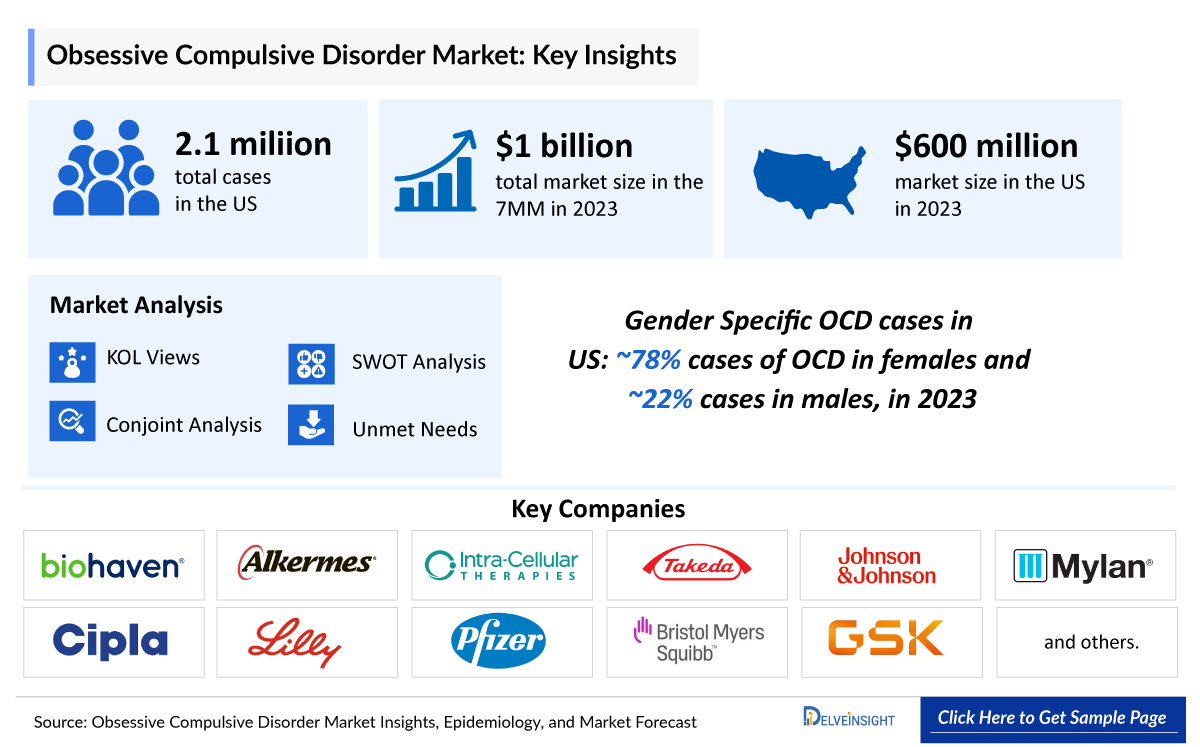
- In 2023, the overall Obsessive Compulsive Disorder market size across the 7MM was estimated at approximately USD 1,096 million and is anticipated to expand at a significant CAGR, reaching a substantial value by 2034.
- In 2023, the United States held the largest share of the Obsessive Compulsive Disorder (OCD) market among the 7MM, valued at around USD 606 million, and is projected to grow at a notable CAGR during the forecast period.
- The Obsessive Compulsive Disorder companies developing therapies include - Biohaven Pharmaceutical Holding Company Ltd., Alkermes plc, Intra-Cellular Therapies, Inc., Takeda Pharmaceutical Company Limited, Johnson & Johnson, Mylan N.V., Cipla Limited, Eli Lilly and Company, Pfizer Inc., Bristol-Myers Squibb Company, GlaxoSmithKline plc, Lundbeck A/S, Otsuka Pharmaceutical Co., Ltd., H. Lundbeck A/S, Neurocrine Biosciences Inc., Impel NeuroPharma, Janssen Pharmaceuticals, Inc. (a subsidiary of Johnson & Johnson), Novartis International AG, Sun Pharmaceutical Industries Ltd., Allergan plc (now part of AbbVie Inc.), and others.
Obsessive Compulsive Disorder Market & Epidemiology Insights
- In 2023, the total prevalent cases of OCD were ~12,125 thousand cases in the 7MM. These cases are expected to increase by 2034.
- In 2023, the total diagnosed cases of OCD were ~7,299 thousand cases in 7MM. These cases are expected to increase by the year 2034.
- Among the EU4 countries and the UK, the highest number of diagnosed cases of OCD were found in Germany, i.e., ~1,305 thousand cases in the year 2023, which are estimated to increase by the year 2034.
- In 2023, total diagnosed prevalent cases in Japan were ~1,168 thousand cases of OCD, which was approximately 16% of the total OCD cases in 7MM.
- In 2023, US accounted for ~319 thousand cases of mild OCD whereas, ~1,106 thousand cases of severe OCD were observed for the severity-specific cases of OCD.
- In 2023, Germany accounted for ~191 thousand cases of mild OCD and ~660 thousand cases of severe OCD were observed for the severity-specific cases of OCD.
- Current Obsessive Compulsive Disorder Treatment includes FDA-approved drugs such as, Sertraline (ZOLOFT), fluoxetine (PROZAC), fluvoxamine (LUVOX), paroxetine (PAXIL), and clomipramine (ANAFRANIL) paroxetine mesylate (PEXEVA).
- According to Delveinsight’s analysis, BHV-4157 (troriluzole) is expected to become highest contributing drug in Obsessive Compulsive Disorder Drugs Market, during the forecast period (2024-2034).
- The Obsessive Compulsive Disorder Market Dynamics are anticipated to change in the coming years owing to the improvement in disease understanding and pathophysiology. Biohaven Pharmaceuticals is investigating its drug candidate, troriluzole, for treating OCD.
Request for Unlocking the Sample Page of the "Obsessive Compulsive Disorder Drugs Market"
Key Factors Driving Obsessive Compulsive Disorder Market:
- Rising prevalence and diagnosis rates: Growing awareness of mental health disorders and improved screening are increasing diagnosed OCD patient populations globally.
- Advancements in pharmacological and digital therapies: Development of novel drug classes, combination therapies, and digital therapeutics is expanding treatment options.
- Increasing mental health awareness and reduced stigma: Public health initiatives and education campaigns are encouraging more patients to seek timely treatment.
- Growing healthcare spending and access to care: Improved insurance coverage and expansion of mental health services are supporting higher treatment uptake.
- Strong research focus and pipeline activity: Ongoing clinical trials and innovation in neuropsychiatric research are driving long-term market growth.
DelveInsight’s “Obsessive Compulsive Disorder Treatment Market Insights, Epidemiology and Market Forecast – 2034” report delivers an in-depth understanding of the Obsessive Compulsive Disorder, historical and forecasted epidemiology as well as the Obsessive Compulsive Disorder Therapeutics Market trends in the United States, EU4 (Germany, Spain, Italy, and France) and the United Kingdom, and Japan.
The table given below further depicts the key segments provided in the report:
Scope of the Obsessive Compulsive Disorder Market | |
|
Study Period |
2020 to 2034 |
|
Forecast Period |
2024-2034 |
|
Geographies Covered |
|
|
Obsessive Compulsive Disorder Drugs Market |
|
|
Obsessive Compulsive Disorder Market Size | |
|
Obsessive Compulsive Disorder Companies |
Biohaven Pharmaceutical Holding Company Ltd., Alkermes plc, Intra-Cellular Therapies, Inc., Takeda Pharmaceutical Company Limited, Johnson & Johnson, Mylan N.V., Cipla Limited, Eli Lilly and Company, Pfizer Inc., Bristol-Myers Squibb Company, GlaxoSmithKline plc, Lundbeck A/S, Otsuka Pharmaceutical Co., Ltd., H. Lundbeck A/S, Neurocrine Biosciences Inc., Impel NeuroPharma, Janssen Pharmaceuticals, Inc. (a subsidiary of Johnson & Johnson), Novartis International AG, Sun Pharmaceutical Industries Ltd., Allergan plc (now part of AbbVie Inc.), and others. |
|
Obsessive Compulsive Disorder Epidemiology Segmentation |
|
Obsessive Compulsive Disorder Disease Understanding
Obsessive Compulsive Disorder (OCD) is a mental health disorder characterized by obsessions, which are unwanted, intrusive, and persistent thoughts, images, or urges that cause anxiety or distress, and compulsions, which are repetitive behaviors or mental acts that a person feels compelled to perform in response to the obsessions or to prevent the feared outcome. OCD affects people of all ages, genders, and ethnicities and can significantly impact their daily lives, relationships, and functioning. Some common obsessions in OCD include contamination or germs, fears of harm or injury to oneself or others, symmetry or order, and religious or moral issues. Compulsions may include excessive cleaning or hand washing, checking behaviors (such as checking doors or appliances), counting, and repeating phrases or prayers, or mental rituals (such as reviewing past events or praying).
Obsessive Compulsive Disorder Diagnosis
Obsessive Compulsive Disorder Diagnosing requires a thorough evaluation by a mental health professional like a psychiatrist, psychologist, or clinical social worker. It involves clinical assessment, symptom evaluation, and excluding other possible causes. The following are the steps involved in Obsessive Compulsive Disorder diagnosing:
- Interview: A mental health professional will conduct a thorough interview with the patient to gather information about their symptoms, medical history, and family history.
- Symptom assessment: The mental health professional will ask the patient about their specific obsessions and compulsions and the severity and frequency of these symptoms. They may also use standardized questionnaires or assessments to gather more detailed information about the patient’s symptoms.
- Ruling out other conditions: The mental health professional may also conduct a physical exam and order laboratory tests to rule out other medical conditions that could be causing the patient’s symptoms. They may also assess for other mental health disorders that can co-occur with OCD, such as depression, anxiety disorders, or tic disorders such as Tourette syndrome.
- Diagnostic criteria: The mental health professional will use the diagnostic criteria outlined in the Diagnostic and Statistical Manual of Mental Disorders (DSM-5) to determine whether the patient meets the criteria for a Obsessive Compulsive Disorder diagnosis.
Further details related to country-based variations are provided in the report…
Obsessive Compulsive Disorder Treatment
Obsessive Compulsive Disorder Treatment comprises several components, starting with building a therapeutic alliance with the patient and psychoeducation. Then, psychological and/or pharmacological approaches, and, for patients with treatment-resistant OCD, neuro-modulation and neurosurgery. Alternative interventions have also attracted interest but require more evidence. Although general principles of management exist, they need to be individually tailored. Thus, for example, some comorbid conditions (such as depression) respond to first-line OCD pharmacotherapies, whereas others (such as bipolar disorder) might require additional interventions.
Obsessive Compulsive Disorder Epidemiology
The OCD epidemiology chapter in the report provides historical as well as forecasted epidemiology segmented by total Obsessive Compulsive Disorder Prevalent Cases, total diagnosed Obsessive Compulsive Disorder cases, Obsessive Compulsive Disorder Gene Mutation-Specific Cases, Obsessive Compulsive Disorder Severity-Specific Cases, Obsessive Compulsive Disorder Age-Specific Cases in the United States, EU4 countries (Germany, France, Italy, Spain) and the United Kingdom, and Japan from 2020 to 2034.
Key Findings from Obsessive Compulsive Disorder Epidemiological Analyses and Forecast
- In 2023, the total prevalent cases of OCD were ~12,125 thousand cases in the 7MM. These cases are expected to increase by 2034.
- In 2023, the total diagnosed cases of OCD were ~7,299 thousand cases in 7MM. These cases are expected to increase by the year 2034.
- Among the EU4 countries and the UK, the highest number of diagnosed cases of OCD were found in Germany, i.e., ~1,305 thousand cases in the year 2023, which are estimated to increase by the year 2034.
- In 2023, total diagnosed prevalent cases in Japan were ~1,168 thousand cases of OCD, which was approximately 16% of the total OCD cases in 7MM.
- In 2023, US accounted for ~319 thousand cases of mild OCD whereas, ~1,106 thousand cases of severe OCD were observed for the severity-specific cases of OCD.
- In 2023, Germany accounted for ~191 thousand cases of mild OCD and ~660 thousand cases of severe OCD were observed for the severity-specific cases of OCD.
- In 2023, the least number of age-specific diagnosed prevalent cases of OCD were observed in the age group, 60 and above, whereas the 30–44 years age group accounted for the highest number of cases of OCD in France.
- In the UK, out of the total prevalent cases, ~101 thousand cases and ~360 thousand cases of OCD were found in males and females, respectively in 2023. These cases are expected to increase by 2034.
Obsessive Compulsive Disorder Epidemiology Segmentation
- Total Prevalent Cases of Obsessive Compulsive Disorder in the 7MM
- Total Diagnosed Cases of Obsessive Compulsive Disorder in the 7MM
- Gender-specific Cases of Obsessive Compulsive Disorder in the 7MM
- Severity-specific Cases of Obsessive Compulsive Disorder in the 7MM
- Age-specific Cases of Obsessive Compulsive Disorder
Obsessive Compulsive Disorder Recent Developments
- In August 2025, neurocare group AG received FDA clearance for its Apollo TMS Therapy device to treat Obsessive Compulsive Disorder (OCD), expanding non-invasive mental health treatment options.
Obsessive Compulsive Disorder Drug Analysis
The section dedicated to drugs in the Obsessive Compulsive Disorder Drugs Market Report provides an in-depth evaluation of late-stage Obsessive Compulsive Disorder Pipeline Drugs (Phase III) related to OCD. The drug chapters section provides valuable information on various aspects related to Obsessive Compulsive Disorder Clinical Trials, such as the pharmacological mechanisms of the drugs involved, designations, approval status, patent information, and a comprehensive analysis of the pros and cons associated with each drug.
Obsessive Compulsive Disorder Emerging Therapies
-
Troriluzole: Biohaven Pharmaceuticals
Troriluzole is a new chemical entity (“NCE”) and tripeptide prodrug of the active metabolite, riluzole. Troriluzole is optimized for improved bioavailability, pharmacokinetics, tolerability, and dosing compared to its active metabolite. Based on its Obsessive Compulsive Disorder Mechanism of Action, preclinical data, and Obsessive Compulsive Disorder Clinical Trials, troriluzole has the potential for therapeutic benefit in neurological and neuropsychiatric illnesses.
Troriluzole has the potential to be developed in a number of other diseases associated with excessive glutamate. The rationale for the use of troriluzole in OCD is supported by clinical data with its active metabolite, riluzole, in populations with Obsessive Compulsive Disorder in open-label and placebo-controlled Obsessive Compulsive Disorder Clinical Trials as well as in preclinical, genetic, and neuroimaging studies implicating the glutamatergic hyperactivity in the Obsessive Compulsive Disorder Pathogenesis.
Obsessive Compulsive Disorder Market Outlook
OCD can be treated using pharmacotherapy, specialized psychotherapy, anatomically targeted treatments, or their combination. First-line treatments include cognitive-behavioral therapy and pharmacotherapy with the selective serotonin reuptake inhibitors (SSRIs). In this article we review evidence-based pharmacotherapies for OCD, as well as alternatives that may be considered in refractory patients. Other treatment modalities are reviewed in other articles in this issue. Unfortunately, even with optimal treatment, many patients continue to experience significant symptoms. Remission of moderate or severe OCD is uncommon, and long-term management is often necessary. The development of new, more effective treatment interventions represents an urgent clinical need.
Many new molecules with novel mechanisms, like SSRI, Serotonin uptake inhibitor, Glutamate release inhibitor among others, are being developed for the Obsessive Compulsive Disorder Treatment by key OCD Companies such as Jazz Pharmaceuticals, Eli Lilly and Company, Biohaven, Spec GX (Mallinckrodt), Apotex among others.
In conclusion, despite the lack of appropriate treatment in the current Obsessive Compulsive Disorder Treatment Market Landscape, potential therapies with novel mechanisms are expected to enter the market, resolving a dire unmet need and leading to significant improvement in the treatment outcome of Obsessive Compulsive Disorder Patients. Hence, with the upcoming availability of new treatment options and increasing healthcare spending across the 7MM, the treatment scenario is expected to experience significant growth during the forecast period (2024–2034).
Obsessive Compulsive Disorder Market Insights
Various key Obsessive Compulsive Disorder Companies such as Jazz Pharmaceuticals, Eli Lilly and Company, Biohaven, Spec GX (Mallinckrodt), Apotex and others. The details of the country-wise and therapy-wise market size have been provided below.
- The total market size of Obsessive Compulsive Disorder in the 7MM was approximately USD 1,096 million in 2023. It is expected to grow at a significant CAGR, reaching a notable value by the end of 2034.
- In 2023, the market size of Obsessive Compulsive Disorder was highest in the US among the 7MM accounting for approximately USD 606 million that is further expected to increase at a significant CAGR throughout the forecast period.
- According to DelveInsight’s analysts, the total EU4 and the UK market size of OCD was found to be ~USD 382 million in 2023, which is further expected to increase in the forecast period (2024–2034).
- Among the European countries, Germany had the highest market size with nearly USD 125 million in 2023, while the UK had the lowest market size of OCD with ~USD 44 million in 2023.
- The market size for OCD in Japan was approximately 10% of the total market of the 7MM, and it is anticipated to rise by 2034.
Obsessive Compulsive Disorder Competitive Landscape
The OCD market is characterized by a mix of established therapies and emerging pipeline candidates targeting unmet needs in both adult and pediatric populations. Key players include Eli Lilly, Pfizer, Johnson & Johnson (Janssen), Takeda, Otsuka Pharmaceutical, and Lundbeck, among others.
- Approved Drugs: Current treatments focus on SSRIs (e.g., fluoxetine, sertraline, fluvoxamine), clomipramine, and adjunctive antipsychotics for resistant cases.
- Emerging Therapies: Novel mechanisms, including glutamatergic modulators, NMDA receptor antagonists, and digital therapeutics, are under investigation to enhance efficacy and safety.
- Market Dynamics: Companies compete on efficacy, safety profile, patient adherence, and innovative delivery methods. Partnerships, licensing deals, and clinical trial advancements shape the competitive environment.
- Pipeline Focus: Research emphasizes treatment-resistant OCD, pediatric OCD, and rapid-acting agents with fewer side effects.
Key Obsessive Compulsive Disorder Companies
The Key Obsessive Compulsive Disorder companies actively involved in the Obsessive Compulsive Disorder treatment landscape include -
- Biohaven Pharmaceutical Holding Company Ltd.
- Alkermes plc
- Intra-Cellular Therapies, Inc.
- Takeda Pharmaceutical Company Limited
- Johnson & Johnson
- Mylan N.V.
- Cipla Limited
- Eli Lilly and Company
- Pfizer Inc.
- Bristol-Myers Squibb Company
- GlaxoSmithKline plc
- Lundbeck A/S
- Otsuka Pharmaceutical Co., Ltd.
- H. Lundbeck A/S
- Neurocrine Biosciences Inc.
- Impel NeuroPharma
- Janssen Pharmaceuticals, Inc. (a subsidiary of Johnson & Johnson)
- Novartis International AG
- Sun Pharmaceutical Industries Ltd.
- Allergan plc (now part of AbbVie Inc.), and others
Latest KOL Views on Obsessive Compulsive Disorder Market Report
To stay abreast of the latest trends in the Obsessive Compulsive Disorder Drugs Market, we conduct primary research by seeking the opinions of Key Opinion Leaders (KOLs) and Subject Matter Experts (SMEs) who work in the relevant field. This helps us fill any gaps in data and validate our secondary research. We have reached out to industry experts to gather insights on various aspects of OCD, including the evolving treatment landscape, patients’ reliance on conventional therapies, their acceptance of therapy switching, drug uptake, and challenges related to accessibility. The experts we contacted included medical/scientific writers, professors, and researchers from prestigious universities in the US, Europe, the UK, and Japan.
Our team of analysts at Delve insight connected with more than 15 KOLs across the 7MM. We contacted institutions such as the Osaka City University Medical School, Institute of Psychiatry, University of Lubeck, Harvard Medical School, etc., among others. By obtaining the opinions of these experts, we gained a better understanding of the current and emerging treatment patterns in the Obsessive Compulsive Disorder Drugs Market, which will assist our clients in analysing the overall epidemiology and market scenario.
Obsessive Compulsive Disorder Pipeline Drugs Market: Qualitative Analysis
We perform Qualitative and Obsessive Compulsive Disorder Pipeline Drugs Market Intelligence analysis using various approaches, such as SWOT analysis and Conjoint Analysis. In the SWOT analysis, strengths, weaknesses, opportunities, and threats in terms of disease diagnosis, patient awareness, patient burden, competitive landscape, cost-effectiveness, and geographical accessibility of therapies are provided. These pointers are based on the Analyst’s discretion and assessment of the patient burden, cost analysis, and existing and evolving Obsessive Compulsive Disorder Treatment Market landscape.
Conjoint Analysis analyses multiple approved and emerging therapies based on relevant attributes such as safety, efficacy, frequency of administration, designation, route of administration, and order of entry. Scoring is given based on these parameters to analyse the effectiveness of therapy. Further, the therapies’ safety is evaluated wherein the acceptability, tolerability, and adverse events are majorly observed, and it sets a clear understanding of the side effects posed by the drug in the trials. In addition, the scoring is also based on the route of administration, order of entry and designation, probability of success, and the addressable patient pool for each therapy. According to these parameters, a final weightage score is decided, based on which the emerging therapies are ranked.
Obsessive Compulsive Disorder Pipeline Drugs Market Access and Reimbursement
Because newly authorized Obsessive Compulsive Disorder Pipeline Drugs are often expensive, some patients escape receiving proper treatment or use off-label, less expensive prescriptions. Reimbursement plays a critical role in how innovative treatments can enter the Obsessive Compulsive Disorder Drugs market. The cost of the medicine, compared to the benefit it provides to patients who are being treated, sometimes determines whether or not it will be reimbursed. Regulatory status, target population size, the setting of treatment, unmet needs, the number of incremental benefit claims, and prices can all affect market access and reimbursement possibilities.
The Obsessive Compulsive Disorder Drugs Market Report further provides detailed insights on the country-wise accessibility and reimbursement scenarios, cost-effectiveness scenario of approved therapies, programs making accessibility easier and out-of-pocket costs more affordable, insights on patients insured under federal or state government prescription drug programs, etc.
Obsessive Compulsive Disorder Drugs Market Report Summary
- The Obsessive Compulsive Disorder Drugs Market Report offers extensive knowledge regarding the epidemiology segments and predictions, presenting a deep understanding of the potential future growth in diagnosis rates, disease progression, and treatment guidelines. It provides comprehensive insights into these aspects, enabling a thorough assessment of the subject matter.
- Additionally, an all-inclusive account of the current management techniques and emerging therapies and the elaborative profiles of late-stage (Phase III and Phase II) and prominent therapies that would impact the current Obsessive Compulsive Disorder Treatment Market Landscape and result in an overall Obsessive Compulsive Disorder drugs market shift has been provided in the report.
- The report also encompasses a comprehensive analysis of the Obsessive Compulsive Disorder Drugs Market, providing an in-depth examination of its historical and projected market size (2020 – 2034). It also includes the Obsessive Compulsive Disorder drugs market share of therapies, detailed assumptions, and the underlying rationale for our methodology. The Obsessive Compulsive Disorder treatment market report also includes drug outreach coverage in the 7MM region.
- The Obsessive Compulsive Disorder Drugs Market Report includes qualitative insights that provide an edge while developing business strategies, by understanding trends, through SWOT analysis and expert insights/KOL views, including experts from various hospitals and prominent universities, patient journey, and treatment preferences that help shape and drive the 7MM Obsessive Compulsive Disorder Treatment Market.
Obsessive Compulsive Disorder Therapeutics Market Report Insights
- Patient-based Obsessive Compulsive Disorder Market Forecasting
- Obsessive Compulsive Disorder Therapeutics Market Approaches
- Obsessive Compulsive Disorder Treatment Market Size and Trends
- Existing Obsessive Compulsive Disorder Drugs Market Opportunity
Obsessive Compulsive Therapeutics Market Disorder Report Key Strengths
- 11-year Obsessive Compulsive Disorder Market Forecast
- The 7MM Coverage
- Obsessive Compulsive Disorder Epidemiology Segmentation
- Key Cross Competition
Obsessive Compulsive Disorder Therapeutics Market Report Assessment
- Current Obsessive Compulsive Disorder Treatment Market Practices
- Obsessive Compulsive Disorder Market Reimbursements
- Obsessive Compulsive Disorder Clinical Trials Market Attractiveness
- Qualitative Analysis (SWOT, Unmet needs)
- Obsessive Compulsive Disorder Market Drivers
- Obsessive Compulsive Disorder Market Barriers
Key Questions Answered In The OCS Market Report:
- Would there be any changes observed in the current treatment approach?
- Will there be any improvements in Obsessive Compulsive Disorder management recommendations?
- Would research and development advances pave the way for future tests and therapies for Obsessive Compulsive Disorder?
- Would the diagnostic testing space experience a significant impact and lead to a positive shift in the Obsessive Compulsive Disorder treatment market landscape?
- What kind of uptake will the new therapies witness in coming years in Obsessive Compulsive Disorder patients?
Stay Updated with us for Recent Articles