Osteoarthritis Market Insights and Trends
- Osteoarthritis is closely associated with age, as radiographic evidence of osteoarthritis occurs in most people by age 65 years and in more than 75% of people older than age 75 years. Although many associations and mechanisms are not well understood, it has been reported that there is a higher prevalence of osteoarthritis among older women.
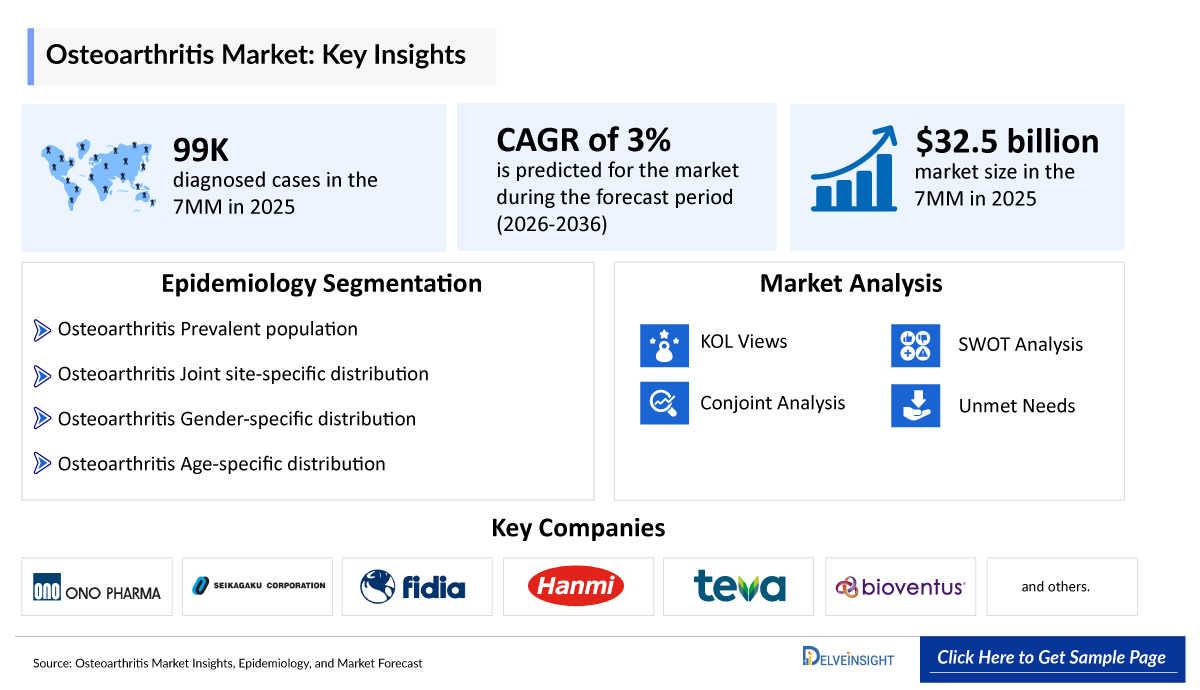
- According to DelveInsight’s analysis, the Osteoarthritis market size was found to be ~32,500 million in the leading markets (the United States, the EU4 (Germany, France, Italy, and Spain), the United Kingdom, and Japan) in 2025.
- Currently, the classes used for the treatment of osteoarthritis include NSAIDs, Opioids, Intra Articular-Corticosteroids, Intra Articular-Hyaluronic acid, and others. FDA-approved hyaluronate products for knee OA comprise SUPARTZ, ORTHOVISC, EUFLEXXA, and GEL-ONE. ZILRETTA, approved in October 2017, is a corticosteroid that demonstrated significant pain reduction in its Pivotal Phase III trial for knee OA.
- Emerging therapies for osteoarthritis include novel agents such as TRPV1 receptor agonists, pan-CLK/DYRK inhibitors, stem cell-based approaches, GLP-1 receptor agonists, selective COX-2 inhibitors, and others. Prominent pipeline candidates include LEVI-04 (Levicept), ZILOSUL (pentosan polysulfate sodium; Paradigm Biopharmaceuticals), TissueGene-C (TG-C; Kolon TissueGene), AMZ001 (Amzell), and SAR446959 (Sanofi)
- JTA-004, an intra-articular osteoarthritis treatment from BioSenic, failed its Phase III trial overall but showed promising post-hoc benefits in severe, inflammatory type-3 osteoarthritis, and is now available for potential out-licensing.
- Resiniferatoxin, a potent TRPV1 agonist acquired from Mestex, failed to meet primary endpoints in two Phase III osteoarthritis pain trials, leading Grünenthal to end the program after completing its ongoing safety study in 2025.
- Mild-to-moderate knee osteoarthritis that is resistant to conservative treatment but is not yet severe enough to warrant joint replacement represents a specific management challenge and a huge unmet need.
Osteoarthritis Market Size and Forecast in the 7MM
- 2025 Osteoarthritis Market Size: ~USD 32,500 million
- 2036 Projected Osteoarthritis Market Size: ~USD 47,000 million
- Osteoarthritis Growth Rate (2026–2036): 3% CAGR
Learn more about disease-modifying therapies for osteoarthritis @ Osteoarthritis Treatment Market
DelveInsight’s “Osteoarthritis – Market Insights, Epidemiology, and Market Forecast – 2036” report delivers an in-depth understanding of Osteoarthritis, historical and forecasted epidemiology as well as Osteoarthritis market trends in the United States, EU4 (Germany, France, Italy, and Spain) and the United Kingdom, and Japan.
The Osteoarthritis market report provides current treatment practices, emerging drugs, market share of individual therapies, and current and forecasted 7MM Osteoarthritis market size from 2022 to 2036. The report also covers current Osteoarthritis treatment practices/algorithms and unmet medical needs to curate the best opportunities and assess the market’s potential.
|
Study Period |
2022–2036 |
|
Historical Year |
2022–2025 |
|
Forecast Period |
2026-2036 |
|
Geographies Covered |
|
|
Osteoarthritis Market CAGR (Forecast period) |
3% (2026–2036) |
|
Osteoarthritis Epidemiology Segmentation Analysis |
Patient Burden Assessment
|
|
Osteoarthritis Key Companies |
|
|
Osteoarthritis Key Therapies |
|
|
Osteoarthritis Market |
Segmented by
|
|
Analysis
|
|
Key Factors Driving the Osteoarthritis Market
Rising Global Disease Burden:
Osteoarthritis represents a significant and growing global health burden, driven by aging populations, increasing obesity rates, and lifestyle factors, leading to a high prevalence of chronic pain and disability worldwide. This expanding patient pool and long-term disease management needs are driving sustained demand for effective symptomatic and disease-modifying therapies.
Emerging Opportunities in Osteoarthritis:
The osteoarthritis landscape is evolving with advancements in disease-modifying therapies, regenerative medicine approaches, and novel pain management options, alongside improved imaging and diagnostic tools. Increasing research focus, growing investments by biopharma companies, and heightened awareness of unmet needs are accelerating innovation and creating new opportunities in the Osteoarthritis treatment market.
Osteoarthritis Understanding and Treatment Algorithm
Osteoarthritis Overview and Diagnosis
Osteoarthritis is the most common form of arthritis and a chronic, degenerative joint disease that primarily affects middle-aged and older adults, characterized by the progressive breakdown of joint cartilage, most commonly in the hands, knees, hips, and spine; it is classified into primary and secondary types and progresses through stages from 0 (normal) to 4 (severe). Diagnosis of Osteoarthritis does not rely on a single definitive laboratory test but instead involves a combination of clinical evaluation and diagnostic tools, where blood tests such as CBC, ESR, rheumatoid factor, and ANA are typically normal, while imaging techniques like X-rays and ultrasound help confirm structural changes such as cartilage loss, osteophytes, synovial inflammation, and joint effusion.
Further details are provided in the report.
Osteoarthritis Treatment Landscape
Osteoarthritis is a progressive and degenerative condition, with unlikely regression and restoration of damaged structures. Thus, current management modalities are targeted towards symptom control unless the degree of severity dictates the necessity of surgical intervention with joint replacement. The Current treatment of Osteoarthritis includes Nonsteroidal anti-inflammatory drugs (NSAIDS), Arcoxia (Etoricoxib), Opioids, currently DUROLANE, GELSYN-3, CINGAL, JOYCLU, and others.
Further details related to country-based variations are provided in the report.
Osteoarthritis Unmet Needs
The section “unmet needs of Osteoarthritis” outlines the critical gaps between the current state of patient care, diagnosis, and the ideal & effective management of the disease. It highlights the obstacles experienced by patients, clinicians, and researchers and identifies potential solutions for future progress.
- Need for developing the ability to phenotype and stratify patients for inclusion in clinical trials
- Challenging diagnosis
- High disease burden & economic impact
- Insufficient knowledge regarding the disease paradigm, and others…..
Note: Comprehensive unmet needs insights in Osteoarthritis and their strategic implications are provided in the full report.
Osteoarthritis Epidemiology
Key Findings from Osteoarthritis Epidemiology Analysis and Forecast
- As per the study by Nalamachu et al. (2020), 41%, 37%, and 22% of the patients with knee osteoarthritis were reported for mild, moderate, and severe pain, respectively, in the US.
- In a study by Schild et al. (2021), patient-level data was extracted from the German Institut für Angewandte Gesundheitsforschung (InGef) database. Of 4,932,543 individuals sampled, 238,306 patients with osteoarthritis were included in the analysis: 80,055 (34%) categorised as having chronic pain (24,463 via opioid prescription) and 158,251 (66%) categorised as not having chronic pain.
- Osteoarthritis is one of the most common chronic diseases in the elderly population, contributing approximately 90–95% of all osteoarthritis cases (people above 40), and its prevalence increases with age.
- It is estimated that the number of cases of osteoarthritis will rise in the coming years because of the rising aging population and obesity, affecting the total pool of knee osteoarthritis.
- In 2025, the total number of diagnosed cases of osteoarthritis was around 99,000 cases in the 7MM, which is anticipated to increase during the forecast period [2026–2036].
- According to Iolascon et al. (2024), in Italy, the knee osteoarthritis burden significantly affects the national healthcare system and society. Knee osteoarthritis accounts for over 5 million prevalent cases and an age-standardized prevalence rate of 4066 cases per 100,000.
- In Japan, the total diagnosed cases of knee osteoarthritis reached 11,500,000 in 2025.
Osteoarthritis Drug Chapters & Competitive Analysis
The Osteoarthritis drug chapter provides a detailed, market-focused review of approved therapies and the emerging pipeline across Phase I–III clinical trials. It covers the mechanism of action, clinical trial data, regulatory approvals, patents, collaborations, and strategic partnerships for each therapy, along with their advantages, limitations, and recent developments. This section offers critical insights into the Osteoarthritis treatment landscape, supporting market assessment, competitive analysis, and growth forecasting for the Osteoarthritis therapeutics market.
Approved Therapies for Osteoarthritis
JOYCLU: Ono Pharmaceutical/Seikagaku
JOYCLU is a formulation in which hyaluronic acid and diclofenac (an anti-inflammatory drug) are chemically bound using Seikagaku’s proprietary technology. It is designed to release diclofenac by hydrolysis in the joint. JOYCLU is approved for treating osteoarthritis (knee joint and hip joint) and is expected to improve osteoarthritis symptoms by the intra-articular injection once every 4 weeks. JOYCLU is the first ethical drug indicating osteoarthritis of the hip joint in Japan among the joint function improvement agents. Seikagaku is involved in the manufacturing and marketing of the product, and Ono is responsible for distribution.
TRILURON: Fidia Farmaceutici
TRILURON is a viscous, sterile solution of high molecular weight (500,000–730,000 Da) purified sodium hyaluronate in buffered physiological sodium chloride (pH 6.8–7.5), derived from rooster combs. Hyaluronic acid, a glycosaminoglycan, forms long-chain polymers of repeating Na-glucuronate-N-acetylglucosamine disaccharides, serving as a natural joint lubricant. This FDA-approved intra-articular viscosupplement relieves knee osteoarthritis pain in patients failing conservative measures like exercise, physical therapy, or simple analgesics.
Note: Detailed marketed therapies assessment will be provided in the final report.
Osteoarthritis Marketed/Approved Therapies | ||||||
|
Drug/Therapy |
Company |
Indication |
Molecule Type |
MoA |
RoA |
Marketed Region |
|
JOYCLU |
Ono Pharmaceutical/Seikagaku Corporation |
Osteoarthritis (knee joint and hip joint) |
Small molecule |
Cyclooxygenase inhibitor |
Intra-articular |
JP: 2021 |
|
TRILURON |
Fidia Farmaceutici |
Knee osteoarthritis |
Glycosaminoglycans |
Hyaluronic acid modulators |
Intra-articular |
US: 2019 |
|
SYNOJOYNT |
Hanmi Pharmaceutical/Teva Pharmaceuticals |
Knee osteoarthritis |
Glycosaminoglycans |
Hyaluronic acid modulators |
Intra-articular |
US: 2018 |
Note: Detailed marketed therapies assessment of therapies will be provided in the final report.
Osteoarthritis Pipeline Analysis
Pentosan polysulfate sodium (ZILOSUL): Paradigm Biopharma
ZILOSUL, or pentosan polysulfate sodium (PPS), is a semi-synthetic drug manufactured from the wood chips of European beech trees. Key features of the activity of PPS are its anti-inflammatory and tissue regenerative properties, as well as its mild anti-thrombotic activity. Due to PPS having multiple mechanisms of action, Paradigm’s broader focus is exploring the use of PPS in treating a wide spectrum of conditions that begin with and are sustained by inflammation, such as osteoarthritis.
Paradigm has a longstanding relationship with Bene PharmaChem, the only FDA-approved manufacturer/supplier of PPS. Through the extensive interaction and collaboration with Bene PharmaChem and Paradigm’s European manufacturers of the injectable formulation of PPS (iPPS), Paradigm has been able to develop its clinical product for trials.
LEVI-04: Levicept
LEVI-04, developed by Levicept, is a fully human chimeric fusion protein combining the Fc fragment of human IgG1 with the p75 neurotrophin receptor (p75NTR) and acts as a first-in-class neurotrophin-3 (NT-3) inhibitor designed to restore neurotrophin homeostasis and provide strong analgesia without the joint-damage risks seen with anti-NGF antibodies. Levicept is developing a Phase III clinical plan for LEVI-04.
- In February 2026, Levicept announced the appointment of James Sandy as Chief Development Officer (CDO).
- In January 2026, Levicept announced the FDA had accepted its Investigational New Drug (IND) application for LEVI-04.
- LEVI-04 showed significant analgesic efficacy and good tolerability in a Phase II knee osteoarthritis trial (NCT05618782) in over 510 patients, meeting all endpoints without increased rapid joint deterioration vs placebo.
To know more about emerging osteoarthritis therapies, visit @ Osteoarthritis Medication
Competitive Landscape of Pipeline Drugs | ||||||
|
Drug Name |
Company |
Highest Phase |
Indication |
RoA |
MoA |
Anticipated Launch in the US |
|
Pentosan polysulfate sodium (ZILOSUL) |
Paradigm Biopharma |
III |
Moderate to severe Knee osteoarthritis |
Subcutaneous |
Non-nucleoside reverse transcriptase inhibitors |
Information is available in the full report |
|
LEVI-04 |
Levicept |
III |
Osteoarthritis |
IV infusion |
TrkC receptor antagonists |
Information is available in the full report |
|
ELIXCYTE |
UnicoCell Biomed |
III |
Knee osteoarthritis |
IA injection |
Cell replacements |
Information is available in the full report |
|
Retatrutide (LY3437943) |
Eli Lilly and Company |
III |
osteoarthritis |
Subcutaneous |
GIP/GLP-1/Glucagon Receptor Agonist |
Information is available in the full report |
|
Note: Launch insights are provisional and may change with future report updates or the occurrence of major key catalysts. | ||||||
Note: Detailed emerging therapies assessment will be provided in the final report.
Osteoarthritis Key Players, Market Leaders, and Emerging Companies
- Ono Pharmaceutical/Seikagaku Corporation
- Fidia Farmaceutici
- Hanmi Pharmaceutical/Teva Pharmaceuticals
- Bioventus
- Pacira BioSciences/Flexion Therapeutics, and others
Osteoarthritis Drug Updates
- Paradigm Biopharmaceuticals reported that as it progresses into FY2026, the company remains focused on achieving key clinical milestones, including completion of patient enrolment in the Phase III PARA_OA_012 trial of ZILOSUL for osteoarthritis. The company is also preparing for the planned interim analysis, with a data readout expected in mid-2026.
- In April 2024, Paradigm submitted key documents to the US FDA for review and agreement on the progression of the Phase III clinical program in osteoarthritis.
Osteoarthritis Market Outlook
The treatment and management of osteoarthritis involve a multifaceted approach. Non-pharmacologic interventions, such as exercise, weight management, and physical therapy, aim to improve joint function and alleviate pain. Pharmacologic options include analgesics, NSAIDs, and intra-articular injections for pain relief and inflammation. Surgical interventions, like joint replacement, may be considered in severe cases. Complementary therapies, including acupuncture and heat/cold therapy, offer additional relief. Patient education and self-management strategies are crucial, empowering individuals to understand and cope with the condition.
Intra-articular corticosteroids have long been used to manage knee osteoarthritis pain, offering short- to medium-term relief. However, study results vary due to differing methodologies, making their overall effectiveness unclear. Similarly, evidence on intra-articular hyaluronic acid is inconsistent, with outcomes influenced by its molecular weight. Common first-line treatments include corticosteroid injections, opioids, bioengineered hyaluronic acid, and NSAIDs. Given that joint inflammation contributes to cartilage damage in knee osteoarthritis, corticosteroid injections may help slow disease progression.
NSAIDs have historically been the most often used medication; however, their long-term use is limited, particularly in elderly patients with multiple comorbidities due to associated gastrointestinal, renal, cardiac, and hematologic adverse events linked to this class of medication. Other anti-inflammatory painkillers with similar effects are celecoxib and etoricoxib. These are COX-2 inhibitors (or coxibs) taken as tablets or directly applied to the painful joint as a gel or cream. DUROLANE a single-injection hyaluronic acid therapy for knee osteoarthritis that restores joint function and provides longer-lasting pain relief versus corticosteroids. Some emerging therapies for knee osteoarthritis include JTA-004 and AMZ001.
The osteoarthritis market is projected to grow from 2022 to 2036, driven by an aging population and rising disease prevalence. Increasing demand for advanced and effective therapies is further supporting market expansion.
- The total market size in the 7MM for osteoarthritis was estimated to be USD 32,500 million in 2025, which is expected to show positive growth by 2036 at a positive CAGR during the forecast period (2026–2036).
- In 2025, Opioids captured the highest market size of osteoarthritis by therapies, i.e., around USD 9,500 million in the US.
- Amongst EU4 and the UK, Germany will capture the maximum revenue share, followed by Spain and France in 2036.
- The upcoming therapies for osteoarthritis are expected to combat the current unmet needs faced by patients with osteoarthritis.
Further details will be provided in the report….
Drug Class/Insights into Leading Emerging and Marketed Therapies in Osteoarthritis (2022–2036 Forecast)
Glycosaminoglycans: Glycosaminoglycans such as chondroitin sulfate and hyaluronic acid are key components of cartilage and synovial fluid and are utilized in osteoarthritis management to support joint structure and function. These agents work by enhancing cartilage hydration, improving viscoelastic properties of synovial fluid, and inhibiting cartilage degradation pathways, thereby helping to reduce joint pain, inflammation, and stiffness while potentially slowing disease progression.
Further details will be provided in the report….
Osteoarthritis Drug Uptake
This section focuses on the uptake rate of potential drugs expected to be launched in the market during the forecast period (2026–2036). The analysis covers the Osteoarthritis market's uptake by drugs, patient uptake by therapy, and sales of each drug.
The landscape of Osteoarthritis treatment has experienced a profound transformation with the uptake of novel drugs. These innovative therapies are redefining standards of care. Furthermore, the increased uptake of these transformative drugs is a testament to the unwavering dedication of physicians, professionals, and the entire healthcare community in their tireless pursuit of advancing disease care. This momentous shift in treatment paradigms is a testament to the power of research, collaboration, and human resilience.
Download the report to understand the future of osteoarthritis treatment @ Osteoarthritis Treatment Options
Market Access and Reimbursement of Osteoarthritis
The United States
|
US Reimbursement for Approved Osteoarthritis Therapies | |
|
Drug/Therapy |
Access Program |
|
ZILRETTA |
Copay assistance program |
Reimbursement is a crucial factor that affects the drug’s access to the market. Often, the decision to reimburse comes down to the price of the drug relative to the benefit it produces in treated patients. To reduce the healthcare burden of these high-cost therapies, many payment models are being considered by payers and other industry insiders.
Further details are provided in the final report…….
Osteoarthritis Therapies Price Scenario & Trends
Pricing and analogue assessment of Osteoarthritis therapies highlights evolving price dynamics structures. This section summarizes the cost of approved treatments, the closest and most appropriate analogue selection for emerging therapies, and the understanding of how pricing influences market access, adherence, and long-term uptake.
Industry Experts and Physician Views for Osteoarthritis
To keep up with Osteoarthritis market trends, we take Key Opinion Leaders (KOLs) and Subject Matter Experts (SMEs) opinions working in the domain through primary research to fill the data gaps and validate our secondary research. Industry experts were contacted for insights on the Osteoarthritis emerging therapies, evolving treatment landscape, patient adherence to conventional therapies, therapy switching trends, drug adoption and uptake, accessibility challenges, and epidemiology and real-world prescription patterns in Osteoarthritis, including MD, PhD, Instructor, Postdoctoral Researcher, Professor, Researcher, and others.
DelveInsight’s analysts connected with 15+ KOLs to gather insights at the country level. Centers such as the Medicine at Harvard Medical School in the US, Oxford University in the UK, University of California, San Francisco, and University of Heidelberg in Germany, etc., were contacted. Their opinion helps understand and validate current and emerging Osteoarthritis therapies, highlight unmet medical needs, provide epidemiological context, and support strategic decisions for market access, therapy adoption, and pipeline prioritization in Osteoarthritis.
|
Region |
Key Opinion Leaders (KOLs) and Subject Matter Experts (SMEs) |
|
United States
|
“There are current treatments for osteoarthritis. However, they are aimed primarily at addressing the symptoms such as the pain, swelling, and disability associated with the progression of the disease, oftentimes this culminates in a joint replacement procedure. These are effective for the symptoms, but it would be correct to say that we don’t have a treatment that is effective in halting or reversing the disease process of osteoarthritis.” |
|
“Osteoarthritis is often thought of as an ‘old person’s disease', but with obesity on the rise, this is no longer the case. While most patients with osteoarthritis are over the age of 60, we see many patients in their 30s developing the disease for a variety of reasons, including obesity, injury, or other conditions.” |
Qualitative Analysis: SWOT and Conjoint Analysis
We perform qualitative and market Intelligence analysis using various approaches, such as SWOT analysis and conjoint analysis.
In the SWOT analysis of Osteoarthritis, strengths, weaknesses, opportunities, and threats in terms of disease diagnosis, patient awareness, patient burden, competitive landscape, cost-effectiveness, and geographical accessibility of therapies are provided.
Conjoint analysis analyzes emerging therapies based on relevant attributes such as safety, efficacy, frequency of administration, route of administration, and order of entry. Scoring is given based on these parameters to analyze the effectiveness of therapy.
The team of analysts analyzes promising emerging therapies based on relevant attributes such as safety, efficacy, frequency of administration, route of administration, and order of entry. In efficacy, the trial’s primary and secondary outcome measures are evaluated, whereas the therapies’ safety is evaluated, wherein the acceptability, tolerability, and adverse events are mainly observed. In addition, the scoring is also based on the route of administration, order of entry, probability of success, and the addressable patient pool for each therapy. According to these parameters, the final weightage score and the ranking of the emerging therapies are decided.
Scope of the Report
- The report covers a segment of key events, an executive summary, a descriptive overview of Osteoarthritis, explaining its causes, signs and symptoms, pathogenesis, and currently available treatments.
- Comprehensive insight has been provided into the epidemiology segments and forecasts, the future growth potential of the diagnosis rate, and disease progression along treatment guidelines.
- Additionally, an all-inclusive account of both the current and emerging treatments, along with the elaborative profiles of late-stage and prominent therapies, will have an impact on the current treatment landscape.
- A detailed review of the Osteoarthritis market, historical and forecasted market size, market share by therapies, detailed assumptions, and rationale behind our approach is included in the report, covering the 7MM drug outreach.
- The report provides an edge while developing business strategies by understanding trends through SWOT analysis and expert insights/KOL views, patient journey, and treatment preferences that help in shaping and driving the 7MM Osteoarthritis market.
Report Insights
- Osteoarthritis Patient Population Forecast
- Osteoarthritis Therapeutics Market Size
- Osteoarthritis Pipeline Analysis
- Osteoarthritis Market Size and Trends
- Osteoarthritis Market Opportunity (Current and forecasted)
Report Key Strengths
- Epidemiology‑based (Epi‑based) Bottom‑up Forecasting
- Artificial Intelligence (AI)-Enabled Market Research Report
- 11-Year Forecast
- Osteoarthritis Market Outlook (North America, Europe, Asia-Pacific)
- Patient Burden Trends (By Geography)
- Osteoarthritis Treatment Addressable Market (TAM)
- Osteoarthritis Competitive Landscape
- Osteoarthritis Major Companies Insights
- Osteoarthritis Price Trends and Analogue Assessment
- Osteoarthritis Therapies Drug Adoption/Uptake
- Osteoarthritis Therapies Peak Patient Share Analysis
Report Assessment
- Osteoarthritis Current Treatment Practices
- Osteoarthritis Unmet Needs
- Osteoarthritis Clinical Development Analysis
- Osteoarthritis Emerging Drugs Product Profiles
- Osteoarthritis Market Attractiveness
- Osteoarthritis Qualitative Analysis (SWOT and conjoint analysis)
FAQs
Market Insights
- What was the Osteoarthritis market size, the market size by therapies, market share (%) distribution in 2025, and what would it look like by 2036? What are the contributing factors for this growth?
- What are the anticipated pricing variations among different geographies for the emerging therapies in the future?
- What can be the future treatment paradigm of Osteoarthritis?
- What are the disease risks, burdens, and unmet needs of Osteoarthritis? What will be the growth opportunities across the 7MM concerning the patient population with Osteoarthritis?
- Who is the major future competitor in the market, and how will the competitors affect their market share?
- What are the current options for the treatment of Osteoarthritis? What are the current guidelines for treating Osteoarthritis in the US, Europe, and Japan?
Reasons to Buy
- The report will help in developing business strategies by understanding the latest trends and changing treatment dynamics driving the Osteoarthritis market.
- Bottom‑up forecasting builds from the affected population to product forecasts, delivering a robust, data‑driven approach ideal for new therapies and novel classes.
- Insights on patient burden/disease incidence, evolution in diagnosis, and factors contributing to the change in the epidemiology of the disease during the forecast years.
- Understand the existing market opportunities in varying geographies and the growth potential over the coming years.
- Identifying strong upcoming players in the market will help devise strategies to help get ahead of competitors.
- Detailed analysis and ranking of class-wise potential current and emerging therapies under the conjoint analysis section to provide visibility around leading classes.
- To understand KOLs’ perspectives on the accessibility, acceptability, and compliance-related challenges of existing treatment to overcome barriers in the future.
- Detailed insights into the unmet needs of the existing market so that the upcoming players can strengthen their development and launch strategy.
- This Artificial Intelligence (AI)‑enabled report summarizes and simplifies complex datasets within the report into clear, actionable insights for stakeholders, investors, and healthcare providers, enabling faster, data‑driven decisions.