
Polymyositis Epidemiology
- According to DelveInsight’s analysis, the polymyositis diagnosed prevalent cases was found to be ~84,000 in the 7MM (the United States, the EU4 (Germany, France, Italy, and Spain), the United Kingdom, and Japan) in 2025.
- Polymyositis mimics many other myopathies and remains a diagnosis of exclusion. It should be viewed as a syndrome of diverse causes that occurs separately or in association with systemic autoimmune disorders or viral infections in patients who do not have any exclusion criteria.
- Females are more prevalent to polymyositis than males with with ~75% of cases belonged to the female gender in the US in 2025.
- The prevalence of Idiopathic Inflammatory Myopathies (IIMs) is fairly low as reported by different research. Polymyositis is rare in childhood and presents mainly after the second decade of life, and the most common time of presentation is between 45–60 years of age. Polymyositis is rarely seen in people younger than 18.
Polymyositis Epidemiology Forecast in the 7MM
- 2025 Diagnosed Prevalent Cases of Polymyositis: ~84,000
- 2036 Projected Polymyositis Diagnosed Prevalent Cases: ~XXX
- Polymyositis Growth Rate (2026–2036): ~2% CAGR
DelveInsight's ‘Polymyositis – Epidemiology Forecast – 2036’ report delivers an in-depth understanding of the polymyositis, historical and forecasted epidemiology, in the United States, EU4 (Germany, Spain, Italy, and France) and the United Kingdom, and Japan.
|
Study Period |
2022–2036 |
|
Historical Year |
2022–2025 |
|
Forecast Period |
2026–2036 |
|
Base Year |
2026 |
|
Geographies Covered |
|
|
Polymyositis Epidemiology CAGR (Forecast period) |
~2% (2026–2036) |
|
Polymyositis Epidemiology Segmentation Analysis |
Patient Burden Assessment
|
Polymyositis Understanding and Diagnosis Algorithm
Polymyositis Overview and Diagnosis
Polymyositis is a rare, chronic autoimmune inflammatory muscle disease characterized by progressive, symmetrical weakness of the proximal skeletal muscles, particularly those affecting the shoulders, hips, neck, and thighs. The condition results from immune-mediated muscle fiber injury, primarily driven by T-cell–mediated inflammation, leading to muscle inflammation, degeneration, and impaired physical function. It is classified as one of the Idiopathic Inflammatory Myopathies and may be associated with extra-muscular manifestations, including Interstitial Lung Disease (ILD), dysphagia, and cardiac involvement. Advances in immunology and disease classification have improved the understanding of polymyositis, with some patients previously diagnosed with the condition now being reclassified into other inflammatory myopathy subtypes based on clinical, serological, and pathological findings.
Further details are provided in the report.
Polymyositis Diagnosis
The diagnosis of polymyositis is based on a comprehensive clinical assessment supported by laboratory testing, imaging, electrophysiological studies, and muscle biopsy while excluding other causes of muscle weakness. Elevated serum muscle enzymes, including creatine kinase, aldolase, aspartate aminotransferase, alanine aminotransferase, and lactate dehydrogenase, indicate ongoing muscle injury. Testing for myositis-specific and myositis-associated autoantibodies helps characterize the disease and identify distinct clinical phenotypes. Magnetic Resonance Imaging (MRI) is commonly used to detect muscle inflammation and guide biopsy, while electromyography demonstrates characteristic inflammatory myopathic changes. Muscle biopsy remains the diagnostic gold standard, typically revealing endomysial inflammatory infiltrates with CD8-positive T lymphocytes invading non-necrotic muscle fibers. The 2017 European Alliance of Associations for Rheumatology/American College of Rheumatology (EULAR/ACR) Classification Criteria for Idiopathic Inflammatory Myopathies are widely used to support accurate diagnosis.
Further details are provided in the report.
Polymyositis Epidemiology
Key Findings from Polymyositis Epidemiological Analysis and Forecast
- As per DelveInsight’s analyst, the diagnosed prevalent cases of polymyositis in 7MM in 2025 were ~84,000 cases.
- Among the 7MM, US accounted for the highest number of diagnosed prevalent cases i.e., ~40,000 cases in 2025.
- Among the EU4 and the UK, Germany had the highest (~30%) number of diagnosed prevalent cases followed by France, and Spain the lowest number of cases in 2025.
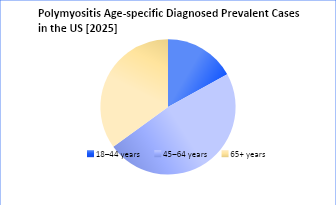
- In Japan, among the gender-specific cases of polymyositis, 45–64 years had the highest (~50%) number of cases followed by 65+ years and 18–44 years in 2025.
Scope of the Report
- The report covers a segment of a descriptive overview of polymyositis, explaining their causes, signs and symptoms, and pathogenesis.
- Comprehensive insight has been provided into the epidemiology segments and forecasts, the future growth potential of the diagnosis rate, and disease progression.
Report Insights
Polymyositis Patient Population Forecast
Report Key Strengths
- Epidemiology‑based (Epi‑based) Bottom‑up Forecasting
- 11-year Forecast
- Patient Burden Trends (by geography)
FAQs
- What are the disease risks, burdens, and unmet needs of polymyositis? What will be the growth opportunities across the 7MM concerning the patient population with polymyositis?
- What is the historical and forecasted polymyositis patient pool in the US, EU4 (Germany, France, Italy, and Spain), the UK, and Japan?
Reasons to Buy
- Insights on patient burden/disease prevalence, evolution in diagnosis, and factors contributing to the change in the epidemiology of the disease during the forecast years.
- To understand key opinion leaders’ perspectives around the diagnostic challenges to overcome barriers in the future.
- Detailed insights on various factors hampering disease diagnosis and other existing diagnostic challenges.