Polymyositis Market Summary
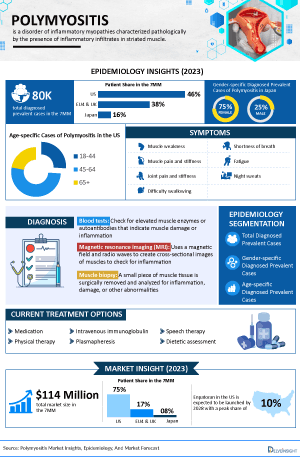
- According to DelveInsight’s analysis, the polymyositis market size was found to be ~USD 120 million in the 7MM (the United States, the EU4 (Germany, France, Italy, and Spain), the United Kingdom, and Japan) in 2025.
- Polymyositis mimics many other myopathies and remains a diagnosis of exclusion. It should be viewed as a syndrome of diverse causes that occurs separately or in association with systemic autoimmune disorders or viral infections in patients who do not have any exclusion criteria.
- Polymyositis can affect people at any age. It most common in adults between ages 50 and 70. It affects women twice as often as men.
- Females are more prevalent to polymyositis than males with with ~75% of cases belonged to the female gender in the US in 2025.
- The prevalence of Idiopathic Inflammatory Myopathies (IIMs) is fairly low as reported by different research. Polymyositis is rare in childhood and presents mainly after the second decade of life, and the most common time of presentation is between 45–60 years of age. Polymyositis is rarely seen in people younger than 18.
- There are currently no therapies specifically approved for polymyositis in the 7MM, with treatment relying primarily on off-label immunosuppressive agents and supportive care.
- The current standard of care for polymyositis is centered on high-dose corticosteroids as first-line therapy, followed by steroid-sparing immunosuppressive agents such as methotrexate, azathioprine, or mycophenolate mofetil for long-term disease control, with intravenous immunoglobulin (IVIG) and rituximab reserved for refractory or severe cases alongside supportive physical rehabilitation.
- The late-stage pipeline is increasingly focused on precision immunotherapy, targeting key immune pathways implicated in the pathogenesis of idiopathic inflammatory myopathies.
- The current pipeline is limited, consisting of only a few assets, namely, Anifrolumab (SAPHNELO) (AstraZeneca), Dazukibart (PF-06823859) (Pfizer), and Efgartigimod (Argenx) amog others. Also, the current standard of care (SOC) fails to cater to the needs of the patients. This leaves immense scope for future players to bring novel treatments to the market.
- Positive Phase III outcomes could establish the first disease-specific biologics for polymyositis, significantly reshaping the competitive landscape and treatment algorithm.
- Given the rarity of polymyositis, orphan drug incentives, expedited regulatory pathways, and premium pricing are expected to support the commercial potential of innovative therapies.
Polymyositis Market Size and Forecast in the 7MM
- 2025 Polymyositis Market Size: ~USD 120 million
- 2036 Projected Polymyositis Market Size: ~ USD XXX million
- Polymyositis Growth Rate (2026–2036): ~20% CAGR
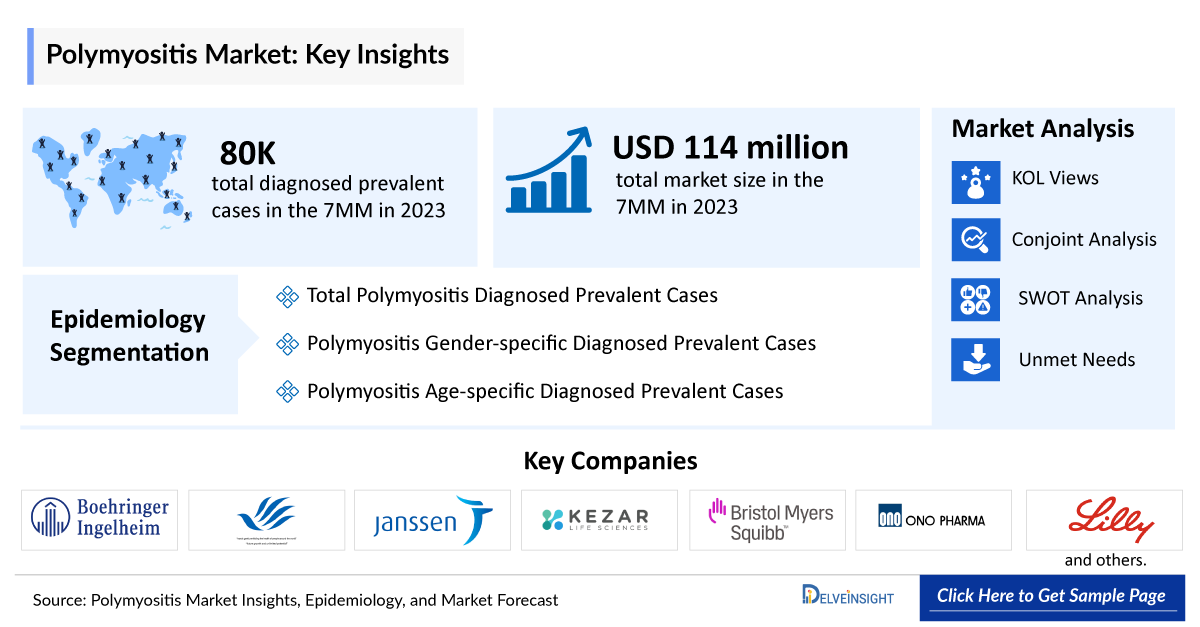
DelveInsight's ‘Polymyositis – Market Insights, Epidemiology and Market Forecast – 2036’ report delivers an in-depth understanding of the polymyositis, historical and forecasted epidemiology, as well as the polymyositis market trends in the United States, EU4 (Germany, Spain, Italy, and France) and the United Kingdom, and Japan.
The polymyositis market report delivers a comprehensive analysis of the current treatment landscape, including standards of care, clinical practices, and evolving therapeutic algorithms. It evaluates polymyositis patient burden trends, revenue & market share dynamics, peak patient share & therapy uptake analysis, and provides an in-depth market size assessment, and growth rate projections (Historical & Forecast 2022–2036) across global regions. The report highlights key unmet medical needs in polymyositis and maps the competitive and clinical landscape to uncover high‑value opportunities, providing a clear outlook on future market growth potential.
|
Study Period |
2022–2036 |
|
Historical Year |
2022–2025 |
|
Forecast Period |
2026–2036 |
|
Base Year |
2026 |
|
Geographies Covered |
|
|
Polymyositis Market CAGR (Forecast period) |
~20% (2026–2036) |
|
Polymyositis Epidemiology Segmentation Analysis |
Patient Burden Assessment
|
|
Polymyositis Companies |
|
|
Polymyositis Therapies |
|
|
Polymyositis Market |
Segmented by
|
|
Analysis |
|
Key Factors Driving the Polymyositis Market
Rising Diagnosis and Improved Disease Recognition
Increasing awareness of polymyositis and advances in diagnostic tools, including myositis-specific antibody testing, muscle MRI, and electromyography, are enabling earlier and more accurate diagnosis. Timely identification of patients is supporting earlier treatment initiation and improving disease management.
Advancements in Targeted Biologics
Emerging targeted therapies such as anifrolumab, dazukibart, and efgartigimod have the potential to transform polymyositis treatment by targeting key immune pathways involved in disease progression. These therapies may offer improved efficacy and reduce dependence on long-term corticosteroids and conventional immunosuppressants.
Favorable Regulatory Support for Rare Diseases
Orphan drug incentives and expedited regulatory pathways are encouraging the development of novel therapies for polymyositis. These programs help accelerate clinical development and regulatory review, supporting faster availability of innovative treatment options for patients.
Polymyositis Understanding and Treatment Algorithm
Polymyositis Overview and Diagnosis
Polymyositis is a rare, chronic autoimmune inflammatory muscle disease characterized by progressive, symmetrical weakness of the proximal skeletal muscles, particularly those affecting the shoulders, hips, neck, and thighs. The condition results from immune-mediated muscle fiber injury, primarily driven by T-cell–mediated inflammation, leading to muscle inflammation, degeneration, and impaired physical function. It is classified as one of the Idiopathic Inflammatory Myopathies and may be associated with extra-muscular manifestations, including Interstitial Lung Disease (ILD), dysphagia, and cardiac involvement. Advances in immunology and disease classification have improved the understanding of polymyositis, with some patients previously diagnosed with the condition now being reclassified into other inflammatory myopathy subtypes based on clinical, serological, and pathological findings.
The diagnosis of polymyositis is based on a comprehensive clinical assessment supported by laboratory testing, imaging, electrophysiological studies, and muscle biopsy while excluding other causes of muscle weakness. Elevated serum muscle enzymes, including creatine kinase, aldolase, aspartate aminotransferase, alanine aminotransferase, and lactate dehydrogenase, indicate ongoing muscle injury. Testing for myositis-specific and myositis-associated autoantibodies helps characterize the disease and identify distinct clinical phenotypes. Magnetic Resonance Imaging (MRI) is commonly used to detect muscle inflammation and guide biopsy, while electromyography demonstrates characteristic inflammatory myopathic changes. Muscle biopsy remains the diagnostic gold standard, typically revealing endomysial inflammatory infiltrates with CD8-positive T lymphocytes invading non-necrotic muscle fibers. The 2017 European Alliance of Associations for Rheumatology/American College of Rheumatology (EULAR/ACR) Classification Criteria for Idiopathic Inflammatory Myopathies are widely used to support accurate diagnosis.
Further details are provided in the report.
Current Polymyositis Treatment Landscape
The treatment of polymyositis focuses on suppressing immune-mediated inflammation, improving muscle strength, preserving physical function, and preventing long-term disability and systemic complications. High-dose corticosteroids remain the cornerstone of initial therapy and are often followed by steroid-sparing immunosuppressive agents to maintain disease control and reduce corticosteroid exposure. IVIG and biologic therapies, including rituximab, are commonly used in patients with refractory or severe disease despite the absence of therapies specifically approved for polymyositis. Comprehensive management also includes physical rehabilitation, occupational therapy, nutritional support, and regular monitoring for complications such as ILD and cardiac involvement. Several targeted biologics, including anifrolumab, dazukibart, and efgartigimod, are currently in Phase III clinical development and have the potential to become the first disease-specific therapies for polymyositis.
Further details related to country-based variations are provided in the report.
Polymyositis Unmet Needs
The section “unmet needs of polymyositis” outlines the critical gaps between the current state of patient care, diagnosis, and the ideal & effective management of the disease. It highlights the obstacles experienced by patients, clinicians, and researchers and identifies potential solutions for future progress.
- Lack of approved disease-specific therapies
- Dependence on long-term corticosteroids
- Limited evidence from large clinical trials due to the rarity of polymyositis
- Management of extra-muscular manifestations, and others…..
Note: Comprehensive unmet needs insights in Polymyositis and their strategic implications are provided in the full report.
Polymyositis Epidemiology
Key Findings from Polymyositis Epidemiological Analysis and Forecast
- As per DelveInsight’s analyst, the diagnosed prevalent cases of polymyositis in 7MM in 2025 were ~84,000 cases.
- Among the 7MM, US accounted for the highest number of diagnosed prevalent cases i.e., ~40,000 cases in 2025.
- Among the EU4 and the UK, Germany had the highest (~30%) number of diagnosed prevalent cases followed by France, and Spain the lowest number of cases in 2025.
- In Japan, among the gender-specific cases of polymyositis, 45–64 years had the highest (~50%) number of cases followed by 65+ years and 18–44 years in 2025.

Polymyositis Drug Analysis & Competitive Landscape
The polymyositis drug chapter provides a detailed, market-focused review of the emerging pipeline across Phase III clinical trials and preclinical trials. It covers the mechanism of action, clinical trial data, regulatory approvals, patents, collaborations, and strategic partnerships for each therapy, along with their advantages, limitations, and recent developments. This section offers critical insights into the polymyositis treatment landscape, supporting market assessment, competitive analysis, and growth forecasting for the polymyositis therapeutics market.
Polymyositis Pipeline Analysis
Anifrolumab (SAPHNELO): AstraZeneca and BMS
Anifrolumab is a fully human monoclonal antibody that blocks the type I interferon (IFN-I) receptor subunit 1 (IFNAR1), thereby inhibiting signaling from all type I interferons implicated in autoimmune inflammation. Building on its established efficacy in systemic lupus erythematosus (SLE), AstraZeneca is evaluating anifrolumab in Phase III (JASMINE) for adults with polymyositis, as an add-on to standard of care. The US FDA granted Orphan Drug Designation (ODD) to anifrolumab for IIM including polymyositis. AstraZeneca in its Q1 2026 results update anticipated Phase III (JASMINE) data in 2027.
Dazukibart (PF-06823859): Pfizer
Dazukibart is a first-in-class humanized monoclonal antibody that selectively neutralizes interferon-beta (IFN-β), a cytokine increasingly recognized as a key driver of inflammation in IIMs. Pfizer is evaluating the therapy in a Phase III, multicenter, randomized, placebo-controlled trial involving patients with active polymyositis receiving background standard therapy. It has received ODD by the US FDA and EMA, Fast Track Designation by the US FDA and PRIME Designation by the EMA.
|
Competitive Landscape of Pipeline Drugs | ||||||
|
Drug Name |
Company |
Highest Phase |
Indication |
RoA |
MoA |
Anticipated Launch in the US |
|
Anifrolumab (SAPHNELO) |
AstraZeneca |
III |
IIM (Polymyositis) |
SC |
IFNAR1 inhibitor |
Information is available in the full report |
|
Dazukibart (PF-06823859) |
Pfizer |
III |
IIM (Polymyositis) |
IV infusion |
IFN-β antagonist |
Information is available in the full report |
|
Efgartigimod |
Argenx |
III |
Polymyositis |
SC |
Neonatal Fc receptor antagonist |
Information is available in the full report |
|
Note: Launch insights are provisional and may change with future report updates or the occurrence of major key catalysts. | ||||||
Note: Detailed emerging therapies assessment will be provided in the final report.
Polymyositis Key Players, Market Leaders and Emerging Companies
- AstraZeneca
- Pfizer
- Argenx, and others
Polymyositis Drug Updates
- In May 2026, Argenx in its corporate presentation anticipated data readout of efgartigimod Phase III in Q3 2026.
Polymyositis Market Outlook
The treatment landscape for polymyositis continues to rely on high-dose corticosteroids as first-line therapy, followed by conventional immunosuppressants such as methotrexate, azathioprine, mycophenolate mofetil, tacrolimus, and IVIG for refractory disease.
Among the most advanced pipeline candidates, anifrolumab is in Phase III (JASMINE) for IIMs, including polymyositis, where it targets the IFNAR1 to suppress interferon-driven inflammation. Dazukibart is a novel investigational agent targeting the inflammatory cytokine IL-6, which plays a significant role in immune system dysregulation. By blocking IL-6, dazukibart aims to reduce inflammation and immune-mediated muscle damage. Efgartigimod, an FcRn antagonist that lowers pathogenic IgG autoantibody levels, is being investigated in Phase III for IIMs and has demonstrated encouraging immunomodulatory activity in earlier studies. Collectively, these late-stage biologics have the potential to become the first targeted therapies specifically approved for polymyositis, transforming the treatment paradigm from broad immunosuppression to mechanism-based intervention.
Overall, the polymyositis market across the 7MM is expected to expand steadily through 2036, supported by improved disease recognition, earlier diagnosis, increasing adoption of biologic therapies, and continued investment in rare autoimmune diseases. The launch of targeted biologics is anticipated to improve long-term outcomes, reduce reliance on corticosteroids, and create significant commercial opportunities in a market that currently lacks approved disease-specific therapies.
- Anifrolumab is expected to be among the leading late-stage candidates, supported by its validated type I interferon inhibition and established clinical experience in autoimmune diseases.
- The approval of any of these Phase III biologics would represent a major milestone, as there are currently no therapies specifically approved for polymyositis, potentially redefining the competitive landscape over the forecast period.
Further details will be provided in the report….
Drug Class/Insights into Leading Emerging and Marketed Therapies in Polymyositis (2022–2036 Forecast)
The polymyositis market (2022–2036 forecast) is evolving toward targeted biologic therapies that selectively modulate immune pathways involved in muscle inflammation while reducing the long-term dependence on corticosteroids and conventional immunosuppressants.
- IFN Pathway Inhibitors: This class includes anifrolumab, a fully human monoclonal antibody targeting the IFNAR1, and dazukibart, a monoclonal antibody that selectively neutralizes IFN-β. Both therapies aim to suppress interferon-driven immune activation, which is implicated in the pathogenesis of IIMs, including polymyositis.
- Neonatal Fc Receptor (FcRn) Antagonists: Efgartigimod belongs to the FcRn inhibitor class. It is an engineered Fc fragment that blocks the neonatal Fc receptor, accelerating the degradation of circulating pathogenic IgG autoantibodies while preserving other components of the immune system.
Overall, innovation in polymyositis is increasingly centered on precision immunomodulation rather than broad immunosuppression. The advancement of interferon pathway inhibitors and FcRn antagonists is expected to reshape the therapeutic landscape by offering more targeted, disease-modifying treatment options with the potential for improved efficacy, reduced corticosteroid exposure, and better long-term safety. As these Phase III candidates progress toward potential approval, they are expected to address significant unmet needs and drive growth across the polymyositis market in the 7MM through 2036.
Polymyositis Drug Uptake
This section focuses on the uptake rate of potential drugs expected to be launched in the market during the forecast period (2026–2036). The analysis covers the polymyositis drug’s uptake, performance at peak, factors affecting performance during prime years of growth, patient uptake by therapy, and anticipated sales generated by each drug.
During the forecast period, anifrolumab is expected to achieve gradual uptake in the polymyositis market following potential approval, driven by its targeted IFNAR1 inhibition and potential to provide a corticosteroid-sparing treatment option for patients with active disease. Dazukibart may gain adoption due to its differentiated IFN-β inhibition mechanism, with uptake primarily among patients with inadequate response to conventional immunosuppressive therapies and those requiring targeted immune modulation. Efgartigimod, an FcRn antagonist, is expected to capture a niche but growing share by reducing pathogenic IgG autoantibody levels, particularly in patients with refractory or antibody-driven disease features.
Overall, successful approval of these Phase III candidates could transform the polymyositis treatment landscape by introducing the first disease-specific targeted therapies and shifting management away from long-term corticosteroid-based approaches toward precision immunotherapy.
Detailed insights of emerging therapies' drug uptake is included in the report
Market Access and Reimbursement of Approved Therapies in Polymyositis
Reimbursement is a crucial factor that affects the drug’s access to the market. Often, the decision to reimburse comes down to the price of the drug relative to the benefit it produces in treated patients. To reduce the healthcare burden of these high-cost therapies, many payment models are being considered by payers and other industry insiders.
Reimbursement is a crucial factor that affects the drug’s access to the market. Often, the decision to reimburse comes down to the price of the drug relative to the benefit it produces in treated patients. To reduce the healthcare burden of these high-cost therapies, many payment models are being considered by payers and other industry insiders.
NOTE: Further Details are provided in the final report….
Polymyositis Therapies Price Scenario & Trends
Pricing and analogue assessment of polymyositis therapies highlights evolving price dynamics structures. This section summarizes the cost of approved treatments, closest and most appropriate analogue selection for emerging therapies, and understanding of how pricing influences market access, adherence, and long-term uptake.
Industry Experts and Physician Views for Polymyositis
To keep up with polymyositis market trends, we take Key Opinion Leaders (KOLs) and Subject Matter Experts (SMEs) opinions working in the domain through primary research to fill the data gaps and validate our secondary research. Industry experts were contacted for insights on the polymyositis emerging therapies, evolving treatment landscape, patient adherence to conventional therapies, therapy switching trends, drug adoption and uptake, accessibility challenges, and epidemiology and real-world prescription patterns in polymyositis, including MD, PhD, Instructor, Postdoctoral Researcher, Professor, Researcher, and others.
DelveInsight’s analysts connected with 15+ KOLs to gather insights at the country level. Centers such as Stanford University School of Medicine, Massachusetts General Hospital, and University Medical Center Göttingen, etc. were contacted. Their opinion helps understand and validate current and emerging polymyositis therapies, highlight unmet medical needs, provide epidemiological context, and support strategic decisions for market access, therapy adoption, and pipeline prioritization in polymyositis.
|
Region |
Key Opinion Leaders (KOLs) and Subject Matter Experts (SMEs) |
|
United States |
“Polymyositis treatment primarily involves corticosteroids and immunosuppressive agents, yet long-term remission is rare. Approximately 60% of cases respond initially, but relapses are common, underscoring the need for more effective therapies.” |
|
Germany |
“The market for polymyositis treatment in the US is expanding due to increasing awareness and the development of new therapies. However, market growth is tempered by the disease's rarity and the high cost of emerging treatments. Continued investment in research and development is essential to meet patient needs and drive market expansion.” |
Qualitative Analysis: SWOT and Conjoint Analysis
We perform qualitative and market Intelligence analysis using various approaches, such as SWOT analysis and conjoint analysis.
In the SWOT analysis of polymyositis, strengths, weaknesses, opportunities, and threats in terms of disease diagnosis, patient awareness, patient burden, competitive landscape, cost-effectiveness, and geographical accessibility of therapies are provided.
Conjoint analysis analyzes emerging therapies based on relevant attributes such as safety, efficacy, frequency of administration, route of administration, and order of entry. Scoring is given based on these parameters to analyze the effectiveness of therapy.
The team of analysts analyzes promising emerging therapies based on relevant attributes such as safety, efficacy, frequency of administration, route of administration, and order of entry. In efficacy, the trial’s primary and secondary outcome measures are evaluated, whereas the therapies’ safety is evaluated, wherein the acceptability, tolerability, and adverse events are majorly observed. In addition, the scoring is also based on the route of administration, order of entry, probability of success, and the addressable patient pool for each therapy. According to these parameters, the final weightage score and the ranking of the emerging therapies are decided.
Scope of the Report
- The report covers a segment of key events, an executive summary, a descriptive overview of polymyositis, explaining their causes, signs and symptoms, pathogenesis, and currently available treatments.
- Comprehensive insight has been provided into the epidemiology segments and forecasts, the future growth potential of the diagnosis rate, and disease progression along treatment guidelines.
- Additionally, an all-inclusive account of both the current and emerging treatments, along with the elaborative profiles of late-stage and prominent therapies, will have an impact on the current treatment landscape.
- A detailed review of the polymyositis market, historical and forecasted market size, market share by therapies, detailed assumptions, and rationale behind our approach is included in the report, covering the 7MM drug outreach.
- The report provides an edge while developing business strategies by understanding trends through SWOT analysis and expert insights/KOL views, patient journey, and treatment preferences that help in shaping and driving the 7MM polymyositis market.
Report Insights
- Polymyositis Patient Population Forecast
- Polymyositis Therapeutics Market Size
- Polymyositis Pipeline Analysis
- Polymyositis Market Size and Trends
- Polymyositis Market Opportunity (Current and forecasted)
Report Key Strengths
- Epidemiology‑based (Epi‑based) Bottom‑up Forecasting
- Artificial Intelligence (AI)-Enabled Market Research Report
- 11-Year Forecast
- Polymyositis Market Outlook (North America, Europe, Asia-Pacific)
- Patient Burden Trends (By Geography)
- Polymyositis Treatment Addressable Market (TAM)
- Polymyositis Competitve Landscape
- Polymyositis Major Companies Insights
- Polymyositis Price Trends and Analogue Assessment
- Polymyositis Therapies Drug Adoption/Uptake
- Polymyositis Therapies Peak Patient Share Analysis
Report Assessment
- Polymyositis Current Treatment Practices
- Polymyositis Unmet Needs
- Polymyositis Clinical Development Analysis
- Polymyositis Emerging Drugs Product Profiles
- Polymyositis Market attractiveness
- Polymyositis Qualitative Analysis (SWOT and conjoint analysis)
FAQs
Market Insights
- What was the polymyositis market size, the market size by therapies, market share (%) distribution in 2025, and what would it look like by 2036? What are the contributing factors for this growth?
- What are the anticipated pricing variations among different geographies for the emerging therapies in the future?
- What can be the future treatment paradigm of polymyositis?
- What are the disease risks, burdens, and unmet needs of polymyositis? What will be the growth opportunities across the 7MM concerning the patient population with polymyositis?
- Who is the major future competitor in the market, and how will the competitors affect their market share?
- What are the current options for the treatment of polymyositis? What are the current guidelines for treating polymyositis in the US, Europe, and Japan?
Reasons to Buy
- The report will help in developing business strategies by understanding the latest trends and changing treatment dynamics driving the polymyositis market.
- Bottom-up forecasting builds from the affected population to product forecasts, delivering a robust, data-driven approach ideal for new therapies and novel classes.
- Insights on patient burden/disease incidence, evolution in diagnosis, and factors contributing to the change in the epidemiology of the disease during the forecast years.
- Understand the existing market opportunities in varying geographies and the growth potential over the coming years.
- Identifying strong upcoming players in the market will help devise strategies to help get ahead of competitors.
- Detailed analysis and ranking of class-wise potential emerging therapies under the conjoint analysis section to provide visibility around leading classes.
- To understand KOLs’ perspectives on the accessibility, acceptability, and compliance-related challenges of existing treatment to overcome barriers in the future.
- Detailed insights on the unmet needs of the existing market so that the upcoming players can strengthen their development and launch strategy.
- This Artificial Intelligence (AI)-enabled report summarize and simplify complex datasets with in the report into clear, actionable insights for stakeholders, investors, and healthcare providers, enabling faster, data-driven decisions.