Radiofrequency Ablation Devices Market Summary
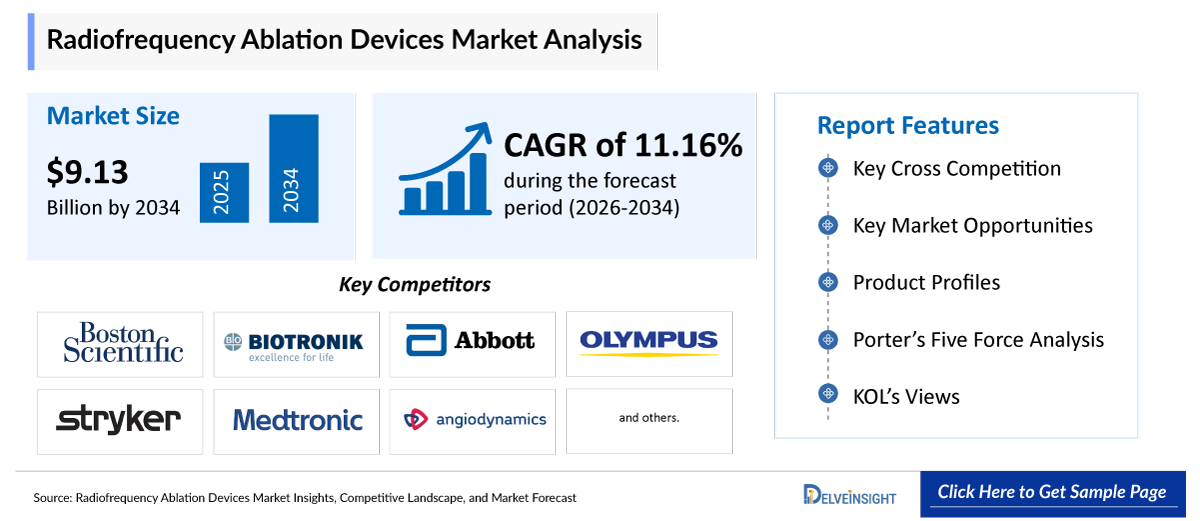
- The Radiofrequency Ablation Devices Market is estimated at USD 4.35 billion in 2025 and is projected to reach USD 11.27 billion by 2034. Growth is anchored in the rising global burden of cardiac arrhythmias and solid-tumor cancers, the accelerating shift toward minimally invasive treatment, and continuous innovation in generator, catheter, and electrode design.
- The Global Radiofrequency Ablation Devices Market is growing at a CAGR of 11.23% during the forecast period from 2026 to 2034.
Radiofrequency Ablation Devices Market Trends & Insights
- By product type, the RF Generators segment dominated the Radiofrequency Ablation Devices market with more than a 50% share in 2025.
- By application, the oncology segment dominated the Radiofrequency Ablation Devices market in 2025, supported by the rising incidence of liver, lung, kidney, and bone cancers.
- By end-user, the hospitals segment dominated the Radiofrequency Ablation Devices market with more than a 55% share in 2025, reflecting the concentration of complex cardiology, oncology, and pain-management procedures in hospital settings.
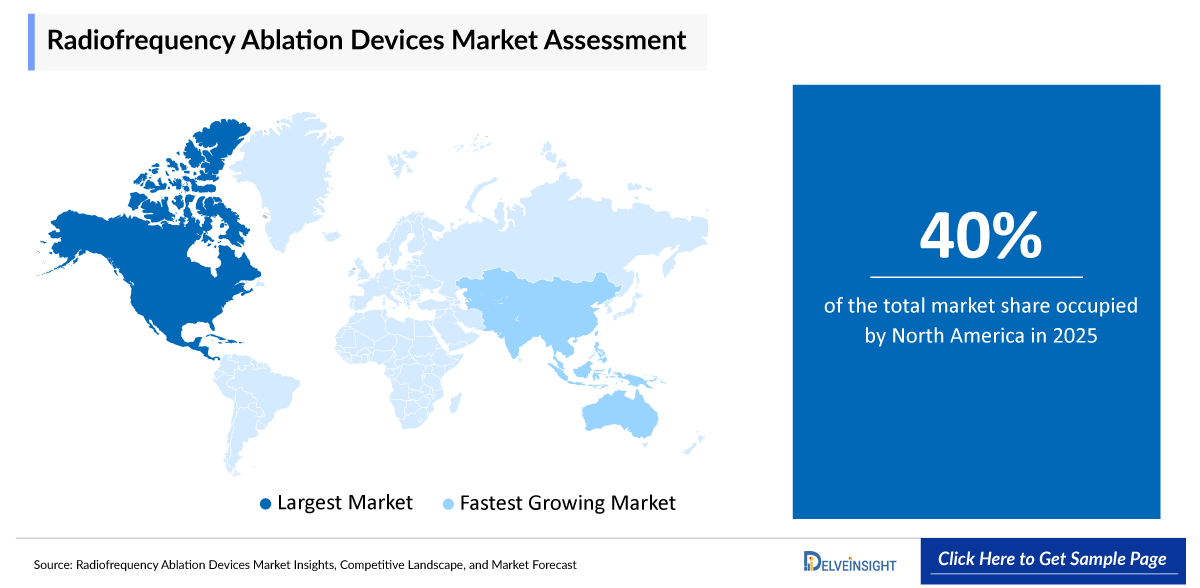
- North America dominated the global Radiofrequency Ablation Devices market with approximately a 40% share in 2025, representing the highest regional market share globally.
Request to unlock the sample page of the "Radiofrequency Ablation Devices Market Size"
Radiofrequency Ablation Devices Market Size
The following snapshot summarizes the principal report metrics for the radiofrequency ablation devices market.
|
Report Metrics |
Details |
|
2025 Market Size | |
|
2034 Projected Market Size | |
|
Growth Rate (2026-2034) | |
|
Largest Market |
North America |
|
Fastest Growing Market |
Asia-Pacific |
|
Market Structure |
Moderately Concentrated |
All market values are expressed in USD and represent DelveInsight estimates synthesized from primary and secondary research.
Factors Contributing to the Growth of the Radiofrequency Ablation Devices Market
Radiofrequency Ablation Devices Market Drivers
-
Rising Prevalence of Chronic Cardiac and Oncologic Disease
The most fundamental driver of the Radiofrequency Ablation Devices market is the growing global burden of chronic cardiac and oncologic disease. Atrial fibrillation prevalence continues to climb alongside an aging population, sustaining high procedural volumes for cardiac RF ablation as a first-line rhythm-control therapy.
In parallel, the rising global incidence of liver, lung, kidney, and bone cancers is expanding demand for image-guided percutaneous RF ablation as a curative or palliative option for patients who are poor surgical candidates. As both disease pools expand, the recurring, procedure-driven nature of RF ablation ensures durable, compounding demand for generators, catheters, and electrodes across the forecast period.
-
Growing Preference for Minimally Invasive Procedures
Patients and healthcare systems are increasingly favoring minimally invasive treatment over open surgery because of the associated reduction in post-operative pain, shorter hospital stays, fewer complications, and faster return to normal activity. RF ablation is a cornerstone of this shift, offering an effective, catheter- or probe-based alternative to surgical resection or ablation across cardiology, oncology, and pain management.
As reimbursement frameworks and clinical guidelines increasingly favor minimally invasive first-line therapy, this preference is expected to keep translating directly into rising procedure volumes and device demand.
-
Technological Advancements in Generators, Catheters, and Navigation
Continuous innovation in RF ablation technology is expanding both the safety and the clinical reach of the modality. Manufacturers are introducing multi-electrode systems capable of creating larger and more uniform ablation zones, irrigated and cooled-tip catheters that reduce charring and the heat-sink effect, and generators with advanced power modulation and real-time impedance and temperature monitoring.
Integration with three-dimensional electroanatomical mapping and imaging-guidance systems is further improving procedural accuracy in both cardiac and oncologic applications, supporting broader physician adoption and better patient outcomes.
-
Expanding Clinical Applications in Pain Management and Emerging Indications
Radiofrequency ablation is expanding well beyond its established cardiology and oncology base into chronic pain management, including facet joint denervation, sacroiliac joint ablation, and peripheral nerve ablation for conditions that are otherwise managed with long-term pharmacologic therapy.
This diversification is broadening the addressable patient population and creating new demand in outpatient and specialty-clinic settings, complementing the more capital-intensive hospital-based cardiology and oncology segments.
-
Rising Adoption of AI-Powered Procedural Support
Artificial intelligence is reshaping the Radiofrequency Ablation Devices market by introducing capabilities that enhance procedural precision, efficiency, and training outcomes. AI-enabled platforms can monitor procedural performance in real time, support pre-procedural planning, and simulate complex or rare scenarios for physician training without patient risk.
As these tools mature, they are expected to reduce procedural variability, shorten the learning curve for new proceduralists, and reinforce the clinical case for RF-based intervention over alternative treatment pathways.
-
Favorable Reimbursement and Expanding Access in Developed Markets
Established reimbursement pathways for cardiac ablation, tumor ablation, and interventional pain procedures in North America, Europe, and parts of Asia-Pacific continue to support steady procedure growth. Combined with rising investment in advanced hospital and specialty-clinic infrastructure, favorable coverage policy is lowering barriers to adoption and encouraging continued capital investment in RF generator platforms across both developed and emerging markets.
Radiofrequency Ablation Devices Market Restraints
Despite favorable underlying demand, the Radiofrequency Ablation Devices market faces several material constraints. RF ablation procedures carry inherent risks of complications, including unintended thermal injury to adjacent nerves, vessels, or organs, along with bleeding or infection at the access site, which can limit adoption among risk-averse providers and patients.
In oncology, a key technical constraint is the limited size of the achievable ablation zone: RF ablation is most effective for tumors smaller than roughly 3 cm in diameter, and larger lesions often require multiple overlapping ablations that extend procedural time and raise the risk of incomplete coverage and local recurrence, which has opened the door to competing technologies such as microwave and cryoablation.
In cardiac electrophysiology specifically, the rapid commercial rise of pulsed field ablation (PFA) is beginning to displace conventional RF and cryoablation catheters in atrial fibrillation treatment, as electrophysiologists increasingly cite PFA's tissue selectivity and safety profile, creating a structural headwind for RF-only catheter platforms even as dual-energy RF/PF systems help offset this shift.
Additional restraints include the high capital cost of RF generator systems, uneven reimbursement across geographies, and cost pressure from U.S. tariffs on imported components and finished devices, which is prompting manufacturers to reassess sourcing and manufacturing footprints. Together, these clinical, technological, and trade-related headwinds are expected to moderate, though not reverse, the market's underlying growth trajectory through 2034.
Radiofrequency Ablation Devices Overview
A radiofrequency ablation device is a medical instrument used in a minimally invasive procedure that destroys a targeted area of diseased tissue using heat generated from high-frequency electrical currents. The device typically comprises a generator that produces the RF energy and a specialized catheter, probe, or electrode that delivers it to the target site.
Because the technology enables precise, localized tissue destruction with minimal collateral damage, RF ablation devices are widely used to treat cardiac arrhythmias such as atrial fibrillation, to destroy solid tumors in the liver, lung, kidney, and bone, and to manage chronic pain through nerve ablation.
The market is organized by product type across RF generators, RF catheters, RF electrodes, and other accessories; by application across cardiology, oncology, pain management, and other emerging indications; and by end-user across hospitals, specialty clinics, and other care settings, including ambulatory surgical centers.
Driven by the rising global burden of cardiovascular disease and cancer, the growing preference for minimally invasive care, and continuous advances in energy delivery, imaging integration, and procedural monitoring, radiofrequency ablation devices have become a foundational technology across modern interventional cardiology, oncology, and pain-management practice.
 Radiofrequency Ablation Devices Market Segment Analysis
The Radiofrequency Ablation Devices by Product Type (RF Generators, RF Catheters, RF Electrodes, and Others), Application (Cardiology, Oncology, Pain Management, and Others), End-User (Hospital, Specialty Clinics, and Others), and Geography (North America, Europe, Asia-Pacific, and Rest of World).
-
Radiofrequency Ablation Devices Market Segmentation By Product Type
Dominant Subsegment: RF Generators. The RF generators category is expected to dominate the market.
Dominant: RF generators ~ 52%
The RF Generators segment accounted for more than 50% of the radiofrequency ablation devices market in 2025. RF generators serve as the core energy source for every ablation procedure, making them the foundational revenue driver of the market. Advancements in generator technology, including improved power modulation, temperature and impedance monitoring, and automated dosing algorithms, are enhancing procedural safety, efficiency, and clinical consistency.
The increasing adoption of minimally invasive treatment across cardiology, oncology, and pain management is fueling steady demand for high-performance generators, while integration with imaging-guidance systems and compatibility with a growing range of catheter and electrode types are expanding their clinical versatility.
RF catheters and electrodes, sold as recurring, often single-use consumables tied to every procedure, are the fastest-growing product categories as procedure volumes rise, but the generator's role as the indispensable capital platform underpinning every ablation secures its leadership across the forecast period.
-
Radiofrequency Ablation Devices Market Segmentation By Application
Dominant Subsegment: Oncology. The oncology category is expected to dominate the market.
Dominant: Oncology ~ 41%
The oncology segment accounted for the largest share of the Radiofrequency Ablation Devices market in 2025. Oncology is a leading application because RF ablation offers a well-validated, minimally invasive alternative to surgical resection for liver, lung, kidney, and bone tumors, particularly in patients who are poor surgical candidates. The rising global incidence of these cancers, combined with the expanding use of image-guided percutaneous techniques and growing acceptance of RF ablation alongside systemic and locoregional therapies, is sustaining strong demand.
Cardiology remains a very large and closely competing application, anchored by the high and recurring procedure volumes associated with atrial fibrillation and other arrhythmias, while pain management is expanding quickly as facet joint and peripheral nerve ablation gain broader adoption. Nonetheless, the breadth of oncologic indications and the steady rise in cancer incidence secure oncology's leadership across the forecast period.
-
Radiofrequency Ablation Devices Market Segmentation By End-User
Dominant Subsegment: Hospitals. The hospitals category is expected to dominate the market.
Dominant: Hospitals ~ 58%
The hospitals segment accounted for the largest share of the Radiofrequency Ablation Devices market in 2025. Hospitals lead because they serve as the primary centers for managing complex cardiac arrhythmias, cancer, and chronic pain, conditions that require specialized RF ablation equipment, advanced imaging infrastructure, and multidisciplinary clinical teams.
The availability of intensive post-procedural care, favorable reimbursement policies, and on-site management of complications reinforces the strong position of hospitals in this segment. Specialty clinics are the fastest-growing end-user category, particularly for pain-management and select oncology procedures that are increasingly shifting to outpatient settings, but the scale, infrastructure, and procedural complexity handled by hospitals secure their leadership through the forecast period.
-
Radiofrequency Ablation Devices Market Region Analysis
- Dominant Region: North America
- Dominant: North America ~ 40% (Largest)
North America accounted for approximately 40% of the global radiofrequency ablation devices market revenue in 2025, representing the highest regional market share globally. The region's leadership reflects a high prevalence of cancer and cardiac arrhythmias, advanced healthcare infrastructure, favorable reimbursement policies, and the concentrated presence of leading device manufacturers and active R&D programs. The United States leads regional adoption, supported by widespread use of cutting-edge ablation technologies and a deep bench of hospital and specialty-clinic infrastructure.
More than 1.9 million new cancer cases are expected to be diagnosed in the United States in 2025 alone, a number projected to keep rising with the aging population, further reinforcing demand for minimally invasive tumor-management options such as RF ablation. Continued technology adoption, strong clinical expertise, and sustained investment in next-generation cardiac and oncology ablation platforms anchor North America's continued leadership across the forecast period.
-
- Fastest Growing Region: Asia-Pacific
Asia-Pacific is the fastest-growing region in the radiofrequency ablation devices market, expanding at approximately 12.5%. The region's elevated growth rate is driven by expanding healthcare infrastructure, rising investment in advanced medical technologies, and the growing adoption of minimally invasive procedures across China, Japan, India, South Korea, and Australia.
China and Japan lead the regional landscape on the strength of established healthcare ecosystems and early adoption of innovative ablation techniques, while India and South Korea are emerging as high-growth markets on the back of rising patient demand and improving healthcare access. The integration of advanced imaging, navigation, and AI-enabled platforms, combined with supportive government initiatives and the rising burden of chronic disease, positions Asia-Pacific as the principal source of incremental growth over the forecast period.
Radiofrequency Ablation Devices Market Key Growth Drivers
- The rising global prevalence of cardiac arrhythmias, particularly atrial fibrillation, and the growing incidence of solid-tumor cancers are expanding the eligible patient pool for RF-based interventions.
- The growing preference for minimally invasive procedures over open surgery is driving adoption, given the benefits of reduced pain, shorter hospital stays, fewer complications, and faster recovery.
- Continuous technological advancement, including multi-electrode systems, irrigated and cooled-tip catheters, and real-time impedance and temperature monitoring, is improving procedural safety and ablation precision.
- Expanding clinical indications beyond cardiology and oncology, including facet joint and sacroiliac nerve ablation for chronic pain, are broadening the addressable market.
- The aging global population and the rising burden of chronic disease are sustaining long-term procedure volume growth across developed and emerging markets alike.
- The emergence of AI-powered procedural monitoring, navigation, and training platforms is improving clinical outcomes and accelerating adoption among proceduralists.
- Sustained product launches, regulatory clearances, and strategic collaborations among leading device manufacturers are reinforcing competitive innovation and market access.
Major Radiofrequency Ablation Devices Companies
The Radiofrequency Ablation Devices Competitive Landscape is led by the following active device manufacturers:
- Boston Scientific Corporation
- BIOTRONIK Schweiz AG
- Abbott
- Olympus Corporation
- Stryker
- Medtronic
- AngioDynamics
- CONMED Corporation
- Lepu Medical Technology (Beijing) Co., Ltd
- Arthrex Inc.
For illustrative purposes, only the top 10 companies are listed in the Table of Contents. The report may include analysis and references to additional companies relevant to the market assessment.
Radiofrequency Ablation Devices Regional Commentary
- North America
North America accounted for approximately 40% of the global Radiofrequency Ablation Devices market revenue in 2025. The United States dominates on the strength of its high cancer and arrhythmia burden, advanced healthcare infrastructure, favorable reimbursement environment, and the concentrated presence of leading manufacturers, while continued investment in next-generation cardiac and oncology ablation platforms reinforces the region's leadership.
- Europe
Europe is a large and advanced regional market, supported by well-established healthcare systems, strong regulatory frameworks under the EU Medical Device Regulation, and high adoption of advanced ablation technologies. Germany, France, and the United Kingdom lead the market on the strength of advanced hospital infrastructure and robust clinical-research activity, while Eastern European markets are emerging as attractive growth destinations as healthcare access and reimbursement continue to improve.
- Asia-Pacific
Asia-Pacific is the fastest-growing region, propelled by expanding healthcare infrastructure, rising investment in advanced medical technologies, and growing adoption of minimally invasive procedures across China, Japan, India, South Korea, and Australia. Government initiatives, an expanding base of trained proceduralists, and rising chronic disease prevalence are accelerating regional adoption and clinical-trial activity.
- Rest of World
The Rest of World region, spanning Latin America, the Middle East, and Africa, is an emerging growth frontier. Expanding healthcare infrastructure, rising demand for minimally invasive cardiology, oncology, and pain-management treatment, and gradual improvement in reimbursement access are broadening adoption, while partnerships with global manufacturers support the build-out of regional procedural capacity.p
Radiofrequency Ablation Devices Market Competitive Landscape
The Radiofrequency Ablation Devices market is classified as Moderately Concentrated. A group of global leaders with broad cardiology, oncology, and pain-management portfolios, including Boston Scientific Corporation, Medtronic, Abbott, and Stryker, anchors the top tier through scale, R&D depth, and multi-specialty reach, while specialized and regionally focused providers such as BIOTRONIK Schweiz AG, Olympus Corporation, AngioDynamics, CONMED Corporation, Lepu Medical Technology, and Arthrex Inc. compete through focused clinical expertise, cost-effective platforms, and targeted geographic expansion, sustaining competitive intensity across the fastest-growing application segments.
The Radiofrequency Ablation Devices Competitive Landscape can be evaluated across the following dimensions:
- Market concentration: Moderately concentrated, with diversified multi-specialty leaders competing alongside focused, application-specific providers.
- Leading players: Boston Scientific Corporation, Medtronic, Abbott, and Stryker anchor the top tier through broad cardiology, oncology, and pain-management portfolios.
- Geographic reach: Leading players operate global commercial and manufacturing networks, while Lepu Medical Technology and other regional providers strengthen distribution across Asia-Pacific.
- Product portfolio strength: Top players offer integrated generator, catheter, electrode, and navigation portfolios spanning cardiology, oncology, and pain management.
- Technology and energy platforms: Dual-energy systems combining RF with pulsed field or other modalities, together with irrigated and multi-electrode catheter designs, are a decisive competitive advantage in cardiac electrophysiology.
- Strategic partnerships: Collaborations with hospitals, imaging providers, and research institutions extend clinical reach and support evidence generation for expanding indications.
- M&A activity: Ongoing consolidation and portfolio expansion, including legacy oncology-ablation platform acquisitions and pain-management product line additions, continue to reshape the competitive field.
- Manufacturing capabilities: Advanced catheter and generator manufacturing, together with regulatory and quality infrastructure, remain key competitive moats.
- Innovation focus: Multi-electrode ablation, irrigated and cooled-tip catheter design, imaging and navigation integration, dual-energy systems, and AI-enabled procedural support define the current innovation frontier.
Radiofrequency Ablation Devices Market Recent Developmental Activities
- In 2026, Medtronic presented late-breaking early feasibility study data on its Affera mapping and ablation system with the Sphere-9 catheter, a dual-energy pulsed field and radiofrequency ablation device, in the treatment of ventricular tachycardia following the U.S. FDA's grant of breakthrough device designation. Strategic significance: Extends Medtronic's dual-energy RF/PF platform into complex ventricular arrhythmia treatment and strengthens its position in advanced cardiac electrophysiology.
- In October 2024, Medtronic announced U.S. FDA approval of the Affera Mapping and Ablation System with Sphere-9 Catheter, an all-in-one, high-density mapping and pulsed field and radiofrequency ablation catheter, for the treatment of persistent atrial fibrillation and for RF ablation of cavotricuspid-isthmus-dependent atrial flutter. Strategic significance: Reinforces Medtronic's dual-energy cardiac ablation portfolio and its competitive position against pure-RF and pure-PFA rivals.
- In March 2024, Medtronic received U.S. FDA 510(k) clearance for its OsteoCool 2.0 bone tumor radiofrequency ablation system for the treatment of painful bone metastases and benign bone tumors such as osteoid osteoma. Strategic significance: Expands Medtronic's oncology RF ablation footprint into interventional pain and musculoskeletal oncology.
- In May 2025, Stryker announced U.S. FDA 510(k) clearance of its OptaBlate Basivertebral Nerve (BVN) radiofrequency ablation system, expanding its advanced pain-therapy portfolio at the intersection of RF ablation technology and vertebral access. Strategic significance: Strengthens Stryker's position in interventional pain management and broadens its RF ablation product line beyond orthopedics.
- Boston Scientific continues to expand its RF ablation portfolio, including the Habib EndoHPB endoluminal radiofrequency ablation catheter used in malignant biliary and pancreatic disease, alongside its DirectSense technology for real-time monitoring of RF ablation effect during cardiac procedures. Strategic significance: Reinforces Boston Scientific's presence across both oncology and cardiology RF ablation applications.
- AngioDynamics continues to market its StarBurst radiofrequency ablation system for percutaneous tumor ablation in the liver, lung, kidney, and bone, supporting its broader oncology and interventional portfolio. Strategic significance: Maintains AngioDynamics' established position in image-guided percutaneous tumor ablation.
- Abbott continues to expand its TactiCath radiofrequency ablation catheter portfolio alongside its growing pulsed field ablation offering, providing electrophysiologists with dual-energy treatment options for atrial fibrillation. Strategic significance: Preserves Abbott's competitive footprint in cardiac RF ablation amid the broader shift toward pulsed field technology.
- Olympus Corporation continues to strengthen its radiofrequency ablation offering for gastrointestinal and endoscopic applications, including ablation of dysplastic Barrett's esophagus and related indications. Strategic significance: Extends RF ablation adoption into endoscopic and gastroenterology practice.
- CONMED Corporation continues to invest in its surgical radiofrequency energy portfolio supporting soft-tissue ablation and pain-management procedures. Strategic significance: Reinforces CONMED's position in surgical and interventional RF energy platforms.
- Lepu Medical Technology (Beijing) Co., Ltd continues to expand its radiofrequency ablation catheter manufacturing capacity and distribution network to support growing cardiac electrophysiology demand across Asia-Pacific. Strategic significance: Strengthens Lepu Medical's regional manufacturing scale and supports Asia-Pacific market growth.
- Arthrex Inc. continues to advance its radiofrequency-based technologies for arthroscopic soft-tissue ablation in sports-medicine procedures. Strategic significance: Extends RF ablation technology into orthopedic and sports-medicine applications.
- BIOTRONIK Schweiz AG continues to invest in its cardiac rhythm management and electrophysiology portfolio supporting radiofrequency ablation procedures across Europe and Asia-Pacific. Strategic significance: Reinforces BIOTRONIK's position in the cardiac electrophysiology segment of the RF ablation market.
Radiofrequency Ablation Devices Market Segmentation
Radiofrequency Ablation Devices Market by Product Type
- RF Generators
- RF Catheters
- RF Electrodes
- Others
Radiofrequency Ablation Devices Market by Application
- Cardiology
- Oncology
- Pain Management
- Others
Radiofrequency Ablation Devices Market by End-Users
- Hospitals
- Specialty Clinics
- Others
Radiofrequency Ablation Devices Market by Geography
North America Radiofrequency Ablation Devices Market
- United States Radiofrequency Ablation Devices Market Size in USD million (2023-2034)
- Canada Radiofrequency Ablation Devices Market Size in USD million (2023-2034)
- Mexico Radiofrequency Ablation Devices Market Size in USD million (2023-2034)
Europe Radiofrequency Ablation Devices Market
- Germany Radiofrequency Ablation Devices Market Size in USD million (2023-2034)
- United Kingdom Radiofrequency Ablation Devices Market Size in USD million (2023-2034)
- France Radiofrequency Ablation Devices Market Size in USD million (2023-2034)
- Italy Radiofrequency Ablation Devices Market Size in USD million (2023-2034)
- Spain Radiofrequency Ablation Devices Market Size in USD million (2023-2034)
- Rest of Europe Radiofrequency Ablation Devices Market Size in USD million (2023-2034)
Asia-Pacific Radiofrequency Ablation Devices Market
- China Radiofrequency Ablation Devices Market Size in USD million (2023-2034)
- Japan Radiofrequency Ablation Devices Market Size in USD million (2023-2034)
- India Radiofrequency Ablation Devices Market Size in USD million (2023-2034)
- Australia Radiofrequency Ablation Devices Market Size in USD million (2023-2034)
- South Korea Radiofrequency Ablation Devices Market Size in USD million (2023-2034)
- Rest of Asia-Pacific Radiofrequency Ablation Devices Market Size in USD million (2023-2034)
Rest of the World (RoW) Radiofrequency Ablation Devices Market
- Middle East Radiofrequency Ablation Devices Market Size in USD million (2023-2034)
- Africa Radiofrequency Ablation Devices Market Size in USD million (2023-2034)
- South America Radiofrequency Ablation Devices Market Size in USD million (2023-2034)
Radiofrequency Ablation Devices Market Recent Industry Trends and Milestones (2023-2026)
|
Category |
Key Developments |
|
Radiofrequency Ablation Devices Market Product Approval |
Regulatory clearances continue to expand commercial reach. Medtronic's Affera Mapping and Ablation System with Sphere-9 Catheter won U.S. FDA approval for persistent atrial fibrillation and RF ablation of cavotricuspid-isthmus-dependent atrial flutter, and later received breakthrough device designation for ventricular tachycardia. Medtronic's OsteoCool 2.0 bone tumor ablation system and Stryker's OptaBlate Basivertebral Nerve system both received FDA 510(k) clearance, extending RF ablation into musculoskeletal oncology and interventional pain management. |
|
Radiofrequency Ablation Devices Market Expansion |
Manufacturers broadened capacity and capability across cardiology, oncology, and pain management. Boston Scientific expanded its endoluminal and cardiac RF ablation offerings, AngioDynamics maintained its percutaneous tumor ablation portfolio, and Lepu Medical expanded manufacturing capacity to support growing Asia-Pacific electrophysiology demand. Integration of real-time monitoring, imaging guidance, and multi-electrode catheter designs improved procedural consistency across applications. |
|
Radiofrequency Ablation Devices Market Investment |
Capital investment concentrated on dual-energy cardiac ablation platforms and expanded catheter manufacturing capacity. Leading cardiac device makers increased R&D spending on RF and pulsed-field combination systems, while regional manufacturers expanded production capacity to meet rising procedure volumes in Asia-Pacific and other emerging markets. |
|
Company Strategy |
Boston Scientific Corporation: Broad cardiology and oncology RF ablation portfolio with continued innovation in real-time lesion monitoring. Medtronic: Dual-energy RF/PF platform expansion and oncology ablation portfolio growth. Abbott: Dual-energy catheter strategy balancing RF and pulsed field ablation. Stryker: Expansion into interventional pain management through RF-based nerve ablation. AngioDynamics, CONMED Corporation, Olympus Corporation, Arthrex Inc., BIOTRONIK Schweiz AG, and Lepu Medical Technology: Focused application-specific and regional expansion strategies across oncology, surgical, endoscopic, orthopedic, cardiac, and Asia-Pacific manufacturing channels, respectively. |
|
Emerging Technologies |
Dual-energy systems combining radiofrequency with pulsed field ablation are the leading edge of innovation in cardiac electrophysiology, supported by multi-electrode catheter designs and advanced mapping integration. AI-powered procedural monitoring, planning, and training platforms are emerging across cardiology and oncology applications, while irrigated and cooled-tip catheter technology continues to improve ablation zone control and procedural safety. |
Radiofrequency Ablation Devices Market Startup Funding and Investment Trends
Investment in the Radiofrequency Ablation Devices ecosystem has concentrated on next-generation cardiac mapping and ablation platforms, dual-energy systems, and expanded catheter manufacturing capacity. The following company illustrates recent funding and investment activity and technology focus.
|
Company |
Total Funding |
Funding Stage |
Main Offering |
Core Technology |
|
Kardium |
USD 104 million |
Late-stage / pre-commercialization |
Globe mapping and ablation device for atrial fibrillation (Pulsar study) |
Pulsed field ablation combined with high-density mapping |
|
Request for unlocking the report of the @ Radiofrequency Ablation Devices Market | ||||
Capital continues to flow toward providers developing next-generation, dual-energy cardiac mapping and ablation platforms that combine radiofrequency with complementary energy modalities. Established manufacturers are simultaneously investing in expanded catheter and generator manufacturing capacity to meet rising procedure volumes across cardiology, oncology, and pain management, signaling continued conviction that energy-platform innovation and manufacturing scale will define the next phase of competitive advantage in the global Radiofrequency Ablation Devices market.
Key Takeaways from the Radiofrequency Ablation Devices Market Report Study
- Market size analysis for the current radiofrequency ablation devices market size (2025), and market forecast for 9 years (2026 to 2034).
- Top key product/technology developments, mergers, acquisitions, partnerships, and joint ventures that happened over the last 3 years.
- Key companies dominating the global radiofrequency ablation devices market.
- Various opportunities available for competitors in the radiofrequency ablation devices market space.
- What are the top-performing segments in 2025? How will these segments perform in 2034?
- Which are the top-performing regions and countries in the current radiofrequency ablation devices market scenario?
- Which are the regions and countries where companies should concentrate their opportunities for radiofrequency ablation devices market growth in the future?
Target audience who can benefit from this radiofrequency ablation devices market report study
- Radiofrequency ablation devices product providers
- Research organizations and consulting companies
- Radiofrequency ablation devices-related organizations, associations, forums, and other alliances.
- Government and corporate offices
- Start-up companies, venture capitalists, and private equity firms
- Distributors and traders dealing in radiofrequency ablation devices
- Various end-users who want to know more about the radiofrequency ablation devices market and the latest technological developments in the radiofrequency ablation devices market.
Stay updated with us for Recent Articles @ New DelveInsight Blogs

