Sciatica Pipeline Summary
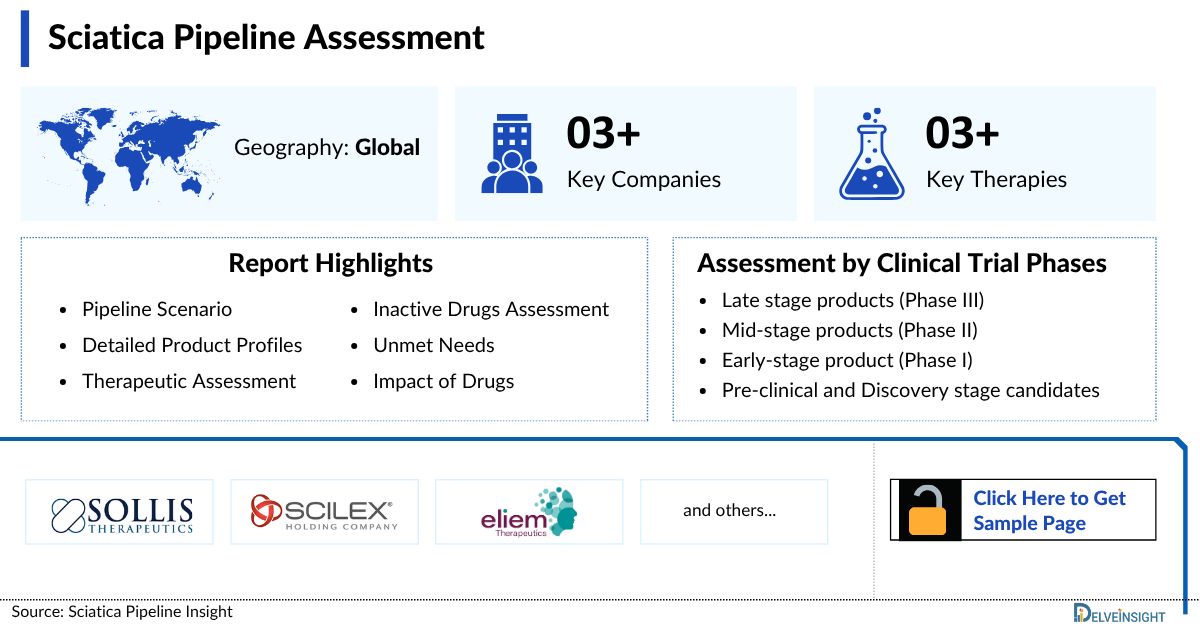
DelveInsight’s, “Sciatica Pipeline Insight, 2026” report provides comprehensive insights about 3+ companies and 3+ pipeline drugs in Sciatica pipeline landscape. It covers the pipeline drug profiles, including clinical and nonclinical stage products. It also covers the therapeutics assessment by product type, stage, route of administration, and molecule type. It further highlights the inactive pipeline products in this space.
Geography Covered
- Global coverage
Sciatica Disease Understanding
Sciatica Overview
Sciatica is a debilitating condition characterized by pain, tingling, or numbness along the distribution of the sciatic nerve or its lumbosacral nerve roots. Although the term is often incorrectly used to describe any form of low back or radiating leg pain, true sciatica specifically results from irritation or pathology of the sciatic nerve or its originating nerve roots (L4–S3). As the body's largest nerve, the sciatic nerve plays a critical role in motor function of the lower limbs and sensory innervation of the lower leg and foot. Symptoms are typically aggravated by activities such as bending, twisting, lumbar flexion, or coughing. In most cases, sciatica arises from inflammation-induced nerve irritation, whereas direct nerve compression is more likely to cause significant motor deficits and warrants prompt diagnostic evaluation.
Sciatica can result from any condition that compresses or irritates the sciatic nerve or its lumbosacral nerve roots. The most common cause is a herniated or bulging lumbar intervertebral disc, while lumbar spinal stenosis is a frequent cause in older adults. Other potential causes include spondylolisthesis, lumbar or pelvic muscle inflammation or spasms, and space-occupying lesions such as spinal or paraspinal tumors, epidural hematomas, or epidural abscesses, all of which can exert pressure on the nerve and produce characteristic sciatic symptoms.
The sciatic nerve is formed by the fusion of the L4–S3 nerve roots within the pelvis and exits through the greater sciatic foramen before descending beneath the piriformis muscle into the posterior thigh. It travels along the back of the thigh and divides in the popliteal fossa into the tibial and common fibular (peroneal) nerves. Sciatica develops when the sciatic nerve or its nerve roots are irritated, inflamed, or compressed at any point along this anatomical pathway, resulting in the characteristic symptoms of radiating pain and neurological dysfunction.
Sciatica is primarily a clinical diagnosis based on a comprehensive patient history and physical examination. Imaging is generally not required during the initial evaluation unless serious underlying pathology is suspected. Plain radiographs or computed tomography (CT) may be used to assess fractures or spondylolisthesis, while magnetic resonance imaging (MRI) is the preferred modality for patients with persistent symptoms lasting more than 6–8 weeks despite conservative treatment or when neurological deficits or suspected nerve compression require prompt evaluation to identify the underlying cause and guide appropriate management.
The management of sciatica focuses on relieving pain, improving function, and addressing the underlying cause. Initial treatment includes patient education on lifestyle modifications, such as applying hot or cold packs, avoiding activities that exacerbate symptoms or prolonged sitting and standing, maintaining proper posture, strengthening core muscles, performing gentle lumbar and hamstring stretches, engaging in low-impact exercises such as walking or swimming, and using correct lifting techniques. Medical management may involve nonsteroidal anti-inflammatory drugs (NSAIDs), analgesics, muscle relaxants, anticonvulsants for neuropathic pain, oral or localized corticosteroids, and supportive therapies such as physical therapy, spinal manipulation, deep tissue massage, and acupuncture. In cases of persistent symptoms or structural abnormalities, including disc herniation, epidural hematoma, epidural abscess, or spinal tumors, surgical evaluation and appropriate intervention may be warranted.
"Sciatica Pipeline Insight, 2026" report by DelveInsight outlays comprehensive insights of present scenario and growth prospects across the indication. A detailed picture of the Sciatica pipeline landscape is provided which includes the disease overview and Sciatica treatment guidelines. The assessment part of the report embraces, in depth Sciatica commercial assessment and clinical assessment of the pipeline products under development. In the report, detailed description of the drug is given which includes mechanism of action of the drug, clinical studies, NDA approvals (if any), and product development activities comprising the technology, Sciatica collaborations, licensing, mergers and acquisition, funding, designations and other product related details.
Sciatica Pipeline Report Highlights
The companies and academics are working to assess challenges and seek opportunities that could influence Sciatica R&D. The therapies under development are focused on novel approaches to treat/improve Sciatica.
Sciatica Emerging Drugs Chapters
This segment of the Sciatica report encloses its detailed analysis of various drugs in different stages of clinical development, including Phase III, II, I, Preclinical and Discovery. It also helps to understand clinical trial details, expressive pharmacological action, agreements and collaborations, and the latest news and press releases.
Sciatica Emerging Drugs
C-1101: Consano Bio
C-1101 is an investigational platelet-derived, multi-protein biologic therapy being developed by Consano Bio for the treatment of chronic painful lumbosacral radiculopathy (LSR), commonly known as chronic sciatica. The therapy consists of a purified solution of cytokines, growth factors, and matrix proteins derived from human platelets and plasma from healthy donors, and is administered as a single epidural injection directly to the site of nerve injury. Unlike conventional therapies that primarily provide symptomatic pain relief, C-1101 is designed as a disease-modifying, non-opioid treatment that targets the underlying pathology by modulating inflammation, promoting reparative inflammation, and stimulating cellular proliferation and nerve tissue repair. Preclinical studies have demonstrated anti-inflammatory activity, enhanced local cell proliferation, neuronal repair, and reduced neuropathic pain, supporting its therapeutic potential. C-1101 is currently being evaluated in a first-in-human Phase I randomized, blinded, dose-escalation clinical trial to assess its safety, tolerability, and preliminary efficacy in patients with chronic sciatica. The program has also received FDA Investigational New Drug (IND) clearance to support expansion of its clinical development in the United States.
Further product details are provided in the report...
Sciatica Therapeutic Assessment
This segment of the report provides insights about the different Sciatica drugs segregated based on following parameters that define the scope of the report, such as:
Major Players in Sciatica
There are approx. 3+ key companies which are developing the therapies for Sciatica. The companies which have their Sciatica drug candidates in the most advanced stage, i.e. Phase III include, Consano Bio.
Sciatica Pipeline Drugs Phases
DelveInsight’s report covers around 3+ products under different phases of clinical development like
- Late stage products (Phase III)
- Mid-stage products (Phase II)
- Early-stage product (Phase I) along with the details of
- Pre-clinical and Discovery stage candidates
- Discontinued & Inactive candidates
Sciatica Drugs Route of Administration
Sciatica pipeline report provides the therapeutic assessment of the pipeline drugs by the Route of Administration. Products have been categorized under various ROAs such as
- Oral
- Intravenous
- Subcutaneous
- Parenteral
- Topical
Sciatica Drugs Molecule Type
Products have been categorized under various Molecule types such as
- Recombinant fusion proteins
- Small molecule
- Monoclonal antibody
- Peptide
- Polymer
- Gene therapy
Sciatica Pipeline Product Type
- Drugs have been categorized under various product types like Mono, Combination and Mono/Combination.
Sciatica Pipeline Development Activities
The Sciatica Pipeline report provides insights into different therapeutic candidates in Phase III, II, I, preclinical and discovery stage. It also analyses Sciatica therapeutic drugs key players involved in developing key drugs.
Sciatica Clinical Trials and Development Activities
The Sciatica Pipeline clinical trials analysis report covers the detailed information of collaborations, acquisition and merger, licensing along with a thorough therapeutic assessment of emerging Sciatica drugs.
Sciatica Pipeline Report Insights
- Sciatica Pipeline Analysis
- Sciatica Therapeutic Assessment
- Sciatica Pipeline Unmet Needs
- Impact of Sciatica Drugs
Sciatica Pipeline Report Assessment
- Sciatica Pipeline Product Profiles
- Sciatica Therapeutic Assessment
- Sciatica Pipeline Assessment
- Inactive Sciatica Pipeline drugs assessment
- Sciatica Pipeline Unmet Needs
Key Questions Answered in the Sciatica Pipeline Report:
- Current Treatment Scenario and Emerging Therapies:
- How many companies are developing Sciatica drugs?
- How many Sciatica drugs are developed by each company?
- How many emerging drugs are in mid-stage, and late-stage of development for the treatment of Sciatica?
- What are the key collaborations (Industry–Industry, Industry–Academia), Mergers and acquisitions, licensing activities related to the Sciatica therapeutics?
- What are the recent trends, drug types and novel technologies developed to overcome the limitation of existing therapies?
- What are the clinical studies going on for Sciatica and their status?
- What are the key designations that have been granted to the emerging drugs?
Key Sciatica Companies
- Consano Bio
- Kolon Life Science
Key Sciatica Pipeline Products
- C-1101
- KLS-2031