Sciatica Market
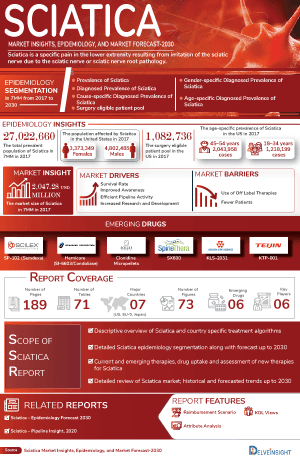
- The Sciatica Treatment Market is expected to grow with a significant CAGR during the Study Period (2019-2032)
- Sciatica Market is anticipated to grow during the forecast period (2023–2032) due to the expected launch of therapies by several Sciatica Companies such as Scilex Pharmaceuticals, Sollis Therapeutics, Spine Thera, Sinfonia Biotherapeutics, and others having their assets in the mid-late stage of development.
- DelveInsight’s analyst estimated that there had been an increase in Sciatica occurrences in recent years, which may be due to increased awareness and understanding of the disease.
- Sciatica Treatment involves corticosteroids, muscle relaxants, NSAIDs, opioid analgesics, antidepressants, and others administered to reduce pain and manage inflammation in Sciatica patients.
- A negative impact on the Sciatica Treatment Market was observed during the COVID-19 Outbreak, resulting in decreased patient visits to hospitals and diagnoses.
Request for unlocking the CAGR of the Sciatica Treatment Market
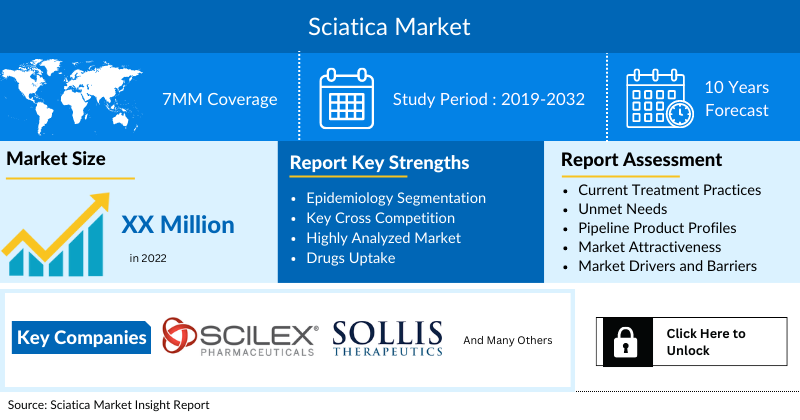
DelveInsight’s report titled “Sciatica Treatment Market Insights, Epidemiology, and Market Forecast 2032” comprehensively analyzes sciatica. The Sciatica Treatment Market Report includes a detailed examination of the historical and projected epidemiology data that includes diagnosed prevalent cases of sciatica, segmented by age and sciatica-associated comorbidities. The Sciatica Treatment Market Report offers an in-depth understanding of the various aspects related to the patient population, including diagnosis, prescriptions patterns, physician perspectives, market access, treatment, and future market developments for the seven major markets, including the United States, EU4 (Germany, France, Italy, and Spain) and the UK, and Japan from 2019 to 2032.
|
Study Period |
2019 to 2032 |
|
Forecast Period |
2023-2032 |
|
Geographies Covered |
|
|
Sciatica Market |
|
|
Sciaticas Market Size | |
|
Sciatica Companies |
|
|
Sciatica Epidemiology Segmentation |
|
Sciatica Treatment Market
Sciatica is pain that spreads down the route of the sciatic nerve, which runs from the lower back to the hips and buttocks and down each leg. It is often described as shooting pain, with symptoms present only on one side of the body. The compression of lumbar nerves L4 or L5 or sacral nerve S1 generally causes sciatica. Less commonly, sacral nerves S2 or S3, or compression of the sciatic nerve itself, may cause sciatica. Sciatica can be caused due to age-related changes to the spine, obesity, occupations where one picks up heavy loads, prolonged sitting, and diabetes; most sciatica cases occur due to a spinal disc bulge or herniation. Spondylolisthesis, musculoskeletal pain disorders, piriformis syndrome, pelvic tumors, and pregnancy are other possible causes of sciatica. Sciatica is further classified as acute, chronic, alternating, bilateral, and wallet sciatica. It is typically diagnosed by physical examination and the history of the symptoms.
Sciatica Diagnosis and Treatment
Diagnosis of Sciatica is based on physical examination, medical history, and imaging tests that include computed tomography (CT scan), magnetic resonance imaging (MRI), and X-ray to help visualize the structures of the spine and rule out conditions such as herniated discs, spinal stenosis, or other abnormalities that may be compressing the Sciatic nerve. An accurate and effective diagnostic method involves nerve block injection. The diagnosis is associated with various challenges, including difficult differential diagnosis and risk of bleeding, nerve damage, and spinal cord tissue damage.
Pharmacological therapies (opioids, muscle relaxants, NSAIDs, steroids, antidepressants, painkillers, etc.) help reduce Sciatica pain. A discectomy or surgery provides pain relief for up to 2 years in patients suffering from sciatica caused by a herniated disc and spinal stenosis. There is a significant unmet need without approved therapies and untargeted treatment approaches.
Sciatica Epidemiology
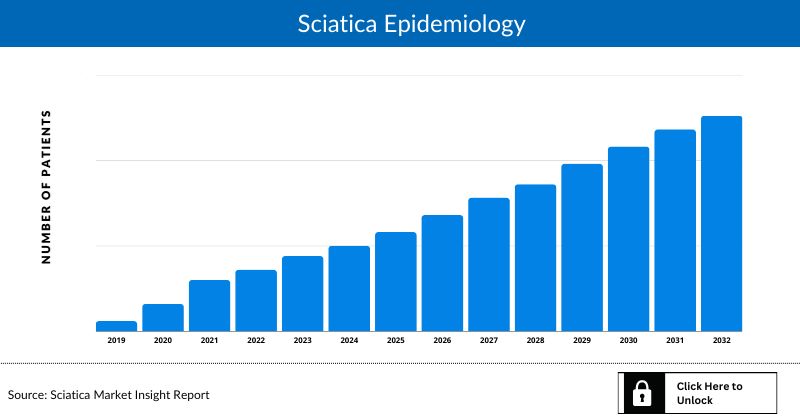
The Sciatica epidemiology section provides insights into the historical and current Sciatica patient pool and forecasted trends for seven individual major countries. It helps to recognize the causes of current and forecasted trends by exploring numerous studies and views of key opinion leaders. This also provides the diagnosed patient pool, its trends, and assumptions undertaken. The epidemiology section of the Sciatica Treatment Market Report offers information on the patient populations, including historical and projected trends for each of the seven major markets. Examining key opinion leader views from physicians or clinical experts can assist in identifying the reasons behind historical and projected trends. The Sciatica Diagnosed Patient Pool, their trends, and the underlying assumptions are all included in this section of the report.
Key Findings
- Clarke et al. (2016) state that 54.5% of US adults suffer from a musculoskeletal pain disorder. Musculoskeletal disorders include lower back pain, sciatica, neck pain, and joint pain. The estimates were based on the National Health Interview Survey (2012) involving the US adult population. As per the estimates, around 12 million people are affected by Sciatica in the US.
- As per Koes et al. (2007), in 90% of cases, sciatica is caused by a herniated spinal disc pressing on one of the lumbar or sacral nerve roots.
- According to Davis et al. (2022), there appears to be no gender predominance in patients suffering from sciatica, with a lifetime incidence reported to be between 10% and 15%.
- In Japan, Matsudaira et al. (2013) reported the results of prospective cohort data collected for the Japanese epidemiological research on occupation-related back pain. It indicated that 18.4% of eligible participants had a new sciatica episode among Japanese workers.
Sciatica Market Outlook
Various factors fuel the growth of the effective Sciatica Treatment Market. The sedentary lifestyle where prolonged sitting, increased occurrence of herniated discs, other risk factors, including occupation where one picks up heavy loads, and growing age, are some of the reasons contributing to the high prevalence of acute and chronic sciatica. Greater awareness and understanding among Sciatica Patients and healthcare professionals has led to their earlier diagnosis and treatment initiation processes. Improved diagnostic techniques and increased healthcare access have also contributed to the identification of more cases, thus significantly increasing the demand for the Sciatica treatment market.
Moreover, one of the major reasons for this dynamic shift in the Sciatica Market Growth is the rising geriatric population globally. Older individuals are more prone to conditions such as herniated discs and degenerative disc diseases, which are common causes of sciatica. Drugs commonly prescribed for managing sciatica include non-steroidal anti-inflammatory drugs (NSAIDs), skeletal muscle relaxants, opioid analgesics, benzodiazepines, systemic corticosteroids, antidepressants, and anticonvulsants.
While many variables propel the growth of the sciatica treatment market, the absence of approved Sciatica therapies is a hurdle to market expansion. Additionally, there are a few non-therapeutic approaches that the patients utilize. Physical therapy, medications, injections, non-surgical and surgical treatments, and alternative therapies, including chiropractic care or acupuncture, are preferred by some individuals, which impacts the demand for medical treatments. The lack of universally accepted treatment guidelines for sciatica has resulted in different treatment approaches among healthcare professionals, leading to inconsistencies in care and potentially suboptimal outcomes. The Sciatica treatment market suffered during COVID-19 due to decreased hospital visits.
"According to DelveInsight, the Sciatica Treatment Market in the 7MM is expected to change significantly during the study period, 2019–2032"
Sciatica Drugs Market Chapters
Marketed Sciatica Drugs
The current Sciatica Treatment Market Landscape lacks disease-modifying therapies and treatment guidelines for sciatica. While symptomatic treatments are widely used, they only show mild to moderate efficacy in relieving pain. There is no FDA-approved drug; the medications commonly used for Sciatica management are often prescribed off-label. NSAIDs such as ibuprofen (Advil, Motrin) and naproxen (Aleve) are commonly used to reduce inflammation and alleviate pain associated with sciatica. Oral steroids, such as prednisone, may be prescribed to reduce inflammation and provide temporary relief from severe sciatica symptoms. Muscle relaxants such as cyclobenzaprine (Flexeril) and methocarbamol (Robaxin) can help relieve muscle spasms and associated pain in sciatica. Anticonvulsant drugs such as gabapentin (Neurontin) and pregabalin (Lyrica) are often prescribed to manage nerve-related pain, including the shooting or burning pain associated with sciatica. Opioids are prescribed for the short term in severe cases of sciatica.
Emerging Sciatica Drugs
The currently available treatments for sciatica aim to mitigate the complications associated with the pain. Due to the approval of emerging drugs, the Sciatica market dynamics are expected to change. Sciatica market players such as Scilex Pharmaceuticals, Sollis Therapeutics, Spine Thera, and Sinfonia Biotherapeutics are actively involved in developing Sciatica treatments.
- SEMDEXA (SP-102): Scilex Pharmaceuticals
Scilex Pharmaceuticals is developing the first non-opioid novel injectable corticosteroid gel formulation product to relieve lumbosacral radicular pain (sciatica), a specific type of leg pain in patients. Dexamethasone sodium phosphate injectable gel acts as a glucocorticoid receptor agonist. It is based on the pre-filled syringe and will be administered by epidural injection. SP-102 received Fast Track status from the FDA in 2021; currently, it is being evaluated in a pivotal Phase III Sciatica clinical trials in the US in patients with lumbosacral radicular pain (Sciatica).
- STX-015: Sollis Therapeutics
STX-015, developed by Sollis Therapeutics, is an alpha 2 adrenergic receptor agonist being evaluated to assess the safety and effectiveness in treating low back and leg pain from sciatica. Currently, it is in the Phase III stage of Sciatica clinical trials evaluation.
|
Drug |
Sciatica MOA |
RoA |
Company |
Phase |
|
SEMDEXA (SP-102) |
Glucocorticoid receptor agonists |
Via Injection (at the site of injury) |
Scilex Pharmaceuticals |
III |
|
STX-015 |
Alpha adrenergic receptor agonist |
XX |
Sollis Therapeutics |
III |
|
SB0101 |
XX |
XX |
Sinfonia Biotherapeutics |
II |
Note: Detailed emerging therapies assessment will be provided in the final report.
Sciatica Market Segmentation
DelveInsight’s ‘Sciatica Treatment Market Insights, Epidemiology, and Market Forecast – 2032’ report provides a detailed outlook of the current and future Sciatica market, segmented within countries, by therapies, and by classes. Further, the market of each region is then segmented by each therapy to provide a detailed view of the current and future Sciatica Drugs Market Share of all therapies.
Sciatica Market Size by Countries
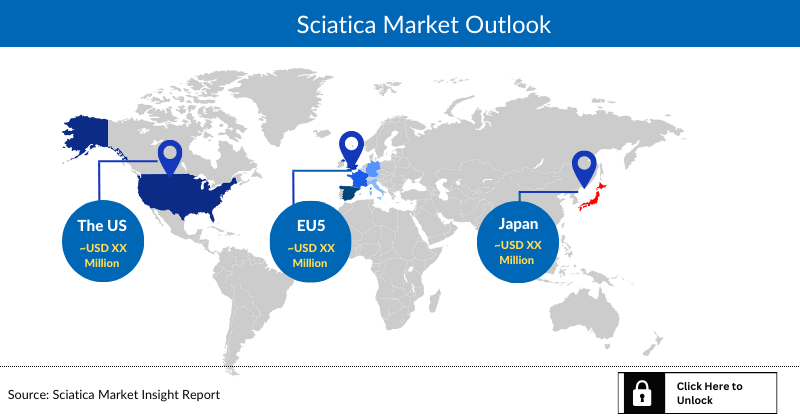
The total Sciatica Treatment Market Size is analyzed for individual countries (the United States Market, EU4 (Germany, France, Italy, and Spain) and the UK market, and Japan). The United States accounted for a larger portion of the 7MM market for sciatica in 2022 due to the high prevalence of the condition and the higher cost of treatments. This dominance is predicted to continue with the potential early entry of new products.
Sciatica Market Size by Therapies
To depict each nation’s distinct historical and projected market shares, the Sciatica market is separated by therapies and medication classes. Various currently used therapies involve NSAIDs, corticosteroids, muscle relaxants, anticonvulsants, opioid analgesics, etc. NSAIDS such as ibuprofen and naproxen reduce inflammation associated with sciatica. Steroids may be prescribed to reduce inflammation and provide temporary relief from severe sciatica symptoms. Muscle relaxants (cyclobenzaprine and methocarbamol) can help relieve muscle spasms and associated pain in sciatica. Anticonvulsant drugs are often prescribed to manage nerve-related pain, including the shooting or burning pain associated with sciatica. Opioids are prescribed for the short term in severe cases of sciatica. A considerable cost of treatment, limited access to advanced therapies in certain regions, and the complexity of pain relief are some of the major challenges hindering the Sciatica market growth.
Sciatica Drugs Uptake
This section focuses on the sales uptake of potential Sciatica drugs that have recently been launched or are anticipated to be launched in the Sciatica market between 2019 and 2032. It estimates the market penetration of the Sciatica drugs for a given country, examining their impact within and across classes and segments. It also touches upon the financial and regulatory decisions contributing to the probability of success (PoS) of the drugs in the Sciatica market. The emerging Sciatica therapies are analyzed based on various attributes such as safety and efficacy in randomized Sciatica Clinical Trials, order of entry, other market dynamics, and the unmet need they fulfill in the Sciatica Drugs Market.
Sciatica Market Access and Reimbursement
DelveInsight’s ‘Sciatica – Market Insights, Epidemiology, and Market Forecast – 2032’ report provides a descriptive overview of the market access and reimbursement scenario of sciatica. This section includes a detailed analysis of the country-wise healthcare system for each therapy, enlightening the market access, reimbursement policies, and health technology assessments.
KOL Views
To keep up with current Sciatica market trends and fulfill gaps in secondary findings, we interview KOLs and SMEs’ working in the Sciatica domain. Their opinion helps understand and validate current and emerging therapies, treatment patterns, or Sciatica market trends. This will support the clients in potential upcoming novel treatments by identifying the overall scenario of the market and the Sciatica unmet needs.
Sciatica: KOL Insights
DelveInsight’s analysts connected with 50+ KOLs to gather insights; however, interviews were conducted with 15+ KOLs in the 7MM. These KOLs were from organizations, institutes, and hospitals, such as Nantes Université in France, the Department of Neurological Surgery at Duke University Medical Center, and Durham in the US.
- “Sciatica is becoming more common in the US with the increasing geriatric population due to age being a great risk factor for the condition.”
- “From an etiological standpoint, about 90% of Sciatica cases are attributed to spinal disc herniation, others resulting from spondylolisthesis, muscle spasm in the back or buttock, spinal stenosis, and pelvic tumors.”
Competitive Intelligence Analysis
We perform Competitive and Market Intelligence analysis of the Sciatica Market using various Competitive Intelligence tools, including SWOT analysis, Market entry strategies, etc. The inclusion of the analysis entirely depends upon the data availability.
Sciatica Pipeline Development Activities
The Sciatica Therapeutics Market Report provides insights into Sciatica clinical trials within the Phase II and III stages. It also analyses Sciatica Companies involved in developing targeted therapeutics.
Pipeline Development Activities
The Sciatica Therapeutics Market Report covers information on collaborations, acquisitions and mergers, licensing, patent details, and other information for emerging Sciatica therapies.
Sciatica Therapeutics Market Report Insights
- Patient-based Sciatica Market Forecasting
- Sciatica Therapeutic Approaches
- Sciatica Pipeline Drugs Analysis
- Sciatica Market Size and Trends
- Sciatica Drugs Market Opportunities
- Impact of Upcoming Therapies
Sciatica Therapeutics Market Report Key Strengths
- 10 years Sciatica Market Forecast
- 7MM Coverage
- Sciatica Epidemiology Segmentation
- Key Cross Competition
- Highly Analyzed Sciatica Drugs Market
- Sciatica Drugs Uptake
Sciatica Therapeutics Market Report Assessment
- Current Sciatica Treatment Market Practices
- Sciatica Unmet Needs
- Sciatica Pipeline Drugs Profiles
- Sciatica Drugs Market Attractiveness
- Sciatica Market Drivers
- Sciatica Market Barriers
Key Questions Answered
- What are the key findings of the Sciatica Drugs Market across 7MM, and what country will have the largest Sciatica market size during the forecast period (2023–2032)?
- What would be the Sciatica Drugs Market Growth till 2032, and what will be the resultant market size in 2032?
- What are the major causes of sciatica, and how is it diagnosed?
- At what CAGR is the Sciatica Drugs Market, and is epidemiology expected to grow in the 7MM during the forecast period (2023–2032)?
- How would the unmet needs impact the Sciatica Market Dynamics and subsequently influence the analysis of related trends?
- What would be the forecasted patient pool of sciatica in the 7MM, covering the United States, EU4 (Germany, France, Italy, and Spain), the UK, and Japan?
- What are the current treatment guidelines and options for Sciatica in the US, Europe, and Japan?
- What are the latest advancements in novel therapies, targets, Sciatica Mechanisms of Action, and technologies being developed to address the limitations of existing therapies for sciatica?
- How many companies are currently engaged in the development of therapies for Sciatica Treatment?
Stay updated with us for Recent Articles