Sleep Apnea Market Summary
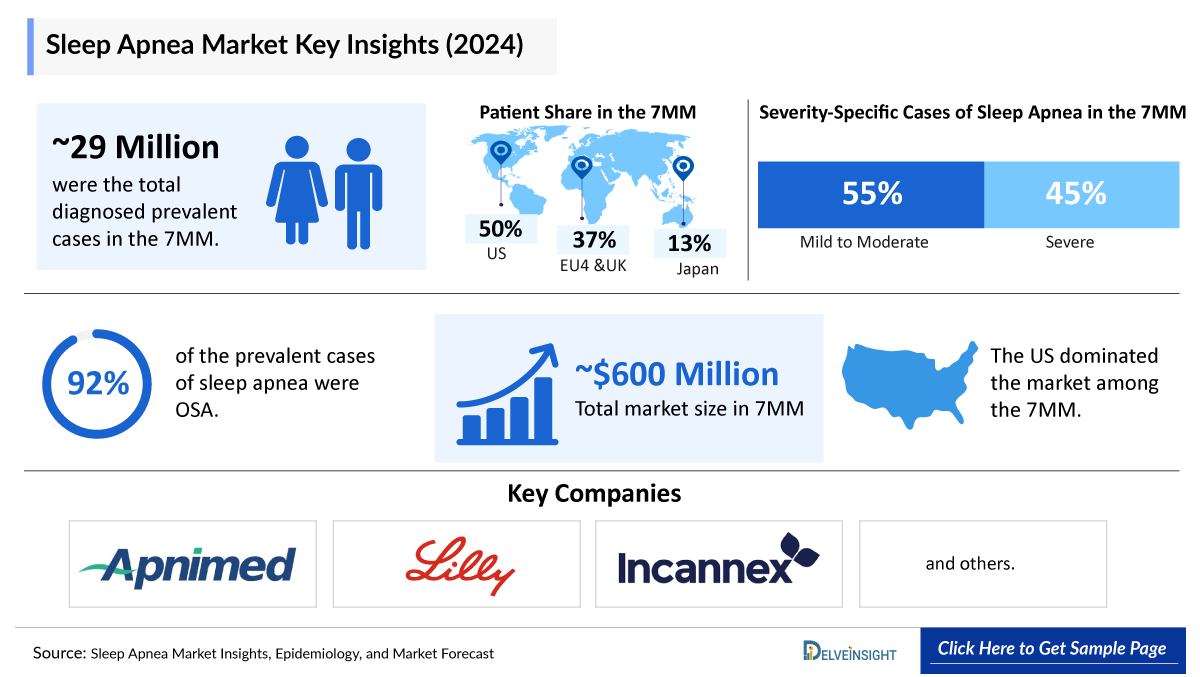
- According to DelveInsight’s analysis, the United States accounted for approximately 75% of the 7MM sleep apnea market in 2025, highlighting the substantial concentration of market value in the US compared with the EU4, the United Kingdom, and Japan.
- In 2025, the total number of diagnosed prevalent cases of sleep apnea in the 7MM was approximately 30 million. Among the 7MM countries, the US accounted for the highest number of diagnosed prevalent cases approximately 15 million.
- The marketed landscape of sleep apnea remains relatively concentrated, reflecting the continued dominance of device-based treatment and the limited number of pharmacological options. ZEPBOUND (tirzepatide) addresses moderate-to-severe obstructive sleep apnea (OSA) in adults with obesity, while SUNOSI (solriamfetol) and OZAWADE (pitolisant) primarily target excessive daytime sleepiness associated with OSA. In contrast, continuous positive airway pressure (CPAP), automatic positive airway pressure (APAP), and bilevel positive airway pressure (BiPAP) remain the cornerstone of OSA management, with oral appliances and surgical interventions providing additional options for selected patients, highlighting the continued reliance on non-pharmacological approaches.
- Sleep Apnea clinical assessment relies on a combination of objective physiological measures and patient-reported outcomes to capture both disease severity and its functional impact. Apnea-hypopnea index (AHI) remains the key objective endpoint, supported by measures such as oxygen desaturation, respiratory events, and CPAP adherence to evaluate treatment response. Increasingly, long-term studies also assess cardiovascular outcomes, blood pressure, mortality, work productivity, and quality of life, reflecting the broader systemic and functional burden of sleep apnea.
- Adult population, particularly 18-69 years, contributes to a growing sleep apnea patient pool because advancing age is associated with an increased risk of sleep-disordered breathing and related comorbidities. The patient pool is likely to favor treatments that can provide durable disease control, improve sleep quality and daytime functioning, and remain suitable for long-term management.
- The development pipeline for sleep apnea therapies is dynamic and expanding, with a strong focus on addressing the unmet needs of OSA. Several leading pharmaceutical companies are advancing novel treatments through various stages of clinical development. Eli Lilly is progressing with promising candidates such as retatrutide and orforglipron, while Incannex Healthcare is developing IHL-42X, a combination therapy of acetazolamide and dronabinol. Apnimed is also making strides with AD109, which combines aroxybutynin and atomoxetine.
DelveInsight’s “Sleep Apnea Market Insights, Epidemiology, and Market Forecast – 2036” report delivers an in-depth understanding of sleep apnea, historical and forecasted epidemiology, as well as the sleep apnea therapeutics market trends in the United States, EU4 (Germany, France, Italy, and Spain), the United Kingdom, and Japan.
The sleep apnea market report delivers a comprehensive analysis of the current treatment landscape, including standards of care, clinical practices, and evolving therapeutic algorithms. It evaluates, sleep apnea patient burden trends, revenue & market share dynamics, peak patient share & therapy uptake analysis, and provides an in-depth market size assessment and growth rate projections (Historical & Forecast 2022–2036) across the 7MM regions. The report highlights key unmet medical needs in sleep apnea and maps the competitive and clinical landscape to uncover high-value opportunities, providing a clear outlook on future market growth potential.
Sleep Apnea Disease Understanding
Sleep Apnea Overview
Sleep apnea is a common and persistent sleep-related breathing disorder characterized by recurrent episodes of partial or complete interruption of breathing during sleep. It is associated with substantial clinical and socioeconomic burden, including impaired sleep quality, excessive daytime sleepiness, cognitive and functional impairment, and reduced quality of life. Sleep apnea may occur as obstructive, central, or complex sleep apnea, with symptoms frequently overlapping across subtypes, contributing to diagnostic challenges. The condition is also associated with comorbidities and neuropsychiatric consequences, including cardiovascular and metabolic disorders, depression, anxiety, memory deficits, and impaired attention, while underdiagnosis and poor treatment adherence remain important barriers to effective disease management.
Sleep Apnea Diagnosis
The diagnosis of sleep apnea involves a comprehensive sleep evaluation aimed at identifying abnormal breathing during sleep, determining the underlying type of sleep-disordered breathing, and assessing symptom severity and associated risk factors. Diagnosis typically begins with a detailed medical and sleep history, including assessment of snoring, witnessed apneas, gasping or choking during sleep, excessive daytime sleepiness, and relevant comorbidities. Screening tools such as the STOP-Bang questionnaire may be used to assess the risk of OSA but should not be used as a standalone diagnostic test. Polysomnography (PSG) is the standard diagnostic test, while home sleep apnea testing (HSAT) may be used in uncomplicated adults with symptoms indicating an increased risk of moderate-to-severe OSA. PSG is preferred when HSAT is negative, inconclusive, or technically inadequate, and in patients with significant cardiorespiratory disease, suspected hypoventilation, neuromuscular weakness, chronic opioid use, prior stroke, or severe insomnia.
Further details related to country-based variations are provided in the report...
Current Sleep Apnea Treatment Landscape
The management of sleep apnea requires a multimodal and individualized approach that addresses disease severity, type of sleep apnea, underlying risk factors, comorbidities, and treatment tolerance. Because sleep apnea may be obstructive, central, or complex in nature, treatment is tailored to the predominant type and the patient’s clinical profile. Current management combines positive airway pressure therapy, pharmacological therapies, lifestyle modifications, oral appliances, and surgical interventions, with the goal of reducing abnormal breathing events, improving sleep quality and daytime symptoms, and supporting long-term disease control.
Positive airway pressure (PAP) therapy, particularly CPAP, remains the main treatment for moderate-to-severe OSA, while automatic PAP and bilevel PAP may be used in selected patients. However, adherence can be challenging because of discomfort and inconvenience, with many patients discontinuing or inconsistently using treatment. Lifestyle measures such as weight loss, avoiding alcohol, smoking cessation, adequate sleep, and positional therapy can also help reduce OSA severity. Oral appliances, particularly mandibular advancement devices, may be used in patients who cannot tolerate or prefer not to use CPAP.
Further details related to country-based variations are provided in the report...
Sleep Apnea Unmet Needs
The section “unmet needs of sleep apnea” outlines the critical gaps between the current state of patient care, diagnosis, and the ideal & effective management of the disease. It highlights the obstacles experienced by patients, clinicians, and researchers and identifies potential solutions for future progress.
1. Need for non-device-based therapies and improved diagnostic accuracy and access
2. Need for better patient adherence strategies
3. Lack of integrated care for comorbid conditions
4. Impact on cognitive and mental health undervalued, and others…
Note: Comprehensive unmet needs insights in sleep apnea and their strategic implications are provided in the full report...
Sleep Apnea Epidemiology
The Sleep Apnea epidemiology section provides insights about the historical and current Sleep Apnea patient pool and forecasted trends for individual seven major countries. It helps to recognize the causes of current and forecasted trends by exploring numerous studies and views of key opinion leaders. This part of the Sleep Apnea market report also provides the diagnosed patient pool and their trends along with assumptions undertaken.
Key Findings from Sleep Apnea Epidemiological Analysis and Forecast
- In 2025, the total number of diagnosed prevalent cases of sleep apnea in the 7MM was around 30 million. Among the 7MM countries, the US accounted for the highest number of diagnosed prevalent cases, contributing approximately 15 million cases.
- According to DelveInsight’s analysis, more than 10 million males and 5 million females were affected with sleep apnea in the US in 2025, reflecting a persistent gender disparity and a growing overall burden.
- Across EU4 and the UK, approximately 10 million diagnosed prevalent cases were reported in 2025. Germany accounted for the largest share, contributing around 4 million diagnosed prevalent cases, followed by the France.
- According to DelveInsight’s estimates, mild sleep apnea accounted for the highest number of diagnosed prevalent cases across EU4 and the UK in 2025, with approximately 6 million cases, followed by moderate to severe (~5 million cases).
- Japan accounted for nearly 4 million diagnosed prevalent cases of sleep apnea in 2025.
- According to Sönmez et al., 2025, a total of 83.7 million adults (aged 20 years and older) were estimated to be living with OSA in the US in 2024, of whom 59% were males and 41% females. This translates to 32.4% overall prevalence in the US among adults aged 20 years and older, with 39.1% among males and 26.0% in females, adjusting for obesity. The distribution of OSA severity was estimated to be 52% mild, 30% moderate, and 18% severe highlighting that the burden of OSA in the US appears substantially higher than clinically recognized.
- The sleep apnea landscape is characterized by a substantial gap between the estimated disease burden and recognized cases, particularly in the US, where the high underlying prevalence of OSA indicates that a considerable proportion of affected individuals may remain undiagnosed. This persistent diagnostic gap highlights an opportunity for improved screening and diagnosis to identify currently unrecognized patients and expand the addressable population for sleep apnea management.
Sleep Apnea Epidemiology Segmentation
Recent Developments in the Sleep Apnea Treatment Landscape:
- In September 2026, Japan's Ministry of Health, Labour and Welfare has granted approval for WAKIX (pitolisant) for the treatment of excessive daytime sleepiness (EDS) associated with obstructive sleep apnea syndrome (OSAS) in patients receiving treatment for airway obstruction, and approval for narcolepsy.
- In August 2026, First patient was dosed with IHL-42X (dronabinol + acetazolamide) in the DReAMzz Phase II dose-optimization study, following positive Phase II RePOSA results, including individual AHI (Apnea-Hypopnea Index) reductions of up to 83%.
- In July 2026, FDA accepted the NDA for AD109 (aroxybutynin + atomoxetine) and assigned a PDUFA date of February 28, 2027.
- In May 2026, Apnimed published Phase III SynAIRgy results for AD109, reporting a 55.6% reduction in AHI at Week 26 versus placebo.
Sleep Apnea Drug Analysis & Competitive Landscape
The sleep apnea drug chapter provides a detailed, market-focused review of approved therapies and the emerging pipeline across Phase I-III Sleep Apnea clinical trials. It covers mechanism of action, clinical trial data, regulatory approvals, patents, collaborations, strategic partnerships upcoming key catalyst for each therapy, along with their advantages, limitations, and recent developments. This section offers critical insights into the sleep apnea treatment landscape, supporting market assessment, competitive analysis, and growth forecasting for the sleep apnea therapeutics market.
Approved Therapies Sleep Apnea
ZEPBOUND/MOUNJARO (tirzepatide): Eli Lilly and Company
ZEPBOUND is a Glucose-dependent Insulinotropic Polypeptide (GIP) receptor and Glucagon-like Peptide-1 (GLP-1) receptor agonist indicated in combination with a reduced-calorie diet and increased physical activity to treat moderate-to-severe OSA in adults with obesity.
- In February 2026, FDA approved a label expansion for ZEPBOUND to include the four-dose, single-patient-use KwikPen, providing an additional monthly administration option in the US.
- In December 2024, ZEPBOUND (tirzepatide) was approved for the treatment of moderate-to-severe OSA in adults with obesity, to be used in combination with a reduced-calorie diet and increased physical activity.
Note: Detailed marketed therapies assessment will be provided in the final report...
Sleep Apnea Pipeline Analysis
Aroxybutynin + Atomoxetine (AD109): Apnimed
Aroxybutynin + atomoxetine (AD109) is an investigational first-in-class combination of aroxybutynin, a novel antimuscarinic, and atomoxetine, a NRI. AD109 is designed to target the neurobiology of the hypoglossal motor nucleus (HMN) to increase signals to the upper airway during sleep to limit or prevent upper airway collapse in people living with OSA. AD109 is also currently being studied in two large, pivotal Phase III randomized clinical trials, LunAIRo and SynAIRgy, for mild, moderate, and severe OSA
- In September 2026, Apnimed reported that AD109's proposed proprietary name is OXNIMBI and that the NDA remains under FDA review.
- In April 2025, Apnimed hosted a virtual investor event, featuring sleep medicine experts Dr. Douglas Kirsch and Dr. Nathaniel Watson, who discussed the unmet medical need in OSA and evolving treatment approaches. The event included new analyses on the potential impact of pharmacotherapies, with a focus on AD109. Apnimed’s leadership also provided updates on the Phase III SynAIRgy and LunAIRo trials and shared a preview of the company’s go-to-market strategy for AD109.
Note: Detailed emerging therapies assessment will be provided in the final report...
Sleep Apnea Key Players, Market Leaders and Emerging Companies
- Axsome Therapeutics
- Bioprojet Pharma
- Apnimed
- Incannex Healthcare
- Eli Lilly and Company and more
Sleep Apnea Market Outlook
The market outlook for sleep apnea remains positive, driven by a growing patient population, increasing disease awareness, improved diagnosis, and a substantial unmet need for effective long-term therapies. Current approaches primarily focus on reducing apnea-hypopnea events, maintaining airway patency, and improving daytime symptoms through pharmacological and non-pharmacological interventions; however, many patients continue to experience persistent symptoms and inadequate disease control. A growing pipeline of novel and targeted therapies is expected to further evolve the treatment landscape, while continued research and advances in personalized and multimodal approaches may improve patient outcomes, reduce disease burden, and support market growth.
- In 2025, the sleep apnea market size in the US was around 75% which is expected to grow significantly with the introduction of emerging therapies.
- The total market size of EU4 and the UK was estimated to be more than 20% in 2025.
- Among EU4 and the UK, Germany accounted for the highest market share in 2025, followed by the France in the respective year, and UK capturing the least market with nearly 2% in 2025.
- Japan represented a smaller share of the 7MM sleep apnea market compared with the US and the combined EU4 and UK markets, although its market is expected to expand with increasing disease recognition and evolving treatment options.
Drug Class/Insights into Leading Emerging Therapies in Sleep Apnea (2026–2036 Forecast)
Novel Targeted and Mechanism-Based Therapies: Emerging therapies represent an increasingly diversified approach to sleep apnea, with candidates targeting upper-airway neuromuscular activity, ventilatory control, respiratory stability, and obesity-associated disease mechanisms. The pipeline includes small-molecule combinations, carbonic anhydrase inhibitors, GLP-1 receptor agonists, and multi-receptor agonists, alongside other mechanism-specific approaches designed to reduce apnea-hypopnea burden, improve airway patency and respiratory control, and address underlying risk factors such as obesity. These therapies may provide oral or less device-dependent treatment options for patients who are unable to tolerate or achieve adequate control with conventional PAP therapy.
Sleep Apnea Drug Uptake
This section focuses on the uptake rate of potential Sleep Apnea drugs expected to be launched in the market during the forecast period (2026–2036). The analysis covers the sleep apnea drug’s uptake, performance at peak, factors affecting performance during prime years of growth, patient uptake by therapy, and anticipated sales generated by each drug.
The emerging sleep apnea treatment landscape is expected to show differentiated uptake based on clinical efficacy, development stage, and ability to address unmet needs. AD109 (aroxybutynin + atomoxetine) and IHL-42X (acetazolamide + dronabinol) are projected to achieve slow-to-medium uptake, reflecting their clinical progress and development stage, while retatrutide and orforglipron are expected to demonstrate medium uptake, supported by their potential to provide pharmacological options for patients with sleep apnea and overweight or obesity. Collectively, these therapies are expected to expand treatment options beyond conventional device-based approaches and improve disease management.
Detailed insights of emerging therapies' drug uptake is included in the report...
Market Access and Reimbursement of Therapies in Sleep Apnea
The report further provides detailed insights on the country-wise accessibility and reimbursement scenarios, cost-effectiveness scenario of therapies, programs making accessibility easier and out-of-pocket costs more affordable, insights on patients insured under federal or state government prescription drug programs, etc.
EU4 and the UK
Reimbursement is a crucial factor that affects the drug’s access to the market. Often, the decision to reimburse comes down to the price of the drug relative to the benefit it produces in treated patients. To reduce the healthcare burden of these high-cost therapies, many payment models are being considered by payers and other industry insiders.
NOTE: Further Details are provided in the final report...
Sleep Apnea Therapies Price Scenario & Trends
Pricing and analogue assessment of sleep apnea therapies highlights evolving price dynamics structures. This section summarizes the cost of approved treatments, closest and most appropriate analogue selection for emerging therapies, and understanding of how pricing influences market access, adherence, and long-term uptake.
Industry Experts and Physician Views for Sleep Apnea
To keep up with sleep apnea market trends, we take Key Opinion Leaders (KOLs) and Subject Matter Experts (SMEs) opinions working in the domain through primary research to fill the data gaps and validate our secondary research. Industry Experts were contacted for insights on the sleep apnea emerging therapies, evolving treatment landscape, patient adherence to conventional therapies, therapy switching trends, drug adoption and uptake, accessibility challenges, and epidemiology and real-world prescription patterns in sleep apnea, including MD, PhD, Instructor, Postdoctoral Researcher, Professor, Researcher, and others.
DelveInsight’s analysts connected with 30+ KOLs to gather insights at country level. Leading centers such as Harvard University, University of Pennsylvania, Université Grenoble Alpes, University of Oxford, and University of Tokyo etc., among others, were consulted to validate clinical practices, treatment patterns, and emerging therapeutic perspectives.
Their opinion helps understand and validate current and emerging sleep apnea therapies, highlight unmet medical needs, provide epidemiological context, and support strategic decisions for market access, therapy adoption, and pipeline prioritization in sleep apnea.
Sleep Apnea Report Qualitative Analysis: SWOT and Attribute Analysis
We perform qualitative and market Intelligence analysis using various approaches, such as SWOT analysis and attribute analysis.
In the SWOT analysis of sleep apnea, strengths, weaknesses, opportunities, and threats in terms of disease diagnosis, patient awareness, patient burden, competitive landscape, cost-effectiveness, and geographical accessibility of therapies are provide attribute analysis analyzes emerging therapies based on relevant attributes such as safety, efficacy, frequency of administration, route of administration, and order of entry. Scoring is given based on these parameters to analyze the effectiveness of therapy.
The team analyzed promising emerging therapies based on relevant attributes such as safety, efficacy, frequency of administration, route of administration, and order of entry. In efficacy, the trial’s primary and secondary outcome measures are evaluated, whereas the therapies’ safety is evaluated, wherein the acceptability, tolerability, and adverse events are majorly observed. In addition, the scoring is also based on the route of administration, order of entry, probability of success, and the addressable patient pool for each therapy. According to these parameters, the final weightage score and the ranking of the emerging therapies are decided.
Scope of the Sleep Apnea Market Report
- The report covers a segment of key events, an executive summary, a descriptive overview of sleep apnea, explaining their causes, signs and symptoms, pathogenesis, and currently available treatments.
- Comprehensive insight has been provided into the epidemiology segments and forecasts, the future growth potential of the diagnosis rate, and disease progression along treatment guidelines.
- Additionally, an all-inclusive account of both the current and emerging treatments, along with the elaborative profiles of late-stage and prominent therapies, will have an impact on the current treatment landscape.
- A detailed review of the sleep apnea market, historical and forecasted market size, market share by therapies, detailed assumptions, and rationale behind our approach is included in the report, covering the 7MM drug outreach.
- The report provides an edge while developing business strategies by understanding trends through SWOT analysis and expert insights/KOL views, patient journey, and treatment preferences that help in shaping and driving the 7MM sleep apnea market.
Sleep Apnea Market Report Insights
- Sleep Apnea Patient Population Forecast
- Sleep Apnea Therapeutics Market Size
- Sleep Apnea Pipeline Analysis
- Sleep Apnea Market Size and Trends
- Sleep Apnea Market Opportunity (Current and Forecasted)
Sleep Apnea Market Report Key Strengths
- Sleep Apnea Epidemiology-based (Epi-based) Bottom-up Forecasting
- Artificial Intelligence (AI) - enabled Market Research Report
- 11-year forecast
- Sleep Apnea Market Outlook (North America, Europe, Asia-Pacific)
- Sleep Apnea Patient Burden Trends (by geography)
- Sleep Apnea Treatment Addressable Market (TAM)
- Sleep Apnea Competitive Landscape
- Sleep Apnea Major Companies Insights
- Sleep Apnea Price Trends and Analogue Assessment
- Sleep Apnea Therapies Drug Adoption/Uptake
- Sleep Apnea Therapies Peak Patient Share analysis
Sleep Apnea Market Report Assessment
- Sleep Apnea Current Treatment Practices
- Sleep Apnea Unmet Needs
- Sleep Apnea Clinical Development Analysis
- Sleep Apnea Emerging Drugs Product Profiles
- Sleep Apnea Market Attractiveness
- Sleep Apnea Qualitative Analysis (SWOT and Attribute analysis)
- Sleep Apnea Market Drivers
- Sleep Apnea Market Barriers
FAQs Related to the Sleep Apnea Market Report:
Sleep Apnea Market Insights
- What was the sleep apnea market size, the market size by therapies, market share (%) distribution in 2025, and what would it look like by 2036? What are the contributing factors for this growth?
- What are the anticipated pricing variations among different geographies for the emerging therapies in the future?
- What can be the future treatment paradigm of sleep apnea?
- What are the disease risks, burdens, and unmet needs of sleep apnea? What will be the growth opportunities across the 7MM concerning the Sleep Apnea patient population?
- Who is the major future competitor in the market, and how will the competitors affect their market share?
- What are the current options for the treatment of sleep apnea? What are the current guidelines for treating sleep apnea in the US, Europe, and Japan?
Reasons to Buy Sleep Apnea Market Forecast Report
- The report will help in developing business strategies by understanding the latest trends and changing treatment dynamics driving the sleep apnea market.
- Bottom up forecasting builds from the affected population to product forecasts, delivering a robust, data driven approach ideal for new therapies and novel classes.
- Insights on patient burden/disease prevalence, evolution in diagnosis, and factors contributing to the change in the epidemiology of the disease during the forecast years.
- Understand the existing market opportunities in varying geographies and the growth potential over the coming years.
- Identifying strong upcoming players in the market will help devise strategies to help get ahead of competitors.
- Detailed analysis, ranking of class-wise potential current, and emerging therapies under the attribute analysis section to provide visibility around leading classes.
- To understand KOLs’ perspectives on the accessibility, acceptability, and compliance-related challenges of existing treatment to overcome barriers in the future.
- Detailed insights on the unmet needs of the existing market so that the upcoming players can strengthen their development and launch strategy.
- This Artificial Intelligence (AI) enabled report summarize and simplify complex datasets with in the report into clear, actionable insights for stakeholders, investors, and healthcare providers, enabling faster, data driven decisions.