Spinal Cord Injury (SCI) Epidemiology Forecast
Key Highlights
- As per DelveInsight’s analysis, approximately 960 thousand diagnosed prevalent cases of SCI were reported in the 7MM in 2024, reflecting a significant disease burden. This high prevalence underscores the need for innovative treatments to address the rising impact on healthcare systems and patient care.
- In 2024, within the EU4 and the UK, Germany reported the highest number of diagnosed prevalent cases of SCI, accounting for approximately 19% of the total cases across the 7MM, followed by France with 15%. According to DelveInsight's analysis, the diagnosed prevalence of SCI is projected to increase in the coming years, reflecting a growing clinical burden across these regions.
- According to DelveInsight analysis, nearly 250 thousand males and 62 thousand females were affected with SCI in the US in 2024. This shows that SCI is more prevalent in males as compared to females.
- In 2024, Italy reported approximately 47 thousand cases of traumatic SCI and around 23 thousand cases of non-traumatic origin. This data highlights a significant burden of spinal cord injuries in the country, with traumatic cases accounting for nearly two-thirds of the total.
- Etiology-specific diagnosed prevalent cases of traumatic SCI is classified into vehicular, falls, sports, violence, medical and others. In 2024, falls emerged as the leading cause of traumatic SCI in Japan, accounting for 55% of the total traumatic SCI cases. This was followed by vehicular accidents, which contributed to 20% of the cases.
DelveInsight’s “SCI – Epidemiology Forecast – 2034” report delivers an in-depth understanding of SCI, historical and forecasted epidemiology of SCI in the United States, EU4 (Germany, France, Italy, and Spain) and the United Kingdom, and Japan.
Geography Covered
- The United States
- EU4 (Germany, France, Italy, and Spain) and the United Kingdom
- Japan
Study Period: 2020–2034
Spinal Cord Injury Understanding
SCI Overview
SCI is characterized by a sudden disruption of neuronal tissue within the spinal canal, caused by either traumatic or non-traumatic factors. The impact of SCI can vary significantly, depending on the location and severity of the damage, and may result in upper or lower motor neuron lesions. These disruptions often lead to a range of motor, sensory, and autonomic impairments, which may be either temporary or permanent. Traumatic causes including motor vehicle accidents, falls, violence, sports-related incidents, and occupational injuries remain among the most common contributors. Additionally, non-traumatic factors such as degenerative diseases, vascular disorders, and inflammatory conditions also play a critical role in the onset of SCI.
SCI Diagnosis
The diagnosis of SCI requires a thorough and multi-faceted approach, integrating clinical evaluation, patient history, and advanced diagnostic imaging. Given the potential for long-term impairment in mobility and sensory function, early and accurate assessment is essential. Initial evaluation typically involves collecting detailed information about the mechanism of injury such as trauma or surgical intervention followed by physical examination. Diagnostic tools commonly used include X-rays, CT scans, MRI, somatosensory evoked potentials (SSEPs), and motor evoked potentials (MEPs), each providing critical insights into the extent and location of the injury. The severity of SCI is further classified using the ASIA Impairment Scale (AIS), a standardized system that grades injury from complete (no preserved motor or sensory function) to various levels of incomplete injury, thereby guiding treatment strategies and prognosis.
Further details related to diagnosis are provided in the report…
Spinal Cord Injury Epidemiology
For the purpose of designing the patient-based model for SCI, the report provides historical as well as forecasted epidemiology segmented by total acute (incident) cases of SCI, total diagnosed prevalent cases of SCI, gender-specific diagnosed prevalent cases of SCI, etiology-specific diagnosed prevalent cases of SCI, and etiology-specific diagnosed prevalent cases of traumatic SCI in the 7MM covering the United States, EU4 countries (Germany, France, Italy, and Spain) and the United Kingdom, and Japan, from 2020 to 2034.
- According to DelveInsight’s analysis, the total number of diagnosed prevalent cases of SCI across the 7MM reached approximately 960 thousand in 2024. This substantial figure highlights the growing clinical burden of SCI and underscores the need for continued advancements in early diagnosis, rehabilitation, and long-term care strategies to support this expanding patient population.
- In 2024, the US reported an estimated 19 thousand new cases of total acute (incident) cases of SCI. This number is expected to increase in the forecast period.
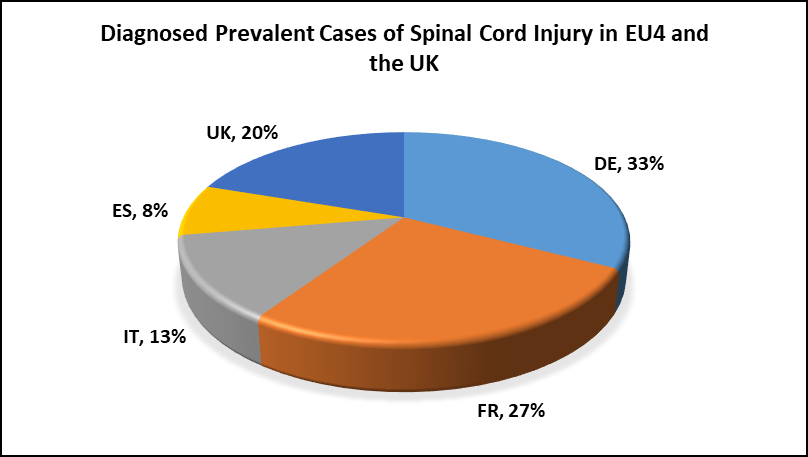
- In 2024, the diagnosed prevalent cases of SCI in EU4 and the UK were estimated at approximately 540,000 accounting for 56% of the total cases across the 7MM. Among these countries, Germany contributed the largest share, representing about 33% of the cases within the region.
- Gender-specific cases of SCI in Italy revealed a notable disparity, with approximately 49 thousand males affected compared to 21 thousand females. This significant difference underscores the higher susceptibility of males to SCI.
- In 2024, Spain recorded approximately 27 thousand traumatic SCI cases, compared to around 13 thousand non-traumatic cases. This distribution indicates that traumatic events remain the primary driver of SCI in the country, underscoring the importance of preventive measures targeting high-risk activities and environments.
- In 2024, the UK reported the highest number of SCI cases attributed to falls, totalling approximately 49 thousand. This was followed by vehicular-related incidents, which accounted for around 32 thousand cases.
- In 2024, Japan reported an estimated 100 thousand cases of traumatic SCI, significantly higher than the approximately 11 thousand non-traumatic cases. This pattern suggests that traumatic causes continue to play a predominant role in the SCI burden within the country, highlighting the importance of ongoing efforts to enhance safety measures and reduce the risk of injury across various settings.
KOL Views
To gaze into the epidemiology insights of the real world, we take KOLs and SMEs’ opinions working in the domain through primary research to fill the data gaps and validate our secondary research on disease prevalence.
DelveInsight’s analysts connected with 20+ KOLs to gather insights; however, interviews were conducted with 10+ KOLs in the 7MM. Centers such as the University of Louisville, Kentucky; University Health Network, US; University Hospital Balgrist, Germany; Raymond Poincaré University Hospital, France; Santa Lucia Foundation Scientific Institute, Italy; National Hospital for Paraplegics, Toledo, Spain; Abigail Lock, chief executive of Back Up, UK; Keio University School of Medicine, Japan and others were contacted. Their opinion helps understand and validate current disease prevalence, gender involved with the disease, diagnosis rate, and diagnostic criteria.
Scope of the Report
- The report covers a segment of executive summary, descriptive overview of SCI, explaining its causes, signs and symptoms, and currently available diagnostic algorithms and guidelines.
- Comprehensive insight has been provided into the epidemiology segments and forecasts, the future growth potential of diagnosis rate, disease progression, and diagnosis guidelines.
- The report provides an edge for understanding trends, expert insights/KOL views, and patient journeys in the 7MM.
- A detailed review of current challenges in establishing the diagnosis.
SCI Report Insights
- Patient Population
- Country-wise Epidemiology Distribution
- Acute (Incident) Cases of SCI
- Total Diagnosed Prevalent Cases of SCI
- Gender-specific Diagnosed Prevalent Cases of SCI
- Etiology-specific Diagnosed Prevalent Cases of SCI
- Etiology-specific Diagnosed Prevalent Cases of Traumatic SCI
SCI Report Key Strengths
- 10 years Forecast
- The 7MM Coverage
- SCI Epidemiology Segmentation
SCI Report Assessment
- Current Diagnostic Practices
- Patient Segmentation
Epidemiology Insights
- What are the disease risk, burdens, and unmet needs of SCI? What will be the growth opportunities across the 7MM concerning the patient population of SCI?
- What is the historical and forecasted SCI patient pool in the United States, EU4 (Germany, France, Italy, and Spain) and the United Kingdom, and Japan?
- Why is the diagnosed prevalent cases of SCI in Japan lower than the US?
- Which country has a high patient share for SCI?
Reasons to Buy
- Insights on patient burden/disease, evolution in diagnosis, and factors contributing to the change in the epidemiology of the disease during the forecast years.
- To understand the SCI prevalence cases in varying geographies over the coming years.
- A detailed overview of Gender-specific diagnosed prevalence of SCI, along with diagnosed prevalence of SCI based on etiology.
- To understand the perspective of key opinion leaders around the current challenges with establishing the diagnosis options.
- Detailed insights on various factors hampering disease diagnosis and other existing diagnostic challenges.