
Spinal Muscular Atrophy Market
- The Spinal Muscular Atrophy market is projected to witness steady growth throughout the forecast period (2023–2032) due to the increasing prevalence of the condition, as well as improved early detection and diagnosis majorly ascribing to the Newborn screening (NBS).
- Analysts at DelveInsight have recently observed a significant uptick in the prevalence of Spinal Muscular Atrophy. The increased availability of Spinal Muscular Atrophy treatments, like Spinraza, Zolgensma, and Evrysdi, along with the emergence of various other therapies, has led to a corresponding interest in adding Spinal Muscular Atrophy to national NBS programs.
- The leading Spinal Muscular Atrophy Companies such as Pfizer Inc., Isis Pharmaceuticals Inc., Sanofi Aventis Inc. (GenZyme Corporation), Avexis Inc., Novartis AG, Biogen Inc., Catalyst Pharmaceutical, Chugai Pharmaceuticals, Cytokinetics Inc., F. Hoffmann La Roche Ltd, and others are debveloping therapies for Spinal Muscular Atrophy Treatment.
- Adulthood marks the onset of Spinal Muscular Atrophy Type 4 symptoms, which include mild to moderate muscle weakness in the arms and legs as well as some difficulty walking. Type 4 Spinal Muscular Atrophy is not fatal.
- Some of the unmet needs for the treatment of Spinal Muscular Atrophy were met with the approval of three medicines for the condition (Spinraza, Evrysdi, and Zolgensma (gene therapy)). Additionally, supportive and multidisciplinary care are the cornerstones of SMA management, with an emphasis on minimising problems and enhancing quality of life.
- The Spinal Muscular Atrophy epidemiology based on gender analyzed that t Spinal Muscular Atrophy (SMA) occurs equally in men and women.
Request for Sample Page @ Spinal Muscular Atrophy Market Report
DelveInsight’s “Spinal Muscular Atrophy Market Insights, Epidemiology, and Market Forecast – 2032” comprehensively analyzes Spinal Muscular Atrophy. The report includes a detailed examination of the historical and projected epidemiology data, Diagnosed Prevalent Cases of Spinal Muscular Atrophy segmented by gender, type, and age. The Spinal Muscular Atrophy (SMA) market report offers an in-depth understanding of the various aspects related to the patient population, including diagnosis, prescription patterns, physician perspectives, market access, treatment, and future market developments for the seven major markets, including the United States, EU4 (Germany, France, Italy, and Spain) and the UK, and Japan from 2019 to 2032.
To gauge the market’s overall potential and identify business opportunities, the report discusses current Spinal Muscular Atrophy treatment practices and algorithms and the related unmet medical needs.
| Study Period |
2019–2032 |
|
Forecast Period |
2023–2032 |
|
Geographies Covered |
US, EU4 (Germany, France, Italy, and Spain) and the UK, and Japan |
|
Spinal Muscular Atrophy Epidemiology |
|
|
Spinal Muscular Atrophy Market |
|
|
Market Analysis |
|
|
Spinal Muscular Atrophy Market Players |
Pfizer Inc., Isis Pharmaceuticals Inc., Sanofi Aventis Inc. (GenZyme Corporation), Avexis Inc., Novartis AG, Biogen Inc., Catalyst Pharmaceutical, Chugai Pharmaceuticals, Cytokinetics Inc., F. Hoffmann La Roche Ltd, and others |
|
Class of Drugs |
|
Spinal Muscular Atrophy Treatment Market
Spinal Muscular Atrophy Overview
Spinal Muscular Atrophy (SMA) is a rare, genetically inherited neuromuscular condition causing progressive muscle weakness and loss of movement due to muscle wasting (atrophy). There are different forms of SMA with a wide spectrum of severity in the children and adults affected. The most common forms of SMA include 5q SMA – comprising of SMA Type 0, 1, 2, 3, and 4.
All types of 5q SMA affect the nerve cells called lower motor neurons. Most people have two copies of the SMN1 gene. People with 5q SMA have two faulty copies of the SMN1 gene, which results in the inability to produce enough SMN protein to have healthy lower motor neurons. As a result, the delivery of signals from the brain to muscles is restricted, making movement difficult. The muscles then waste due to lack of use – this is known as muscular atrophy.
Spinal Muscular Atrophy Diagnosis
SMA can be diagnosed using a genetic test. Genetic tests use a blood sample to identify alterations in a certain gene; genes make up the DNA. More than 95% of people with SMA can be diagnosed by a deleted portion of the SMN1 gene.
Spinal Muscular Atrophy Treatment Landscape
Imperatively, there is no complete cure for SMA. Treatment consists of managing the symptoms and preventing complications. The management of SMA is also based on supportive and multidisciplinary care with a focus on reducing complications and improving QoL. The current market holds approaches for SMA management focusing on nutrition, respiratory care assessment, respiratory muscle weakness, orthopedic care, rehabilitation, and a few medications. The approved drugs for the treatment of the condition include SPINRAZA (Nusinersen), ZOLGENSMA (Onasemnogene abeparvovec-xioi), and EVRYSDI (Risdiplam).
Expected Launch of potential therapies like Apitegromab (Scholar Rock) and Taldefgrobep alfa (Biohaven Pharmaceuticals) is expected to increase the market size during the forecast period (2022–2032) and assisted by an increase in the prevalent population of SMA. It is expected that these therapies will help thrive the market of SMA post-launch in the treatment market.
Spinal Muscular Atrophy Epidemiology
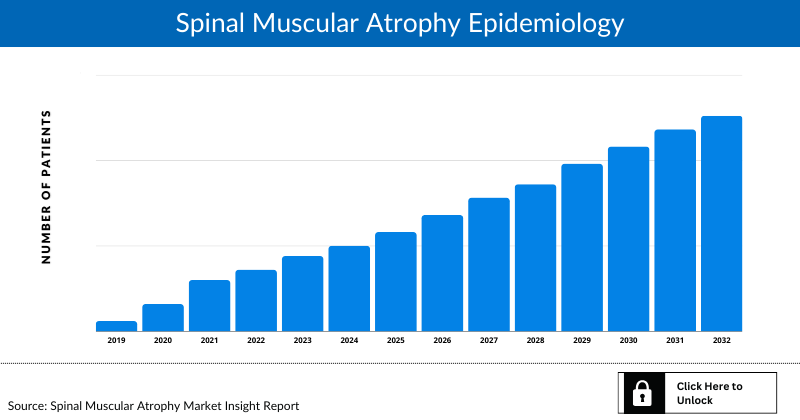
The Spinal Muscular Atrophy epidemiology section provides insights into the historical and current Spinal Muscular Atrophy patient pool and forecasted trends for seven individual major countries. It helps recognize the causes of current and forecasted trends by exploring numerous studies and views of key opinion leaders. This part of the report also provides the diagnosed patient pool, its trends, and assumptions undertaken.
The epidemiology section on the Spinal Muscular Atrophy (SMA) market report offers information on the patient populations, including historical and projected trends for each of the seven major markets. Examining key opinion leader views from physicians or clinical experts can assist in identifying the reasons behind historical and projected trends. The diagnosed patient pool, their trends, and the underlying assumptions are all included in this section of the report.
Key Findings
- The NORD estimates that there are 10,000 live births per 10,000 cases of all kinds of SMA. Approximately 60% of SMA individuals have Type 1 SMA, often known as the Werdnig-Hoffmann type. About 30% of cases of SMA incidence are SMA 2, sometimes referred to as intermediate SMA. Compared to Type I, the most lethal of all its kinds, the second sickness has a greater survival rate.
- From March to September 2019, Okamoto et al. (2020) mailed questionnaires to 131 hospitals in Shikoku with paediatrics or neurology departments, inquiring if any of them had SMA patients at the time. The first questionnaire received responses from 117 hospitals (89.3%), and 21 SMA patients were identified, 16 of whom had homozygous deletion of SMN1. Nine of the 21 had SMA type 1, five had type 2, five had type 3, one had type 4, and one had an unknown kind. SMA overall and 5q-SMA were both projected to have prevalence rates of 0.56 and 0.43 per 100,000 people, respectively.According to a study by Ghetti et al. (2020), there are now an estimated 2,500 cases of spinal muscular atrophy in Italy.
- The Spinal Muscular Atrophy Foundation states that the disease is thought to affect 10,000 to 25,000 children and adults in the United States, and that 1 in 40 to 1 in 50 persons are genetic carriers of the disease.
- A retrospective epidemiological study conducted by Darin and Tulinius (2000) considered numerous neuromuscular disorders. The derived point prevalence was 2.8 per 100,000 inhabitants. This study was considered in conjunction with the recent research published by Lally et al. (2017), which estimated the prevalence of Spinal Muscular Atrophy in the United States using birth prevalence from literature, age of symptom onset, and SMA-type specific survival.
- The gender-based segmentation was derived from a study by Belter et al. (2018), which assessed the cure SMA database where gender difference in patient population with Spinal Muscular Atrophy was reported. In this, slightly more than 50% of the patient pool was shown to be attributed to the male population when considering the data from 2010 to 2016. Specifically, the percentage of SMA-diagnosed males was reported as 51%.
- In Italy, the prevalence rate was sourced from a study by Ghetti et al. (2020), which stated a prevalence rate of 1.41 per 100,000 inhabitants based on the data collected from 2019 to 2020 in approximately 80% of Italian SMA pediatric centers via physician interviews and questionnaires and from hospital registries.
Spinal Muscular Atrophy Market Outlook
The market outlook for Spinal Muscular Atrophy indicates potential growth and increased attention in the coming years. The market is expected to expand with the rising prevalence of Spinal Muscular Atrophy, advancements in understanding the disorder, and the development of targeted therapies. Pharmaceutical companies are actively engaged in research and clinical trials to introduce novel treatments to manage Spinal Muscular Atrophy symptoms effectively.
SPINRAZA (nusinersen), manufactured by Biogen and an approved drug for treating SMA in adults and children, is the first-ever approved treatment for SMA and addresses the underlying genetic cause of SMA. The active ingredient of the drug is Nusinersen. It is a modified oligonucleotide with 2’-hydroxyl groups of the ribofuranosyl rings that are replaced with 2’-O-2-methoxyethyl groups and the phosphate linkages that are replaced with phosphorothioate linkages. Nusinersen targets the intronic splicing silencer N1 (ISS-N1) of exon 7 of the SMN2 transcript. It blocks the ISS-N1, which destabilizes an inhibitory stem-loop RNA structure in intron 7, close to the end of exon 7, and thus leads to increased exon inclusion.
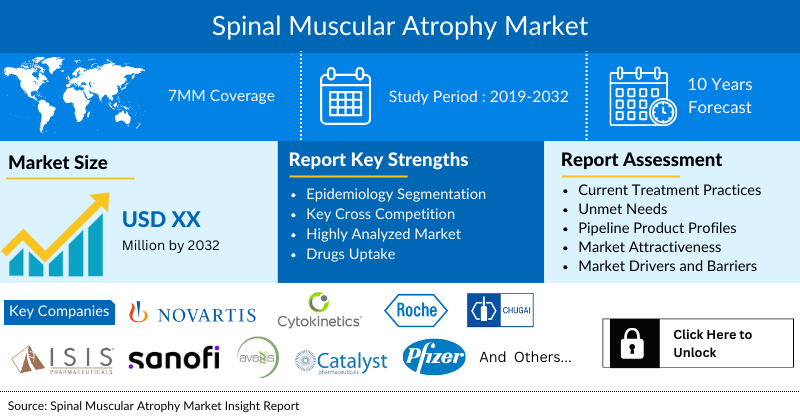
According to DelveInsight, the Spinal Muscular Atrophy (SMA) market in the 7MM is expected to change during the study period 2019–2032 significantly.

Spinal Muscular Atrophy Drug Chapters
Marketed Spinal Muscular Atrophy Drugs
ZOLGENSMA (Onasemnogene abeparvovec-xioi): Novartis Gene Therapies, Inc.
ZOLGENSMA (onasemnogene abeparvovec-xioi) is an adeno-associated virus vector-based gene therapy indicated for treating pediatric patients less than 2 years of age with SMA with bi-allelic mutations in the SMN1 gene. The therapy aims to deliver a fully functional human SMN gene into target motor neuron cells, producing sufficient SMN protein levels to improve motor neuron function and sustained protein expression. It is a gene therapy designed to deliver a functional copy of the SMN1 gene to motor neurons in SMA patients. It comprises the shell of a genetically engineered virus, the adeno-associated virus (AAV) 9, known as the capsid, which delivers a normal copy of the SMN1 gene to the target motor neurons. In March 2023, Novartis presented new data that underscore the transformational and sustained benefit of Zolgensma.
Note: Detailed marketed therapies assessment will be provided in the final report...
Emerging Spinal Muscular Atrophy (SMA) Drugs
The currently available treatments for Spinal Muscular Atrophy (SMA) aim to mitigate the existing treatment gap in the Spinal Muscular Atrophy (SMA) landscape. The Spinal Muscular Atrophy (SMA) market dynamics are expected to change, primarily due to increased healthcare spending worldwide. Spinal Muscular Atrophy (SMA) Market players such as Biogen, Novartis, Hoffmann-La Roche, Scholar Rock, Biohaven Pharmaceuticals, Inc., Astellas Pharma, Cytokinetics, and NMD Pharma, and others are actively involved in developing Spinal Muscular Atrophy (SMA) treatments.
Apitegromab (SRK-015): Scholar Rock
Apitegromab (SRK-015) is an investigational, fully human, monoclonal antibody that specifically binds to myostatin proforms, including promyostatin and latent myostatin, inhibiting myostatin activation. By targeting its precursors, apitegromab prevents the release of the active mature myostatin and subsequent binding to its muscle surface receptor. In vitro binding studies demonstrate that apitegromab does not bind the mature myostatin growth factor and does not bind to any form of GDF-11, activin A, or the mature forms of BMP9/10 or TGFβ1 which all share the same receptor.
Note: Detailed emerging therapies assessment will be provided in the final report...
Spinal Muscular Atrophy Market Segmentation
DelveInsight’s ‘Spinal Muscular Atrophy Market Insights, Epidemiology, and Market Forecast – 2032’ report provides a detailed outlook of the current and future Spinal Muscular Atrophy (SMA) market, segmented within countries, by therapies, and by classes. Further, the market of each region is then segmented by each therapy to provide a detailed view of the current and future market share of all therapies.
Spinal Muscular Atrophy Market Size by Countries
The total Spinal Muscular Atrophy market size is analyzed for individual countries the United States Market, EU4 (Germany, France, Italy, and Spain) and the UK market, and Japan. The United States accounted for a larger portion of the 7MM market for Spinal Muscular Atrophy in 2022 due to the increasing cases of the condition and the cost of treatments. This dominance is predicted to continue with the potential early entry of new products.
Spinal Muscular Atrophy Market Size by Therapies
SMA is a devastating childhood motor neuron disease that causes death within the first 2 years of life in the most severe cases if untreated. Recent therapeutic advances offer hope to families and patients by supplementing survival motor neuron (SMN) protein deficiencies through gene therapy and other genetic manipulations. However, these treatments alone cannot cure SMA. With SMA treatment development and treatment options evolving rapidly, the overall scenario on the therapeutic front is optimistic. Improved interdisciplinary clinical care and technological advances have altered the natural history of patients with SMA. Until a few years ago, there were no disease-modifying treatments for SMA. SPINRAZA was the first treatment approved in 2016, and all three approved treatments offering different doses and administration options are available.
Imperatively, there is no complete cure for SMA. Treatment consists of managing the symptoms and preventing complications. The management of SMA is also based on supportive and multidisciplinary care with a focus on reducing complications and improving QoL. The current market holds approaches for SMA management focusing on nutrition, respiratory care assessment, respiratory muscle weakness, orthopedic care, rehabilitation, and a few medications.
Note: Detailed market segment assessment will be provided in the final report....
Spinal Muscular Atrophy Drugs Uptake
This section focuses on the sales uptake of potential Spinal Muscular Atrophy drugs that have recently launched or are anticipated to be launched in the Spinal Muscular Atrophy market between 2019 and 2032. It estimates the market penetration of Spinal Muscular Atrophy drugs for a given country, examining their impact within and across classes and segments. It also touches upon the financial and regulatory decisions contributing to the drug’s probability of success (PoS) in the Spinal Muscular Atrophy market.
The emerging Spinal Muscular Atrophy therapies are analyzed based on various attributes such as safety and efficacy in randomized clinical trials, order of entry and other market dynamics, and the unmet need they fulfill in the Spinal Muscular Atrophy (SMA) market.
Note: Detailed assessment of drug uptake and attribute analysis will be provided in the full report on Spinal Muscular Atrophy...
Spinal Muscular Atrophy Market Access and Reimbursement
DelveInsight’s ‘Spinal Muscular Atrophy Market Insights, Epidemiology, and Market Forecast – 2032’ report provides a descriptive overview of the market access and reimbursement scenario of Spinal Muscular Atrophy.
This section includes a detailed analysis of the country-wise healthcare system for each therapy, enlightening the market access, reimbursement policies, and health technology assessments.
KOL Views
To keep up with current Spinal Muscular Atrophy (SMA) market trends and fill gaps in secondary findings, we interview KOLs and SMEs working in the Spinal Muscular Atrophy (SMA) domain. Their opinion helps understand and validate current and emerging therapies and treatment patterns or Spinal Muscular Atrophy (SMA) market trends. This will support the clients in potential upcoming novel treatments by identifying the overall scenario of the market and the Spinal Muscular Atrophy (SMA) unmet needs.
Spinal Muscular Atrophy: KOL Insights
- DelveInsight’s analysts connected with 50+ KOLs to gather insights; however, interviews were conducted with 15+ KOLs in the 7MM. These KOLs were from organizations, institutes, and hospitals, such as the Department of Neurology, the Ohio State University Wexner Medical Center, the University of Arizona College of Medicine, Kings College Hospital, NHS Foundation Trust, and others.
- “Approximately 96% of all 5q SMA patients have the same mutation that can be tested quickly and reliably. All 5q-SMA patients have at least one to several SMN2 copy genes that are therapeutic targets.”
- “Due to newborn screening schemes and illness awareness, the diagnosis of SMA is 90% in the US. Numerous epidemiology studies in the US have reported 8,500 diagnosed cases in the United States who undergo further treatment based on the level of change in motor function, breathing function, and patient compliance.”
Note: Detailed assessment of KOL Views will be provided in the full report of Spinal Muscular Atrophy...
Competitive Intelligence Analysis
We perform Competitive and Market Intelligence analysis of the Spinal Muscular Atrophy (SMA) Market using various Competitive Intelligence tools, including SWOT analysis, Market entry strategies, etc. The inclusion of the analysis entirely depends upon the data availability.
Spinal Muscular Atrophy Pipeline Development Activities
The report provides insights into Spinal Muscular Atrophy Clinical Trials within Phase II and III stages. It also analyzes Spinal Muscular Atrophy (SMA) Companies involved in developing targeted therapeutics.
Pipeline Development Activities
The report covers information on collaborations, acquisition and merger, licensing, patent details, and other information for emerging Spinal Muscular Atrophy (SMA) therapies.
Spinal Muscular Atrophy Report Insights
- Spinal Muscular Atrophy Patient Population
- Spinal Muscular Atrophy Therapeutic Approaches
- Spinal Muscular Atrophy Pipeline Analysis
- Spinal Muscular Atrophy Market Size and Trends
- Spinal Muscular Atrophy Market Opportunities
- Impact of Upcoming Spinal Muscular Atrophy Therapies
Spinal Muscular Atrophy Report Key Strengths
- 10 Years Forecast
- The 7MM Coverage
- Spinal Muscular Atrophy Epidemiology Segmentation
- Key Cross Competition
- Highly Analyzed Spinal Muscular Atrophy Market
- Spinal Muscular Atrophy Drugs Uptake
Spinal Muscular Atrophy Report Assessment
- Spinal Muscular Atrophy Current Treatment Practices
- Spinal Muscular Atrophy Unmet Needs
- Spinal Muscular Atrophy Pipeline Product Profiles
- Spinal Muscular Atrophy Market Attractiveness
- Spinal Muscular Atrophy Market Drivers
- Spinal Muscular Atrophy Market Barriers
Key Questions Answered In The Spinal Muscular Atrophy Market Report
- What are the key findings of the market across the 7MM, and what country will have the largest Spinal Muscular Atrophy market size during the forecast period (2023–2032)?
- At what CAGR is the Spinal Muscular Atrophy market, and is epidemiology expected to grow in the 7MM during the forecast period (2023–2032)?
- What are the key drivers of growth in the Spinal Muscular Atrophy market (2023–2032)?
- What are the most commonly prescribed medications for Spinal Muscular Atrophy (2023–2032)?
- Are regulatory or reimbursement challenges affecting the Spinal Muscular Atrophy market (2023–2032)?
- Are there any market barriers or challenges hindering the growth of the Spinal Muscular Atrophy market (2023–2032)?
- What strategies are pharmaceutical companies adopting to capture a larger share of the Spinal Muscular Atrophy market (2023–2032)?
.png&w=256&q=75)