Status Epilepticus Market
Key Highlights
- According to Wylie et al. (2022), the incidence of status epilepticus has a bimodal age distribution with peaks during infancy and in the elderly. The incidence rate ranges between approximately 7 to 40 cases per 100,000 persons per year. Status epilepticus seems to be more common in males. A significant proportion of both children, approximately 16 to 38%, and adults, approximately 42 to 50% with status epilepticus, have a history of epilepsy. The short-term mortality (within 30 days) of status epilepticus ranges from 7.6 to 22% across all age groups and is highest among the elderly.
- Status Epilepticus epidemiology is segmented as Total Incident Cases of Status Epilepticus, Type-specific Incident Cases of Status Epilepticus, Age-specific Incident Cases of Status Epilepticus, Total Incident Cases of Established Status Epilepticus, Refractory Status Epilepticus and Super Refractory Status Epilepticus, and Treated Cases of Status Epilepticus in the Status Epilepticus market report.
Request for unlock CAGR of Status Epilepticus Market
DelveInsight’s “Status Epilepticus Market Insights, Epidemiology, and Market Forecast – 2034” report delivers an in-depth understanding of the Status Epilepticus, historical and forecasted epidemiology as well as the Status Epilepticus market trends in the United States, EU4 (Germany, France, Italy, and Spain) and the United Kingdom, and Japan.
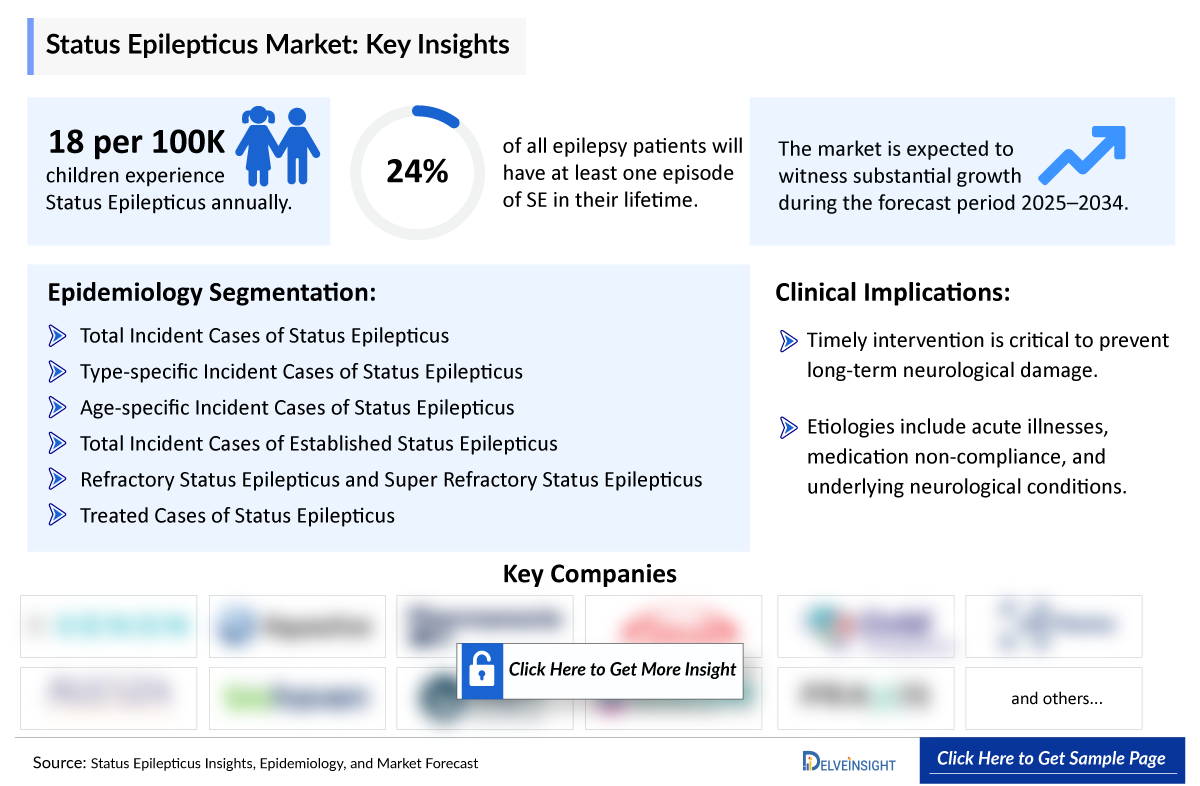
The Status Epilepticus market report provides current treatment practices, emerging drugs, the Status Epilepticus market share of individual therapies, and current and forecasted Status Epilepticus market size from 2020 to 2034, segmented by the seven major markets. The report also covers the current Status Epilepticus treatment practices/algorithms and unmet medical needs to curate the best of the opportunities and assess the underlying potential of the market.
Geography Covered
- The United States
- EU4 (Germany, France, Italy, and Spain) and the United Kingdom
- Japan
Study period: 2020–2034
Status Epilepticus Market: Understanding and Treatment Algorithm
The DelveInsight’s Status Epilepticus market report gives a thorough understanding of the Status Epilepticus by including details such as disease definition, symptoms, causes, pathophysiology, diagnosis, and treatment.
Status epilepticus is a common, life-threatening neurologic disorder. It is a neurological emergency requiring immediate evaluation and management to prevent significant morbidity or mortality as the condition may lead to permanent brain damage or death or permanent neuronal damage. It is defined by the Neurocritical Care Society (2012), as any seizure lasting more than five minutes or any continuous clinical and electrographic seizure activity, or recurrent seizure activity (more than one seizure within five minutes), without recovery in between episodes.
It may be convulsive, non-convulsive, focal motor, myoclonic, or refractory. Convulsive status epilepticus consists of generalized tonic-clonic movements and mental status impairment. Non-convulsive status epilepticus is defined as seizure activity identified on an electroencephalogram with no accompanying tonic-clonic movements. Focal motor status epilepticus involves the refractory motor activity of a limb or a group of muscles on one side of the body and that with or without loss of consciousness is myoclonic status epilepticus. Refractory status epilepticus refers to continuing seizures (convulsive or non-convulsive) despite appropriate antiepileptic drugs.
Chronic processes that may result in status epilepticus include pre-existing epilepsy with breakthrough seizures or non-compliance with anti-epileptic drugs, ethanol withdrawal, CNS tumors, and remote CNS pathology. Acute processes account for most cases of status epilepticus in adults. Febrile status epilepticus is the most common cause in pediatric patients. Children and the elderly (≥60 years of age) have the highest incidence of status epilepticus. Elderly individuals are much more likely to have more severe consequences from seizures. The overall mortality of status epilepticus is quite high and occurs early, often within the first few days, and is related to the cause, with mortality of more than 80% in persons with anoxia.
In children, the main cause of status epilepticus is an infection with a fever or inborn errors of metabolism. While, in adults, the common causes include, stroke, imbalance of substances in the blood, such as low blood sugar and drinking too much alcohol, or having alcohol withdrawal after previous heavy alcohol use.
The common symptoms of status epilepticus include muscle spasms, falling, confusion, unusual noises, loss of bowel or bladder control, clenched teeth, irregular breathing, unusual behavior, difficulty speaking, and a daydreaming look.
Status Epilepticus Diagnosis
The diagnosis of convulsive status epilepticus is usually done clinically and it requires emergent neuroimaging and laboratory studies to identify a potential etiology. A head computed tomography (CT) scan is the most recommended and also the most easily available. Magnetic resonance imaging (MRI) of the brain is more sensitive for identifying malformations in pediatric patients but is difficult to obtain and may require sedation.
Laboratory studies include bedside blood glucose level, serum electrolytes (sodium, potassium, calcium, and magnesium), BUN, creatinine, serum bicarbonate, a complete blood count, and a lumbar puncture with cerebrospinal fluid (CSF) evaluation. If any individual has a known seizure disorder, anti-epileptic drug levels are also determined. Urine toxicology screen and serum levels of specific toxins such as theophylline or lithium are recommended if there is suspicion of a toxic ingestion. Other studies may be considered based on the presentation like liver function tests, inborn errors of metabolism, and coagulation studies.
Non-convulsive status epilepticus requires all of the previously mentioned imaging and laboratory studies for the identification of an underlying etiology but also requires EEG monitoring for confirmatory diagnosis.
Status Epilepticus Treatment
Status epilepticus must be addressed quickly and in an organized manner, with simultaneous management of the airway, breathing, and circulation, while also administering antiepileptic drug treatment. The primary goal of management is to definitively abort seizure activity as rapidly as possible while supporting the patient’s cardiovascular and respiratory status.
Anti-seizure drugs to treat the problem include diazepam, lorazepam, phenytoin, fosphenytoin, phenobarbital, and valproate. The drug treatment algorithms for status epilepticus generally has three stages, starting with benzodiazepines: lorazepam, midazolam, or diazepam as first-line drugs, moving to levetiracetam, valproate or fos-phenytoin as second-line drugs, ending, if necessary, with anesthetics like propofol or midazolam. Thus benzodiazepines are the antiepileptic drug of choice for emergent control. Lorazepam is preferred because of its rapid onset of action.
Treatment in the elderly is essentially the same as in younger adults with benzodiazepines (lorazepam, diazepam, clonazepam) and longer-acting antiseizure drugs (phenytoin, fosphenytoin, valproate, levetiracetam, and lacosamide. In refractory status epilepticus, continuous infusion of an antiepileptic drug is recommended. Choices include an intravenous infusion of midazolam, pentobarbital, thiopental, or propofol.
In 2020, the US FDA approved SESQUIENT, a fosphenytoin sodium for injection from Sedor Pharmaceuticals for the treatment of status epilepticus in adults and children, specifically for benzodiazepine-refractory status epilepticus. This is the second drug approved with CEREBYX being the first one. Recently in 2022, the US FDA also approved a 10-mg midazolam autoinjector by Rafa Laboratories for the treatment of status epilepticus in adults.
Status Epilepticus Epidemiology
The Status Epilepticus epidemiology section provides insights into the historical and current Status Epilepticus patient pool and forecasted trends for seven individual major countries. It helps recognize the causes of current and forecasted trends by exploring numerous studies and views of key opinion leaders. This part of the Status Epilepticus report also provides the incident patient pool, its trends, and assumptions undertaken.
Key findings
- According to Wylie et al. (2022), the incidence of status epilepticus has a bimodal age distribution with peaks during infancy and in the elderly. The incidence rate ranges between approximately 7 to 40 cases per 100,000 persons per year. Status epilepticus seems to be more common in males. A significant proportion of both children, approximately 16 to 38%, and adults, approximately 42 to 50% with status epilepticus, have a history of epilepsy. The short-term mortality (within 30 days) of status epilepticus ranges from 7.6 to 22% across all age groups and is highest among the elderly.
- The Status Epilepticus epidemiology covered in the report provides historical as well as forecasted Status Epilepticus epidemiology [segmented as Total Incident Cases of Status Epilepticus, Type-specific Incident Cases of Status Epilepticus, Age-specific Incident Cases of Status Epilepticus, Total Incident Cases of Established Status Epilepticus, Refractory Status Epilepticus and Super Refractory Status Epilepticus, and Treated Cases of Status Epilepticus in the 7MM covering the United States, EU4 (Germany, France, Italy, and Spain) and the United Kingdom, and Japan from 2020 to 2034.
Country-wise Status Epilepticus Epidemiology
The epidemiology segment also provides the Status Epilepticus epidemiology data and findings across the United States, EU4 (Germany, France, Italy, and Spain) and the United Kingdom, and Japan.
Learn more about the evolving epidemiology trends and key developments: Status Epilepticus Epidemiology Forecast
Status Epilepticus Drug Chapters
The drug chapter segment of the Status Epilepticus report encloses a detailed analysis of Status Epilepticus marketed drugs and late-stage (Phase III and Phase II) Status Epilepticus pipeline drugs. It also helps understand the Status Epilepticus clinical trial details, expressive pharmacological action, agreements and collaborations, approval and patent details, advantages and disadvantages of each included drug, and the latest news and press releases.
Emerging Status Epilepticus drugs
The report details the emerging Status Epilepticus therapies under the late and mid-stage of development for Status Epilepticus treatment.
Status Epilepticus Market Outlook
The Status Epilepticus market outlook of the report helps to build a detailed comprehension of the historical, current, and forecasted Status Epilepticus market trends by analyzing the impact of current therapies on the market, unmet needs, and demand for better technology.
This segment gives a thorough detail of the Status Epilepticus market trend of each marketed drug and late-stage pipeline therapy by evaluating their impact based on the annual cost of therapy, inclusion and exclusion criteria, mechanism of action, compliance rate, growing need for the market, increasing patient pool, covered patient segment, expected launch year, competition with other therapies, brand value, their impact on the market and view of the key opinion leaders. The calculated market data are presented with relevant tables and graphs to give a clear view of the market at first sight.
According to DelveInsight, the Status Epilepticus market in the 7MM is expected to witness a major change in the study period 2020–2034.
Key findings
This section includes a glimpse of the Status Epilepticus market in the 7MM.
The United States: Status Epilepticus Market Outlook
- This section provides the total Status Epilepticus market size and market size by therapies in the United States.
EU4 and the United Kingdom: Status Epilepticus Market Outlook
- The total Status Epilepticus market size and market size by therapies in EU4 (Germany, France, Italy, and Spain) and the United Kingdom are provided in this section.
Japan: Status Epilepticus Market Outlook
- The total Status Epilepticus market size and market size by therapies in Japan are also mentioned.
Status Epilepticus Drug Uptake
This section focuses on the rate of uptake of the potential drugs recently launched in the Status Epilepticus market or expected to get launched in the market during the study period 2020–2034. The analysis covers Status Epilepticus market uptake by drugs, patient uptake by therapies, and sales of each drug.
This will help in understanding the Status Epilepticus drugs with the most rapid uptake and the reasons behind the maximal use of new drugs and allows the comparison of the drugs based on market share and size, which again will be useful in investigating factors important in the market uptake and in making financial and regulatory decisions.
Status Epilepticus Pipeline Development Activities
The report provides insights into different therapeutic candidates in Phase II, and Phase III stages. It also analyses the Status Epilepticus’s key players involved in developing targeted therapeutics.
Status Epilepticus Clinical Trial Development Activities
The report covers detailed information on collaborations, acquisitions, and mergers, licensing patent details, and other information for Status Epilepticus emerging therapies.
Learn more about the emerging therapies and key companies active in the therapeutics segment: Status Epilepticus Pipeline Insight
Status Epilepticus Reimbursement Scenario
Approaching reimbursement proactively can have a positive impact both during the late stages of product development and well after product launch. In a report, we consider reimbursement to identify economically attractive indications and market opportunities. When working with finite resources, the ability to select the markets with the fewest reimbursement barriers can be a critical business and price strategy.
KOL Views
To keep up with current epidemiology and market trends, we take KOLs and SMEs' opinions working in the Status Epilepticus domain through primary research to fill the data gaps and validate our secondary research. Their opinion helps to understand and validate current and emerging therapies and treatment patterns along with Status Epilepticus market trends. This will support the clients in potential upcoming novel treatments by identifying the overall scenario of the market and the unmet needs.
Competitive Intelligence Analysis
We perform competitive and market intelligence analysis of the Status Epilepticus market by using various competitive intelligence tools that include – SWOT analysis, PESTLE analysis, Porter's five forces, BCG Matrix, Market entry strategies, etc. The inclusion of the analysis entirely depends upon the data availability.
Scope of the Status Epilepticus Market Report
- Descriptive overview of Status Epilepticus, disease overview, patient journeys, treatment algorithms, diagnosis, and currently available therapies.
- Comprehensive insight into the Status Epilepticus epidemiology and forecasts in the 7MM.
- An all-inclusive account of both the current and emerging therapies for Status Epilepticus, along with the assessment of new therapies, is expected to have an impact on the current treatment landscape.
- Exhaustive analysis of the Status Epilepticus market; historical and forecasted covering drug outreach in the 7MM.
- Detailed Patient Based Market Forecasting determines the trends shaping and driving the global Status Epilepticus market.
Status Epilepticus Market Report Highlights
- In the coming years, the Status Epilepticus market is set to change due to the rising awareness of the disease and incremental healthcare spending across the world; which would expand the size of the market to enable the drug manufacturers to penetrate more into the market.
- The companies and academics are working to assess challenges and seek opportunities that could influence Status Epilepticus R&D. The therapies under development are focused on novel approaches to treat/improve the disease condition.
- ajor players are involved in developing Status Epilepticus therapies. The launch of emerging therapies will significantly impact the Status Epilepticus market.
- A better understanding of Status Epilepticus pathogenesis will also contribute to the development of novel therapeutics for Status Epilepticus.
- Our in-depth analysis of the Status Epilepticus pipeline assets across different stages of development (Phase III and Phase II), emerging trends, and comparative analysis of pipeline products with detailed Status Epilepticus Clinical Trial profiles, key cross-competition, launch date along with product development activities will support the clients in the decision-making process regarding their therapeutic portfolio by identifying the overall scenario of the research and development activities.
Status Epilepticus Report Insights
- Patient Based Market Forecasting
- Therapeutic approaches
- Status Epilepticus pipeline analysis
- Status Epilepticus market size and trends
- Status Epilepticus market opportunities
- Impact of upcoming therapies
Status Epilepticus Report Key Strengths
- 11 years forecast
- The 7MM Coverage
- Status Epilepticus epidemiology segmentation
- Key cross competition
- KOL views
- Status Epilepticus drugs uptake
Status Epilepticus Report Assessment
- Current treatment practices
- Unmet needs
- Status Epilepticus pipeline product profiles
- Status Epilepticus market attractiveness
Key Questions
- Status Epilepticus market insights:
- What would be the Status Epilepticus market growth till 2025, and what will be the resultant market size in 2034?
- What was the Status Epilepticus drug class share (in percentage) distribution in 2025, and how would it look in 2034?
- What would be the Status Epilepticus total market size and market size by therapies across the 7MM during the forecast period (2025–2034)?
- What are the key findings of the market across the 7MM, and which country will have the largest Status Epilepticus market size during the forecast period (2025–2034)?
- How would the unmet needs affect the Status Epilepticus market dynamics and subsequent analysis of the associated trends?
Status Epilepticus Epidemiology Insights:
- What are the disease risk, burden, and regional/ethnic differences of the Status Epilepticus?
- What is the historical and forecasted Status Epilepticus patient pool in the 7MM, and where can one observe the highest patient population and growth opportunities?
- What are the key factors driving the epidemiology trends for seven major markets covering the United States, EU4 (Germany, France, Italy, and Spain) and the United Kingdom, and Japan?
- ent Treatment Scenario, Marketed Drugs, and Emerging Therapies
- What are the current treatment guidelines and treatment options, in addition to approved therapies for Status Epilepticus in the US, Europe, and Japan?
- What are the key collaborations (Industry–Industry, Industry-Academia), mergers and acquisitions, and licensing activities related to Status Epilepticus therapies?
- What are the recent novel therapies, targets, mechanisms of action, and technologies being developed to overcome the limitation of existing therapies?
- What are the clinical studies going on for Status Epilepticus and its status, along with the challenges faced?
Reasons to Buy
- The Patient Based Market Forecasting analysis will help in developing business strategies by understanding trends shaping and driving the Status Epilepticus market.
- Organize sales and marketing efforts by identifying the best opportunities for Status Epilepticus in the US, EU4 (Germany, France, Italy, and Spain) and the UK, and Japan.
- Identification of strong upcoming players in the market that will help devise strategies that will help in getting ahead of competitors
Stay Updated with us for Recent Articles
- Role of Seizures Alert and Monitoring Devices in the Management of Epilepsy
- Which Pharma Companies are Transforming the Drug-Resistant Epilepsy Market Landscape?
- 21 of the most common questions about Epilepsy
- Ever-evolving Market Dynamics of Epilepsy – a silver lining!
- DRUG-RESISTANT EPILEPSY
- World Epilepsy Day
- EPILEPSY - A Neurological Disorder
- XEN-1101: An Illuminating Prospect for Adults Afflicted by Focal Epilepsy
- LIBERVANT Buccal Film: Pioneering Pediatric Epilepsy Treatment Advancements
- Unveiling Boundless Horizons: Unlocking BHV-7000’s Potential in Epilepsy
- Soticlestat (TAK-935): A Paradigm Shift in Epilepsy Treatment Strategies
- Improving Epilepsy Care: XCOPRI’s Effectiveness and Safety
- Latest DelveInsight Blogs