
Stuttering Epidemiology
- Stuttering can be developmental, usually occurring in young children due to genetic and neurological factors, or neurogenic, an another type which happens after brain injuries or strokes. Psychogenic stuttering is uncommon.
- According to the secondary analysis, stuttering prevalence among 3-year-old children in Japan is estimated at around 6.5%, aligning with rates reported internationally in early childhood. This early presentation reflects the developmental stage where speech and language skills are rapidly evolving. A family history of stuttering is noted as a meaningful contributing factor, with children having such a background demonstrating a higher likelihood of exhibiting stuttering compared to those without this history.
- Diagnosis of stuttering involves distinguishing it from developmental dysfluency by evaluating repetitions of sounds or syllables, prolongations, silent pauses, and struggle behaviors. Physicians assess speech disruption frequency, motor and language skills, and the child’s or parents’ concern to determine the presence and severity of stuttering and guide referral for therapy.
- While developmental stuttering resolves spontaneously in most children, approximately 25% experience persistent symptoms that continue into adulthood, a condition known as persistent developmental stuttering.
Stuttering Epidemiology Forecast in the 7MM
- 2025 Diagnosed Prevalent Cases of Stuttering: ~ USD XX million
- 2036 Projected Diagnosed Prevalent Cases of Stuttering: ~ USD XX million
- Stuttering Growth Rate (2026–2036): ~XX % CAGR
DelveInsight's ‘Stuttering – Epidemiology Forecast – 2036’ report delivers an in-depth understanding of the Stuttering, historical and forecasted epidemiology in the United States, EU4 (Germany, Spain, Italy, and France) and the United Kingdom, and Japan.
|
Study Period |
2022–2036 |
|
Historical Year |
2022–2025 |
|
Forecast Period |
2026–2036 |
|
Base Year |
2026 |
|
Geographies Covered |
|
|
Stuttering Epidemiology CAGR (Study period/Forecast period) |
~XX % (2026–2036) |
|
Stuttering Epidemiology Segmentation Analysis |
Patient Burden Assesment
|
Stuttering Understanding and Diagnostic Algorithm
Stuttering Overview and Diagnosis
Childhood-onset fluency disorder, commonly known as stuttering or stammering, is a common speech disorder characterized by disruptions in the normal flow of speech, including involuntary repetitions, prolongations of sounds or syllables, and speech blocks that occur beyond the speaker’s control. These core speech disfluencies may occur at the level of sounds, syllables, words, or phrases and are often accompanied by negative emotions such as anxiety, frustration, embarrassment, or fear. In response to these challenges, individuals may develop secondary behaviors, including “flight behaviors” such as avoiding certain words, withdrawing from speaking situations, or concealing their stuttering, as well as “fight behaviors” such as excessive blinking, facial tension, or body movements used to force speech production.
Stuttering is typically diagnosed by a speech-language pathologist (SLP), who evaluates the individual's speech patterns, language abilities, medical and family history, duration of symptoms, and the impact of stuttering on daily life. In children, assessment also focuses on determining the likelihood of persistence versus spontaneous recovery, considering factors such as family history, symptom duration, and the presence of other speech or language difficulties. However, the classification and severity assessment of stuttering may vary across different clinical guidelines and expert recommendations.
Further details are provided in the report.
Stuttering Epidemiology
Key Findings from Stuttering Epidemiological Analysis and Forecast
- As per the secondary analysis, stuttering affects approximately 1% of the population in the US, with a clear gender difference, as males are affected about four times more frequently than females.
- With a prevalence rate of approximately 1%, it is estimated that three million people stutter in the United States
- Germany shows that stuttering is more frequently observed in boys, representing around three-quarters of all cases. The prevalence of stuttering is highest at approximately age 5, during the critical period of early speech and language development, with about 0.89% of boys and 0.40% of girls affected at this stage.
- Developmental stuttering occurs in five percent of children and persists in about 1 percent of the adult population. It is estimated that 3 million Americans stutter. Stuttering usually begins between the ages of 3 to 5 years.
- Stuttering can affect individuals of all ages but occurs most frequently in young children between the ages of 2 and 6. Boys are two to three times more likely than girls to stutter.
- Approximately 95% of children who stutter start to do so before the age of 4 years, and the average age of onset is approximately 33 months. Onset may be progressive or sudden.
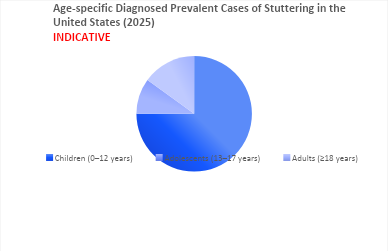
- According to published epidemiological studies, stuttering is most prevalent during early childhood, with approximately 5–10% of preschool children (2–6 years) experiencing developmental stuttering at some point. The prevalence declines with age due to spontaneous recovery in many individuals, falling to around 1.4% among children overall, approximately 0.67% among adolescents aged 14–17 years, and 0.21% among older adolescents and young adults aged 16–20 years. In adulthood, the prevalence stabilizes at approximately 0.6–1.0%, indicating that only a subset of individuals experience persistent stuttering into later life.
Scope of the Report
- The report covers a segment of an executive summary, a descriptive overview of stuttering, explaining its causes, signs and symptoms, and pathogenesis.
- Comprehensive insight has been provided into the epidemiology segments and forecasts, the future growth potential of the diagnosis rate, and disease progression.
Report Insights
- Stuttering Patient Population Forecast
Report Key Strengths
- Epidemiology‑based (epi‑based) Bottom‑up Forecasting
- 11-year Forecast
- Patient Burden Trends (by geography)
FAQs
- What are the disease risks, burdens, and unmet needs of stuttering? What will be the growth opportunities across the 7MM concerning the patient population with Stuttering?
- What is the historical and forecasted stuttering patient pool in the US, EU4 (Germany, France, Italy, and Spain), the UK, and Japan?
Reasons to Buy
- Insights on patient burden/disease prevalence, evolution in diagnosis, and factors contributing to the change in the epidemiology of the disease during the forecast years.
- To understand key opinion leaders’ perspectives around the diagnostic challenges to overcome barriers in the future.
- Detailed insights on various factors hampering disease diagnosis and other existing diagnostic challenges.