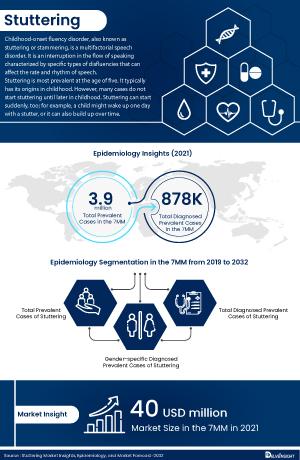
Stuttering Market Summary
- Speech is produced through coordinated muscle movements involving breathing, voice, and articulation, all controlled by the brain. Stuttering severity varies, often worsening in stressful situations and improving during singing, reading, or speaking in unison.
- Stuttering can be developmental, usually occurring in young children due to genetic and neurological factors, or neurogenic, an another type which happens after brain injuries or strokes. Psychogenic stuttering is uncommon.
- Approximately 5% of all children go through a period of stuttering that lasts six months or more. Three-quarters of those will recover by late childhood, leaving about 1% with a long-term problem. The best prevention tool is early intervention.
- According to the secondary analysis, stuttering prevalence among 3-year-old children in Japan is estimated at around 6.5%, aligning with rates reported internationally in early childhood. This early presentation reflects the developmental stage where speech and language skills are rapidly evolving. A family history of stuttering is noted as a meaningful contributing factor, with children having such a background demonstrating a higher likelihood of exhibiting stuttering compared to those without this history.
- Diagnosis of stuttering involves distinguishing it from developmental dysfluency by evaluating repetitions of sounds or syllables, prolongations, silent pauses, and struggle behaviors. Physicians assess speech disruption frequency, motor and language skills, and the child’s or parents’ concern to determine the presence and severity of stuttering and guide referral for therapy.
- While developmental stuttering resolves spontaneously in most children, approximately 25% experience persistent symptoms that continue into adulthood, a condition known as persistent developmental stuttering.
- Current stuttering management is individualized and primarily relies on speech therapy, behavioral interventions, psychological support, and parental guidance, as there are no approved pharmacological therapies specifically indicated for stuttering.
- Techniques such as delayed auditory feedback, timed syllabic speech, and shadowing may improve speech fluency, while supportive communication environments, parental involvement, and assistive devices help reduce the psychosocial burden associated with the disorder.
- The stuttering treatment pipeline is currently limited, with Gemlapodect (NOE-105) by Noema Pharma representing the sole emerging pharmacologic therapy under development, likely due to the complex neurobiological mechanisms and historically high unmet challenges in developing targeted drugs for this disorder.
Stuttering Market Size and Forecast in the 7MM
- 2025 Stuttering Market Size: ~USD XX million
- 2036 Projected Stuttering Market Size: ~USD XX million
- Stuttering Growth Rate (2026–2036): ~XX% CAGR
DelveInsight's ‘Stuttering – Market Insights, Epidemiology and Market Forecast – 2036’ report delivers an in-depth understanding of the stuttering, historical and forecasted epidemiology, as well as the stuttering market trends in the United States, EU4 (Germany, Spain, Italy, and France) and the United Kingdom, and Japan.
The stuttering market report delivers a comprehensive analysis of the current treatment landscape, including standards of care, clinical practices, and evolving therapeutic algorithms. It evaluates stuttering patient burden trends, revenue & market share dynamics, peak patient share & therapy uptake analysis, and provides an in-depth market size assessment and growth rate projections (historical & forecast 2022–2036) across global regions. The report highlights key unmet medical needs in stuttering and maps the competitive and clinical landscape to uncover high‑value opportunities, providing a clear outlook on future market growth potential.
|
Study Period |
2022–2036 |
|
Historical Year |
2022–2025 |
|
Forecast Period |
2026–2036 |
|
Base Year |
2026 |
|
Geographies Covered |
|
|
Stuttering Market CAGR (Forecast period) |
~XX% (2026–2036) |
|
Stuttering Epidemiology Segmentation Analysis |
Patient Burden Assessment
|
|
Stuttering Companies |
|
|
Stuttering Therapies |
|
|
Stuttering Market |
Segmented by
|
|
Analysis |
• Addressable Patient Population • Market Drivers And Market Barriers • Cost Assumptions And Pricing Analogues • KOL Views • SWOT Analysis • Reimbursement • Conjoint Analysis • Unmet Needs |
Key Factors Driving the Stuttering Market
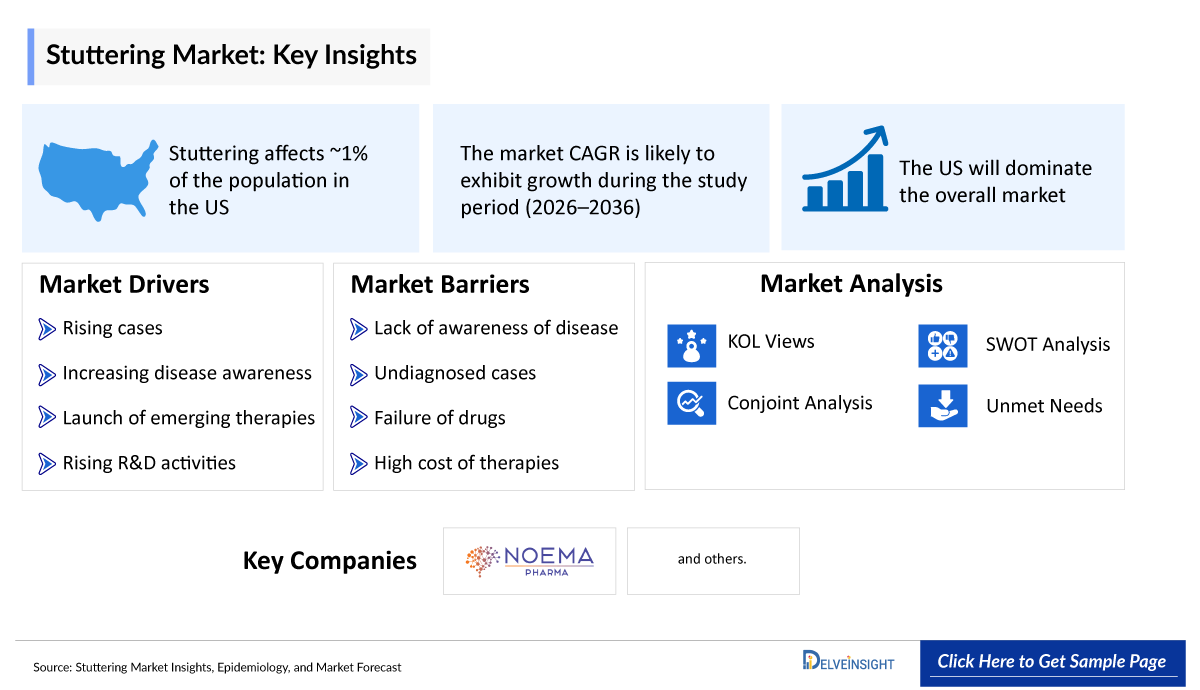
- Increasing awareness and early diagnosis of stuttering
Particularly in pediatric populations, are leading to greater treatment-seeking behavior and improved access to speech-language interventions. Early identification enables timely intervention, improving speech fluency and long-term developmental outcomes.
- Advancements in speech therapy technologies
Digital therapeutics, telepractice platforms, AI-enabled speech training tools, and mobile applications are enhancing treatment accessibility and patient engagement. These innovations facilitate personalized therapy, remote monitoring, and improved adherence to treatment programs.
- Increasing availability of specialized speech-language pathology services
Expanded speech-language pathology services and supportive reimbursement initiatives are improving treatment uptake across major markets. Greater access to multidisciplinary care is helping patients receive comprehensive and continuous management, particularly in underserved regions.
Stuttering Understanding and Treatment Algorithm
Stuttering Overview and Diagnosis
Childhood-onset fluency disorder, commonly known as stuttering, is a speech disorder characterized by involuntary disruptions in the normal flow of speech, including repetitions, sound prolongations, and speech blocks. These disfluencies are often accompanied by secondary behaviors, such as facial movements or avoidance of speaking situations, as well as emotional distress including anxiety and frustration. Diagnosis is primarily performed by a speech-language pathologist (SLP) through evaluation of speech patterns, medical and family history, symptom duration, and the impact on daily functioning. In children, assessment also considers the likelihood of persistent stuttering versus spontaneous recovery based on established clinical risk factors.
Further details are provided in the report.
Current Stuttering Treatment Landscape
There are currently no FDA-approved medications specifically for the treatment of stuttering, and management primarily relies on speech therapy, which remains the standard of care for improving speech fluency and communication skills. Additional approaches, including cognitive behavioral therapy (CBT), help address the emotional and psychological impact of stuttering, while electronic speech devices may improve fluency in selected individuals. Although dopamine-blocking agents have demonstrated some benefit, their clinical use is limited by adverse effects. Ongoing clinical research is focused on developing novel therapies to improve treatment outcomes and address the unmet needs of individuals with stuttering.
Further details related to country-based variations are provided in the report.
Stuttering Unmet Needs
The section “unmet needs of stuttering” outlines the critical gaps between the current state of patient care, diagnosis, and the ideal & effective management of the disease. It highlights the obstacles experienced by patients, clinicians, and researchers and identifies potential solutions for future progress.
- No approved pharmacological therapies target the underlying causes of stuttering.
- Speech therapy often provides incomplete or variable improvements, especially in persistent cases.
- Limited access to specialized speech-language therapy remains a major challenge.
- Psychosocial impacts, including anxiety, social stigma, and reduced quality of life, remain inadequately addressed, and others…..
Note: Comprehensive unmet needs insights in Stuttering and their strategic implications are provided in the full report.
Stuttering Epidemiology
Key Findings from Stuttering Epidemiological Analysis and Forecast
- As per the secondary analysis, stuttering affects approximately 1% of the population in the US, with a clear gender difference, as males are affected about four times more frequently than females.
- With a prevalence rate of approximately 1%, it is estimated that three million people stutter in the United States
- Germany shows that stuttering is more frequently observed in boys, representing around three-quarters of all cases. The prevalence of stuttering is highest at approximately age 5, during the critical period of early speech and language development, with about 0.89% of boys and 0.40% of girls affected at this stage.
- Developmental stuttering occurs in five percent of children and persists in about 1 percent of the adult population. It is estimated that 3 million Americans stutter. Stuttering usually begins between the ages of 3 to 5 years.
- Stuttering can affect individuals of all ages but occurs most frequently in young children between the ages of 2 and 6. Boys are two to three times more likely than girls to stutter.
- Approximately 95% of children who stutter start to do so before the age of 4 years, and the average age of onset is approximately 33 months. Onset may be progressive or sudden.
- According to published epidemiological studies, stuttering is most prevalent during early childhood, with approximately 5–10% of preschool children (2–6 years) experiencing developmental stuttering at some point. The prevalence declines with age due to spontaneous recovery in many individuals, falling to around 1.4% among children overall, approximately 0.67% among adolescents aged 14–17 years, and 0.21% among older adolescents and young adults aged 16–20 years. In adulthood, the prevalence stabilizes at approximately 0.6–1.0%, indicating that only a subset of individuals experience persistent stuttering into later life.

Stuttering Drug Analysis & Competitive Landscape
The stuttering drug chapter provides a detailed, market-focused review of approved therapies and the emerging pipeline across Phase I–III clinical trials. It covers the mechanism of action, clinical trial data, patents, collaborations, and strategic partnerships, upcoming key catalysts for each therapy, along with their advantages, limitations, and recent developments. This section offers critical insights into the stuttering treatment landscape, supporting market assessment, competitive analysis, and growth forecasting for the stuttering therapeutics market.
Stuttering Pipeline Analysis
NOE-105 (Gemlapodect): Noema Pharmaceuticals
Gemlapodect represents a novel pharmacologic approach for COFD, commonly known as stuttering. The therapy targets neural pathways involved in speech motor control, with a focus on modulating dopamine signaling rather than blocking it. This mechanism differentiates it from currently available treatments commonly used in related conditions and may offer improved tolerability and clinical benefit for individuals who stutter.
Note: Detailed emerging therapies assessment will be provided in the final report.
Stuttering Key Players, Market Leaders and Emerging Companies
- Noema Pharmaceuticals, and others
Stuttering Market Outlook
Stuttering is managed through individualized, multidimensional treatment approaches tailored to a patient's age, symptom severity, communication needs, and associated emotional factors. Speech-language therapy remains the cornerstone of management, focusing on improving fluency, reducing speech-related effort, and addressing the psychological impact of the disorder.
In children, early intervention is particularly important and often involves parent-guided strategies that promote supportive communication environments, encourage positive speaking experiences, and help prevent the development of maladaptive speech behaviors.
For adolescents and adults, therapy commonly incorporates speech modification techniques such as controlled breathing, slowed speech rate, gentle onset of sounds, and gradual exposure to increasingly complex speaking situations, alongside interventions targeting communication anxiety, avoidance behaviors, and self-confidence. Additional supportive options include electronic fluency devices that modify auditory feedback and self-help or peer-support groups that provide opportunities for practice and emotional support. Although several pharmacological agents have been explored, there are currently no FDA-approved medications for stuttering, highlighting the continued reliance on behavioral and speech-based interventions as the primary standard of care.
Further details will be provided in the report….
Drug Class/Insights into Leading Emerging and Marketed Therapies in Stuttering (2022-2036)
The stuttering pipeline comprises investigational therapies aimed at improving speech fluency, reducing the frequency and severity of speech disfluencies, and addressing the underlying neurobiological mechanisms associated with stuttering. These approaches seek to overcome the limitations of current speech therapy–based management by providing more durable and clinically meaningful improvements in communication. Emerging therapies are focused on enhancing verbal fluency, reducing speech-related anxiety and psychosocial burden, improving functional communication outcomes, and ultimately enhancing the quality of life and social participation of individuals living with stuttering.
- PDE10A inhibitor: Works by modulating dopamine D2 receptor signaling in the brain. Over activity in this signaling pathway is believed to contribute to the motor disruptions characteristic of stuttering. Instead of blocking the D2 receptor, as done by antipsychotics used in Tourette syndrome, gemlapodect fine-tunes the pathway, aiming to reduce abnormal motor patterns while preserving normal dopaminergic function.
Stuttering Drug Uptake
This section focuses on the uptake rate of potential drugs expected to be launched in the market during the forecast period (2026–2036). The analysis covers the stuttering drug’s uptake, performance at peak, factors affecting performance during prime years of growth, patient uptake by therapy, and anticipated sales generated by each drug.
Detailed insights into emerging therapies' drug uptake are included in the report.
Market Access and Reimbursement of Approved Therapies in Stuttering
The report further provides detailed insights on the country-wise accessibility and reimbursement scenarios, cost-effectiveness scenario of approved therapies, programs making accessibility easier and out-of-pocket costs more affordable, insights on patients insured under federal or state government prescription drug programs, etc.
Reimbursement is a crucial factor that affects the drug’s access to the market. Often, the decision to reimburse comes down to the price of the drug relative to the benefit it produces in treated patients. To reduce the healthcare burden of these high-cost therapies, many payment models are being considered by payers and other industry insiders.
The programs available in the US are:
- Vaccines for Children Program (VFC)
- Children’s Health Insurance Program (CHIP)
- Medicare and Medicaid Coverage
NOTE: Further Details are provided in the final report….
Stuttering Therapies Price Scenario & Trends
Pricing and analogue assessment of stuttering therapies highlights evolving price dynamics structures. This section summarizes the cost of approved treatments, the closest and most appropriate analogue selection for emerging therapies, and the understanding of how pricing influences market access, adherence, and long-term uptake.
Industry Experts and Physician Views for Stuttering
To keep up with stuttering market trends, we take Key Opinion Leaders (KOLs) and Subject Matter Experts (SMEs) opinions working in the domain through primary research to fill the data gaps and validate our secondary research. Industry Experts were contacted for insights on stuttering emerging therapies, evolving treatment landscape, patient adherence to conventional therapies, therapy switching trends, drug adoption and uptake, accessibility challenges, and epidemiology and real-world prescription patterns in stuttering, including MD, PhD, Instructor, Postdoctoral Researcher, Professor, Researcher, and others.
DelveInsight’s analysts connected with 10+ KOLs to gather insights; however, interviews were conducted with 6+ KOLs in the 7MM. Centers such as the Hillman Cancer Center, Université Centre Léon Bérard, Society of Hematology, Aichi Medical University, etc. were contacted. Their opinion helps understand and validate current and emerging stuttering therapies, highlight unmet medical needs, provide epidemiological context, and support strategic decisions for market access, therapy adoption, and pipeline prioritization in stuttering.
|
Region |
Key Opinion Leaders (KOLs) and Subject Matter Experts (SMEs) |
|
United States |
“Individuals with stuttering show altered expression of genes also implicated in schizophrenia and major depressive disorder. This suggests shared neurogenetic pathways involving neural network development and gene regulation, without implying that stuttering is a psychiatric disorder, but rather that it arises from interconnected neurodevelopmental mechanisms.” |
|
Spain |
“Despite stuttering affecting both children and adults, no approved pharmacologic therapies currently exist to reduce its severity or progression. This highlights a significant unmet medical need and underscores the critical importance of continued research and targeted drug development in this area.” |
Qualitative Analysis: SWOT and Conjoint Analysis
We perform qualitative and market Intelligence analysis using various approaches, such as SWOT analysis and conjoint analysis.
In the SWOT analysis of Stuttering, strengths, weaknesses, opportunities, and threats in terms of disease diagnosis, patient awareness, patient burden, competitive landscape, cost-effectiveness, and geographical accessibility of therapies are provided.
Conjoint analysis analyzes emerging therapies based on relevant attributes such as safety, efficacy, frequency of administration, route of administration, and order of entry. Scoring is given based on these parameters to analyze the effectiveness of therapy.
The team of analysts analyzes promising emerging therapies based on relevant attributes such as safety, efficacy, frequency of administration, route of administration, and order of entry. In efficacy, the trial’s primary and secondary outcome measures are evaluated, whereas the therapies’ safety is evaluated, wherein the acceptability, tolerability, and adverse events are mainly observed. In addition, the scoring is also based on the route of administration, order of entry, probability of success, and the addressable patient pool for each therapy. According to these parameters, the final weightage score and the ranking of the emerging therapies are decided.
Scope of the Report
- The report covers a segment of key events, an executive summary, a descriptive overview of stuttering, explaining its causes, signs and symptoms, pathogenesis, and currently available treatments.
- Comprehensive insight has been provided into the epidemiology segments and forecasts, the future growth potential of the diagnosis rate, and disease progression along treatment guidelines.
- Additionally, an all-inclusive account of both the current and emerging treatments, along with the elaborative profiles of prominent therapies, will have an impact on the current treatment landscape.
- A detailed review of the stuttering market, historical and forecasted market size, market share by therapies, detailed assumptions, and rationale behind our approach is included in the report, covering the 7MM drug outreach.
- The report provides an edge while developing business strategies by understanding trends through SWOT analysis and expert insights/KOL views, patient journey, and treatment preferences that help in shaping and driving the 7MM stuttering market.
Report Insights
- Stuttering Patient Population Forecast
- Stuttering Therapeutics Market Size
- Stuttering Pipeline Analysis
- Stuttering Market Size and Trends
- Stuttering Market Opportunity (Current and forecasted)
Report Key Strengths
- Epidemiology‑based (Epi‑based) Bottom‑up Forecasting
- Artificial Intelligence (AI)-Enabled Market Research Report
- 11-Year Forecast
- Stuttering Market Outlook (North America, Europe, Asia-Pacific)
- Patient Burden Trends (By Geography)
- Stuttering Treatment Addressable Market (TAM)
- Stuttering Competitive Landscape
- Stuttering Major Companies Insights
- Stuttering Price Trends and Analogue Assessment
- Stuttering Therapies Drug Adoption/Uptake
- Stuttering Therapies Peak Patient Share Analysis
Report Assessment
- Stuttering Current Treatment Practices
- Stuttering Unmet Needs
- Stuttering Clinical Development Analysis
- Stuttering Emerging Drugs Product Profiles
- Stuttering Market attractiveness
- Stuttering Qualitative Analysis (SWOT and Conjoint analysis)
FAQs
Market Insights
- What was the stuttering market size, the market size by therapies, market share (%) distribution in 2025, and what would it look like by 2036? What are the contributing factors for this growth?
- What are the anticipated pricing variations among different geographies for the emerging therapies in the future?
- What can be the future treatment paradigm of stuttering?
- What are the disease risks, burdens, and unmet needs of stuttering? What will be the growth opportunities across the 7MM concerning the patient population with stuttering?
- Who is the major future competitor in the market, and how will the competitors affect their market share?
- What are the current options for the treatment of stuttering? What are the current guidelines for treating stuttering in the US, Europe, and Japan?