Systemic Scleroderma Market Summary
- The Systemic Scleroderma Market Size is anticipated to grow with a significant CAGR during the study period (2020-2034).
- The leading Systemic Scleroderma companies developing therapies in the market include - Genentech, Kyowa Kirin, GSK, AstraZeneca, Amgen (Horizon Therapeutics), Mitsubishi Tanabe Pharma, Roche (Genentech), Kiniksa Pharmaceuticals, Boehringer Ingelheim, aTyr Pharma, Kyorin Pharmaceutical, Cumberland Pharmaceuticals, and others.
Systemic Scleroderma Market and Epidemiology Analysis
- According to DelveInsight’s 2024 analysis, the 7MM accounted for nearly 231,200 diagnosed prevalent Systemic Scleroderma cases, with numbers expected to rise over the forecast period.
- RITUXAN and ACTEMRA, whose primary patents have expired, face biosimilar competition in several indications, impacting their overall sales significantly.
- Approved therapies for Systemic Scleroderma include OFEV (nintedanib) from Boehringer Ingelheim, ACTEMRA (tocilizumab) by Roche, RITUXAN (rituximab) from Zenyaku Kogyo/Chugai Pharmaceutical, and CELLCEPT (mycophenolate), all of which are used to manage different aspects of the disease.
- Although the prognosis for Systemic Scleroderma patients has significantly improved over time, the disease is still among the most serious. The specific disease subgroup, the autoantibody profile, and above all the exact organ involvement determine the prognosis.
- In June 2025, aTyr Pharma announced interim Phase II EFZOCONNECT trial results for efzofitimod, demonstrating favorable safety and tolerability, along with stable or improved mRSS across all patients, meaningful clinical benefits in diffuse SSc-ILD, and promising biomarker responses.
- Systemic Scleroderma Patients with diffuse cutaneous Systemic Scleroderma or those with lung, heart, or kidney involvement need to be closely monitored to avoid irreversible organ damage or potentially fatal complications. In contrast, patients with limited cutaneous Systemic Scleroderma and no significant organ involvement have a prognosis comparable to that of healthy individuals.
- In Systemic Scleroderma Patients, the lungs may be substantially affected. Breathing becomes challenging while breathing with interstitial lung disease because normal lung tissue is fibrotic. With an exceptionally high morbidity and death rate, interstitial lung disease is present in about half of Systemic Scleroderma patients.
- Although OFEV and ACTEMRA are approved therapies for SSc-ILD, both of these medications have demonstrated no significant difference in change in modified Rodnan skin score (mRSS) compared to placebo. Rituximab is the only drug that showed statistically significant improvements in mRSS in the actual drug group compared with the placebo group
- CAR-T cell therapies such as KYV 101 (Kyverna Therapeutics) and CABA-201 (Cabaletta Bio) are currently in Phase I/II clinical development. These therapies may present a significant advantage over current standard-of-care therapies by aiming to directly deplete B cells and potentially resetting disease-contributing B cells. CABA-201 received Orphan Drug Designation by the US FDA in March 2024.
- In September 2023, Roche withdrew its application for the use of ROACTEMRA in the treatment of interstitial lung disease associated with Systemic Scleroderma in Europe.
- The introduction of novel treatments for Systemic Scleroderma, along with a promising pipeline of upcoming products, is likely to spur industry growth. The pipeline of Systemic Scleroderma holds a few late-stage and some mid-stage drugs such as LUMICEF (Kyowa Kirin), BENLYSTA (GSK), SAPHNELO (AstraZeneca), UPLIZNA (Amgen [Horizon Therapeutics]/Mitsubishi Tanabe Pharma), Vixarelimab (Roche [Genentech]/Kiniksa Pharmaceuticals), Efzofitimod (aTyr Pharma/Kyorin Pharmaceutical), and others.
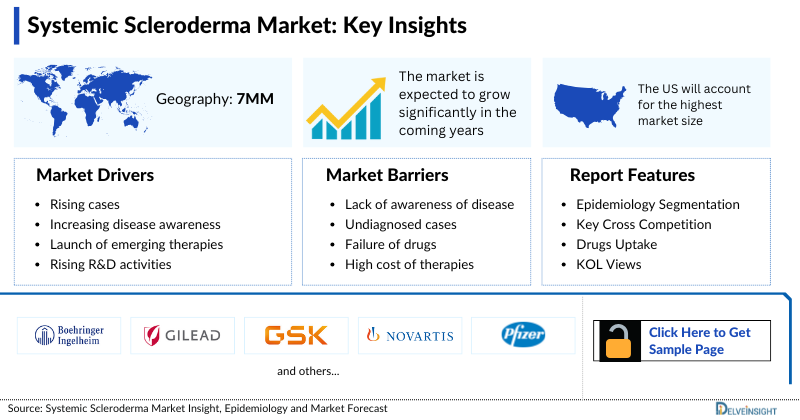
Request for unlocking the Sample Page of the "Systemic Scleroderma Market Insights"
Key Factors Driving the Systemic Scleroderma Market
- Rising Awareness and Early Diagnosis: Improved physician education, advanced diagnostic tools, and growing patient advocacy are leading to earlier identification of systemic scleroderma, expanding the treated patient population.
- Increasing Focus on Targeted & Biologic Therapies: Advancements in immunology and fibrosis research have accelerated the development of targeted biologics and antifibrotic agents, strengthening the clinical pipeline.
- High Unmet Medical Need: Limited curative options and the progressive, multi-organ nature of systemic scleroderma create strong demand for disease-modifying therapies.
- Regulatory Incentives for Rare Diseases: Orphan drug designations, fast-track approvals, and market exclusivity benefits are encouraging pharmaceutical investment in systemic scleroderma treatments.
- Growing R&D Investments and Strategic Collaborations: Partnerships between biotech firms, academic institutions, and pharmaceutical companies are accelerating innovation and expanding therapeutic approaches.
DelveInsight's "Systemic Scleroderma Market Insights, Epidemiology, and Market Forecast-2034" report delivers an in-depth understanding of the Systemic Scleroderma, historical and forecasted epidemiology as well as the Systemic Scleroderma therapeutics market trends in the United States, EU5 (Germany, Spain, Italy, France, and United Kingdom) and Japan.
The Systemic Scleroderma market report provides current treatment practices, emerging drugs, Systemic Scleroderma market share of the individual therapies, current and forecasted Systemic Scleroderma market Size from 2020 to 2034 segmented by seven major markets. The Report also covers current Systemic Scleroderma treatment practice/algorithm, market drivers, market barriers and unmet medical needs to curate the best of the opportunities and assesses the underlying potential of the Systemic Scleroderma market.
Scope of the Systemic Scleroderma Market | |
|
Study Period |
2020 to 2034 |
|
Forecast Period |
2024-2034 |
|
Geographies Covered |
|
|
Systemic Scleroderma Market |
|
|
Systemic Scleroderma Market Size | |
|
Systemic Scleroderma Companies |
Genentech, Kyowa Kirin, GSK, AstraZeneca, Amgen (Horizon Therapeutics), Mitsubishi Tanabe Pharma, Roche (Genentech), Kiniksa Pharmaceuticals, Boehringer Ingelheim, aTyr Pharma, Kyorin Pharmaceutical, Cumberland Pharmaceuticals, and others |
|
Systemic Scleroderma Epidemiology Segmentation |
|
Systemic Scleroderma Disease Understanding
The DelveInsight’s Systemic Scleroderma market report gives a thorough understanding of the Systemic Scleroderma by including details such as disease definition, symptoms, causes, pathophysiology, diagnosis, and treatment.
Systemic Scleroderma Overview
Systemic scleroderma, also known as Systemic Scleroderma, is a rare, chronic autoimmune disorder characterized by excessive collagen production, vascular abnormalities, and progressive fibrosis of the skin and internal organs. The disease results from immune system dysfunction that triggers inflammation and abnormal connective tissue buildup.
Systemic Scleroderma Diagnosis
The diagnosis of Systemic Scleroderma is based on a combination of clinical evaluation, laboratory testing, imaging studies, and organ function assessments. Early diagnosis is crucial to prevent irreversible organ damage and initiate timely treatment.
Key Diagnostic Approaches:
Clinical Assessment: Physicians evaluate characteristic symptoms such as skin thickening, digital ulcers, and Raynaud's phenomenon, which is often the earliest presenting sign.
Autoantibody Testing:
- Blood tests detect disease-specific antibodies, including:
- Anti-centromere antibodies (common in limited cutaneous type)
- Anti–topoisomerase I (Scl-70) antibodies
- Anti–RNA polymerase III antibodies
Nailfold Capillaroscopy: A non-invasive test that examines capillary abnormalities in the nailfold region, helping identify early microvascular damage.
Imaging & Organ Evaluation:
- High-resolution CT (HRCT) scans to detect interstitial lung disease
- Pulmonary function tests (PFTs)
- Echocardiography to assess pulmonary hypertension
- Renal function tests
Systemic Scleroderma Treatment
The treatment of Systemic Scleroderma focuses on slowing disease progression, managing organ involvement, and improving quality of life. As there is no definitive cure, therapy is tailored based on disease subtype, severity, and affected organs.
Key Treatment Approaches:
- Immunosuppressive Therapy: Agents such as mycophenolate mofetil and cyclophosphamide are commonly used to reduce immune-driven inflammation and manage skin and lung involvement.
- Antifibrotic Therapy: Nintedanib is approved to slow the progression of interstitial lung disease (ILD) associated with Systemic Scleroderma.
- Biologic Agents: Tocilizumab may help reduce inflammation and preserve lung function in selected patients.
- Vascular & Symptom Management: Vasodilators are used to manage Raynaud's phenomenon and prevent digital ulcers. Proton pump inhibitors are prescribed for gastrointestinal complications, while ACE inhibitors are critical in treating scleroderma renal crisis.
- Supportive & Multidisciplinary Care: Physical therapy, pulmonary rehabilitation, and regular monitoring of organ function are essential components of comprehensive care.
Systemic Scleroderma Epidemiology
The Systemic Scleroderma epidemiology section provides insights about the historical and current Systemic Scleroderma patient pool and forecasted trends for individual seven major countries. It helps to recognize the causes of current and forecasted trends by exploring numerous studies and views of key opinion leaders. This part of the Systemic Scleroderma market report also provides the diagnosed patient pool and their trends along with assumptions undertaken.
Key Findings in the Systemic Scleroderma Epidemiology Forecast
- Based on DelveInsight's assessment in 2024, the 7MM had approximately 231,200 diagnosed prevalent cases of Systemic Scleroderma. These cases are projected to increase during the forecast period.
- Among EU4 and the UK, Italy had the highest number of diagnosed prevalent cases of Systemic Scleroderma, while Spain had the lowest number of diagnosed prevalent cases.
- It is observed that Systemic Scleroderma occurs majorly in the age group of 40–69 years.
- Systemic Scleroderma severity is distributed by organ damage and skin thickness. Mild organ damage and mild skin thickness are present in a majority of patients with Systemic Scleroderma.
- Analysis of age-specific data in the US indicates that Systemic Scleroderma was least prevalent among individuals aged 39 years or younger, with the highest number of diagnosed cases observed in those aged between 40 and 69 years.
Systemic Scleroderma Epidemiology Segmentation
- Total Diagnosed Prevalent Cases of Systemic Scleroderma in the 7MM
- Systemic Scleroderma by Disease Subset in the 7MM
- Age-specific Cases of Systemic Scleroderma in the 7MM
- Systemic Scleroderma Severity by Skin Thickness in the 7MM
- Systemic Scleroderma Severity by Organ Damage in the 7MM
- Systemic Scleroderma With Organ Involvement in the 7MM
Country Wise- Systemic Scleroderma Epidemiology
The epidemiology segment also provides the Systemic Scleroderma epidemiology data and findings across the United States, EU5 (Germany, France, Italy, Spain, and the United Kingdom), and Japan.
Systemic Scleroderma Drug Chapters
The drug chapter segment of the Systemic Scleroderma report encloses the detailed analysis of Systemic Scleroderma marketed drugs and late-stage (Phase-III and Phase-II) Systemic Scleroderma pipeline drugs. It also helps to understand the Systemic Scleroderma clinical trial details, expressive pharmacological action, agreements and collaborations, approval and patent details, advantages and disadvantages of each included drug and the latest news and press releases.
Systemic Scleroderma Marketed Drugs
-
OFEV (nintedanib): Boehringer Ingelheim
Nintedanib is in a class of medications called kinase inhibitors and works by blocking the action of enzymes involved in causing fibrosis. It is used to slow the rate of decline in lung function in people with Systemic Scleroderma-associated interstitial lung disease, a disease in which there is scarring of the lungs that is often fatal. In September 2020, the US FDA approved OFEV capsules to slow the rate of decline in pulmonary function in adults with Systemic Scleroderma-associated interstitial lung disease. The company holds Orphan drug exclusivity of OFEV until 2026.
-
ACTEMRA (tocilizumab): Roche
ACTEMRA is an anti-IL-6 receptor biologic and is available in both intravenous (IV) and subcutaneous (SC) formulations. ACTEMRA SC is approved in the US to slow the rate of pulmonary function decline in adult patients with Systemic Scleroderma-associated interstitial lung disease. The drug is part of a co-development agreement with Chugai Pharmaceutical. In March 2021, the US FDA approved ACTEMRA SC injection for slowing the rate of decline in pulmonary function in adult patients with Systemic Scleroderma-associated interstitial lung disease. In September 2023, Roche withdrew its application to use ROACTEMRA in Europe for the same.
Systemic Scleroderma Emerging Drugs
-
LUMICEF (brodalumab/KHK-4827): Kyowa Kirin
LUMICEF is a recombinant, human IgG monoclonal antibody to the interleukin (IL)-17A receptor, the engagement of which results in the release of pro-inflammatory mediators. The binding of the monoclonal antibody blocks the interaction of IL-17A with its receptor and thus decreases inflammatory pathways that are involved in immune-mediated cell injury. In December 2020, LUMICEF was designated as an Orphan Drug by the Ministry of Health, Labour and Welfare (MHLW) for Systemic Scleroderma and is subject to Priority Review. The application of LUMICEF is under review in Japan for Systemic Scleroderma. In December 2021, Kyowa Kirin announced that the company filed an application to the MHLW for a partial change of approved indication of LUMICEF for Systemic Scleroderma in Japan.
-
BENLYSTA (belimumab): GSK
BENLYSTA is a recombinant, fully human monoclonal antibody that is approved by the US FDA for the treatment of systemic lupus erythematosus. It binds to soluble human BLyS and inhibits its biological activity, leading to apoptosis of B lymphocytes and decreased autoantibody production. In February 2023, GSK announced that the US FDA granted an Orphan Drug Designation to BENLYSTA for the potential treatment of Systemic Scleroderma. As per GSK’s first quarter 2024 clinical trial appendix, for the BLISSc-ILD Phase III trial, the data is anticipated in 2026+.
-
SAPHNELO (anifrolumab): AstraZeneca
SAPHNELO is a first-in-class, fully human monoclonal antibody. It disrupts the Type I interferon auto-amplification loop that can trigger the loss of immune tolerance and autoimmunity. In addition, it partially inhibits the upregulation of costimulatory molecules and the production of pro-inflammatory cytokines by plasmacytoid dendritic cells (pDCs). SAPHNELO was granted Orphan Drug Designation by the US FDA for the treatment of Systemic Scleroderma in 2013.
As per AstraZeneca’s first quarter report of 2024, the first patient commenced dosing in the fourth quarter of 2023, the first estimated filing acceptance and the data is anticipated >2025 in the Phase III DAISY clinical trial.
Systemic Scleroderma Market Outlook
The Systemic Scleroderma market outlook of the report helps to build a detailed comprehension of the historic, current, and forecasted Systemic Scleroderma market trends by analyzing the impact of current Systemic Scleroderma therapies on the market, unmet needs, drivers and barriers, and demand for better technology.
This segment gives a thorough detail of Systemic Scleroderma market trend of each marketed drug and late-stage pipeline therapy by evaluating their impact based on the annual cost of therapy, inclusion and exclusion criteria's, mechanism of action, compliance rate, growing need of the market, increasing patient pool, covered patient segment, expected launch year, competition with other therapies, brand value, their impact on the market and view of the key opinion leaders. The calculated Systemic Scleroderma market data are presented with relevant tables and graphs to give a clear view of the market at first sight.
According to DelveInsight, the Systemic Scleroderma market in 7MM is expected to witness a major change in the study period 2020-2034.
Key Findings
This section includes a glimpse of the Systemic Scleroderma market in 7MM.
The United States Systemic Scleroderma Market Outlook
This section provides the total Systemic Scleroderma market size and market size by therapies in the United States.
EU-5 Countries Systemic Scleroderma Market Outlook
The total Systemic Scleroderma market size and market size by therapies in Germany, France, Italy, Spain, and the United Kingdom is provided in this section.
Japan Systemic Scleroderma Market Outlook
The total Systemic Scleroderma market size and market size by therapies in Japan is also mentioned.
Systemic Scleroderma Competitive Landscape
The systemic scleroderma market features a diverse competitive landscape comprising established pharmaceutical companies, emerging biotechs, and specialty rare disease developers focused on novel antifibrotic, immunomodulatory, and multi-organ targeted therapies. Key players are advancing both mechanism-based treatments and symptom-focused agents to address skin fibrosis, lung involvement (especially interstitial lung disease), and vascular manifestations.
Major industry participants leverage strategic collaborations, licensing agreements, and clinical partnerships to strengthen pipelines and accelerate late-stage development. Biotechs with innovative platforms often partner with larger pharma companies to co-develop or co-commercialize promising candidates, particularly in immunotherapy and targeted small molecules.
Competition is driven not just by therapeutic efficacy but also by differentiated safety profiles, convenience of administration, and real-world outcomes in slowing disease progression. With limited approved options currently available, the competitive arena is dynamic, with multiple candidates in Phase II/III trials potentially poised to change standard of care. Emerging entrants focusing on precision medicine, biomarkers, and combination regimens further intensify the market landscape as companies compete to address specific unmet needs within systemic scleroderma.
Key Systemic Scleroderma Companies
The Key Systemic Scleroderma companies actively involved in the Systemic Scleroderma treatment landscape include -
- Genentech
- Kyowa Kirin
- GSK
- AstraZeneca
- Amgen (Horizon Therapeutics)
- Mitsubishi Tanabe Pharma
- Roche (Genentech)
- Kiniksa Pharmaceuticals
- Boehringer Ingelheim
- aTyr Pharma
- Kyorin Pharmaceutical
- Cumberland Pharmaceuticals, and others
Systemic Scleroderma Drugs Uptake
This section focuses on the rate of uptake of the potential Systemic Scleroderma drugs recently launched in the Systemic Scleroderma market or expected to get launched in the market during the study period 2020-2034. The analysis covers Systemic Scleroderma market uptake by drugs; patient uptake by therapies; and sales of each drug.
Systemic Scleroderma Drugs Uptake helps in understanding the drugs with the most rapid uptake, reasons behind the maximal use of new drugs, and allow the comparison of the drugs on the basis of Systemic Scleroderma market share and size which again will be useful in investigating factors important in market uptake and in making financial and regulatory decisions.
Systemic Scleroderma Clinical Trial Activities
The Systemic Scleroderma pipeline report provides insights into different Systemic Scleroderma clinical trials within Phase II, and Phase III stage. It also analyses Systemic Scleroderma key players involved in developing targeted therapeutics.
Systemic Scleroderma Pipeline Development Activities
The Systemic Scleroderma clinical trial analysis report covers the detailed information of collaborations, acquisition, and merger, licensing, patent details, and other information for Systemic Scleroderma emerging therapies.
Systemic Scleroderma Market Reimbursement Scenario
Approaching reimbursement proactively can have a positive impact both during the late stages of product development and well after product launch. In a report, we take reimbursement into consideration to identify economically attractive indications and market opportunities. When working with finite resources, the ability to select the markets with the fewest reimbursement barriers can be a critical business and price strategy.
Latest KOL- Views on the Systemic Scleroderma Market Report
To keep up with current Systemic Scleroderma market trends, we take KOLs and SMEs ' opinion working in the Systemic Scleroderma domain through primary research to fill the data gaps and validate our secondary research. Their opinion helps to understand and validate current and emerging therapies treatment patterns or Systemic Scleroderma market trends. This will support the clients in potential upcoming novel treatment by identifying the overall scenario of the market and the unmet needs.
Systemic Scleroderma Competitive Intelligence Analysis
We perform Competitive and Market Intelligence analysis of the Systemic Scleroderma Market by using various Competitive Intelligence tools that include - SWOT analysis, PESTLE analysis, Porter's five forces, BCG Matrix, Market entry strategies etc. The inclusion of the analysis entirely depends upon the data availability.
Scope of the Systemic Scleroderma Market Report
- The report covers the descriptive overview of Systemic Scleroderma, explaining its causes, signs and symptoms, pathophysiology, diagnosis and currently available therapies
- Comprehensive insight has been provided into the Systemic Scleroderma epidemiology and treatment in the 7MM
- Additionally, an all-inclusive account of both the current and emerging therapies for Systemic Scleroderma is provided, along with the assessment of new therapies, which will have an impact on the current treatment landscape
- A detailed review of the Systemic Scleroderma market; historical and forecasted is included in the report, covering drug outreach in the 7MM
- The report provides an edge while developing business strategies, by understanding trends shaping and driving the global Systemic Scleroderma market
Systemic Scleroderma Market Report Highlights
- In the coming years, the Systemic Scleroderma market is set to change due to the rising awareness of the disease, and incremental healthcare spending across the world; which would expand the size of the market to enable the drug manufacturers to penetrate more into the market
- The companies and academics are working to assess challenges and seek opportunities that could influence Systemic Scleroderma R&D. The therapies under development are focused on novel approaches to treat/improve the disease condition
- Major players are involved in developing therapies for Systemic Scleroderma. The launch of emerging therapies will significantly impact the Systemic Scleroderma market
- A better understanding of disease pathogenesis will also contribute to the development of novel therapeutics for Systemic Scleroderma
- Our in-depth analysis of the pipeline assets across different stages of development (Phase III and Phase II), different emerging trends and comparative analysis of pipeline products with detailed clinical profiles, key cross-competition, launch date along with product development activities will support the clients in the decision-making process regarding their therapeutic portfolio by identifying the overall scenario of the research and development activities
Systemic Scleroderma Market Report Insights
- Systemic Scleroderma Patient Population
- Systemic SclerodermaTherapeutic Approaches
- Systemic Scleroderma Pipeline Analysis
- Systemic Scleroderma Market Size and Trends
- Systemic Scleroderma Market Opportunities
- Impact of upcoming Systemic Scleroderma Therapies
Systemic Scleroderma Market Report Key Strengths
- 11 Years Forecast
- 7MM Coverage
- Systemic Scleroderma Epidemiology Segmentation
- Key Cross Competition
- Highly Analyzed Market
- Systemic Scleroderma Drugs Uptake
Systemic Scleroderma Market Report Assessment
- Current Systemic Scleroderma Treatment Practices
- Systemic Scleroderma Unmet Needs
- Systemic Scleroderma Pipeline Product Profiles
- Systemic Scleroderma Market Attractiveness
- Systemic Scleroderma Market Drivers
- Systemic Scleroderma Market Barriers
Key Questions Answered In The Systemic Scleroderma Market Report:
Systemic Scleroderma Market Insights:
- What was the Systemic Scleroderma drug class share (%) distribution in 2020 and how it would look like in 2034?
- What would be the Systemic Scleroderma total market size as well as market size by therapies across the 7MM during the forecast period (2020-2034)?
- What are the key findings pertaining to the market across 7MM and which country will have the largest Systemic Scleroderma market size during the forecast period (2020-2034)?
- At what CAGR, the Systemic Scleroderma market is expected to grow by 7MM during the forecast period (2020-2034)?
- What would be the Systemic Scleroderma market outlook across the 7MM during the forecast period (2020-2034)?
- What would be the Systemic Scleroderma market growth till 2034, and what will be the resultant market Size in the year 2034?
- How would the unmet needs affect the market dynamics and subsequent analysis of the associated trends?
Systemic Scleroderma Epidemiology Insights:
- What are the disease risk, burden, and regional/ethnic differences of the Systemic Scleroderma?
- What are the key factors driving the epidemiology trend for seven major markets covering the United States, EU5 (Germany, Spain, France, Italy, UK), and Japan?
- What is the historical Systemic Scleroderma patient pool in seven major markets covering the United States, EU5 (Germany, Spain, France, Italy, UK), and Japan?
- What would be the forecasted patient pool of Systemic Scleroderma in seven major markets covering the United States, EU5 (Germany, Spain, France, Italy, UK), and Japan?
- Where will be the growth opportunities in the 7MM with respect to the patient population pertaining to Systemic Scleroderma?
- Out of all 7MM countries, which country would have the highest prevalent population of Systemic Scleroderma during the forecast period (2020-2034)?
- At what CAGR the patient population is expected to grow in 7MM during the forecast period (2020-2034)?
Current Systemic Scleroderma Treatment Scenario, Marketed Drugs and Emerging Therapies:
- What are the current options for the Systemic Scleroderma treatment in addition to the approved therapies?
- What are the current treatment guidelines for the treatment of Systemic Scleroderma in the USA, Europe, and Japan?
- What are the Systemic Scleroderma marketed drugs and their respective MOA, regulatory milestones, product development activities, advantages, disadvantages, safety and efficacy, etc.?
- How many companies are developing therapies for the treatment of Systemic Scleroderma?
- How many therapies are in-development by each company for Systemic Scleroderma treatment?
- How many are emerging therapies in mid-stage, and late stage of development for Systemic Scleroderma treatment?
- What are the key collaborations (Industry - Industry, Industry - Academia), Mergers and acquisitions, licensing activities related to the Systemic Scleroderma therapies?
- What are the recent novel therapies, targets, mechanisms of action and technologies being developed to overcome the limitation of existing therapies?
- What are the clinical studies going on for Systemic Scleroderma and their status?
- What are the current challenges faced in drug development?
- What are the key designations that have been granted for the emerging therapies for Systemic Scleroderma?
- What are the global historical and forecasted market of Systemic Scleroderma?
Reasons to buy Systemic Scleroderma Market Forecast Report
- The report will help in developing business strategies by understanding trends shaping and driving the Systemic Scleroderma market
- To understand the future market competition in the Systemic Scleroderma market and Insightful review of the key market drivers and barriers
- Organize sales and marketing efforts by identifying the best opportunities for Systemic Scleroderma in the US, Europe (Germany, Spain, Italy, France, and the United Kingdom) and Japan
- Identification of strong upcoming players in the market will help in devising strategies that will help in getting ahead of competitors
- Organize sales and marketing efforts by identifying the best opportunities for Systemic Scleroderma market
- To understand the future market competition in the Systemic Scleroderma market