Thyroid Eye Disease Pipeline Summary
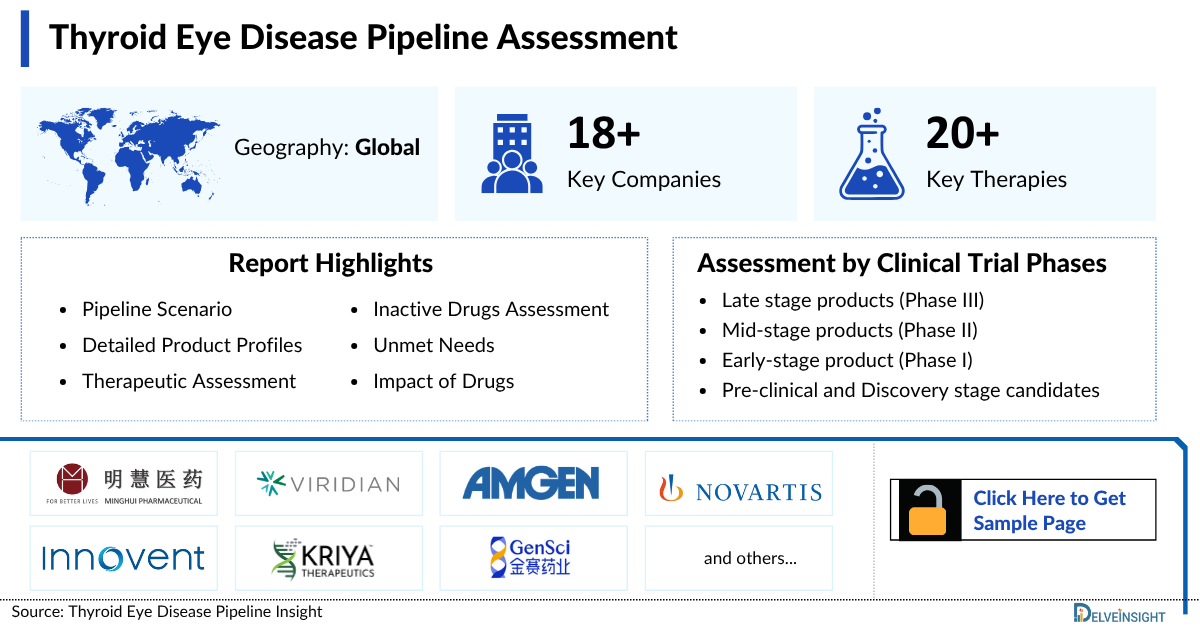
DelveInsight’s, “Thyroid Eye Disease Pipeline Insight, 2026” report provides comprehensive insights about 18+ companies and 20+ pipeline drugs in Thyroid Eye Disease pipeline landscape. It covers the pipeline drug profiles, including clinical and nonclinical stage products. It also covers the therapeutics assessment by product type, stage, route of administration, and molecule type. It further highlights the inactive pipeline products in this space.
Geography Covered
- Global coverage
Thyroid Eye Disease Disease Understanding
Thyroid Eye Disease Overview
Thyroid eye disease (TED) is a chronic, immune-mediated inflammatory disorder affecting the tissues around the eyes and is the most common cause of unilateral and bilateral proptosis in adults. It commonly occurs in individuals with Graves’ disease, although not all patients are affected. Characterized by inflammation and expansion of the orbital tissues, TED can lead to proptosis, ophthalmoplegia, and other vision-related complications. The condition has been recognized for centuries, with its clinical association with Graves’ disease later established through the work of Robert Graves.
The exact cause of thyroid eye disease (TED) is not fully understood, but it is driven by a complex autoimmune process involving orbital fibroblasts, adipocytes, and immune cells. Orbital fibroblasts play a central role by expressing thyroid-stimulating hormone (TSH) receptors and differentiating into either fat cells or myofibroblasts, resulting in orbital fat expansion, muscle enlargement, and tissue fibrosis. Autoimmune activation of TSH receptors, insulin-like growth factor-1 (IGF-1) receptors, and other signaling pathways triggers the release of pro-inflammatory cytokines and chemokines, leading to the recruitment of T cells and B cells that sustain chronic inflammation and autoantibody production. Over time, this persistent inflammatory response causes remodeling of the orbital tissues, manifesting as either fat-predominant or muscle-predominant disease, with the pattern influenced in part by age-related fibroblast activity.
Several factors increase the risk of developing thyroid eye disease (TED), including older age, female sex, Black ethnicity, genetic predisposition, and the presence of Graves’ disease or other autoimmune disorders. Smoking is one of the strongest modifiable risk factors and is associated with greater disease severity. Additional factors that may increase the risk or worsen TED include thyroid dysfunction, radioactive iodine therapy, psychological stress, the postpartum period, orbital trauma, and elevated serum cholesterol. While TED is more common in women, men and older individuals are more likely to experience severe ocular involvement and poorer clinical outcomes.
Thyroid eye disease (TED) typically follows a self-limiting course characterized by an initial active inflammatory phase, a stable plateau phase, and a subsequent inactive or burnout phase. During the active stage, progressive inflammation and immune-mediated tissue remodeling lead to orbital fat expansion, extraocular muscle enlargement, proptosis, and venous congestion. Although disease activity eventually subsides, residual fibrotic changes often persist, resulting in long-term structural and functional impairment. Early immunosuppressive treatment during the active phase may reduce irreversible tissue damage, whereas surgical intervention is generally reserved for the inactive phase when inflammation has stabilized.
Thyroid eye disease (TED) is evaluated based on disease activity and severity using standardized clinical assessment systems. Earlier classifications, such as NO SPECS and RELIEF, primarily assessed disease severity but did not account for inflammatory activity. Current practice relies on the Clinical Activity Score (CAS) and the European Group on Graves’ Orbitopathy (EUGOGO) classification, which evaluate inflammation, ocular involvement, functional impairment, and categorize disease as mild, moderate-to-severe, or sight-threatening. The VISA classification further assesses vision, inflammation, strabismus, and appearance to guide treatment decisions. In addition to clinical examination, imaging modalities including optical coherence tomography angiography (OCTA), orbital ultrasonography, computed tomography (CT), magnetic resonance imaging (MRI), and orbital color Doppler imaging provide valuable insights into orbital inflammation, extraocular muscle enlargement, optic nerve compression, vascular changes, and overall disease progression, supporting accurate diagnosis, severity assessment, and treatment planning.
Management of thyroid eye disease (TED) focuses on preventing disease progression, preserving vision, and improving quality of life through timely assessment and appropriate intervention. Preventive measures include smoking cessation, early diagnosis and treatment of thyroid dysfunction, restoration of euthyroid status, and ocular surface protection with lubricants. Mild TED is primarily managed with supportive care, including artificial tears and selenium supplementation, while temporary eyelid retraction may be treated with botulinum toxin or corticosteroid injections. Moderate-to-severe active disease requires immunosuppressive therapy, with intravenous corticosteroids as the first-line treatment, followed by immunomodulators or targeted biologic therapies such as teprotumumab, rituximab, and tocilizumab in selected patients. Inactive disease is managed with lubrication and rehabilitative surgical procedures to correct residual proptosis, strabismus, or eyelid abnormalities. Sight-threatening TED, particularly dysthyroid optic neuropathy, requires urgent high-dose corticosteroids and, when necessary, orbital decompression surgery. Elective surgical interventions are typically reserved for stable, inactive disease to restore both functional vision and cosmetic appearance.
"Thyroid Eye Disease Pipeline Insight, 2026" report by DelveInsight outlays comprehensive insights of present scenario and growth prospects across the indication. A detailed picture of the Thyroid Eye Disease pipeline landscape is provided which includes the disease overview and Thyroid Eye Disease treatment guidelines. The assessment part of the report embraces, in depth Thyroid Eye Disease commercial assessment and clinical assessment of the pipeline products under development. In the report, detailed description of the drug is given which includes mechanism of action of the drug, clinical studies, NDA approvals (if any), and product development activities comprising the technology, Thyroid Eye Disease collaborations, licensing, mergers and acquisition, funding, designations and other product related details.
Report Highlights
The companies and academics are working to assess challenges and seek opportunities that could influence Thyroid Eye Disease R&D. The therapies under development are focused on novel approaches to treat/improve Thyroid Eye Disease.
Thyroid Eye Disease Emerging Drugs Chapters
This segment of the Thyroid Eye Disease report encloses its detailed analysis of various drugs in different stages of clinical development, including Phase III, II, I, Preclinical and Discovery. It also helps to understand clinical trial details, expressive pharmacological action, agreements and collaborations, and the latest news and press releases.
Thyroid Eye Disease Emerging Drugs
MHB018A: Minghui Pharmaceutical
MHB018A is Minghui Pharmaceutical's lead investigational therapy for moderate-to-severe Thyroid Eye Disease (TED). It is a novel humanized subcutaneous antibody targeting the insulin-like growth factor-1 receptor (IGF-1R). The antibody blocks the binding of both IGF-1 and IGF-2 to IGF-1R and promotes receptor internalization and degradation, thereby inhibiting inflammatory signaling, tissue expansion, and orbital remodeling associated with TED. Unlike currently approved intravenous IGF-1R therapies, MHB018A is administered subcutaneously once every four weeks, offering the potential for improved patient convenience and accessibility. Phase I/II studies demonstrated encouraging efficacy in both active and chronic TED, with a favorable safety profile and no reports of severe or permanent hearing damage among treated patients. Currently, the drug is in Phase III stage of its development for the treatment of thyroid eye disease.
AMG-732: Amgen
Amgen's AMG-732 is an investigational monoclonal antibody designed to selectively target the insulin-like growth factor-1 receptor (IGF-1R), a key mediator implicated in the pathogenesis of thyroid eye disease (TED). By inhibiting IGF-1R signaling, AMG-732 aims to reduce the autoimmune-driven inflammation, tissue remodeling, and orbital changes associated with TED. The therapy is currently being evaluated in Phase II clinical studies for its potential to improve disease activity, alleviate ocular symptoms, and offer a targeted treatment approach for patients with TED.
IBI-3031: Innovent Biologics
IBI3031 is a novel bispecific antibody engineered to simultaneously target the insulin-like growth factor-1 receptor (IGF-1R) and the thyroid-stimulating hormone receptor (TSHR), two key drivers of thyroid eye disease (TED). By combining dual-target inhibition with advanced antibody engineering, IBI3031 is designed to enhance therapeutic efficacy beyond the current standard of care while supporting more convenient future administration. Preclinical studies have demonstrated that the therapy effectively suppresses orbital fibroblast proliferation, hyaluronic acid production, and myofibroblast differentiation, while reducing thyroid cell hyperactivity, highlighting its potential as a targeted treatment for TED. Currently, the drug is in Phase I stage of its development for the treatment of thyroid eye disease.
Further product details are provided in the report...
Thyroid Eye Disease Therapeutic Assessment
This segment of the report provides insights about the different Thyroid Eye Disease drugs segregated based on following parameters that define the scope of the report, such as:
Major Players in Thyroid Eye Disease
There are approx. 18+ key companies which are developing the therapies for Thyroid Eye Disease. The companies which have their Thyroid Eye Disease drug candidates in the most advanced stage, i.e. Phase III include, Minghui Pharmaceutical.
Thyroid Eye Disease Drugs Phases
DelveInsight’s report covers around 20+ products under different phases of clinical development like
- Late stage products (Phase III)
- Mid-stage products (Phase II)
- Early-stage product (Phase I) along with the details of
- Pre-clinical and Discovery stage candidates
- Discontinued & Inactive candidates
Thyroid Eye Disease Drugs Route of Administration
Thyroid Eye Disease pipeline report provides the therapeutic assessment of the pipeline drugs by the Route of Administration. Products have been categorized under various ROAs such as
- Oral
- Intravenous
- Subcutaneous
- Parenteral
- Topical
Thyroid Eye Disease Drugs Molecule Type
Products have been categorized under various Molecule types such as
- Recombinant fusion proteins
- Small molecule
- Monoclonal antibody
- Peptide
- Polymer
- Gene therapy
Thyroid Eye Disease Pipeline Product Type
Drugs have been categorized under various product types like Mono, Combination and Mono/Combination.
Thyroid Eye Disease Pipeline Development Activities
The Thyroid Eye Disease Pipeline report provides insights into different therapeutic candidates in Phase III, II, I, preclinical and discovery stage. It also analyses Thyroid Eye Disease therapeutic drugs key players involved in developing key drugs.
Thyroid Eye Disease Clinical Trials and Development Activities
The Thyroid Eye Disease clinical trials analysis report covers the detailed information of collaborations, acquisition and merger, licensing along with a thorough therapeutic assessment of emerging Thyroid Eye Disease drugs.
Thyroid Eye Disease Pipeline Report Insights
- Thyroid Eye Disease Pipeline Analysis
- Thyroid Eye Disease Therapeutic Assessment
- Thyroid Eye Disease Unmet Needs
- Impact of Thyroid Eye Disease Drugs
Thyroid Eye Disease Pipeline Report Assessment
- Thyroid Eye DiseasePipeline Product Profiles
- Thyroid Eye DiseaseTherapeutic Assessment
- Thyroid Eye DiseasePipeline Assessment
- Inactive Thyroid Eye Diseasedrugs assessment
- Thyroid Eye Disease Unmet Needs
Key Questions Answered in the Thyroid Eye Disease Pipeline Report:
Current Treatment Scenario and Emerging Therapies:
- How many companies are developing Thyroid Eye Disease drugs?
- How many Thyroid Eye Disease drugs are developed by each company?
- How many emerging drugs are in mid-stage, and late-stage of development for the treatment of Thyroid Eye Disease?
- What are the key collaborations (Industry–Industry, Industry–Academia), Mergers and acquisitions, licensing activities related to the Thyroid Eye Disease therapeutics?
- What are the recent trends, drug types and novel technologies developed to overcome the limitation of existing therapies?
- What are the clinical studies going on for Thyroid Eye Disease and their status?
- What are the key designations that have been granted to the emerging drugs?
Key Thyroid Eye Disease Companies
- Minghui Pharmaceutical
- Viridian Therapeutics
- Amgen
- Novartis
- Innovent Biologics
- Kriya Therapeutics
- Changchun GeneScience Pharmaceutical
- Sinocelltech Ltd
- Nanjing Chia-tai Tianqing Pharmaceutical
- Beijing Kanghong Biological Medicine
- H. Lundbeck A/S
- Sling Therapeutics
Key Thyroid Eye Disease Pipeline Products
- MHB018A
- VRDN-003
- Research Program: Anti-TSHR
- AMG-732
- TOUR006
- IBI-3031
- KRIYA-586
- GenSci098
- SCTT11
- NTB003
- KHN939
- Lu AG22515
- Linsitinib


