Thyroid Eye Disease Market
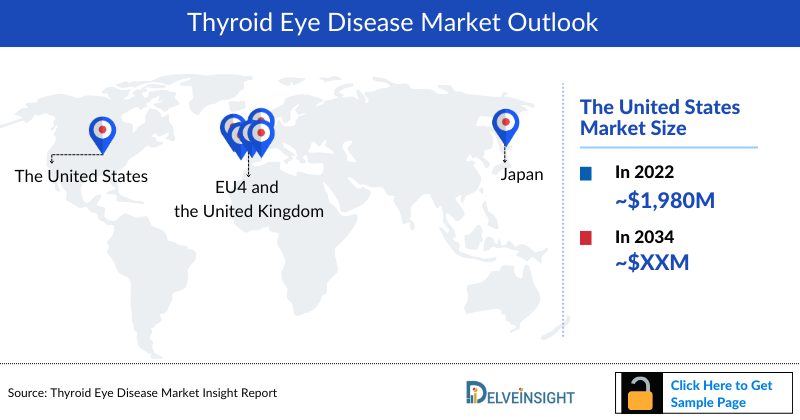
- In 2022, the Thyroid Eye Disease market size was the highest in the US among the 7MM, accounting for approximately USD 1,980 million, which is further expected to increase by 2034.
- The leading Thyroid Eye Disease Companies such as Allergan PLC, Eli Lilly & Company, Boehringer Ingelheim, Merck & Co. Inc., Astellas Pharma Inc., Olympus Medical, Butterfly Medical, SRS Medical, Teleflex Interventional Urology, Urotronic, Zenflow, ProArc Medical, Medion Biodesign, and others are developing therapies for Thyroid Eye Disease Treatment.
- Thyroid Eye Disease represents a broad spectrum of disease, although the diagnosis is readily apparent in those with severe and active disease, establishing the diagnosis in patients with lesser degrees of thyroid eye disease can be challenging, and this may be the primary cause for low diagnosis rate seen across the 7MM since many people go misdiagnosed.
- Due to the recent approval of TEPEZZA in 2020 and the company’s efforts to increase patient and clinician awareness of thyroid eye disease with various awareness campaigns, an increase in early diagnosis and treatment of thyroid eye disease is expected.
- Horizon Therapeutics’ TEPEZZA (teprotumumab) is the only approved drug by US FDA for treating thyroid eye disease.
- Most treatment guidelines, like EUGOGO, recommend IV methylprednisolone in combination with oral mycophenolate sodium (or mofetil), which represents the first-line treatment for moderate-to-severe and acute and acute Thyroid Eye Disease.
- Among the emerging Thyroid Eye Disease therapies, the three promising drugs, Viridian Therapeutics’ VRDN-001, Immunovant Sciences’ batoclimab, and Novartis’ COSENTYX (secukinumab), have the potential to create a significant positive shift in the Thyroid Eye Disease market size.
- The advantage of the emerging candidate, batoclimab, over the already approved drug teprotumumab is that it is being developed as a self-administered SC injection, and it can potentially fulfill the unmet of an approved drug.
Request for Sample Page @ Thyroid Eye Disease Market Report
DelveInsight’s “Thyroid Eye Disease Market Insights, Epidemiology and Market Forecast – 2034” report delivers an in-depth understanding of the Thyroid Eye Disease, historical and forecasted epidemiology as well as the Thyroid Eye Disease market trends in the United States, EU4 (Germany, France, Italy, and Spain) and the United Kingdom, and Japan.
Thyroid Eye Disease market report provides current treatment practices, emerging drugs, market share of individual therapies, and current and forecasted 7MM Thyroid Eye Disease market size from 2020 to 2034. The report also covers current Thyroid Eye Disease treatment practice/algorithm and unmet medical needs to curate the best of the opportunities and assess the market’s underlying potential.
Geography Covered
- The United States
- EU4 (Germany, France, Italy, and Spain) and the United Kingdom
- Japan
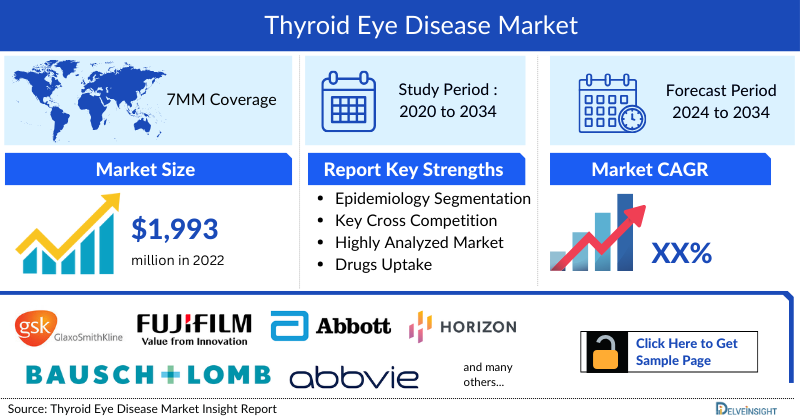
Study period: 2020–2034
Thyroid Eye Disease Treatment Market
Thyroid Eye Disease overview
Thyroid Eye Disease is an autoimmune inflammatory disorder associated with thyroid disease, which affects ocular and orbital tissues. It is also known as Graves’ orbitopathy, Graves’ eye disease, graves’ ophthalmopathy, and thyroid-associated ophthalmopathy. It is the main extrathyroidal manifestation of Graves’ disease (GD) and is often disfiguring, significantly impairing the QoL of affected individuals and causing great indirect and direct costs to health systems.
Being an immune-mediated inflammatory disorder, it produces expansion of the extraocular muscles and fat in orbit. Edema, accumulation of glycosaminoglycans and collagen, and adipogenesis cause most patients to enlarge both extraocular muscle and orbital adipose tissue, with a predominance of either in some patients.
Thyroid Eye Disease diagnosis
Diagnosis of thyroid eye disease is complex because it overlaps symptoms with other diseases, including inflammatory orbitopathy, such as granulomatosis with polyangiitis (GPA, formerly known as Wegener’s granulomatosis), allergic conjunctivitis and especially in case euthyroid and hypothyroidism. Although the diagnosis is generally straightforward without additional laboratory or imaging data in thyrotoxic patients with bilateral proptosis, it can be more difficult in euthyroid patients with unilateral proptosis. In these cases, the presence of thyroid autoimmunity, especially the positivity of TSH receptor antibodies (either thyroid-stimulating immunoglobulins [TSI] or thyrotropin-binding inhibitor immunoglobulins [TBII]), is useful in establishing a diagnosis of thyroid eye disease. They can also be diagnosed by CT scanning or MRI with special attention to the orbits that may identify an orbital mass lesion, an infiltrative process, idiopathic orbital inflammation (pseudotumor), orbital abnormality.
If the imaging is compatible with thyroid eye disease, the finding of elevated TRAb helps make the diagnosis in a euthyroid patient. Although the absence of elevated TRAb in this setting does not rule out the diagnosis of thyroid eye disease, it makes the diagnosis less likely and necessitates further evaluation and/or observation over time.
The timely and accurate diagnosis of acute thyroid eye disease is vital as the natural history of thyroid eye disease is such that early intervention in the acute inflammatory phase may improve the long-term outcome. Thyroid Eye Disease represents a broad spectrum of disease. Although the diagnosis is readily apparent in those with severe and acute disease, establishing the diagnosis in patients with lesser degrees of thyroid eye disease can be challenging. Identifying these patients is important as it is not only those with sight-threatening, acute diseases which benefit from early treatment.
Further details related to country-based variations are provided in the reported...
Thyroid Eye Disease treatment
Until 2019, corticosteroids, immunosuppressants, and other biologics, including rituximab and tocilizumab, were the mainstay treatment options for patients with moderate-to-severe acute thyroid eye disease and garnered a market size of approximately USD 37 million across the 7MM.
According to the European Group on Graves’ Orbitopathy (EUGOGO) clinical practice guidelines 2021, IV methylprednisolone in combination with oral mycophenolate sodium (or mofetil) represents the first-line treatment for moderate-to-severe and acute thyroid eye disease, and in the more severe forms of moderate-to-severe and acute thyroid eye disease, including constant/inconstant diplopia, severe inflammatory signs and exophthalmos >25 mm, IV methyl-prednisolone at the highest cumulative dose (7.5 g per cycle) as monotherapy represents an additional valid first-line treatment.
Over the next few years, the US Thyroid Eye Disease Market is expected to substantially change and experience growth, as an already approved Thyroid Eye Disease product, TEPEZZA, will dominate it. In contrast, we also anticipate the launch of a second product, batoclimab, in the US Thyroid Eye Disease market in the coming 2–3 years. Considering that the acute cases of thyroid eye disease are the ones that get treated, which is around 20%, we expect the market to expand, especially as safer and more effective therapies enter the Thyroid Eye Disease market.
Thyroid Eye Disease Epidemiology
The Thyroid Eye Disease epidemiology is not very well studied and understood. Most of the data available over secondary search are of incidence. It has an active inflammatory phase that lasts an average of 3–6 months but may be as long as 3 years, followed by a fibrotic inactive phase. About 1% of patients experience reactivation after a period of inactivity. Therefore, prevalence becomes the better parameter to understand the epidemiology of this disease. Additionally, even though many patients suffer from thyroid eye disease, it is referred to as a rare disease because of the difficulty in diagnosing the targeted patient pool.
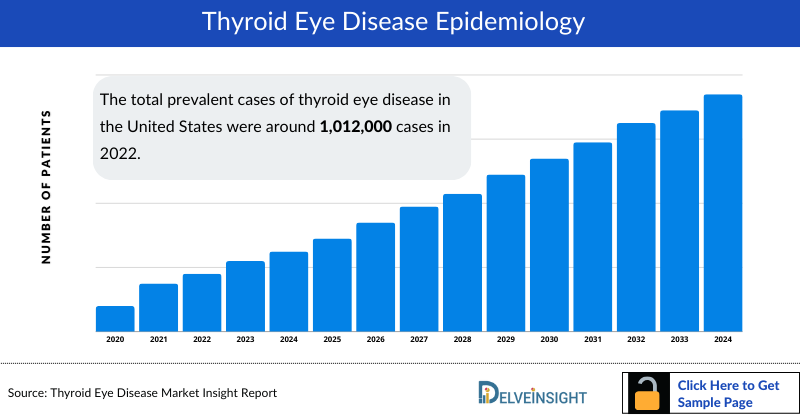
As the market is derived using the patient-based model, the thyroid eye disease epidemiology chapter in the report provides historical as well as forecasted epidemiology segmented by, Prevalent Cases of Thyroid Eye Disease, Diagnosed Prevalent Cases of Thyroid Eye Disease, Gender-specific Diagnosed Prevalent Cases of Thyroid Eye Disease, Diagnosed Prevalent Cases of Thyroid Eye Disease, and Moderate-to-severe Drug-treated Cases of Acute Thyroid Eye Disease in the 7MM covering the United States, EU4 countries (Germany, France, Italy, and Spain), United Kingdom, and Japan from 2020 to 2034. The total prevalence of Thyroid Eye Disease in the 7MM comprised approximately 2,386,000 cases in 2022 and are projected to increase during the forecasted period.
Key Findings
- The total prevalent cases of thyroid eye disease in the United States were around 1,012,000 cases in 2022.
- The US contributed to the largest prevalent population of thyroid eye disease, acquiring ~42% of the 7MM in 2022. Whereas Germany accounted for around 13% and Japan accounted for around 8% of the total population share, respectively, in 2022.
- Among EU4 countries, Germany accounted for the largest number of thyroid eye disease cases, followed by France, whereas Spain accounted for the lowest number of cases in 2022.
- According to DelveInsight estimates, there were around 16,300 cases of acute Thyroid Eye Disease and 41,900 cases of chronic Thyroid Eye Disease in Japan in 2022. These cases are projected to increase during the forecasted period.
- In the 7MM, approximately 20% of the patient share is attributed to males, whereas only 80% of females suffer from thyroid eye disease.
- The diagnosis and treatment rate of thyroid eye disease is expected to increase in the coming years due to the increase in expected approvals of several pipeline candidates for the treatment of thyroid eye disease, thus leading to the increase in awareness among patients and clinicians.
Thyroid Eye Disease Recent Developments
- In May 2025, Viridian Therapeutics (Nasdaq: VRDN) announced that the FDA granted Breakthrough Therapy Designation to veligrotug (“veli”), its lead anti-insulin-like growth factor-1 receptor (IGF-1R) drug candidate, for the treatment of Thyroid Eye Disease (TED).
Thyroid Eye Disease Drug Chapters
The drug chapter segment of the thyroid eye disease therapeutics market report encloses a detailed analysis of thyroid eye disease marketed drugs and late-stage (Phase-III and Phase-II) pipeline drugs. It also helps understand thyroid eye disease clinical trial details, expressive pharmacological action, agreements and collaborations, approval and patent details, advantages and disadvantages of each included drug, and the latest news and press releases.
Thyroid Eye Disease Marketed drugs
TEPEZZA (teprotumumab): Horizon Therapeutics
Insulin-like growth factor I receptor (IGF-IR) is implicated as a potential cause of thyroid eye disease, and overexpression of IGF-IR is found in orbital fibroblasts and lymphocytes. Features of thyroid eye disease include periorbital edema, proptosis, strabismus, and eyelid retraction, which can progress to vision-threatening complications, such as exposure keratopathy and compression neuropathy. Current management of this condition is not very effective and includes systemic steroids or radiation of the orbit, both of which are associated with significant adverse effects and complications.
TEPEZZA (teprotumumab) is currently the only FDA-approved therapy for treating thyroid eye disease. Significant improvements in proptosis, diplopia, and quality of life are noted following its 24-week course of therapy. It is a fully human IgG1 monoclonal antibody directed against the human insulin-like growth factor-1 receptor; the metabolism of teprotumumab has not been fully characterized; however, it is expected to undergo metabolism via proteolysis. It is supplied as a sterile, preservative-free, and white to off-white, lyophilized powder for IV infusions. It significantly improved ptosis, diplopia, CAS score, and quality of life in moderate-to-severe thyroid eye disease and showed a favorable safety profile.
It is an exciting, first-in-kind medication for thyroid eye disease that has shown impressive efficacy in reducing proptosis and other complications of thyroid eye disease. The amount of reduction in proptosis is similar to that with orbital decompression surgery, which is associated with significant complications, including exacerbation of the inflammation and worsening of the strabismus.
Note: Detailed current therapies assessment will be provided in the full report of Thyroid Eye Disease
Thyroid Eye Disease Emerging drugs
Batoclimab: Immunovant Sciences
Immunovant’s first investigational product, batoclimab (IMVT-1401), is a novel, fully human monoclonal antibody targeting the neonatal Fc receptor (FcRn). In nonclinical studies and clinical trials, batoclimab has been observed to reduce IgG antibody levels. High levels of pathogenic IgG antibodies drive a variety of autoimmune diseases, and, as a result, this product candidate has the potential to address a variety of IgG-mediated autoimmune diseases as a self-administered SC injection.
Batoclimab is being evaluated for treating patients with severe autoimmune diseases mediated by pathogenic immunoglobulin G (IgG), including thyroid eye disease. In 2019, it was evaluated in an open-label, single-arm Phase IIa clinical trial to treat Thyroid Eye Disease. Most subjects (four of seven) evaluated at the end of treatment experienced a ≥2-point improvement in clinical activity score (CAS). Three of the seven subjects were proptosis responders. Afterward, a Phase IIb trial was initiated and paused in February 2021 due to elevated total cholesterol and low-density lipoprotein (“LDL”) levels observed in some trial subjects treated with IMVT-1401. Then later, the company achieved alignment with the FDA Division of Ophthalmology to move forward in thyroid eye disease and initiated two Phase III clinical trials to evaluate batoclimab to treat Thyroid Eye Disease in the second half of 2022. Top-line results from both Phase III trials are expected to be available by the first half of 2025.
The drug is expected to launch in 2025 for a monotherapy regimen. Being a novel MoA drug, it can be a potential game changer in the treatment landscape of thyroid eye disease. The company intends to develop batoclimab as a self-administered subcutaneous injection and fulfill the unmet of an approved drug, like reducing the risk of disease occurrences. This could help people living with Thyroid Eye Disease and healthcare providers manage the long-term consequences of Thyroid Eye Disease, which include the social burden as well as the risk of developing severe sight-threatening problems.
Note: Detailed emerging therapies assessment will be provided in the final report.
Thyroid Eye Disease Drug class insights
Treatment of thyroid eye disease has evolved from nonspecific immunosuppression to targeted biological therapies. Current medical therapies target the active stage to decrease inflammation, minimize the worsening of functional ocular sequel, and in some cases, improve ocular signs, including proptosis and double vision. The mainstay of treatment for years has been steroids and orbital radiation (ORT). Several biologics have been assessed in recent years: rituximab, tocilizumab, and teprotumumab.
Corticosteroids have been used to treat thyroid eye disease since the 1950s; several studies have demonstrated the superiority of IV over oral steroids. There was a significant improvement in disease severity, activity, and QoL, minimal proptosis, and no significant improvement in diplopia with IV compared with oral steroids. There are limited data regarding the long-term efficacy of IV steroids. Side effects of IV steroids include liver failure and death.
Rituximab is a monoclonal antibody that blocks CD20, expressed in the B lymphocyte. Its fundamental use comes from experience in the hematology-oncology field, where it revolutionized the treatment approach of many lymphoproliferative disorders, as well as in the field of systemic autoimmune diseases. Regarding thyroid eye disease, it was speculated that its use could be important, given that it is a disease mediated by antibodies against the TSH receptor. However, it was observed that, with B-cell depletion treatment, the levels of antibodies are not modified, which suggests that the mode of action in this disease should involve T-cell activity modulation.
As the first biological treatment used for thyroid eye disease, it is currently recommended by the EUGOGO guidelines to treat patients refractory to steroid treatment.
Tocilizumab is a monoclonal antibody that blocks the interleukin 6 (IL-6) receptor and is used as a biologic drug in the treatment of autoinflammatory diseases and systemic autoimmune diseases, such as rheumatoid arthritis and giant cell arteritis. IL-6 is a ubiquitous protein in the body and is highly involved in controlling the inflammatory response.
Thyroid Eye Disease has a relevant role as an inducer of local inflammation concerning the increase in the expression of the thyrotropin receptor in the orbital connective tissue.
Teprotumumab is a humanized monoclonal antibody against the G1 immunoglobulin subclass. It binds to the insulin growth factor 1 (IGF1R) receptor, acting as a powerful inhibitor of the activation of IGF1R signaling, which is over-expressed in orbital fibroblasts and plays a vital role in Thyroid Eye Disease inflammation. It is the only drug approved by the US FDA for treating thyroid eye disease. It is supplied as a sterile, preservative-free, and white to off-white, lyophilized powder for IV infusions. It significantly improved ptosis, diplopia, CAS score, and quality of life in moderate-to-severe thyroid eye disease and showed a favorable safety profile.
Moreover, the upcoming treatment landscape is poised to see further expansion after the emergence of new classes, such as neonatal Fc receptor antagonists, IL17A protein inhibitors, and others.
Thyroid Eye Disease Market Outlook
Thyroid Eye Disease treatment in the US is entering a new era with changing dynamics. To this date, only one drug has been approved by the US FDA to treat Thyroid Eye Disease: insulin-like growth factor-I receptor antagonist TEPEZZA.
It is worth mentioning that the European Group on Graves’ orbitopathy (EUGOGO) clinical practice guidelines 2021 recommends IV methylprednisolone in combination with oral mycophenolate sodium (or mofetil) as the first-line treatment for moderate-to-severe and acute thyroid eye disease, and in the more severe forms of moderate-to-severe and acute thyroid eye disease, including constant/inconstant diplopia, severe inflammatory signs and exophthalmos >25 mm, IV methyl-prednisolone at the highest cumulative dose (7.5 g per cycle) as monotherapy represents an additional valid first-line treatment.
The current Thyroid Eye Disease market has been segmented into different commonly used drugs based on the prevailing treatment pattern across the 7MM, presenting minor variations in the overall prescription pattern. Corticosteroids, immunosuppressants, neonatal Fc receptor antagonists, IL17A protein inhibitors, Insulin-like growth factor-I receptor antagonists, and others (rituximab, tocilizumab, eye drops, pain killers, supplements like selenium) are the major drug classes that have been covered in the forecast model.
The expected launch of upcoming Thyroid Eye Disease therapies and greater integration of early patient screening, medication in secondary care and other clinical settings, research on best methods for implementation, and an upsurge in awareness will eventually facilitate the development of effective treatment options. However, there are a few roadblocks regarding the timely diagnosis and treatment of these patients; for instance, since the condition is referred to as a rare indication, the companies are charging premium prices, which often become a hindrance when adopting newer therapies.
Key Thyroid Eye Disease companies such as Immunovant Sciences (batoclimab), Novartis Pharmaceuticals (secukinumab), Viridian Therapeutics (VRDN-001), Sling Therapeutics (linsitinib), Regeneron Pharmaceuticals (aflibercept), ValenzaBio (VB421), and several others are evaluating their lead candidates in different stages of clinical development, respectively. They aim to investigate their products for the treatment of Thyroid Eye Disease.
Currently, teprotumumab is the only FDA-approved therapy for the treatment of Thyroid Eye Disease; for this reason, research into new drugs is unsurprisingly demanding. A few potential therapies are in the advanced phase for treating Thyroid Eye Disease; the rest are in Phase II. It is early to comment on the above-mentioned promising candidate to enter the market during the forecast period (2020–2034); it is safe to assume that the future of this market will depend upon the success of the trial result of these emerging drugs. New Thyroid Eye Disease companies have a huge opportunity to enter the Thyroid Eye Disease market.
Key Findings
- The total Thyroid Eye Disease market size in the 7MM was approximately USD 1,993 million in 2022 and is projected to increase during the forecast period (2024–2034).
- The Thyroid Eye Disease market size in the 7MM will increase due to recent efforts to increase patient and clinician awareness of thyroid eye disease, with various awareness campaigns, are expected to increase early diagnosis and treatment of thyroid eye disease.
- Among EU4 countries and the UK, Germany accounted for the maximum Thyroid Eye Disease market size in 2022.
- By 2034, among all the emerging therapies, the highest Thyroid Eye Disease revenue is expected to be generated by batoclimab, followed by Vrdn-001 and secukinumab in the 7MM.
Thyroid Eye Disease Drugs Uptake
This section focuses on the uptake rate of potential Thyroid Eye Disease drugs expected to get launched in the market during 2020–2034. For example, batoclimab, being developed by mid-cap company Immunovant Sciences, we expect the drug uptake to be medium-fast with a probability-adjusted peak share of 16%, and years to the peak is expected to be 6 years from the year of launch for monotherapy.
Further detailed analysis of emerging therapies drug uptake in the report…
Thyroid Eye Disease Pipeline Development Activities
The Thyroid Eye Disease drugs market report provides insights into Thyroid Eye Disease Clinical Trails within Phase III, Phase II, and Phase I stage. It also analyzes key Thyroid Eye Disease companies involved in developing targeted therapeutics.
Pipeline development activities
The Thyroid Eye Disease market report covers detailed information on collaborations, acquisition and merger, licensing, and patent details for thyroid eye disease emerging therapies.
KOL Views
To keep up with current Thyroid Eye Disease market trends, we take KOLs and SMEs’ opinions working in the domain through primary research to fill the data gaps and validate our secondary research. Industry experts contacted for insights on Thyroid Eye Disease evolving treatment landscape, patient reliance on conventional therapies, patient’s therapy switching acceptability, drug uptake along with challenges related to accessibility, including Medical/scientific writers, Jules Stein Eye Institute the University of California, Cedars-Sinai Medical Center, Premier Vision Group, and Others.
Delveinsight’s analysts connected with 50+ KOLs to gather insights; however, interviews were conducted with 15+ KOLs in the 7MM. Their opinion helps understand and validate current and emerging therapies and treatment patterns or Thyroid Eye Disease market trend. This will support the clients in potential upcoming novel treatments by identifying the overall scenario of the market and the unmet needs.
Qualitative Analysis
We perform Qualitative and market Intelligence analysis using various approaches, such as SWOT analysis, and Conjoint Analysis. In the SWOT analysis, strengths, weaknesses, opportunities, and threats in terms of disease diagnosis, patient awareness, patient burden, competitive landscape, cost-effectiveness, and geographical accessibility of therapies are provided. These pointers are based on the Analyst’s discretion and assessment of the patient burden, cost analysis, and existing and evolving treatment landscape.
Conjoint Analysis analyzes multiple approved and emerging Thyroid Eye Disease therapies based on relevant attributes such as safety, efficacy, treatment duration and frequency of administration, route of administration, and order of entry. Scoring is given based on these parameters to analyze the effectiveness of therapy.
In efficacy, the trial’s primary and secondary outcome measures are evaluated; for instance, in Thyroid Eye Disease clinical trials, one of the most important primary outcome measures is reducing proptosis response.
Further, the therapies’ safety is evaluated wherein the acceptability, tolerability, and adverse events are majorly observed, and it sets a clear understanding of the side effects posed by the drug in the trials. In addition, the scoring is also based on the route of administration, order of entry, probability of success, and the addressable patient pool for each therapy. According to these parameters, the final weightage score and the ranking of the emerging therapies are decided.
Thyroid Eye Disease Market Access and Reimbursement
Reimbursement of rare disease therapies can be limited due to lack of supporting policies and funding, challenges of high prices, lack of specific approaches to evaluating rare disease drugs given limited evidence, and payers’ concerns about budget impact. The high cost of rare disease drugs usually has a limited impact on the budget due to the small number of eligible patients being prescribed the drug. The US FDA has approved several rare disease therapies in the past few years. From a patient perspective, health insurance and payer coverage guidelines surrounding rare disease treatments restrict broad access to these treatments, leaving only a small number of patients who can bypass insurance and pay for products independently.
TEPEZZA (teprotumumab) is an insulin-like growth factor-1 receptor inhibitor (IGF-1R), a fully human IgG1 monoclonal antibody. The mechanism of action of teprotumumab in patients with thyroid eye disease has not been fully characterized. TEPEZZA binds to IGF-1R and blocks its activation and signaling.
Centers for Medicare and Medicaid Services (CMS) has assigned a permanent, product-specific Healthcare Common Procedure Coding System (HCPCS) J-code (J3241) for TEPEZZA (teprotumumab); it is the first and only FDA-approved medicine for the treatment of Thyroid Eye Disease. The permanent J-code, which enables reimbursement in all outpatient treatment settings, came into effect in October 2020. In the interim, a temporary C-code (C9061) has been established between July and October for TEPEZZA to support medicare fee-for-service pass-through payment in the hospital outpatient department. Other payers, such as commercial insurers, may also use C9061 in the interim. Commercial insurers use J-codes and government payers to standardize claims submissions and reimbursements for medicines, such as TEPEZZA, administered by a healthcare professional. While not a guarantee of payment, these codes enable timely claims adjudication and processing
The Thyroid Eye Disease market report further provides detailed insights on the country-wise accessibility and reimbursement scenarios, cost-effectiveness scenario of approved therapies, programs making accessibility easier and out-of-pocket costs more affordable, insights on patients insured under federal or state government prescription drug programs, etc.
|
Report Metrics |
Details |
|
Study Period |
2020 to 2034 |
|
Forecast Period |
2024 to 2034 |
|
CAGR | |
|
Thyroid Eye Disease Market Size |
USD XX Million by 2034 |
|
Key Thyroid Eye Disease Companies |
Fujifilm Holdings Corp., GlaxoSmithKline PLC, Abbott Laboratories Inc., Bausch & Lomb Inc., Horizon therapeutics PLC., Bayer AG, Eyevance Pharmaceuticals LLC, AbbVie, Inc., Akron Inc, and Many Others. |
Scope of the Thyroid Eye Disease Market Report
- The Thyroid Eye Disease market report covers a segment of key events, an executive summary, a descriptive overview of thyroid eye disease, explaining its causes, signs and symptoms, pathogenesis, and currently available therapies.
- Comprehensive insight has been provided into the epidemiology segments and forecasts, the future growth potential of diagnosis rate, disease progression, and treatment guidelines.
- Additionally, an all-inclusive account of the current and emerging Thyroid Eye Disease therapies, along with the elaborative profiles of late-stage and prominent therapies, will impact the current treatment landscape.
- A detailed review of Thyroid Eye Disease market, historical and forecasted market size, market share by therapies, detailed assumptions, and rationale behind our approach is included in the report, covering the 7MM drug outreach.
- The Thyroid Eye Disease market report provides an edge while developing business strategies, by understanding trends, through SWOT analysis and expert insights/KOL views, patient journey, and treatment preference that help in shaping and driving the 7MM Thyroid Eye Disease market.
Thyroid Eye Disease Market report insights
- Thyroid Eye Disease Patient population
- Thyroid Eye Disease Therapeutic approaches
- Thyroid Eye Disease pipeline analysis
- Thyroid Eye Disease market size
- Thyroid Eye Disease market trends
- Existing and future Thyroid Eye Disease market opportunity
Thyroid Eye Disease Market report key strengths
- 11 years forecast
- 7MM coverage
- Thyroid Eye Disease epidemiology segmentation
- Key cross competition
- Attribute analysis
- Thyroid Eye Disease Drugs uptake
- Key Thyroid Eye Disease market forecast assumptions
Thyroid Eye Disease Market report assessment
- Current Thyroid Eye Disease treatment practices
- Thyroid Eye Disease Unmet needs
- Thyroid Eye Disease Pipeline product profiles
- Thyroid Eye Disease Market attractiveness
- Qualitative analysis (SWOT and Conjoint Analysis)
Key Questions Answered In The Thyroid Eye Disease Market Report
Thyroid Eye Disease Market insights
- What was Thyroid Eye Disease’s market size, the market size by therapies, market share (%) distribution in 2020, and how would it look in 2034? What are the contributing factors for this growth?
- How will insulin-like growth factor-1 receptor inhibitors as a class affect the treatment paradigm in Thyroid Eye Disease?
- What kind of uptake will TEPEZZA (teprotumumab) witness in Thyroid Eye Disease patients in the coming 10 years?
- How will emerging Thyroid Eye Disease drugs compete with recently approved therapy in the Thyroid Eye Disease market?
- Which class is going to be the largest contributor in 2034?
- What are the pricing variations among different geographies for approved and off-label therapies?
- How would the market drivers, barriers, and future opportunities affect the Thyroid Eye Disease market dynamics and subsequent analysis of the associated trends?
Thyroid Eye Disease Epidemiology insights
- What are the disease risk, burdens, and unmet needs of Thyroid Eye Disease? What will be the growth opportunities across the 7MM with respect to the patient population of Thyroid Eye Disease?
- What is the historical and forecasted Thyroid Eye Disease patient pool in the United States, EU4 (Germany, France, Italy, and Spain) and the United Kingdom, and Japan?
- Even with a large patient pool, why the Thyroid Eye Disease receive rare disease benefits?
- Why are only limited patients with symptoms treated? Why is the current year treatment rate not high?
- What factors are affecting the increase in the diagnosis of symptomatic cases?
Current treatment scenario, marketed drugs, and emerging therapies
- What are the current options for the treatment of Thyroid Eye Disease? What are the current guidelines for treating Thyroid Eye Disease in the US, Europe, and Japan?
- How many Thyroid Eye Disease companies are developing therapies for the treatment of Thyroid Eye Disease?
- How many emerging Thyroid Eye Disease therapies are in the mid-stage and late stage of development for the treatment of Thyroid Eye Disease?
- What are the recent novel therapies, targets, Thyroid Eye Disease mechanisms of action, and technologies developed to overcome the limitation of existing Thyroid Eye Disease therapies?
- What are the key designations that have been granted for the emerging therapies for Thyroid Eye Disease?
- What is the cost burden of approved Thyroid Eye Disease therapies on the patient?
- Patient acceptability in terms of preferred treatment options as per real-world scenarios?
- What are the country-specific accessibility issues of expensive, recently approved therapy?
- What are the 7MM historical and forecasted Thyroid Eye Disease market?
Reasons to buy Thyroid Eye Disease Market Report
- The Thyroid Eye Disease market report will help develop business strategies by understanding the latest trends and changing treatment dynamics driving the Thyroid Eye Disease Market.
- Insights on patient burden, Thyroid Eye Disease prevalence, evolution in diagnosis, and factors contributing to the change in the epidemiology of the disease during the forecast years.
- To understand the existing Thyroid Eye Disease market opportunity in varying geographies and the growth potential over the coming years.
- Distribution of historical and current Thyroid Eye Disease patient share based on real-world prescription data along with reported sales of approved products in the US, EU4 (Germany, France, Italy, and Spain) and the United Kingdom, and Japan.
- Identifying strong upcoming Thyroid Eye Disease companies in the market will help devise strategies to help get ahead of competitors.
- Detailed analysis and ranking of class-wise potential current and emerging therapies under the Conjoint analysis section to provide visibility around leading classes.
- Highlights of Access and Reimbursement policies of approved therapies, barriers to accessibility of expensive off-label therapies, and patient assistance programs.
- To understand the perspective of Key Opinion Leaders around the accessibility, acceptability, and compliance-related challenges of existing treatment to overcome barriers in the future.
- Detailed insights on the unmet need of the existing Thyroid Eye Disease market so that the upcoming players can strengthen their development and launch strategy.