
Tissue Heart Valves Market Summary
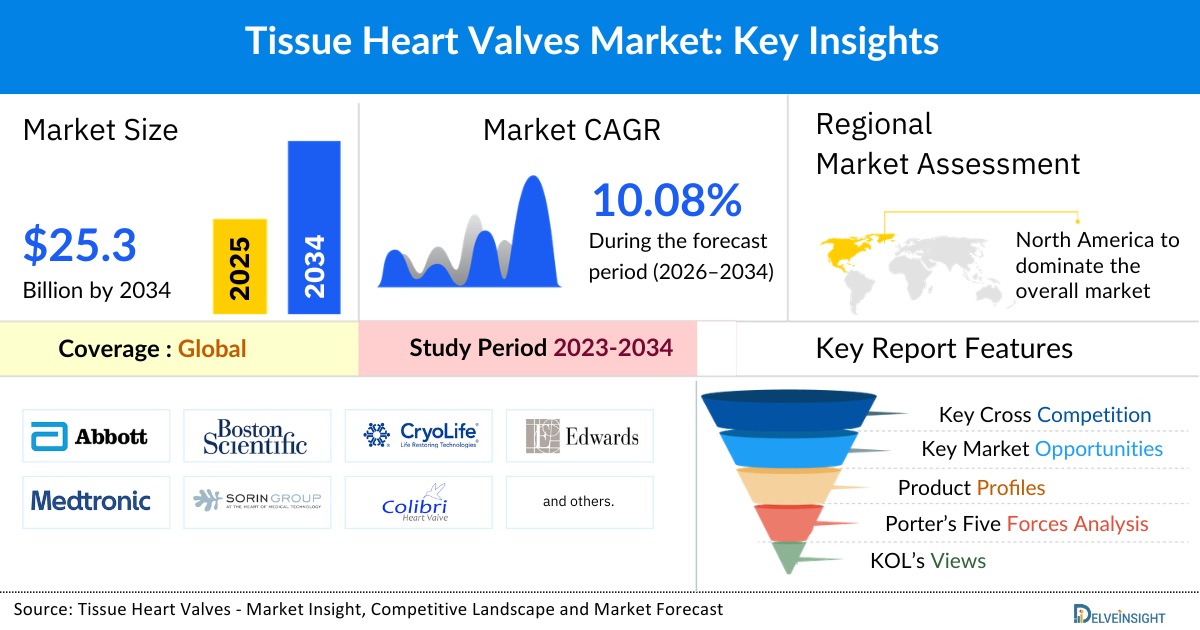
- The Global Tissue Heart Valves market is expected to increase from USD 10,743.75 million in 2025 to USD 25,307.93 million by 2034, reflecting strong and sustained growth.
- The Global Tissue Heart Valves market is growing at a CAGR of 10.08% during the forecast period from 2026 to 2034.
- The Tissue Heart Valves Market is primarily driven by the rising prevalence of valvular heart diseases, particularly aortic stenosis and mitral regurgitation, along with the rapid expansion of transcatheter procedures such as TAVR. The growing geriatric population, which prefers tissue valves due to the reduced need for lifelong anticoagulation therapy compared to mechanical valves, further supports demand. Additionally, continuous technological advancements that enhance valve durability and enable minimally invasive and valve-in-valve procedures are significantly accelerating market growth worldwide.
- The leading Tissue Heart Valves Companies such as Abbott, Boston Scientific Corporation, CryoLife, Edward Lifesciences Corporation, Medtronic, Sorin Group (LivaNova PLC), Braile Biomédica and Labcor Laboratórios, Colibri Heart Valve, ON-X LIFE TECHNOLOGIES, JenaValve Technology Inc., TTK Healthcare Limited, Comed BV, Meril Life Sciences, Beijing Balance Medical Technology Co., Venus Medtech, and others.
- North America is expected to dominate the Tissue Heart Valves Market due to the high prevalence of valvular heart diseases, strong adoption of advanced transcatheter procedures such as TAVR, and the presence of leading market players. Favorable reimbursement policies, well-established cardiac care infrastructure, and a rapidly growing elderly population further contribute to the region’s leading market share.
- In the procedure type of devices segment of the tissue heart valves market, the stented category is estimated to account for the largest market share in 2025.
Request for unlocking the report of the @ Tissue Heart Valves Market
Tissue Heart Valves Market Size and Forecasts
|
Report Metrics |
Details |
|
2025 Market Size |
USD 10,743.75 million |
|
2034 Projected Market Size |
USD 25,307.93 million |
|
Growth Rate (2026-2034) |
10.08% CAGR |
|
Largest Market |
North America |
|
Fastest Growing Market |
Asia-Pacific |
|
Market Structure |
Moderately Concentrated |
Factors Contributing to the Growth of the Tissue Heart Valves Market
-
Rising Prevalence of valvular heart diseases leading to a surge in tissue heart valves:
The rising prevalence of valvular heart diseases, particularly aortic stenosis and mitral regurgitation, is significantly increasing the demand for tissue heart valves. As the global population ages and risk factors such as hypertension, diabetes, and rheumatic heart disease remain common, the number of patients requiring valve replacement continues to grow. Tissue heart valves are widely preferred due to their improved durability and reduced need for lifelong anticoagulation, leading to a surge in procedural volumes and overall market expansion.
-
Rapid growth of Transcatheter Valve Procedures (TAVR/TAVI) is escalating the market of tissue heart valves:
The rapid growth of transcatheter valve procedures, particularly Transcatheter Aortic Valve Replacement (TAVR/TAVI), is significantly accelerating the tissue heart valves market. As TAVR is exclusively performed using bioprosthetic (tissue) valves, the expansion of this minimally invasive procedure into intermediate- and low-risk patient groups has substantially increased procedural volumes. Shorter hospital stays, faster recovery times, and reduced surgical risks compared to open-heart surgery have further boosted adoption, directly driving demand for tissue heart valves worldwide.
-
Increase in technological advancement:
The increase in technological advancements is significantly driving the tissue heart valves market by improving valve durability, safety, and procedural outcomes. Innovations such as enhanced anti-calcification treatments, advanced leaflet designs, sutureless surgical valves, and next-generation transcatheter delivery systems have extended valve lifespan and reduced complications. These improvements increase physician confidence, expand eligibility to younger and lower-risk patients, and ultimately accelerate overall market growth.
Tissue Heart Valves Market Report Segmentation
This Tissue Heart Valves Market report offers a comprehensive overview of the Global Ttissue Heart Valves market, highlighting key trends, growth drivers, challenges, and opportunities. It covers detailed market segmentation by Type (Stented, Stentless, and Sutureles), Valve Position (Aortic Valve, Mitral Valve, Pulmonary Valve, and Tricuspid Valve), End User (Hospitals, Ambulatory Surgical Centers, and Cardiac Specialty Centers), and geography. The report provides valuable insights into the competitive landscape, regulatory environment, and market dynamics across major markets, including North America, Europe, and Asia-Pacific. Featuring in-depth profiles of leading industry players and recent product innovations, this report equips businesses with essential data to identify market potential, develop strategic plans, and capitalize on emerging opportunities in the rapidly growing tissue heart valves market.
Tissue heart valves, also known as bioprosthetic heart valves, are artificial replacement valves made from biological tissue, typically derived from bovine (cow) pericardium or porcine (pig) heart valves. They are used to replace diseased or damaged native heart valves affected by conditions such as aortic stenosis or mitral regurgitation. These valves are designed to mimic the natural function of the human heart valve and allow one-way blood flow through the heart chambers. Tissue heart valves can be implanted through open-heart surgery or via minimally invasive transcatheter procedures such as TAVR.
The Tissue Heart Valves Market is primarily driven by the rising prevalence of valvular heart diseases, particularly aortic stenosis and mitral regurgitation, along with the rapid expansion of transcatheter procedures such as TAVR. The growing geriatric population, which prefers tissue valves due to the reduced need for lifelong anticoagulation therapy compared to mechanical valves, further supports demand. Additionally, continuous technological advancements that enhance valve durability and enable minimally invasive and valve-in-valve procedures are significantly accelerating market growth worldwide.
Get More Insights into the Report @ Tissue Heart Valves Market
What are the latest Tissue Heart Valves Market Dynamics and Trends?
The increasing cases of valvular heart disease, is significantly driving the demand for tissue heart valves. According to the data provided by the recent studies (2026), aortic stenosis was the most common valvular heart disease in industrialized countries, affecting approximately 10% of individuals over the age of 75, with around 2–4% experiencing severe forms of the condition. Nearly half of those affected were asymptomatic at the time of diagnosis.
Additionally as per the data provided by the DelveInsight Business Research LLP (2026), the population prevalence of aortic stenosis in individuals aged 75 years and older was estimated at 12.4%, with 3.4% experiencing severe aortic stenosis, based on studies conducted predominantly in Europe and the US. As the condition progresses, it leads to narrowing of the aortic valve, restricting blood flow from the heart and ultimately requiring valve replacement in moderate to severe cases. The rapid adoption of minimally invasive procedures such as transcatheter aortic valve replacement (TAVR), which exclusively uses bioprosthetic (tissue) valves, has substantially increased procedural volumes worldwide.
Furthermore, as per the recent studies (2025), the global prevalence of moderate-to-severe mitral regurgitation was 0.67%. Prevalence increased greatly with age, and it was estimated to be approximately 0.63% at age 50, 2.85% at 70, and 6.45% by 90 years. As the mitral valve fails to close properly, backward blood flow leads to symptoms such as fatigue, shortness of breath, and progressive cardiac dysfunction, often necessitating valve repair or replacement in advanced stages. The growing adoption of surgical mitral valve replacement and emerging transcatheter mitral valve replacement (TMVR) procedures both of which commonly utilize bioprosthetic tissue valves has significantly expanded treatment volumes.
Furthermore, the presence of key market players are further escalating the overall market of tissue heart valves. For instance, in April 2024, Medtronic plc, a global leader in healthcare technology, announced the launch of its latest innovation in cardiac surgery, the Avalus Ultra™ valve. This next-generation surgical aortic tissue valve is designed to facilitate ease of use at implant and lifetime patient management. It’s an excellent choice for cardiac surgeons and their patients seeking an aortic valve solution that can be fit for the future, right from the start. Thus, the factors mentioned above are expected to boost the overall market of tissue heart valves during the forecast period from 2026 to 2034.
However, the Tissue Heart Valves Market faces limitations due to the relatively limited durability of bioprosthetic valves, as they are prone to structural valve degeneration and calcification over time, particularly in younger patients. This increases the likelihood of reintervention and long-term treatment costs. Additionally, the high cost of transcatheter procedures such as TAVR restricts accessibility in cost-sensitive and developing regions. Stringent regulatory approval processes, requiring extensive clinical trials and long-term safety data, further delay product launches and increase development expenses, collectively acting as significant restraining factors for Tissue Heart Valves Market Growth.
Tissue Heart Valves Market Segment Analysis
Tissue Heart Valves Market Type of Type (Stented, Stentless, and Sutureles), Valve Position (Aortic Valve, Mitral Valve, Pulmonary Valve, and Tricuspid Valve), End User (Hospitals, Ambulatory Surgical Centers, and Cardiac Specialty Centers), and Geography (North America, Europe, Asia-Pacific, and Rest of the World).
By Type: Stented Category Dominates the Market
In the type segment of the tissue heart valves market, the stented category is estimated to account for the largest market share of 75% in 2025. The stented category is significantly boosting the overall tissue heart valves market due to its widespread clinical acceptance, ease of implantation, and strong compatibility with both surgical and transcatheter procedures. Stented tissue valves consist of biological leaflets mounted on a supportive frame, which provides structural stability and ensures predictable valve positioning during implantation.
This design simplifies surgical handling, reduces operative time, and improves procedural outcomes, making them the preferred choice among cardiac surgeons. In addition, most transcatheter aortic valve replacement (TAVR) systems are based on stented bioprosthetic platforms, further expanding their adoption globally. Continuous technological advancement such as enhanced anti-calcification treatments, low-profile stent frames, improved hemodynamics, and better coronary access have increased durability and safety, thereby broadening their use in intermediate- and low-risk patient populations. The strong clinical data supporting long-term performance, combined with expanding indications and rising procedural volumes in elderly patients, has positioned stented tissue valves as the dominant revenue-generating segment, substantially driving overall market growth.
Additionally, the increase in product development activites are further boosting the overall Tissue Heart Valves Market. For instance, in March 2023, Abbott announced that the U.S. Food and Drug Administration (FDA) has approved the company's Epic™ Max stented tissue valve to treat people with aortic regurgitation or stenosis. This device is the latest addition to Abbott's Epic surgical valve platform which has a decades-long history of safety and strong clinical outcomes, with an optimized design to further improve valve blood flow. Thus, the factors mentioned above are expected to boost the market of stented category thereby escalating the overall Tissue Heart Valves Market
By Valve Position: Aortic Valve Category Dominates the Market
In the valve position segment of the Tissue Heart Valves Market, the aortic category is estimated to account for the largest market share of 78% in 2025. The aortic valve position is significantly boosting the overall tissue heart valves market because aortic valve disease particularly aortic stenosis is the most prevalent and clinically treated form of valvular heart disease worldwide. The high incidence of degenerative calcific aortic stenosis in the aging population has led to a substantial rise in both surgical aortic valve replacement (SAVR) and transcatheter aortic valve replacement (TAVR) procedures, both of which predominantly use bioprosthetic (tissue) valves.
The expansion of TAVR indications into intermediate- and low-risk patient groups has dramatically increased procedural volumes, making the aortic segment the largest revenue contributor within the tissue heart valve market. Additionally, continuous advancements in valve design such as improved hemodynamics, enhanced durability through anti-calcification treatments, and better delivery systems have strengthened physician confidence and broadened patient eligibility. Since the majority of global valve replacement procedures are performed in the aortic position, its dominance directly drives product demand, technological innovation, and overall market expansion in the tissue heart valves sector.
By End-Users: Hospitals Category Dominates the Market
In the end-user segment of the tissue heart valves market, the hospitals category is estimated to account for the largest market share in 2025. The hospitals category is boosting the overall market of tissue heart valves as hospitals serve as the primary centers for both surgical valve replacement and transcatheter procedures such as TAVR and TMVR. These facilities are equipped with advanced cardiac catheterization labs, hybrid operating rooms, and specialized cardiac surgery teams required for complex valve interventions. The increasing number of hospital-based cardiac programs, rising patient admissions for valvular heart diseases, and improved reimbursement support are driving higher procedural volumes. As most tissue heart valve implantations are performed in tertiary and specialty hospitals, their expanding infrastructure and adoption of advanced technologies directly contribute to market growth.
Tissue Heart Valves Market Regional Analysis
North America Tissue Heart Valves Market Trends
North America is poised to secure the largest share of 38% in the Global Tissue Heart Valves market in 2025 due to the high prevalence of valvular heart diseases, strong adoption of advanced transcatheter procedures such as TAVR, and the presence of leading market players. Favorable reimbursement policies, well-established cardiac care infrastructure, and a rapidly growing elderly population further contribute to the region’s leading Tissue Heart Valves Market Share.
Accorindg to the research provided by the DelveInsight Business Research LLP (2026), more than 13% of Americans aged 75 years and older are affected by aortic stenosis. The condition is also common in individuals over the age of 65, and if left untreated, it can lead to heart failure and death. As the aortic valve becomes narrowed and calcified, blood flow from the heart is restricted, eventually requiring valve replacement in moderate to severe cases. The growing number of elderly patients diagnosed with severe aortic stenosis has led to a substantial increase in both surgical aortic valve replacement (SAVR) and transcatheter aortic valve replacement (TAVR) procedures, both of which predominantly use bioprosthetic (tissue) valves. The expansion of TAVR into intermediate- and low-risk patient groups has further amplified procedural volumes, directly increasing demand for tissue heart valves across the region.
Furthermore, the increasing product development activities are further boosting the market in North America. For instance, in February 2024, FDA approved Edwards EVOQUE Tricuspid Valve Replacement System. The Edwards EVOQUE Tricuspid Valve Replacement System mainly includes an artificial tricuspid valve (called the EVOQUE valve) and a delivery catheter. The EVOQUE valve is made of cow tissue attached to a self-expanding metal (nickel-titanium) frame for support. Thus, the factors mentioned above are expected to boost the overall market of tissue heart valves in North America during the forecasted period.
Europe Tissue Heart Valves Market Trends
Europe is driving the growth of the Tissue Heart Valves market due to its rapidly aging population, high prevalence of valvular heart diseases, and strong adoption of advanced transcatheter procedures such as TAVR. The region benefits from well-established cardiac care infrastructure, early regulatory approvals through CE Mark pathways, and the presence of leading medical device manufacturers. Additionally, favorable reimbursement frameworks and increasing clinical research activities further support higher procedural volumes, making Europe a key contributor to market expansion.
Accorindg to the research provided by the DelveInsight Business Research LLP (2026), in the UK, the point prevalence of severe aortic stenosis among individuals aged 55 years and older was estimated at 1.48% in 2019. Additionally, the estimated prevalence of aortic stenosis in the adult population of France is approximately 1.17%, based on its proportion among all valvular heart disease cases.
With progressive valve narrowing leading to symptoms such as chest pain, breathlessness, and heart failure, timely valve replacement becomes essential for survival in severe cases. Since transcatheter therapies for aortic stenosis exclusively utilize tissue-based valves, the rapid adoption of minimally invasive interventions has significantly accelerated market expansion. Additionally, physicians often prefer tissue valves in elderly aortic stenosis patients to avoid lifelong anticoagulation therapy, further strengthening demand and reinforcing the dominance of this segment in the Europe market.
However, in May 2024, Edwards Lifesciences announced the European launch of the SAPIEN 3 Ultra RESILIA valve, the only transcatheter aortic heart valve to incorporate the company’s breakthrough RESILIA tissue technology, designed to extend the valve’s durability. Edwards’ SAPIEN 3 Ultra RESILIA valve received CE Mark for use in patients with heart valve disease due to native calcific aortic stenosis at all levels of surgical risk or due to the failure of either a transcatheter or a surgical bioprosthetic valve who are judged to be at high or greater risk for open surgical therapy. Thus, the factors mentioned above are expected to boost the overall market of tissue heart valves in Europe.
Asia-Pacific Tissue Heart Valves Market Trends
The Asia-Pacific region is emerging as a key growth driver in the Tissue Heart Valves market due to its rapidly aging population, rising prevalence of valvular heart diseases, and improving access to advanced cardiac care. Increasing healthcare investments, expanding hospital infrastructure, and growing adoption of minimally invasive procedures such as TAVR are accelerating procedural volumes across countries like China, India, and Japan. Additionally, supportive government initiatives and the entry of global as well as regional manufacturers are further strengthening market growth in the region.
However, the increase in product development activites are further boosting the overall market of tissue heart valves. For instance, in September 2025, Edwards Lifesciences launched its next-generation transcatheter heart valve in India for treating aortic stenosis, providing a durable, minimally invasive alternative to open-heart surgery for patients in the Asia-Pacific region. This launch reflected the growing adoption of advanced TAVR therapies in emerging markets. Thus, the factors mentioned are expected to boost the overall market of tissue heart valves in the Asia-Pacific region during the forecast period.
Who are the major players in the Tissue Heart Valves Market?
The following are the leading companies in the tissue heart valves market. These companies collectively hold the largest market share and dictate industry trends.
- Abbott
- Boston Scientific Corporation
- CryoLife
- Edward Lifesciences Corporation
- Medtronic
- Sorin Group (LivaNova PLC)
- Braile Biomédica and Labcor Laboratórios
- Colibri Heart Valve
- ON-X LIFE TECHNOLOGIES
- JenaValve Technology Inc.
- TTK Healthcare Limited
- Comed BV
- Meril Life Sciences
- Beijing Balance Medical Technology Co.
- Venus Medtech
- Others
How is the competitive landscape shaping the Tissue Heart Valves market?
The competitive landscape of the tissue heart valves market is shaped by a mix of well-established global players and emerging regional innovators, leading to a moderately concentrated yet dynamic environment. Major medical device companies such as Edwards Lifesciences, Medtronic, Abbott Laboratories and Boston Scientific dominate the market by offering comprehensive portfolios of surgical and transcatheter tissue valves across multiple valve positions (aortic, mitral, pulmonary). These companies leverage strong R&D capabilities, extensive clinical evidence, global sales networks, and early regulatory approvals to secure leading market shares, particularly in developed regions such as North America and Europe.
Emerging competitors and regional manufacturers especially in the Asia-Pacific market are increasingly gaining traction by introducing cost-competitive devices tailored to local clinical needs and regulatory frameworks. Examples include Meril Life Sciences’ Myval TAVR system and domestic transcatheter valve systems approved in markets like India and Korea. Despite this growing competition, the segment remains relatively concentrated at the top, with the leading players collectively accounting for a substantial portion of global revenues due to their technological advantage, broad indication coverage, and strong physician preference. At the same time, partnerships, mergers, and incremental innovations in durability and minimally invasive technology continue to intensify competitive activity and may gradually diversify market share over the coming years.
Recent Developmental Activities in the Tissue Heart Valves Market
- In September 2025, Edwards Lifesciences launched its next-generation transcatheter heart valve in India for treating aortic stenosis, providing a durable, minimally invasive alternative to open-heart surgery for patients in the Asia-Pacific region. This launch reflected the growing adoption of advanced TAVR therapies in emerging markets.
- In May 2024, Edwards Lifesciences announced the European launch of the SAPIEN 3 Ultra RESILIA valve, the only transcatheter aortic heart valve to incorporate the company’s breakthrough RESILIA tissue technology, designed to extend the valve’s durability.
- In April 2024, Medtronic plc, a global leader in healthcare technology, announced the launch of its latest innovation in cardiac surgery, the Avalus Ultra™ valve. This next-generation surgical aortic tissue valve is designed to facilitate ease of use at implant and lifetime patient management. It’s an excellent choice for cardiac surgeons and their patients seeking an aortic valve solution that can be fit for the future, right from the start.
- In February 2024, FDA approved Edwards EVOQUE Tricuspid Valve Replacement System. The Edwards EVOQUE Tricuspid Valve Replacement System mainly includes an artificial tricuspid valve (called the EVOQUE valve) and a delivery catheter. The EVOQUE valve is made of cow tissue attached to a self-expanding metal (nickel-titanium) frame for support.
- In March 2023, Abbott announced that the U.S. Food and Drug Administration (FDA) has approved the company's Epic™ Max stented tissue valve to treat people with aortic regurgitation or stenosis. This device is the latest addition to Abbott's Epic surgical valve platform which has a decades-long history of safety and strong clinical outcomes, with an optimized design to further improve valve blood flow.
|
Report Metrics |
Details |
|
Study Period |
2023 to 2034 |
|
Base Year |
2025 |
|
Forecast Period |
2026 to 2034 |
|
Tissue Heart Valves Market CAGR (2026-2034) |
10.08% |
|
Key Companies in the Tissue Heart Valves Market |
Abbott, Boston Scientific Corporation, CryoLife, Edward Lifesciences Corporation, Medtronic, Sorin Group (LivaNova PLC), Braile Biomédica and Labcor Laboratórios, Colibri Heart Valve, ON-X LIFE TECHNOLOGIES, JenaValve Technology Inc., TTK Healthcare Limited, Comed BV, Meril Life Sciences, Beijing Balance Medical Technology Co., Venus Medtech, and others. |
|
Tissue Heart Valves Market Segments |
by Type, by Valve Position, by End-Users, and by Geography |
|
Tissue Heart Valves Regional Scope |
North America, Europe, Asia Pacific, Middle East, Africa, and South America |
|
Tissue Heart Valves Country Scope |
U.S., Canada, Mexico, Germany, United Kingdom, France, Italy, Spain, China, Japan, India, Australia, South Korea, and key Countries |
Tissue Heart Valves Market Segmentation
· Tissue Heart Valves by Type Exposure
o Stented
o Stentless
o Sutureles
· Tissue Heart Valves Valves Position Exposure
o Aortic Valve
o Mitral Valve
o Pulmonary Valve
o Tricuspid Valve
· Tissue Heart Valves End-Users Exposure
o Hospitals
o Ambulatory Surgical Centers
o Cardiac Specialty Centers
· Tissue Heart Valves Geography Exposure
o North America Tissue Heart Valves Market
§ United States Tissue Heart Valves Market
§ Canada Tissue Heart Valves Market
§ Mexico Tissue Heart Valves Market
o Europe Tissue Heart Valves Market
§ United Kingdom Tissue Heart Valves Market
§ Germany Tissue Heart Valves Market
§ France Tissue Heart Valves Market
§ Italy Tissue Heart Valves Market
§ Spain Tissue Heart Valves Market
§ Rest of Europe Tissue Heart Valves Market
o Asia-Pacific Tissue Heart Valves Market
§ China Tissue Heart Valves Market
§ Japan Tissue Heart Valves Market
§ India Tissue Heart Valves Market
§ Australia Tissue Heart Valves Market
§ South Korea Tissue Heart Valves Market
§ Rest of Asia-Pacific Tissue Heart Valves Market
o Rest of the World Tissue Heart Valves Market
§ South America Tissue Heart Valves Market
§ Middle East Tissue Heart Valves Market
§ Africa Tissue Heart Valves Market
Tissue Heart Valves Market Recent Industry Trends and Milestones (2022-2026)
|
Category |
Key Developments |
|
Tissue Heart Valves Regulatory Approvals |
Edwards EVOQUE Tricuspid Valve Replacement System (FDA). Abbott Epic™ Max stented tissue valve (FDA) |
|
Tissue Heart Valves Regulatory Launch |
Edwards Lifesciences launched its next-generation transcatheter heart valve in India, Edwards Lifesciences announced the European launch of the SAPIEN 3 Ultra RESILIA valve, Medtronic plc, launched of its latest innovation in cardiac surgery, the Avalus Ultra™ valve. |
|
Company Strategy |
Edwards Lifesciences - Strong focus on transcatheter valve expansion (TAVR & TMVR) across risk categories, Continuous innovation in RESILIA tissue technology to improve durability and reduce calcification, Expansion into mitral and tricuspid transcatheter therapies beyond aortic dominance. Medtronic - Strengthening its Evolut TAVR platform with design improvements (coronary access, deliverability), Expanding presence in low-risk patient segments, Developing solutions for pulmonary and structural heart markets. |
|
Emerging Technology |
Advanced 3D‑printing and bioprinting techniques, bioresorbable materials, novel fabrication methods, anti‑calcification treatments and advanced tissue preservation chemistries, and others |
Impact Analysis
AI-Powered Innovations and Applications:
AI‑powered innovations in tissue heart valves are rapidly advancing both the design and clinical application of these devices by leveraging data, predictive modeling, and automation. Machine learning algorithms are being used to analyze large sets of patient imaging and biomechanical data to optimize valve geometries that better mimic native heart function and reduce stress points that lead to early failure. AI‑driven computational modeling and simulation tools enable virtual testing of valve prototypes under varied physiological conditions, drastically accelerating development cycles and reducing the need for extensive physical testing. In the clinical setting, AI aids in patient selection and personalized treatment planning by integrating patient‑specific risk profiles, anatomical data from CT/MRI, and procedural outcomes to guide whether a tissue valve is appropriate and what size/configuration will perform best.
Additionally, advanced AI systems are being developed to predict long‑term valve performance and potential complications such as calcification or degeneration, enabling proactive follow‑up and earlier interventions. Coupled with robotics and augmented reality, AI also supports precision implantation during transcatheter valve procedures by enhancing intraoperative imaging interpretation and navigation, which can improve procedural success rates and reduce operative time. Together, these applications are making tissue heart valve therapy more personalized, efficient, and effective.
U.S. Tariff Impact Analysis on Tissue Heart Valves Market:
The imposition of U.S. tariffs on tissue heart valves and other medical devices has had a noticeable impact on the industry by increasing costs, disrupting established global supply chains, and creating uncertainty for manufacturers and healthcare providers. Since many cardiovascular devices including tissue heart valves and related components are produced or sourced internationally, tariffs raise the cost of imported materials and finished products, which manufacturers may pass on to hospitals and patients, potentially leading to higher healthcare expenses and reduced access to advanced therapies. Tariff‑related cost pressures also risk slowing growth in the U.S. cardiovascular device market by forcing companies to adjust forecasts, absorb expenses, or reconsider investment and pricing strategies, and they contribute to supply chain instability that can delay production and distribution of critical heart valve technologies. In response, some industry stakeholders caution that prolonged trade barriers could dampen innovation and competitiveness unless policies become more stable and supportive of both domestic production and international collaboration.
How This Analysis Helps Clients
- Cost Management: By understanding the tariff landscape, clients can anticipate cost increases and adjust pricing strategies accordingly, ensuring profitability.
- Supply Chain Optimization: Clients can identify alternative sourcing options and diversify their supply chains to reduce dependency on high-tariff regions, enhancing resilience.
- Regulatory Navigation: Expert guidance on navigating the evolving regulatory environment helps clients maintain compliance and avoid potential legal challenges.
- Strategic Planning: Insights into tariff impacts enable clients to make informed decisions about manufacturing locations, partnerships, and market entry strategies.
Startup Funding & Investment Trends
|
Company Name |
Total Funding |
Main Products |
Stage of Development |
Core Technology |
|
Novostia |
€2.5 million |
Innovative artificial heart valve |
Series A |
The company is focused on a patented biocompatible polymer valve designed to improve durability and reduce the need for anticoagulation compared with traditional tissue valves. |
Key takeaways from the Tissue Heart Valves market report study
- Market size analysis for the current tissue heart valves market size (2025), and market forecast for 8 years (2026 to 2034)
- Top key product/technology developments, mergers, acquisitions, partnerships, and joint ventures happened over the last 3 years.
- Key companies dominating the tissue heart valves market.
- Various opportunities available for the other competitors in the tissue heart valves market space.
- What are the top-performing segments in 2025? How these segments will perform in 2034?
- Which are the top-performing regions and countries in the current tissue heart valves market scenario?
- Which are the regions and countries where companies should have concentrated on opportunities for the tissue heart valves market growth in the future?

