Tuberculosis Pipeline Insight
- The Global Tuberculosis Pipeline is witnessing steady progress, driven by increasing research activities and the development of novel therapeutic candidates across various stages of clinical trials.
- The leading Tuberculosis Companies include Biofabri, Serum Institute of India Pvt. Ltd., Shanghai Jiatan Pharmatech, Sequella Inc., LegoChem Biosciences, GlaxoSmithKline, BioVersys, BioNTech, and others.
Request for Unlocking the Sample Page of the Report "Tuberculosis Pipeline'
Key Factors Driving the Growth of the Tuberculosis Pipeline by DelveInsight
-
Rising Global Burden of Tuberculosis
The persistent prevalence of tuberculosis, particularly in high-burden countries, continues to drive demand for innovative and more effective treatment options.
-
Increasing Incidence of Drug-Resistant Tuberculosis
The growing number of multidrug-resistant (MDR-TB) and extensively drug-resistant (XDR-TB) cases has accelerated the development of novel anti-tuberculosis therapies.
-
Robust Clinical Pipeline
A diverse pipeline of new antibiotics, host-directed therapies, immunotherapies, and vaccine candidates is expanding the future treatment landscape for tuberculosis.
-
Advancements in Diagnostic Technologies
Improved molecular diagnostics, rapid drug susceptibility testing, and genomic sequencing are enabling earlier diagnosis and personalized treatment strategies.
-
Growing Focus on Shorter and More Effective Treatment Regimens
Research aimed at reducing treatment duration while improving efficacy and patient adherence is driving innovation across the TB pipeline.
-
Expansion of Vaccine Development Programs
Growing efforts to develop more effective preventive and therapeutic tuberculosis vaccines are strengthening the overall pipeline landscape.
-
Integration of Precision Medicine Approaches
Advances in biomarker research and host-pathogen interaction studies are supporting the development of targeted therapies for specific patient populations.
DelveInsight’s “Tuberculosis Pipeline Insight, 2026” report provides comprehensive insights about 30+ companies and 35+ pipeline drugs in the Tuberculosis Pipeline landscape. It covers Tuberculosis Pipeline drug profiles, including products at the clinical and nonclinical stages. It also covers the therapeutics assessment by product type, stage, route of administration, and molecule type. It further highlights the inactive pipeline products in this space.
Geography Covered
- Global coverage
Tuberculosis Understanding
Tuberculosis: Overview
Tuberculosis (TB), caused by the bacterium Mycobacterium tuberculosis (Mtb), is a deadly infectious disease that has plagued humanity for centuries, with evidence found in ancient Egyptian mummies. Identified by Robert Koch in 1882, Mtb's complete genome was mapped in 1998, revealing insights for new therapies. Despite the Bacille Calmette-Guérin (BCG) vaccine and effective short-course chemotherapy (DOTS), TB remains a global health challenge, exacerbated by drug-resistant strains and synergy with HIV.
Declared a global emergency by the WHO in 1993, TB is difficult to diagnose, treat, and prevent due to Mtb's slow growth, dormancy, complex cell envelope, and intracellular pathogenesis. Its prevention is hampered by factors like poverty, overcrowding, and poor public health infrastructure, while nonspecific symptoms like persistent cough lead to high transmission rates.
TB spreads through the air when infected individuals cough, sneeze, or spit. Though a quarter of the global population is infected, only 5-10% develop active TB, which is preventable and curable but requires prolonged antibiotic treatment, challenging even robust health systems.
Active TB presents with symptoms like a persistent cough, chest pain, fatigue, fever, night sweats, and weight loss; it can also manifest as extrapulmonary TB affecting various organs with variable symptoms. Symptoms differ across age groups, with children and infants often presenting more subtle or severe signs, respectively. Timely diagnosis and adherence to a lengthy antibiotic treatment are crucial for managing active TB and preventing transmission.
Diagnosing and treating tuberculosis (TB) involves a comprehensive approach to effectively manage and control the disease. Diagnosis begins with a thorough medical history and physical examination, followed by specific tests such as the tuberculin skin test (TST) or interferon-gamma release assay (IGRA) to detect latent TB infection. For active TB, chest X-rays and sputum tests, including smear microscopy, culture, and molecular tests like the GeneXpert MTB/RIF assay, are critical in identifying the presence of Mycobacterium tuberculosis.
Once diagnosed, the standard treatment for active TB involves a lengthy regimen of multiple antibiotics over a minimum of six months, typically including first-line drugs such as isoniazid, rifampin, ethambutol, and pyrazinamide. Treatment adherence is essential to ensure the complete eradication of the bacteria and to prevent the development of drug-resistant strains. Directly observed therapy (DOT) is often employed to enhance compliance, where healthcare providers supervise patients taking their medication.
In cases of drug-resistant TB, second-line drugs and a longer treatment duration may be required, often accompanied by more severe side effects. Regular monitoring through follow-up visits, sputum tests, and imaging is crucial to assess treatment efficacy and detect any potential complications. Addressing TB also involves public health measures such as contact tracing, vaccination with Bacille Calmette-Guérin (BCG) in high-risk areas, and improving living conditions to reduce transmission. Overall, the combination of early diagnosis, appropriate treatment, and preventive strategies is vital to controlling TB and mitigating its public health impact.
“Tuberculosis Pipeline Insight, 2026" report by DelveInsight outlays comprehensive insights of present scenario and growth prospects across the mechanism of action. A detailed picture of the Tuberculosis pipeline landscape is provided which includes the disease overview and Tuberculosis treatment guidelines. The assessment part of the report embraces, in depth Tuberculosis commercial assessment and clinical assessment of the pipeline products under development. In the report, detailed description of the drug is given which includes Tuberculosis mechanism of action of the drug, clinical studies, NDA approvals (if any), and product development activities comprising the technology, Tuberculosis collaborations, licensing, mergers and acquisition, funding, designations and other product related details.
Explore More Insights of the Report @ Tuberculosis Treatment Market Size
Tuberculosis Pipeline Report Highlights
- The Tuberculosis Companies and academics are working to assess challenges and seek opportunities that could influence Tuberculosis R&D. The Tuberculosis Therapies under development are focused on novel approaches to treat/improve Tuberculosis.
Tuberculosis Emerging Drugs Analysis
This segment of the Tuberculosis Pipeline Report encloses its detailed analysis of various drugs in different stages of clinical development, including Phase III, II, I, preclinical, and Discovery. It also helps to understand Tuberculosis Clinical Trial details, expressive pharmacological action, agreements and collaborations, and the latest Tuberculosis news and press releases.
Tuberculosis Emerging Drugs
-
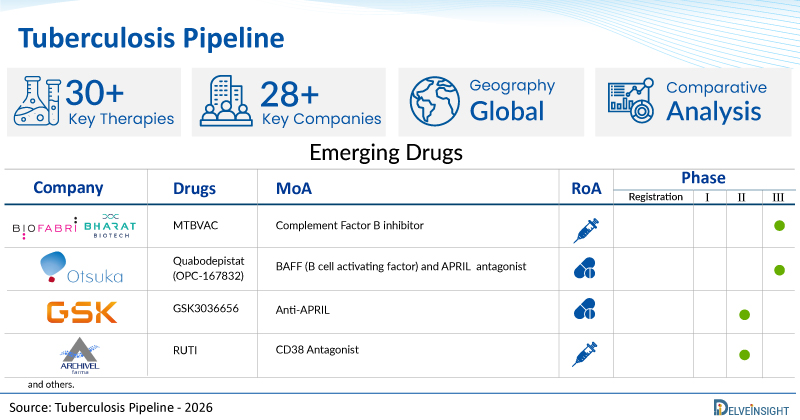
MTBVAC: Biofabri
MTBVAC is a vaccine formulated from a strain isolated in humans that has been designed by the Mycobacteria Genetics Group of the University of Zaragoza. MTBVAC is a vaccine that seeks to activate the immune system to be able to recognize the infectious agent and confer long-term protection against the most common form of the disease. Preclinical studies in different animal models indicated that MTBVAC is safe and is able to induce an improved protection compared to BCG. Currently, the drug is in the Phase III stage of its development for the treatment of Tuberculosis.
-
LCB01-037: LigaChem Biosciences, Inc.
LCB01-0371, also known as delpazolid, is a novel oxazolidinone derivative antibacterial agent developed by LegoChem Biosciences for the treatment of multi-drug resistant gram-positive infections. It is a new molecular entity with a cyclic amidrazone structure. LCB01-0371 works by blocking protein synthesis in bacteria through binding to the 23S ribosomal RNA, preventing the initiation of protein translation.
Early bactericidal activity studies in tuberculosis patients showed that LCB01-0371 had average daily declines in bacterial load comparable to standard anti-TB therapy. LCB01-0371 has completed phase I trials demonstrating good safety and tolerability, with no significant food effect on its pharmacokinetics. Currently, the drug is in Phase II stage of its clinical trial for the treatment of Tuberculosis.
-
BNT-164: BioNTech
BNT-164 is an investigational drug, being developed by BioNTech. BioNTech is collaborating with the Bill & Melinda Gates Foundation since 2019 with the aim to develop HIV and tuberculosis treatments. The first mRNA vaccine candidates targeting tuberculosis are currently investigated in randomized Phase I trials in Germany and South Africa. The drug is currently being evaluated under Phase I/II clinical trial for the treatment of Tuberculosis.
Tuberculosis Pipeline Therapeutic Assessment
This segment of the Tuberculosis Pipeline Report provides insights about the different Tuberculosis Drugs segregated based on following parameters that define the scope of the report, such as:
Tuberculosis Companies
There are approx. 30+ key companies that are developing therapies for Tuberculosis. The Tuberculosis Companies that have their Tuberculosis drug candidates in the most advanced stage, i.e. Phase III include Biofabri
Tuberculosis Phases
DelveInsight’s Tuberculosis Pipeline Report covers around 35+ products under different phases of clinical development like
- Late stage products (Phase III)
- Mid-stage products (Phase II)
- Early-stage product (Phase I) along with the details of
- Pre-clinical and Discovery stage candidates
- Discontinued & Inactive candidates
Tuberculosis Route of Administration
The Tuberculosis Pipeline report provides the therapeutic assessment of the pipeline drugs by the Route of Administration. Products have been categorized under various ROAs such as
- Intra-articular
- Intraocular
- Intrathecal
- Intravenous
- Oral
- Parenteral
- Subcutaneous
- Topical
- Transdermal
Tuberculosis Molecule Type
Tuberculosis Products have been categorized under various Molecule types such as
- Oligonucleotide
- Peptide
- Small molecule
Tuberculosis Product Type
Tuberculosis Drugs have been categorized under various product types like Mono, Combination and Mono/Combination.
Tuberculosis Clinical Trials Activities
The Tuberculosis Pipeline Report provides insights into different therapeutic candidates in phase II, I, preclinical and discovery stage. It also analyses Tuberculosis Therapeutic Drugs key players involved in developing key drugs.
Tuberculosis Pipeline Development Activities
The Tuberculosis Pipeline Report covers the detailed information of collaborations, acquisition and merger, licensing along with a thorough therapeutic assessment of emerging Tuberculosis drugs.
Tuberculosis Pipeline Report Insights
- Tuberculosis Pipeline Analysis
- Tuberculosis Therapeutic Assessment
- Tuberculosis Unmet Needs
- Impact of Tuberculosis Drugs
Tuberculosis Pipeline Report Assessment
- Pipeline Product Profiles
- Therapeutic Assessment
- Pipeline Assessment
- Inactive drugs assessment
- Unmet Needs
Key Questions Answered in the Tuberculosis Pipeline Report
Current Tuberculosis Treatment Scenario and Emerging Therapies:
- How many companies are developing Tuberculosis drugs?
- How many Tuberculosis drugs are developed by each company?
- How many emerging drugs are in mid-stage, and late-stage of development for the treatment of Tuberculosis?
- What are the key collaborations (Industry–Industry, Industry–Academia), Mergers and acquisitions, licensing activities related to the Tuberculosis therapeutics?
- What are the recent trends, drug types and novel technologies developed to overcome the limitation of existing therapies?
- What are the clinical studies going on for Tuberculosis and their status?
- What are the key designations that have been granted to the emerging drugs?
Stay updated with us for Recent Articles