
Urothelial Carcinoma Epidemiology
Urothelial Carcinoma Insights and Trends
- The total cases of urothelial carcinoma in the 7MM comprised ~206,300 cases in 2025 and are projected to increase during the forecast period.
- Metastatic or unresectable disease is identified in approximately 20% of patients presenting with invasive urothelial cancer. In addition, up to 50% of patients will develop metastases following radical cystectomy for clinically localized disease.
- Among 7MM, the US accounted for the highest number of incident cases of urothelial carcinoma, i.e., around 87,800 in 2025.
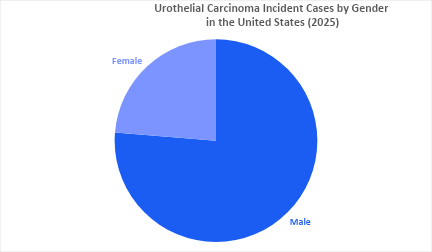
- The incidence of Upper Tract Urothelial Carcinoma (UTUC) peaks in ages of 70–90 years and three times more common in males than in females.
- Urothelial cancer is a malignant tumor that arises from the urothelial (transitional) cells lining the urinary tract, including the bladder, ureters, and renal pelvis. These specialized cells can stretch and contract, and cancer in this tissue most commonly affects the bladder.
- Urothelial carcinoma is the 10th most common cancer worldwide, with a prevalence nearly four times higher in men, and is primarily associated with risk factors such as advanced age, smoking, arsenic exposure, and other carcinogens.
- Bladder cancer is the most prevalent malignancy of the urinary tract, with over 90% of cases in Europe classified as urothelial carcinomas.
- Approximately 4–10% of urothelial carcinomas cases arise in the upper urinary tract, including the renal pelvis and ureter.
- Around one-quarter of patients are diagnosed at the metastatic stage, where prognosis is poor, with overall survival typically ranging from 8–15 months, particularly in untreated individuals.
- Metastatic urothelial carcinoma is associated with a poor prognosis, with a 5-year overall survival rate of less than 5%, highlighting the aggressive nature of the disease.
- The majority of urothelial carcinoma occurs in males and has approximately a two to threefold greater incidence than in females.
Urothelial Carcinoma Epidemiology Forecast in the 7MM
- 2025 Diagnosed Prevalent Cases of Urothelial Carcinoma: ~206,300
- 2036 Projected Diagnosed Prevalent Cases of Urothelial Carcinoma: ~XXX
- Urothelial Carcinoma Growth Rate (2026–2036): ~0.4% CAGR
DelveInsight's ‘Urothelial Carcinoma Epidemiology Forecast - 2036’ report delivers an in-depth understanding of the urothelial carcinoma, historical and forecasted epidemiology in the United States, EU4 (Germany, Spain, Italy, and France) and the United Kingdom, and Japan.
|
Study Period |
2022–2036 |
|
Historical Year |
2022–2025 |
|
Forecast Period |
2026–2036 |
|
Base Year |
2026 |
|
Geographies Covered |
|
|
Urothelial Carcinoma Epidemiology CAGR (Study period/Forecast period) |
~0.4% (2026-2036) |
|
Urothelial Carcinoma Epidemiology Segmentation Analysis |
Patient Burden Assesment
|
Urothelial Carcinoma Understanding and Diagnosis Algorithm
Urothelial Carcinoma Overview
Urothelial carcinoma spans a broad clinical spectrum. At one end, it presents as a low-grade, non-muscle-invasive disease that, while rarely life-threatening, is prone to recurrence and requires long-term surveillance. At the other extreme, it manifests as high-grade disease, either non-muscle-invasive or muscle-invasive, with significantly higher risks. Muscle-invasive bladder cancer (MIBC) is life-threatening and demands prompt treatment. High-grade non-muscle-invasive disease carries a notable risk of progression to muscle-invasive or metastatic stages, often with poor outcomes. Metastatic progression occurs in approximately 25% of pT2, 50% of pT3, and 80% of pT4 tumors, with corresponding five-year survival rates of 67%, 35%, and 27%. Due to the heterogeneity of urothelial carcinoma, particularly in intermediate cases, standard treatment approaches may not be effective for up to 25% of patients.
Urothelial Carcinoma Diagnosis
Urine cytology is the most commonly used noninvasive test for detecting urothelial tumors, although its sensitivity remains limited. Cystoscopy continues to be the gold standard for diagnosis and surveillance of bladder cancer despite being invasive and costly. Several urine-based biomarkers, including BTA Stat, BTA TRAK, NMP-22, ImmunoCyt/uCyt, and UroVysion, have received FDA clearance or approval to support diagnosis and monitoring. Imaging techniques such as computed tomography (CT) are widely used to assess tumor location, extent, and multifocal disease, largely replacing intravenous pyelography (IVP). The US Preventive Services Task Force (USPSTF) does not recommend routine bladder cancer screening in asymptomatic adults due to the low predictive value of current noninvasive tests.
Further details are provided in the report.
Urothelial Carcinoma Epidemiology
Key Findings from Urothelial Carcinoma Epidemiological Analysis and Forecast
- According to DelveInsight’s estimates, in 2025, there were nearly 206,300 incident cases of urothelial carcinoma in the 7MM.
- The total diagnosed prevalent cases of urothelial carcinoma in the United States were around 87,800 in 2025.
- In EU4 and the UK, males accounted for more incident cases of urothelial carcinoma, i.e., nearly 75%, as compared to females, in 2025.
- As per the analysis, the median age of diagnosis of urothelial carcinoma is 69 years in men and 71 years in women.
- Tumors occurring in along the renal calyces and renal pelvis are twice as common as tumors found in the ureters. Carcinoma in situ (CIS) in the upper urinary tract may exist in 11–36% of individuals and UTUC can be multifocal in 10–20% of patients. Over 60% of UTUCs are muscle invasive at diagnosis and about 17% of cases are synchronous with a bladder tumor.
- Among the mutations observed in urothelial carcinoma, approximately 50% of the patients had a TP53 mutation, followed by a FGFR3 mutation (nearly 30%) in the United States.
- Following treatment for UTUC, recurrence in the bladder occurs in 29% of UTUC patients, depending on patient-, tumour- and treatment-specific characteristics compared to a 2–5% recurrence rate in the contralateral upper tract.
- Nearly all cases of urothelial carcinoma are UBCs, whereas UTUC accounts for just 5–10% of all urothelial malignancies.
- In the United States in 2025, Urothelial Carcinoma was found to be more incident in age group 80 years and above (~30,000) followed by age group 70-79 years.
- In Japan, among stage specific urothelial carcinoma in 2025, Non-muscle invasive urothelial carcinoma was found to be more incident (~15,600 cases), followed by muscle invasive urothelial carcinoma with locally advanced or metastatic urothelial carcinoma was the lowest.
Scope of the Report
- The report covers a segment of an executive summary, a descriptive overview of Urothelial carcinoma, explaining its causes, signs and symptoms, and pathogenesis.
- Comprehensive insight has been provided into the epidemiology segments and forecasts, the future growth potential of the diagnosis rate, and disease progression.
Report Insights
Urothelial Carcinoma Patient Population Forecast
Report Key Strengths
- Epidemiology‑based (epi‑based) Bottom‑up Forecasting
- 11-year Forecast
- Patient Burden Trends (by geography)
FAQs
- What are the disease risks, burdens, and unmet needs of urothelial carcinoma? What will be the growth opportunities across the 7MM concerning the patient population with urothelial carcinoma ?
- What is the historical and forecasted urothelial carcinoma patient pool in the US, EU4 (Germany, France, Italy, and Spain), the UK, and Japan?
Reasons to Buy
- Insights on patient burden/disease prevalence, evolution in diagnosis, and factors contributing to the change in the epidemiology of the disease during the forecast years.
- To understand key opinion leaders’ perspectives around the diagnostic challenges to overcome barriers in the future.
- Detailed insights on various factors hampering disease diagnosis and other existing diagnostic challenges.