Usher Syndrome Market
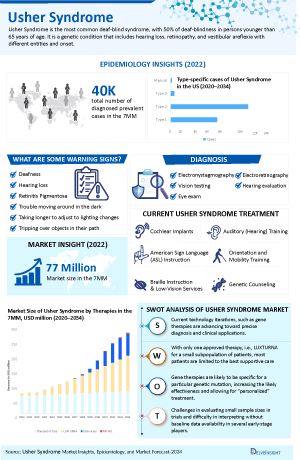
- As per DelveInsight, in 2023, total Usher Syndrome Market Size was ~ USD 77 million in the 7MM and is anticipated to grow with a significant CAGR during the study period (2020-2034).
- Usher Syndrome (USH) is the most common genetic condition responsible for combined loss of hearing and vision. Balance disorders and bilateral vestibular areflexia are also observed in some cases.
- Limited knowledge regarding pathophysiology, disease severity, and consequences is impeding the development of effective treatments for Usher Syndrome.
- People who have Usher Syndrome are born with it, but they usually get diagnosed as children or teenagers. There's no cure for Usher Syndrome, but treatments can help people manage their vision, hearing, and balance problems.
- Among the 7MM, the US accounted for the highest prevalent cases of Usher Syndrome in 2023, with around 21,000 cases; these cases are expected to increase during the forecast period.
- Leading Usher Syndrome companies include Eli Lilly, Atsena Therapeutics, Nacuity Pharmaceuticals, and others driving innovative therapies and research forward.
- The market relies on off-label therapies that do not address Usher Syndrome’s root cause. Patients depend on supportive care, including vitamin supplements, sunlight protection, and visual aids.
- Currently, Luxturna is the only approved therapy for retinal degeneration, which is a common feature of Usher Syndrome.
- In January 2020, the US FDA granted Rare Pediatric Disease (RPD) designation for QR-421a for the treatment of patients with mutations in exon 13 of the USH2A gene.
Download the Sample PDF to Get More Insight @ Usher Syndrome Treatment Market
Key Factors Driving Usher Syndrome Market
Rising USH Prevalence and Genetic Burden
Usher Syndrome (USH), the leading genetic condition causing combined hearing and vision loss, continues to present a growing health challenge. In 2023, the US accounted for approximately 21,000 prevalent cases, the highest among the 7MM, and these numbers are expected to increase during the forecast period. The condition is inherited, typically diagnosed in childhood or adolescence, and can also involve balance disorders and bilateral vestibular areflexia, further impacting quality of life.
Advancements in Gene and RNA-Based Therapies
In recent years, the pipeline for Usher Syndrome has gained momentum, particularly in the area of gene and RNA-based interventions. For example, in January 2020, the US FDA granted Rare Pediatric Disease (RPD) designation to QR-421a for patients with mutations in exon 13 of the USH2A gene. These advancements signal growing recognition of the unmet need in this rare inherited disorder.
Launch of Emerging USH Drugs
Several innovative therapies are under development to address the root cause of Usher Syndrome and move beyond supportive care. Emerging candidates include NPI-001 (Nacuity Pharmaceuticals), Ultevursen (Laboratoires Théa), and other novel approaches from companies such as Aavantgarde Bio, Odylia Therapeutics, Eli Lilly, Atsena Therapeutics, and Clearside Biomedical. These therapies, if successful, hold the potential to alter disease progression and significantly improve patient outcomes in the years ahead.
DelveInsight’s " Usher Syndrome Market Insights, Epidemiology, and Market Forecast – 2034" report delivers an in-depth understanding of Usher Syndrome, historical and forecasted epidemiology as well as the Usher Syndrome therapeutics market trends in the United States, EU4 (Germany, France, Italy, and Spain) and the United Kingdom, and Japan.
The Usher Syndrome Treatment Market Report provides current treatment practices, emerging drugs, Usher Syndrome market share of the individual therapies, and current and forecasted Usher Syndrome market size from 2020 to 2034, segmented by seven major markets. The report also covers current Usher Syndrome treatment market practices/algorithms and unmet medical needs to curate the best of the opportunities and assess the underlying potential of the market.
|
Study Period |
2020 to 2034 |
|
Forecast Period |
2024-2034 |
|
Geographies Covered |
|
|
Usher Syndrome Market |
|
|
Usher Syndromes Market Size | |
|
Usher Syndrome Companies |
Laboratoires Théa, Nacuity Pharmaceuticals, Aavantgarde Bio, Odylia Therapeutics, Eli Lilly And Company, Atsena Therapeutics, Clearside Biomedical, and others. |
|
Usher Syndrome Epidemiology Segmentation |
|
Usher Syndrome Treatment Market
Usher Syndrome (USH) is the most common deaf-blind syndrome, with 50% of deaf-blindness in persons younger than 65 years of age. It is a genetic condition that includes hearing loss, retinopathy (retinitis pigmentosa), and vestibular areflexia with different entities and onset. It is an autosomal recessive disorder - passing from parents to children - that impacts three major senses in the body: vision, hearing and balance. Balance disorders and bilateral vestibular areflexia are also observed in some cases. USH has been grouped into three main clinical types: 1, 2, and 3, which are caused by mutations in different genes and are further divided into different subtypes.
Usher Syndrome Diagnosis
Diagnosis of Usher Syndrome involves pertinent questions regarding the person’s medical history and testing of hearing, balance, and vision. A hearing (audiologic) exam measures the frequency and loudness of sounds that a person can hear. An electroretinogram measures the electrical response to the light-sensitive cells in the retina of the eyes. A retinal exam is done to observe the retina and other structures in the back of the eye. Vestibular (balance) function can be assessed by a variety of tests that evaluate different parts of the balance system. Genetic testing is clinically available for most of the genes associated with Usher Syndrome.
Further details related to diagnosis will be provided in the report…
Usher Syndrome Treatment
Presently, there is no cure for Usher Syndrome. Treatment involves managing hearing, vision, and balance problems. Some researchers have shown that taking a specific daily dose of vitamin A may slow the progression of retinal degeneration in some people with typical RP and Usher Syndrome type 2. Typically, treatment for hearing management includes hearing aids, assistive listening devices, cochlear implants, or other communication methods. Although some ophthalmologists believe that a high dose of vitamin A palmitate may slow, but not halt the progression of retinitis pigmentosa. Other treatments such as gene therapy, drug based therapy, artificial organ replacement are currently leading the market. Ongoing research on the Usher proteins function in auditory and visual cells will be important in determining the optimal target for gene replacement therapy. Usher Syndrome clinical trials are advancing treatments, focusing on gene therapies, vision preservation, and hearing restoration for affected individuals worldwide.
Further details related to treatment will be provided in the report…..
.jpg)
Usher Syndrome Epidemiology
The Usher Syndrome epidemiology chapter in the report provides historical as well as forecasted epidemiology segmented by the total prevalent cases of Usher Syndrome, diagnosed prevalent cases of Usher Syndrome, and type-specific cases of Usher Syndrome in the 7MM market covering the United States, EU4 (Germany, France, Italy, and Spain) and the United Kingdom, and Japan from 2020 to 2034.
- Among the 7MM, the US accounted for the highest prevalent cases of Usher Syndrome in 2023, with around 21,000 cases; these cases are expected to increase during the forecast period.
- Amongst EU4 and the UK, the total prevalent cases of Usher Syndrome were highest in Germany, while the lowest number of cases were in Spain in 2023.
- According to the estimates, in the US, it is observed that type 2 of Usher Syndrome was most prevalent type, accounting for over 60% of total cases in 2023.
Usher Syndrome Drugs Chapters
The drug chapter segment of the Usher Syndrome drugs market report encloses a detailed analysis of the early-stage (Phase I/II and Phase I) and mid-stage (Phase II and Phase II/III) pipeline drug. The current key players for emerging Usher Syndrome drugs and their respective drug candidates include Nacuity Pharmaceuticals (NPI-001), Laboratoires Théa (Ultevursen). The drug chapter also helps understand the Usher Syndrome clinical trial details, expressive pharmacological action, agreements and collaborations, approval, and patent details, and the latest news and press releases. The Usher Syndrome drugs market is evolving rapidly, driven by ongoing research, novel therapies, and increasing awareness among healthcare professionals.
Emerging Usher Syndrome Drugs
- NPI-001: Nacuity Pharmaceuticals
NPI-001 is a differentiated, purified, prescription-quality, GMP-grade N-acetylcysteine amide (NACA) being developed to treat a broad set of diseases and conditions associated with oxidative stress and reduced glutathione levels. In preclinical animal studies, NPI-001 preserved photoreceptor cells and functionality. A Phase I clinical trial of Nacuity’s GMP-grade NPI-001 solution in healthy volunteers was completed with no serious adverse events. Currently, the company is investigating iptacopan in the Phase I/II trial (NCT04355689) for the treatment of patients with RP (retinitis pigmentosa) associated with Usher Syndrome.
- Ultevursen: Laboratoires Théa
Ultevursen (formerly QR-421a) is a first-in-class investigational RNA therapy designed to address the underlying cause of vision loss in Usher Syndrome type 2a and non-syndromic USH due to mutations in exon 13 of the USH2A gene. QR-421a is designed to restore functional usherin protein by using an exon-skipping approach with the aim of stopping or reversing vision loss in patients. Ultevursen is intended to be administered through intravitreal injections in the eye and has been granted Orphan Drug Designation in the US and the European Union and received Fast Track and Rare Pediatric Disease Designations from the FDA. Currently, Ultevursen is being investigated in a Phase II/III trial, SIRIUS, for treating Usher Syndrome Type 2.
Usher Syndrome Drugs Market Insights
Free radical scavenger
Free radical scavengers play a role in the treatment of Usher Syndrome by helping to reduce oxidative stress, which is implicated in the progression of the disease. Usher Syndrome is a genetic condition characterized by hearing loss and vision impairment, including retinitis pigmentosa. Research has shown that free radical scavengers, such as minocycline, nanoceria, and edaravone, possess antioxidant properties that can help reduce reactive oxygen species (ROS) levels and increase the expression of antioxidant-associated proteins in the retina. This can potentially contribute to the preservation of retinal function in conditions like retinitis pigmentosa, which is a major hallmark of Usher Syndrome.
.jpg)
Usher Syndrome Market Outlook
Currently, LUXTURNA (voretigene neparvovec) is the only approved therapy for Usher Syndrome and is only authorized for the treatment of a small subpopulation of patients that have the RPE65 mutation. There is currently no standard treatment for patients without the RPE65 mutation; therefore, most patients are limited to the best supportive care, including reliance on vitamin supplements, protection from sunlight, and visual aids. Only few key players are active in the pipeline such as Nacuity Pharmaceuticals and Laboratoires Théa for the treatment of Usher Syndrome.
Based on randomized clinical trials with vitamins and supplements, the only widely recommended treatment is supplementation with high-dose vitamin A palmitate and fish oil, along with avoidance of vitamin E, but these adjustments only delay degeneration. However, a comparison of seven clinical trials that measured visual acuity as a secondary outcome indicator showed that no significant difference was found in the Early Treatment Diabetic Retinopathy Study (ETDRS) visual acuity with different doses of vitamin A and vitamin E in Usher Syndrome across treatment groups. Groups were either administered high-dose vitamin A, high-dose vitamin E, high-dose vitamin A and E, or trace amounts of both vitamins. This indicates that vitamin supplementation may have no beneficial effect in Usher Syndrome patients. Consequently, for most patients with Usher Syndrome, there is currently no cure or effective treatment to slow or stop disease progression.
The precise mechanism by which vitamin A supplementation provides its benefit is not known. It has been speculated that vitamin A rescues remaining cones, thereby explaining how one supplement may help a group of patients with different rod-specific gene defects. Vitamin E may lead to an adverse effect on the course of Usher Syndrome by inhibiting the absorption or transport of vitamin A.
Detailed market assessment will be provided in the final report.
Key Findings
- The total Usher Syndrome market size in the US was estimated to be ~USD 45 million in 2023, which is expected to grow during the forecast period (2024–2034).
- The total Usher Syndrome market size in EU4 and the UK for Usher Syndrome was estimated to be nearly USD 30 million in 2023, which is expected to grow during the forecast period.
- In 2032, among the emerging therapies, the highest revenue was generated by Ultevursen, in the US.
Usher Syndrome Drugs Uptake
This section focuses on the uptake rate of potential Usher Syndrome drugs expected to be launched in the market during 2024–2034. The Usher Syndrome treatment market landscape has experienced a transformation with the uptake of novel drugs. These innovative therapies are redefining standards of care. Furthermore, the increased uptake of these transformative drugs is a testament to the unwavering dedication of retinal physicians, otolaryngologists, professionals, and the entire healthcare community in their tireless pursuit of advancing care. This momentous shift in treatment paradigms is a testament to the power of research, collaboration, and human resilience.
Usher Syndrome Pipeline Development Activities
The Usher Syndrome therapeutics market report provides insights into different Usher Syndrome clinical trials within Phase II/III, Phase II. It also analyzes key Usher Syndrome Companies involved in developing targeted therapeutics. Companies like Nacuity Pharmaceuticals and Laboratoires Théa actively engage in mid stage research and development efforts for Usher Syndrome. The Usher Syndrome pipeline possesses few potential drugs. However, there is a positive outlook for the therapeutics market, with expectations of growth during the forecast period (2024–2034).
Usher Syndrome Pipeline Development Activities
The report provides insights into different Usher Syndrome clinical trials within Phase III and Phase II. It also analyzes key players involved in developing targeted therapeutics.
Pipeline Development Activities
The Usher Syndrome therapeutics market report covers information on collaborations, acquisitions and mergers, licensing, and patent details for Usher Syndrome emerging therapy.
Stay ahead with key updates on Usher Syndrome treatments. Access the 2025 pipeline report for exclusive insights!
Usher Syndrome Therapeutics Market Access and Reimbursement
In the US healthcare system, both Public and Private health insurance coverage are included. Also, Medicare and Medicaid are the largest government-funded programs in the US. The major healthcare programs, including Medicare, Medicaid, the Children’s Health Insurance Program (CHIP), and the state and federal health insurance marketplaces, are overseen by the Centers for Medicare & Medicaid Services (CMS). Other than these, Pharmacy Benefit Managers (PBMs), third-party organizations that provide services and educational programs to aid patients are also present.
The Centers for Medicare & Medicaid Services (CMS) agency within the US Department of Health and Human Services (HHS) administers the nation’s major healthcare programs. The CMS oversees programs, including Medicare, Medicaid, the Children’s Health Insurance Program (CHIP), and the state and federal health insurance marketplaces. CMS collects and analyzes data, produces research reports, and works to eliminate fraud and abuse within the healthcare system.
Detailed market access and reimbursement assessment will be provided in the final report.
Usher Syndrome Treatment Market Report Scope
- The Usher Syndrome therapeutics market report covers a segment of key events, an executive summary, and a descriptive overview, explaining its causes, signs, symptoms, pathogenesis, and currently used therapies.
- Comprehensive insight into the Usher Syndrome epidemiology segments and forecasts, disease progression, and treatment guidelines has been provided.
- Additionally, an all-inclusive account of the emerging therapies and the elaborative profiles of mid-stage and prominent therapies will impact the current treatment landscape.
- A detailed review of the Usher Syndrome drugs market, historical and forecasted Usher Syndrome treatment market size, market share by therapies, detailed assumptions, and rationale behind our approach is included in the report, covering the 7MM drug outreach.
- The Usher Syndrome therapeutics market report provides an edge while developing business strategies by understanding trends through SWOT analysis and expert insights/KOL views, patient journey, and treatment preferences that help shape and drive Usher Syndrome.
Usher Syndrome Treatment Market Report Insights
- Usher Syndrome Patient Population
- Usher Syndrome Therapeutic Approaches
- Usher Syndrome Pipeline Drugs Analysis
- Usher Syndrome Market Size and Trends
- Usher Syndrome Drugs Market
- Existing and Future Usher Syndrome Market Opportunity
Usher Syndrome Treatment Market Report Key Strengths
- 11 Years Usher Syndrome Market Forecast
- The 7MM Coverage
- Usher Syndrome Epidemiology Segmentation
- Key Cross Competition in the Usher Syndrome Drugs Market
- Usher Syndrome Drugs Uptake
- Key Usher Syndrome Market Forecast Assumptions
Usher Syndrome Treatment Market Report Assessment
- Current Usher Syndrome Treatment Market Practices
- Unmet Needs in the Usher Syndrome Drugs Market
- Usher Syndrome Pipeline Drugs Profiles
- Usher Syndrome Drugs Market Attractiveness
- Qualitative Analysis (SWOT and Analyst Views)
- Usher Syndrome Market Drivers
- Usher Syndrome Market Barriers
FAQs
- What was the Usher Syndrome treatment market size, the Usher Syndrome market size by therapies, market share (%) distribution in 2023, and what would it look like by 2034? What are the contributing factors for this growth?
- What can be the future treatment paradigm for Usher Syndrome?
- What are the disease risks, burdens, and unmet needs of Usher Syndrome? What will be the growth opportunities across the 7MM concerning the patient population with Usher Syndrome?
- What are the current options for the treatment of Usher Syndrome? What are the current guidelines for treating Usher Syndrome in the 7MM?
- What are the recent novel therapies, targets, Usher Syndrome Mechanisms of Action, and technologies being developed to overcome the limitations of existing therapies?
- What is the patient share in Usher Syndrome?
Reasons to Buy
- The Usher Syndrome therapeutics market report will help develop business strategies by understanding the latest trends and changing treatment dynamics driving Usher Syndrome.
- Insights on patient burden/disease Usher Syndrome Prevalence, evolution in diagnosis, and factors contributing to the change in the epidemiology of the disease during the forecast years.
- Understand the existing market opportunities in varying geographies and the growth potential over the coming years.
- Identifying strong upcoming players in the Usher Syndrome Drugs Market will help devise strategies to help get ahead of competitors.
- Detailed analysis ranking of class-wise potential current and emerging therapies under the analyst view section to provide visibility around leading classes.
- Highlights of access and reimbursement policies of current therapies, barriers to accessibility of expensive off-label therapies, and patient assistance programs.
- To understand Key Opinion Leaders’ perspectives around the accessibility, acceptability, and compliance-related challenges of existing treatment to overcome barriers in the future.
- Detailed insights on the unmet needs of the existing Usher Syndrome Drugs Market so that the upcoming players can strengthen their development and launch strategy.
Stay Updated with us for Recent Articles:-