
Virtual Care Market Summary
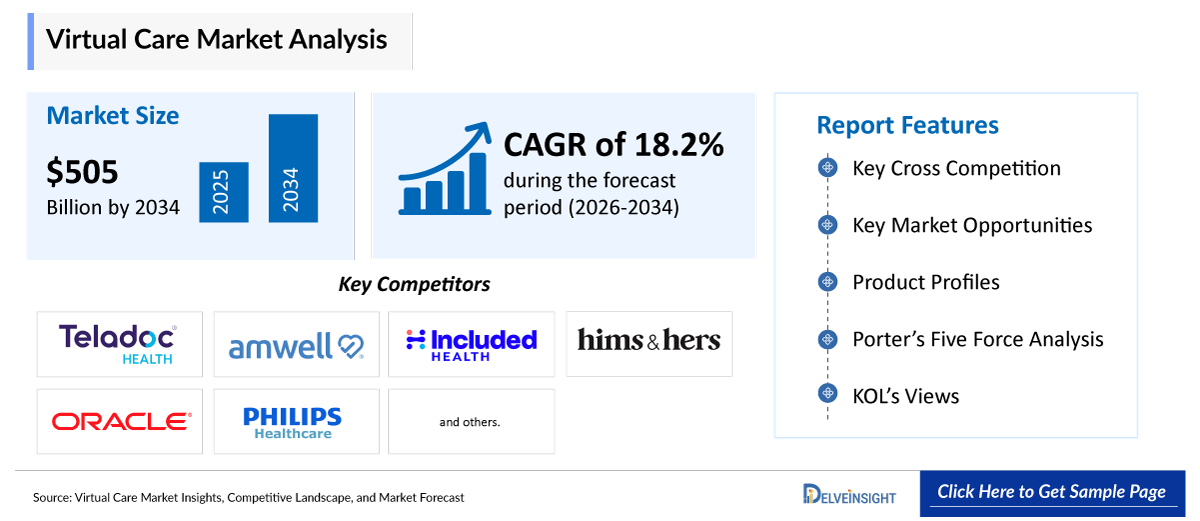
- The global virtual care market size was valued at USD 112.00 billion in 2025 and is projected to reach USD 505.00 billion by 2034.
- The market is expected to expand at a CAGR of 18.2% during the forecast period 2026-2034, supported by the sustained high utilization of virtual care after the pandemic, regulatory flexibilities and reimbursement expansion, the rising burden of chronic disease and behavioral health needs, and the adoption of hybrid and virtual-first care by providers and health systems.
- By component, the services segment dominated the virtual care market with a 48% share in 2025.
- By modality, the telemedicine segment dominated the virtual care market with a 52% share in 2025.
- By application, the behavioral health and telepsychiatry segment dominated the virtual care market with a 30% share in 2025.
- By end-user, the healthcare providers segment dominated the virtual care market with a 44% share in 2025.
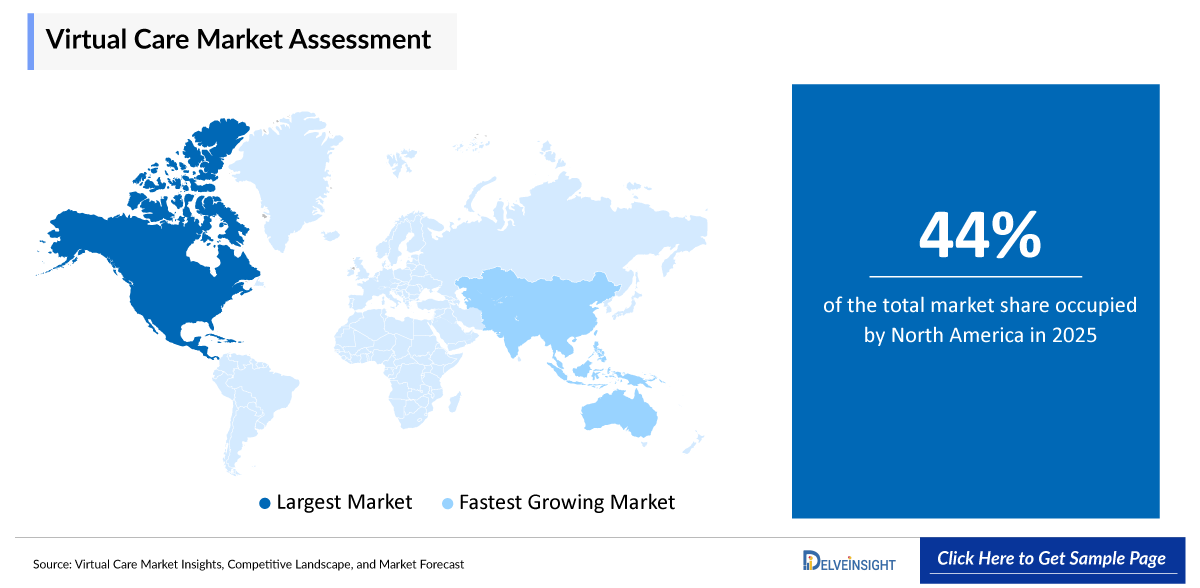
- North America accounted for the largest share of the virtual care market at 44% in 2025, while Asia-Pacific is anticipated to register the fastest growth through 2034.
Virtual care is the delivery of healthcare services and the management of health remotely through digital technology, encompassing real-time video and audio visits, remote patient monitoring, store-and-forward exchange of clinical information, and mobile health, delivered across the care continuum from urgent and primary care to behavioral health, chronic disease management, specialty consultation, and acute and post-acute care. The scope spans the software platforms that host and orchestrate virtual visits and programs, the hardware that enables them, including telehealth carts, kiosks, connected examination devices, and remote monitoring devices, and the clinical and operational services that deliver and support care.
Leading vendors provide comprehensive platforms and services, and Teladoc Health delivers a suite of connected care solutions spanning general medical, mental health, chronic condition management, and expert medical services for individuals, health plans, employers, and hospitals, while Amwell operates its Converge platform with an open architecture that integrates virtual visits, remote monitoring, and third-party applications for health systems, health plans, and employers. The workflow connects patients and clinicians across settings and devices, integrates with the electronic health record, and supports scheduling, visits, monitoring, and follow-up. The contemporary market is defined by the sustained utilization of virtual care after the pandemic, the evolving regulatory and reimbursement environment, and the integration of artificial intelligence and connected devices.
Virtual Care Market Key Growth Drivers
- Sustained high utilization of virtual care after the pandemic, with the volume of telehealth claims stabilizing at a level thirty-eight times higher than before the pandemic.
- Regulatory flexibilities and reimbursement expansion, with the Drug Enforcement Administration and the Department of Health and Human Services issuing a fourth extension of telemedicine flexibilities for the prescribing of controlled medications through December 31, 2026.
- The importance of continuity in reimbursement policy, illustrated by a 24 percent decline in fee-for-service telemedicine visits following the lapse of Medicare telehealth flexibilities in September 2025.
- Rising burden of chronic disease and behavioral health needs that drive demand for remote monitoring, chronic care management, and telepsychiatry.
- Adoption of hybrid and virtual-first care by providers and health systems that integrate virtual care across the care continuum.
- Expansion of remote patient monitoring and connected devices that extend care into the home.
- Integration of artificial intelligence, unified platforms, and technology partnerships that enhance virtual care delivery.
Key Companies in Virtual Care Market
The leading participants in the virtual care market include the following:
- Teladoc Health, Inc.
- American Well Corporation
- Included Health, Inc.
- Hims & Hers Health, Inc.
- Oracle Corporation
- Koninklijke Philips N.V.
- Caregility Corporation
- TytoCare Ltd.
- Doximity, Inc.
- Zoom Communications, Inc., and others
For illustrative purposes, only the top 10 companies are listed in the Table of Contents. The report may include analysis and references to additional companies relevant to the market assessment.
Virtual Care Market Size
The following table summarizes the headline market metrics for the global virtual care market across the base year and the forecast horizon.
|
Report Metrics |
Details |
|
2025 Market Size |
USD 112.00 billion |
|
2034 Projected Market Size |
USD 505.00 billion |
|
Growth Rate (2026-2034) |
18.2% CAGR |
|
Largest Market |
North America (44% share in 2025) |
|
Fastest Growing Market |
Asia-Pacific |
|
Market Structure |
Fragmented |
All market values are expressed in USD and represent DelveInsight estimates synthesized from primary and secondary research.
Factors Contributing to the Growth of the Virtual Care Market
Virtual Care Market Drivers
- Sustained High Utilization of Virtual Care After the Pandemic: The foundational driver of the virtual care market is the sustained high utilization of virtual care in the years following the pandemic, which established virtual care as a permanent mode of healthcare delivery rather than a temporary response. During the public health emergency, the use of telehealth expanded rapidly as patients and providers adopted remote visits, and although utilization moderated from its peak, it has stabilized at a level far above the pre-pandemic baseline, with the volume of telehealth claims stabilizing at a level thirty-eight times higher than before the pandemic. Virtual care has become an existential platform in the operation of healthcare, positioned alongside the electronic health record and the claims system as core infrastructure, and patients now expect the convenience and access that virtual visits provide. The normalization of virtual care across urgent, primary, behavioral, chronic, and specialty care has created durable demand for the platforms, devices, and services that deliver it, and providers, health plans, and employers have embedded virtual care into their offerings. The persistence of utilization at a high and stable level, the changed expectations of patients, and the integration of virtual care into the operations of health systems and health plans sustain the demand for virtual care. The establishment of virtual care as permanent healthcare infrastructure anchors the growth of the market across the forecast period.
- Regulatory Flexibilities and Reimbursement Expansion: Regulatory flexibilities and the expansion of reimbursement are central drivers of the virtual care market, since coverage and prescribing authority determine the scope of what virtual care can deliver. During the public health emergency, the Centers for Medicare and Medicaid Services expanded telehealth coverage, and the Drug Enforcement Administration and the Department of Health and Human Services waived the in-person evaluation requirement for prescribing controlled medications via telemedicine; these flexibilities have been extended through a series of temporary rules. The Drug Enforcement Administration and the Department of Health and Human Services issued a fourth extension of telemedicine flexibilities for the prescribing of controlled medications through December 31, 2026, allowing registered practitioners to prescribe Schedule II to V controlled substances via telemedicine without a prior in-person evaluation while permanent regulations, including a proposed Special Registration for Telemedicine, are finalized. The extensions preserve access to care for conditions including chronic pain, opioid use disorder, and attention deficit hyperactivity disorder that require controlled medications, and the expansion of Medicare and commercial coverage of virtual visits supports the reimbursement of virtual care across settings. The continuation and eventual permanence of these flexibilities, and the expansion of reimbursement parity, enlarge the scope and sustainability of virtual care. The regulatory and reimbursement environment, when supportive, is a powerful driver of virtual care adoption and sustains the growth of the market.
- The Importance of Reimbursement Continuity: The importance of continuity in reimbursement and regulatory policy is a driver that shapes the trajectory of the virtual care market, since interruptions in coverage produce immediate declines in utilization. The temporary nature of many telehealth flexibilities has created recurring uncertainty, and lapses in coverage have demonstrated the sensitivity of virtual care utilization to policy, with a 24 percent decline in fee-for-service telemedicine visits following the lapse of Medicare telehealth flexibilities in September 2025. This sensitivity underscores the dependence of virtual care on supportive reimbursement and has focused the industry, providers, and policymakers on avoiding the abrupt reduction of access described as the telemedicine cliff. The recurring extensions of Medicare telehealth flexibilities and of the Drug Enforcement Administration prescribing flexibilities reflect the recognition that continuity of coverage is essential to preserve access, and the movement toward permanent regulations aims to provide the stability that sustains investment and adoption. The demonstrated impact of coverage on utilization drives the industry and policymakers to secure continuity and permanence, and the progressive establishment of stable reimbursement supports the long-term growth of virtual care. The pursuit of reimbursement continuity and the eventual establishment of permanent policy sustain the confidence and investment that drive the virtual care market across the forecast period.
- Rising Burden of Chronic Disease and Behavioral Health Needs: The rising burden of chronic disease and the growing demand for behavioral health services drive the adoption of virtual care for monitoring, management, and treatment. Chronic conditions such as diabetes, hypertension, and cardiovascular disease require continuous monitoring and regular follow-up, and virtual care and remote patient monitoring enable the ongoing management of these conditions in the home, with connected devices and coaching that track and manage diabetes, weight, and blood pressure. The demand for behavioral health services has grown substantially, and virtual care has become a leading channel for mental health treatment, expanding access to therapists and psychiatrists and reducing the barriers of stigma, travel, and provider shortages, which has made behavioral health the largest application of virtual care. Virtual care addresses the access gaps and provider shortages that constrain chronic and behavioral care, and it enables the frequent, convenient contact that these conditions require. The aging of the population, the increasing prevalence of chronic disease, and the growing recognition of behavioral health needs enlarge the population that benefits from virtual monitoring and treatment. As health systems and health plans seek to manage chronic disease and expand behavioral health access, they adopt the virtual care and remote monitoring solutions that deliver ongoing, convenient care. The rising burden of chronic and behavioral conditions sustains demand for virtual care across the forecast period.
- Provider and Health System Adoption of Hybrid and Virtual-First Care: The adoption of hybrid and virtual-first care models by providers and health systems is a major driver that embeds virtual care across the care continuum. Health systems have moved from piloting telehealth to integrating virtual care into their operations, offering virtual visits alongside in-person care and extending virtual care from ambulatory settings to acute, inpatient, and home-based care. Amwell powers telehealth for a large network of health systems and hospitals, health plans, and employers, reaching a broad population, and Teladoc Health enables health systems to offer virtual care across the continuum from ambulatory to emergent to inpatient care and care in the home. Health systems adopt virtual care to expand access, extend the reach of specialists, manage capacity, and improve patient experience, and they integrate virtual platforms with the electronic health record and clinical workflows. The migration toward hybrid models, in which virtual and in-person care are combined to suit clinical need and patient preference, sustains demand for enterprise virtual care platforms, devices, and services. Partnerships between health systems, virtual care vendors, and technology companies accelerate this integration. As providers and health systems embed virtual care across settings and integrate it into their operations, demand for comprehensive virtual care platforms and services grows. The adoption of hybrid and virtual-first care by providers sustains the growth of the enterprise virtual care market across the forecast period.
- Expansion of Remote Patient Monitoring and Connected Devices: The expansion of remote patient monitoring and connected devices extends virtual care into the home and drives demand for the devices, platforms, and services that enable it. Remote patient monitoring uses connected devices to capture vital signs and health data and to transmit them to clinicians, enabling the continuous monitoring and management of chronic conditions, post-acute recovery, and acute care in the home. Connected devices capture vital signs including blood pressure, heart rate, blood oxygenation, and respiratory rate through wearable and disposable monitors, and handheld examination devices enable remote physical examination during virtual visits, extending the clinical capability of virtual care. Virtual care platforms integrate these devices to combine video visits with continuous monitoring, and health systems use remote monitoring to manage chronic disease, reduce readmissions, and deliver hospital-at-home programs. The growth of wearable and connected health devices, the expansion of hospital-at-home and home-based care, and the integration of monitoring into virtual care platforms enlarge the demand for remote patient monitoring. As care shifts into the home and as devices and platforms enable continuous monitoring, demand for remote patient monitoring and connected devices grows. The expansion of remote monitoring and connected devices deepens the clinical capability of virtual care and sustains demand across the forecast period.
- Integration of Artificial Intelligence, Platforms, and Technology Partnerships: The integration of artificial intelligence, unified platforms, and technology partnerships enhances virtual care delivery and drives investment in modern platforms. Vendors have built open, unified platforms that host virtual visits, remote monitoring, and third-party applications on a single architecture, and Amwell built its Converge platform with an open architecture and a single code base to unify its products and third-party applications. Artificial intelligence and natural language processing provide real-time captioning and translation, support documentation, and surface health education, and virtual care vendors collaborate with technology companies to embed these capabilities, with Amwell working with Google Cloud for artificial intelligence and natural language processing and Teladoc Health collaborating with Microsoft to integrate its platform with communication and collaboration tools. These partnerships combine virtual care delivery with communication, collaboration, and artificial intelligence to reduce administrative burden and improve the experience for clinicians and patients. The integration of artificial intelligence and the unification of virtual care on open platforms enhance the capability, efficiency, and experience of virtual care, and they shift competition toward the intelligence and integration of the platform. As vendors embed artificial intelligence and partner with technology companies, virtual care platforms deliver greater value, sustaining investment and adoption. The integration of artificial intelligence, platforms, and partnerships sustains the modernization and growth of the virtual care market across the forecast period.
Virtual Care Market Restraints
The virtual care market faces several interrelated restraints that temper its growth. The foremost is the uncertainty of the regulatory and reimbursement environment, since many of the flexibilities that enable virtual care are temporary and subject to expiration, and the recurring risk of the telemedicine cliff creates uncertainty that complicates investment and planning, while the demonstrated decline in utilization following the lapse of Medicare flexibilities in September 2025 illustrates the sensitivity of the market to policy. The restrictions and uncertainty surrounding the prescribing of controlled substances via telemedicine, pending the finalization of permanent regulations and a special registration pathway, constrain certain virtual care services and add compliance burden. State licensure requirements limit the ability of clinicians to provide virtual care across state lines, fragmenting the market and constraining the scale of virtual care networks despite interstate compacts.
Data privacy and security obligations add compliance burden and risk, since virtual care processes sensitive health information across networks and devices. The digital divide, including gaps in access to devices, broadband, and digital literacy, limits the reach of virtual care to underserved and rural populations, which are among those that could benefit most. Clinical limitations persist, since some conditions require physical examination and in-person care that virtual visits cannot fully replace, and concerns about quality, continuity, and appropriate use require careful program design. The market is highly competitive and fragmented, with many platforms and point solutions competing for providers, payers, and consumers, which pressures margins and complicates procurement. Concerns about fraud, overutilization, and the integration of virtual care into clinical workflows require oversight and management. Together, these factors moderate the pace and scope of virtual care adoption and require vendors to demonstrate value, quality, compliance, and integration to sustain growth.
Virtual Care Market Segment Analysis
The global virtual care market is segmented by component (software, hardware, and services), by modality (telemedicine, remote patient monitoring, store and forward, and mobile health), by application (teleconsultation and urgent care, behavioral health and tele psychiatry, chronic disease management, specialty care, and others), by end-users (healthcare providers, payers, patient and consumers, employers, and others), and by geography (North America, Europe, Asia-Pacific, and the Rest of the World).
By Component
Dominant Subsegment: Services.
The services category is expected to dominate the market. The services segment accounted for a 48% share of the virtual care market in 2025. Services encompass the clinical delivery of virtual care, including virtual visits, behavioral health sessions, chronic care management, and expert medical services, together with the implementation, integration, staffing, and support services required to operate virtual care programs, and they represent the largest share of the market because virtual care is fundamentally the delivery of care as a service. The dominance of the segment reflects the centrality of the clinical service, whether delivered by the vendor's own provider network or enabled for the client's clinicians, and the recurring nature of service revenue from visits, subscriptions, and program fees. Vendors deliver connected care solutions that combine software, hardware, and services, and the service component, including the provider networks, care delivery, and program management, is the largest part of the value that virtual care provides. Health plans, employers, and health systems purchase virtual care as a service to expand access and manage care, and the recurring engagement of patients with virtual services sustains the revenue base. As virtual care becomes embedded in the delivery of healthcare and as engagement grows across urgent, behavioral, chronic, and specialty care, the demand for virtual care services grows. The centrality of care delivery, the recurring nature of service revenue, and the breadth of virtual care services sustain the leadership of the services segment across the forecast period.
By Modality
Dominant Subsegment: Telemedicine.
The telemedicine category is expected to dominate the market. The telemedicine segment accounted for a 52% share of the virtual care market in 2025. Telemedicine, defined as the real-time delivery of clinical care through synchronous audio and video visits between patients and clinicians, is the core modality of virtual care and the one through which the large majority of virtual visits are delivered. The dominance of the segment reflects the centrality of the real-time virtual visit to virtual care across urgent, primary, behavioral, chronic, and specialty care, and the scale of adoption of video visits by patients, providers, health plans, and employers. Real-time telemedicine enables the direct clinical interaction that most virtual care requires, and it is the modality through which behavioral health, urgent care, primary care, and specialty consultation are predominantly delivered. Vendors have built their platforms on the real-time virtual visit and extended them with scheduling, documentation, integration, and follow-up, and the sustained high utilization of telehealth reflects the adoption of real-time visits. While remote patient monitoring, store-and-forward, and mobile health are growing modalities that extend virtual care, the real-time virtual visit remains the central and largest modality. The centrality of the real-time visit to clinical care, the scale of its adoption, and its role across applications sustain the leadership of the telemedicine segment across the forecast period, even as remote monitoring and other modalities grow.
By Application
Dominant Subsegment: Behavioral Health and Telepsychiatry.
The behavioral health and telepsychiatry category is expected to dominate the market. The behavioral health and telepsychiatry segment accounted for a 30% share of the virtual care market in 2025. Behavioral health has become the largest application of virtual care because mental health conditions are well suited to remote treatment, because virtual care expands access to a constrained supply of behavioral health providers, and because it reduces the barriers of stigma, travel, and wait times that limit access to in-person care. The dominance of the segment reflects the high and rising demand for mental health services, the suitability of therapy and psychiatry for delivery by video, and the role of virtual care as a leading channel for behavioral health treatment. Virtual care connects patients with networks of licensed therapists and psychiatrists for the treatment of anxiety, depression, stress, and other conditions, and dedicated behavioral health services have grown rapidly. The shortage of behavioral health providers, the geographic maldistribution of mental health services, and the convenience and privacy of virtual visits make virtual care particularly valuable for behavioral health, and behavioral health accounts for a large share of telehealth utilization. As the demand for mental health services grows and as virtual care expands access to constrained provider supply, behavioral health remains the leading application. The high demand for mental health services, the suitability of behavioral care for virtual delivery, and the access that virtual care provides sustain the leadership of the behavioral health and telepsychiatry segment across the forecast period.
By End-User
Dominant Subsegment: Healthcare Providers.
The healthcare providers category is expected to dominate the market. The healthcare providers segment accounted for a 44% share of the virtual care market in 2025. Healthcare providers, including hospitals, health systems, and physician practices, are the principal deployers of virtual care platforms and the principal purchasers of the enterprise virtual care solutions that integrate virtual care into clinical operations, which concentrates market value in this segment. The dominance of the segment reflects the scale of provider adoption of virtual care across the care continuum, the integration of virtual care into clinical workflows and the electronic health record, and the investment providers make in enterprise virtual care platforms, devices, and services. Health systems deploy virtual care to expand access, extend specialists, manage capacity, and deliver care across ambulatory, acute, inpatient, and home settings, and vendors power virtual care for large networks of health systems and hospitals. Providers integrate virtual visits, remote monitoring, and connected devices into their care models and combine virtual and in-person care in hybrid models. While payers, patients, and employers are important purchasers and users of virtual care, the healthcare providers segment leads through the scale of provider deployment and the depth of provider investment in enterprise virtual care. The scale of provider adoption, the integration of virtual care into clinical operations, and the investment in enterprise platforms sustain the leadership of the healthcare providers segment across the forecast period, and it shapes the direction of the market.
Virtual Care Market Region Analysis
Dominant Region: North America
North America accounted for a 44% share of the global virtual care market in 2025, representing the highest regional market share globally. The leadership of the region reflects the early and extensive adoption of virtual care, the concentration of the leading vendors, the scale of the healthcare system, and the evolving but supportive regulatory and reimbursement environment. The United States is the largest national market, supported by the rapid and sustained adoption of telehealth, the presence of the leading virtual care platform and service companies, and the coverage of virtual care by Medicare, Medicaid, and commercial payers. The Centers for Medicare and Medicaid Services expanded telehealth coverage during the public health emergency and has extended flexibilities through subsequent policy, and the Drug Enforcement Administration and the Department of Health and Human Services extended telemedicine prescribing flexibilities for controlled medications through December 31, 2026, preserving access while permanent regulations are developed. The leading vendors, including Teladoc Health, Amwell, Included Health, and Hims and Hers, are headquartered and operate in the region, and health systems, health plans, and employers have integrated virtual care extensively. The scale of adoption, the concentration of vendors, the coverage of virtual care, and the evolving regulatory environment reinforce the leadership of the region, tempered by the uncertainty of temporary flexibilities. The combination of adoption, vendor presence, coverage, and infrastructure sustains the position of North America as the largest regional market across the forecast period.
Fastest Growing Region: Asia-Pacific
Asia-Pacific is projected to register the fastest compound annual growth rate through 2034. The region is expanding access to healthcare, digitizing health services, and adopting virtual care to address provider shortages and access gaps across large and dispersed populations, which drives demand for virtual care. China, Japan, and India are the principal national markets, supported by large populations, government initiatives to expand digital health and telemedicine, the growth of private healthcare and insurance, and the adoption of mobile health by populations with high mobile penetration. Virtual care addresses the shortage and maldistribution of providers and the access gaps in rural and underserved areas, and the digitization of healthcare and the growth of connected devices enable its expansion. As governments and health systems adopt telemedicine and remote monitoring to expand access and as consumers adopt mobile health, the region increases its use of virtual care, and the large and underserved populations create substantial long-term demand. The combination of access expansion, healthcare digitization, government initiatives, and mobile adoption positions Asia-Pacific as the fastest-growing regional market, and it attracts investment and commercial focus from the leading global vendors seeking presence in high-growth national markets.
Virtual Care Market Regional Commentary
North America
North America leads the market, supported by the early and extensive adoption of virtual care, the concentration of the leading vendors, and the coverage of virtual care by public and commercial payers. The United States dominates the region through the scale of its healthcare system, the sustained adoption of telehealth, and the presence of the leading platform and service companies. The evolving regulatory environment, including the extension of Medicare and Drug Enforcement Administration flexibilities, sustains demand while introducing uncertainty through the temporary nature of the flexibilities.
Europe
Europe is a substantial market shaped by universal and statutory health systems, national digital health strategies, and the integration of virtual care into public and private healthcare. Germany, the United Kingdom, France, Italy, and Spain are the principal national markets, supported by government digital health initiatives, the adoption of telemedicine by health systems, and the growth of remote monitoring. Demand is sustained by the digitization of healthcare and by the use of virtual care to expand access and manage chronic disease.
Asia-Pacific
Asia-Pacific is the fastest-growing region, driven by the expansion of healthcare access, the digitization of health services, and the adoption of virtual care to address provider shortages across China, Japan, and India. Government digital health initiatives, high mobile penetration, and the growth of private healthcare sustain demand, and the region attracts commercial focus from the leading global vendors.
Rest of World
The Rest of World, spanning Latin America, the Middle East, and Africa, represents an emerging opportunity as healthcare access expands and as digital health adoption grows. Growth is supported by the use of virtual care to reach underserved and rural populations, the growth of mobile health, and government and private investment in digital health, though adoption varies by market. Vendors pursue these markets through mobile and platform solutions suited to expanding access.
Virtual Care Market Competitive Landscape
The global virtual care market is classified as Fragmented. A large number of participants compete across the virtual care value chain, including virtual care platform and service companies, connected device and remote monitoring vendors, communications and enterprise technology companies, and specialist and direct-to-consumer providers, and no single participant holds a dominant share of the global market. Competition centers on the breadth of the platform and services, clinical quality and provider networks, integration with the electronic health record and devices, artificial intelligence and technology partnerships, and reach across providers, payers, employers, and consumers, and partnerships, acquisitions, and platform launches intensify the contest.
The competitive landscape is evaluated across the following dimensions:
- Market concentration: Fragmented, with a large number of virtual care platform and service companies, connected device and remote monitoring vendors, communications and enterprise technology companies, and direct-to-consumer providers, and no single participant holding a dominant global share.
- Leading players: Teladoc Health and Amwell lead among comprehensive virtual care platform and service companies; Included Health and Hims and Hers compete in virtual-first and direct-to-consumer care, Oracle and Zoom compete in enterprise platforms and communications, and Philips, Caregility, TytoCare, and Doximity contest connected care, remote monitoring, and clinician networks.
- Geographic reach: The leading vendors operate extensive networks concentrated in North America and expand internationally, while regional and specialist providers serve defined markets and populations.
- Product portfolio strength: Competitive advantage rests on breadth across the virtual visit, remote monitoring, connected devices, and services, and across urgent, behavioral, chronic, and specialty care, delivered on unified platforms integrated with the electronic health record.
- Pipeline strength: Development is concentrated in artificial intelligence, unified and open platforms, remote patient monitoring and connected devices, behavioral health, and hospital-at-home and home-based care.
- Strategic partnerships: Collaboration spans partnerships between virtual care vendors, health systems, and technology companies, integration with the electronic health record, and alliances that combine virtual care with communication, collaboration, and artificial intelligence.
- M&A activity: Consolidation has shaped the field, exemplified by the combination of virtual care, behavioral health, and chronic care assets within the leading platforms, alongside continued acquisition of point solutions and capabilities.
- Innovation focus: Innovation is shifting toward artificial intelligence, unified open platforms, remote monitoring and connected devices, behavioral health, and hybrid and home-based care.
- Regulatory standing: Command of the evolving telehealth reimbursement and prescribing environment, including the Centers for Medicare and Medicaid Services coverage policy and the Drug Enforcement Administration prescribing flexibilities, together with licensure and privacy compliance, is a decisive competitive credential and a principal axis of competition among the leaders.
Virtual Care Market Recent Developmental Activities
- In December 2025, the Drug Enforcement Administration and the Department of Health and Human Services issued a fourth temporary extension of telemedicine flexibilities for the prescribing of controlled medications through December 31, 2026, allowing registered practitioners to prescribe Schedule II to V controlled substances via telemedicine without a prior in-person evaluation. Strategic significance: the extension preserved access to virtual care for conditions requiring controlled medications and sustained the utilization and investment that depend on prescribing authority.
- In September 2025, the lapse of Medicare telehealth flexibilities produced a 24 percent decline in fee-for-service telemedicine visits before the flexibilities were restored. Strategic significance: the decline demonstrated the sensitivity of virtual care utilization to reimbursement policy and reinforced the industry focus on continuity and permanence of coverage.
- In January 2025, the Drug Enforcement Administration released a proposed rule on Special Registrations for Telemedicine, proposing pathways for practitioners to prescribe and platforms to dispense controlled substances via telemedicine. Strategic significance: the proposal advanced the movement toward a permanent framework for telemedicine prescribing that would provide stability for virtual care.
- In 2024 and 2025, Teladoc Health, Inc. advanced its integrated suite of connected care solutions across general medical, mental health, chronic condition management, and expert medical services for individuals, health plans, employers, and hospitals. Strategic significance: the developments reinforced the position of a leading comprehensive virtual care company across consumer, payer, employer, and provider markets.
- In 2024 and 2025, American Well Corporation advanced its Converge platform, an open-architecture platform that unifies virtual visits, remote monitoring, and third-party applications on a single code base and integrates connected examination and monitoring devices. Strategic significance: the platform reinforced the position of a leading enterprise virtual care vendor and advanced the integration of devices and third-party applications.
- In 2024 and 2025, the leading vendors integrated artificial intelligence and natural language processing, including real-time captioning and translation, into virtual care platforms through partnerships with technology companies. Strategic significance: the integration of artificial intelligence enhanced the capability and experience of virtual care and became a defining axis of competition.
- In 2024 and 2025, Hims & Hers Health, Inc. advanced its direct-to-consumer virtual care and pharmacy platform across wellness, dermatology, mental health, and chronic care. Strategic significance: the developments reinforced the growth of direct-to-consumer virtual care and the integration of virtual visits with pharmacy and personalized treatment.
- In 2024 and 2025, Included Health, Inc. advanced its integrated virtual care and navigation platform combining primary care, specialty care, and behavioral health for employers and health plans. Strategic significance: the developments strengthened the position of a leading virtual-first care and navigation company serving employers and payers.
- In 2024 and 2025, remote patient monitoring and connected device vendors advanced continuous monitoring of vital signs through wearable and disposable devices and remote examination through handheld devices integrated with virtual care platforms. Strategic significance: the developments extended the clinical capability of virtual care into the home and reinforced the growth of remote patient monitoring.
- In 2024 and 2025, Caregility Corporation and TytoCare Ltd. advanced connected care and remote examination solutions integrated with enterprise virtual care platforms for health systems. Strategic significance: the developments reinforced the role of connected care and remote examination in extending the clinical reach of virtual care.
- In 2024 and 2025, Oracle Corporation and Zoom Communications, Inc. advanced enterprise virtual care and communication platforms integrated with clinical workflows and the electronic health record. Strategic significance: the developments reinforced the role of enterprise technology and communications vendors in enabling virtual care delivery.
- In 2024 and 2025, the leading vendors advanced unified open platforms, artificial intelligence, remote monitoring, behavioral health, and hybrid and home-based care across the virtual care value chain. Strategic significance: the convergence of the leaders on unified platforms, artificial intelligence, remote monitoring, and behavioral health confirmed these as the defining axes of competition and signaled a market maturing into permanent, integrated, and intelligent virtual care.
Virtual Care Market Segmentation
- Virtual Care Market Assessment by Component
- Software
- Hardware
- Services
- Virtual Care Market Assessment by Modality
- Telemedicine
- Remote Patient Monitoring
- Store-and-Forward
- Mobile Health
- Virtual Care Market Assessment by Application
- Teleconsultation and Urgent Care
- Behavioral Health and Telepsychiatry
- Chronic Disease Management
- Specialty Care
- Others
- Virtual Care Market Assessment by End-User
- Healthcare Providers
- Payers
- Patients and Consumers
- Employers
- Others
Virtual Care Market Assessment by Geography
- North America Virtual Care Market Assessment
- United States Virtual Care Market Size in USD million (2023-2034)
- Canada Virtual Care Market Size in USD million (2023-2034)
- Mexico Virtual Care Market Size in USD million (2023-2034)
- Europe Virtual Care Market Assessment
- Germany Virtual Care Market Size in USD million (2023-2034)
- United Kingdom Virtual Care Market Size in USD million (2023-2034)
- France Virtual Care Market Size in USD million (2023-2034)
- Italy Virtual Care Market Size in USD million (2023-2034)
- Spain Virtual Care Market Size in USD million (2023-2034)
- Rest of Europe Virtual Care Market Size in USD million (2023-2034)
- Asia-Pacific Virtual Care Market Assessment
- China Virtual Care Market Size in USD million (2023-2034)
- Japan Virtual Care Market Size in USD million (2023-2034)
- India Virtual Care Market Size in USD million (2023-2034)
- Australia Virtual Care Market Size in USD million (2023-2034)
- South Korea Virtual Care Market Size in USD million (2023-2034)
- Rest of Asia-Pacific Virtual Care Market Size in USD million (2023-2034)
- Rest of the World Virtual Care Market Assessment
- Middle East Virtual Care Market Size in USD million (2023-2034)
- Africa Virtual Care Market Size in USD million (2023-2034)
- South America Virtual Care Market Size in USD million (2023-2034)
Virtual Care Market Recent Industry Trends and Milestones (2023-2026):
|
Category |
Key Developments |
|
Virtual Care Market Product Advancement |
The period was defined by the advancement of unified, open, and artificial intelligence-enabled virtual care platforms. Amwell advanced its Converge platform with an open architecture that unifies virtual visits, remote monitoring, and third-party applications; Teladoc Health advanced its integrated suite across general medical, mental health, and chronic care, and Hims and Hers and Included Health advanced direct-to-consumer and virtual-first care. Vendors integrated connected examination and monitoring devices and embedded artificial intelligence and natural language processing through technology partnerships. Together, these advances concentrated competition in unified, intelligent, and device-integrated virtual care platforms. |
|
Virtual Care Market Product Expansion |
Product expansion advanced along three axes. The first is unified and open platforms, as vendors built architectures that host virtual visits, remote monitoring, and third-party applications on a single code base. The second is remote monitoring and connected devices, as vendors integrated wearable, disposable, and handheld devices to extend virtual care into the home and enable remote examination. The third is application breadth, as vendors expanded across urgent, behavioral, chronic, and specialty care and into hospital-at-home and home-based care. Vendors also embedded artificial intelligence, including real-time captioning and translation, and expanded reach across providers, payers, employers, and consumers. |
|
Virtual Care Market Investment |
Investment was shaped by the maturation of virtual care and the evolving policy environment. Vendors invested in unified platforms, artificial intelligence, remote monitoring, and behavioral health, and health systems invested in integrating virtual care across the care continuum. The extension of Medicare and Drug Enforcement Administration flexibilities and the movement toward permanent regulations shaped investment and planning, and the demonstrated sensitivity of utilization to policy focused investment on continuity. Investment also flowed into remote monitoring and connected devices, hospital-at-home, and direct-to-consumer care, and vendors pursued partnerships with technology companies and health systems. |
|
Company Strategy |
The unifying strategic theme is the combination of a unified virtual care platform with artificial intelligence, connected devices, and reach across markets. Teladoc Health is advancing an integrated suite across consumer, payer, employer, and provider markets; Amwell is advancing its open Converge platform for health systems and plans, and Hims and Hers and Included Health are advancing direct-to-consumer and virtual-first care. Oracle and Zoom are advancing enterprise platforms and communications, and Philips, Caregility, and TytoCare are advancing connected care and remote examination. Across the field, strategy centers on unified platforms, artificial intelligence, remote monitoring, behavioral health, and integration with providers and technology partners. |
|
Emerging Technologies |
The defining emerging technologies are unified open platforms that host virtual visits, remote monitoring, and third-party applications on a single architecture; artificial intelligence and natural language processing that provide captioning, translation, documentation support, and decision support; remote patient monitoring and connected devices that capture vital signs and enable remote examination in the home; and integration with the electronic health record and clinical workflows. Supporting these are hospital-at-home and home-based care models, behavioral health platforms, and mobile health. Across these, the trajectory is toward virtual care that is unified, intelligent, device-enabled, and integrated across settings, expanding access, extending care into the home, and improving the experience for patients and clinicians. |
Virtual Care Market Startup Funding and Investment Trends
Investment in the virtual care field has concentrated on technologies and models that expand access, extend care into the home, and improve the experience of virtual care, namely virtual-first and direct-to-consumer care, remote patient monitoring and connected devices, behavioral health, and artificial intelligence for virtual care delivery. Because the market is fragmented and served by comprehensive platform companies, connected device vendors, and enterprise technology companies, innovators pursue differentiated models and technologies that serve defined populations or that a larger platform can absorb. The table below summarizes representative companies advancing the next generation of virtual care.
|
Company |
Total Funding |
Funding Stage |
Main Product/Offering |
Core Technology |
|
Included Health, Inc. |
Venture-backed |
Commercial stage |
Virtual care and navigation platform |
Integrated virtual-first care and navigation |
|
TytoCare Ltd. |
Venture-backed |
Commercial stage |
Remote examination platform |
Handheld connected examination devices |
|
Request for unlocking the report of the @ Virtual Care Market Insights | ||||
Capital formation in this field is shaped by the maturation of the market and the presence of large comprehensive platforms, so investors have favored companies that serve defined populations or that introduce differentiated technologies, such as remote examination, continuous monitoring, or specialized behavioral health, that integrate with or complement the leading platforms. Virtual-first and direct-to-consumer care is a clear thesis, seeking to serve consumers and employers with convenient, integrated care. Remote patient monitoring and connected devices constitute a second thesis, extending care into the home for chronic disease and post-acute recovery, and virtual behavioral health a third, addressing the high demand for mental health services and the shortage of providers. The archetypal outcome is acquisition by or partnership with a comprehensive virtual care platform or a health system seeking to add capability or population reach, which provides a path that sustains earlier-stage investment. The principal risks are the uncertainty of the reimbursement and regulatory environment, the sensitivity of utilization to policy, the fragmentation and competition of the market, and the clinical and licensure constraints on virtual care.
Key Takeaways from the Virtual Care Market Report Study
- Market size analysis for the current virtual care market size (2025), and market forecast for 9 years (2026 to 2034).
- Top key product and technology developments, mergers, acquisitions, partnerships, and joint ventures that happened over the last 3 years.
- Key companies dominating the global virtual care market.
- Various opportunities available for competitors in the virtual care market space.
- What are the top-performing segments in 2025? How will these segments perform in 2034?
- Which are the top-performing regions and countries in the current virtual care market scenario?
- Which are the regions and countries where companies should concentrate their opportunities for virtual care market growth in the future?
Target audience who can benefit from this virtual care market report study
- Virtual care platform, device, and service providers
- Research organizations and consulting companies
- Virtual care-related organizations, associations, forums, and other alliances
- Government and corporate offices
- Start-up companies, venture capitalists, and private equity firms
- Distributors and traders dealing in virtual care
- Various end-users who want to know more about the virtual care market and the latest technological developments in the virtual care market.

