Non-Small Cell Lung Cancer Market Size in 7MM Set to Nearly Double, Surpassing USD 67 Billion by 2036
Get a Sneak Peek at the Latest non small cell lung cancer market analysis Report
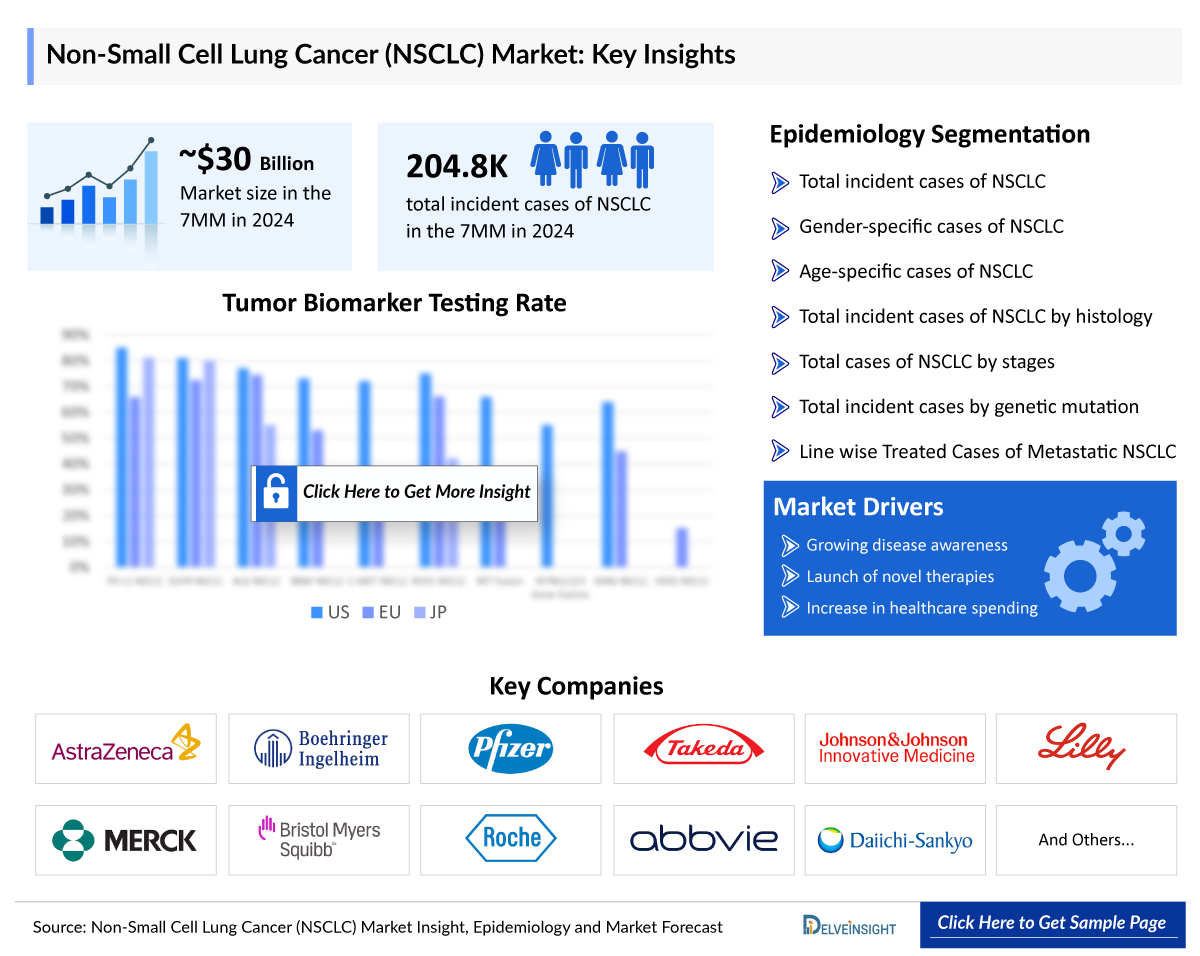
- According to DelveInsight's analysis, the Non-Small Cell Lung Cancer (NSCLC) Therapeutics Market size across the 7MM (the United States, EU4 [Germany, France, Italy, and Spain], the United Kingdom, and Japan) was valued at approximately USD 33 billion in 2025 and is projected to reach around USD 67 billion by 2036, growing at a CAGR of 6.6% during 2026–2036. DelveInsight's comprehensive market research provides critical insights into such market trends, enabling stakeholders to understand growth drivers, emerging opportunities, and potential challenges within the Non-Small Cell Lung Cancer landscape.
- Among the 7MM, the United States accounted for the highest incident cases of NSCLC in 2025, followed by Japan, while Spain accounted for the least number of cases. Among the EU4 and the UK, Germany had the highest number of NSCLC cases in 2025, at roughly 57,000, while Spain had the lowest, at around 2,700.
- In 2025, the 7MM had approximately 539,000 incident cases of NSCLC, a figure expected to rise through the forecast period (2026–2036) due to the growing incident population and advancements in diagnostic capabilities. NSCLC is slightly more common in men than in women, and prevalence is substantially higher among individuals aged 65 years and older, although cases among those younger than 65 have also been rising. Most cases continue to be diagnosed at advanced Stage IV, though early-stage (Stage I) diagnoses have been increasing due to wider low-dose CT screening and incidental imaging findings.
DelveInsight's report "Non-Small Cell Lung Cancer Market Insights, Epidemiology, and Market Forecast – 2036" provides a comprehensive analysis of the Non-Small Cell Lung Cancer landscape. The report delivers detailed insights into the disease, including historical and forecasted epidemiology, market trends, treatment patterns, and competitive dynamics across the United States, EU4 (Germany, France, Italy, and Spain), the United Kingdom, and Japan, equipping decision-makers with actionable intelligence for strategic planning, investment, and research initiatives.
To know in detail about the Non-Small Cell Lung Cancer market outlook, drug uptake, treatment scenario and epidemiology trends, Click here; Non-Small Cell Lung Cancer Market Forecast
Some of the key facts of the Non-Small Cell Lung Cancer Market Report:
- Key Non-Small Cell Lung Cancer Companies: AstraZeneca, Boehringer Ingelheim, Pfizer, Takeda Pharmaceuticals, Johnson & Johnson, Eli Lilly, Bristol-Myers Squibb, Merck, AbbVie, Amgen, Mirati Therapeutics, Novartis, Immutep, Moderna Therapeutics, ImmunityBio, Gilead Sciences, and others
- Key Non-Small Cell Lung Cancer Therapies: Osimertinib (TAGRISSO), Afatinib maleate (GILOTRIF/GIOTRIF), Dacomitinib (VIZIMPRO), Mobocertinib (EXKIVITY), Aumolertinib mesylate (AUMSEQA), Sunvozertinib (ZEGFROVY), Amivantamab (RYBREVANT), Datopotamab deruxtecan (DATROWAY), Necitumumab (PORTRAZZA), Pembrolizumab (KEYTRUDA), Nivolumab (OPDIVO), Atezolizumab (TECENTRIQ), BMS-986504, Izalontamab brengitecan (Iza-bren), Neladalkib (NVL-655), and others
- NSCLC is the most common type of lung cancer, accounting for approximately 85% of all lung cancers, and is expected to see continued growth in incidence and market value driven by the shift toward targeted and immunotherapies.
Non-Small Cell Lung Cancer Overview
Lung cancer primarily originates in the lungs and may spread to lymph nodes or distant organs such as the brain, a process known as metastasis. It is mainly classified into two types: Small Cell Lung Cancer (SCLC) and NSCLC. NSCLC is the most common type, accounting for about 85% of all lung cancers, and is mainly subcategorized into adenocarcinoma, squamous cell carcinoma, and large cell carcinoma, with less common types including adenosquamous and sarcomatoid carcinomas. Compared with NSCLC, SCLC is more aggressive, composed of smaller cells, spreads rapidly, and can become fatal within weeks if untreated. Common symptoms of NSCLC include persistent cough, chest pain, shortness of breath, wheezing, loss of appetite, weight loss, and fatigue.
Get a Free sample for the Non-Small Cell Lung Cancer Market Forecast, Size & Share Analysis Report: Non-Small Cell Lung Cancer Market Report Sample
Key Trends in Non-Small Cell Lung Cancer Therapeutics Market
- Shift Toward Targeted and Immunotherapies: The real-world treatment trend depicts a significant shift towards targeted and immunotherapies from only systemic therapies in the past, which is expected to contribute the most going forward.
- Rising Competition in EGFR Exon 20 and Uncommon Mutations: Exon 20 insertion EGFR mutations have received the most attention in recent years, and this space has become competitive, with uncommon/atypical EGFR mutations (G719X, S768I, and PACC mutations) representing another emerging frontier.
- Growing Competitiveness in the KRAS G12C Segment: KRAS G12C is the most frequent KRAS variant in NSCLC, and since the majority of treatments now target this variant, the segment is likely to become increasingly crowded.
- Progress in Rare Biomarker-Driven NSCLC: Rare biomarkers such as ROS-1, HER2, RET fusion, and NTRK1/2/3 gene fusion have seen substantial progress in recent years, even as the treatment paradigm for rare mutations remains less defined due to limited late-stage clinical data.
- Unmet Need in Early-Stage Disease: Despite advances in precision medicine and immunotherapy, early-stage NSCLC (Stages I–III) remains a major unmet need, with routine use of immunotherapies in early-stage care still evolving and unevenly accessible.
Non-Small Cell Lung Cancer Epidemiology
The Non-Small Cell Lung Cancer epidemiology section provides insights into the historical, current, and forecasted epidemiology trends across the 7MM from 2022 to 2036. Based on DelveInsight's assessment, the 7MM had approximately 539,000 incident cases of NSCLC in 2025, a figure expected to rise due to the growing incident population and advancements in diagnostic capabilities during the forecast period. The rising incidence of adenocarcinoma may partly reflect improved evaluation and reporting practices as well as a sustained rise in cigarette smoking, given adenocarcinoma's strong dose-response relationship with tobacco exposure.
Non-Small Cell Lung Cancer Epidemiology Segmentation
The Non-Small Cell Lung Cancer market report proffers epidemiological analysis for the study period 2022–2036 in the 7MM segmented into:
- Total Non-Small Cell Lung Cancer Incident Cases
- Non-Small Cell Lung Cancer Gender-specific Cases
- Non-Small Cell Lung Cancer Age-specific Cases
- Total Incident Cases of NSCLC by Histology
- Total Incident Cases of NSCLC by Stage
- Total Incident Cases of NSCLC by Genetic Mutations/Biomarkers
- Patient Seeking Treatment for NSCLC
- Line-wise Treated Cases of Metastatic NSCLC
Download the report to understand which factors are driving Non-Small Cell Lung Cancer epidemiology trends @ Non-Small Cell Lung Cancer Epidemiology Forecast
Recent Developments in the Non-Small Cell Lung Cancer Treatment Landscape
- In July 2026, Abbisko Therapeutics entered a strategic collaboration with AstraZeneca to advance a novel immunotherapy-tyrosine kinase inhibitor combination, pairing Abbisko's oral PD-L1 inhibitor lumipodlin (ABSK043) with AstraZeneca's TAGRISSO (osimertinib) for EGFR-mutated, PD-L1 positive NSCLC.
- In July 2026, CStone Pharmaceuticals signed an exclusive commercialization agreement with Arrotex to bring sugemalimab to Australia and New Zealand, including for non-small cell lung cancer.
- In June 2026, Kelun-Biotech announced that its Phase III trial of sacituzumab tirumotecan combined with pembrolizumab met its primary endpoint of progression-free survival as a first-line treatment for PD-L1-negative, non-squamous NSCLC.
- In June 2026, Dizal announced positive topline results from its global Phase 3 WU-KONG28 trial, showing Zegfrovy (sunvozertinib) significantly outperformed platinum-doublet chemotherapy in first-line advanced NSCLC with EGFR exon 20 insertion mutations.
- In May 2026, China's NMPA accepted for review a Supplemental New Drug Application for sacituzumab tirumotecan in combination with pembrolizumab as frontline treatment for advanced PD-L1 positive NSCLC.
- In May 2026, Nuvation Bio entered a strategic collaboration with Thermo Fisher Scientific for U.S.-based manufacturing of ibtrozi, an investigational drug targeting ROS1-positive NSCLC.
- In May 2026, Innovent Biologics announced proof-of-concept data for IBI363, a PD-1/IL-2α-bias bispecific fusion protein, showing an 86.4% objective response rate and 100% disease control rate in combination with chemotherapy as first-line treatment for advanced NSCLC with low or negative PD-L1 expression.
Non-Small Cell Lung Cancer Drugs Uptake and Pipeline Development Activities
The drugs uptake section focuses on the rate of uptake of potential drugs recently launched or expected to launch in the NSCLC market during the forecast period (2026–2036), covering patient uptake by therapy and anticipated sales generated by each drug. Among the emerging first-line therapies are Zipalertinib (TAS6417) + CTx, Furmonertinib/Firmonertinib, Pamvatamig (MCLA-129) ± Osimertinib, Aumolertinib (AUMSEQA), Sunvozertinib (ZEGFROVY), Datopotamab deruxtecan (DATROWAY) ± Osimertinib (TAGRISSO), Telisotuzumab adizutecan (Temab-A) + TAGRISSO, Sutetinib, and JMT101 + Osimertinib. Firmonertinib, sunvozertinib, and JMT101 in combination with osimertinib are anticipated to be among the first to enter the market by 2027 and are expected to compete closely with established therapies such as RYBREVANT and TAGRISSO.
The report also covers the Non-Small Cell Lung Cancer Pipeline Analysis, including Iza-bren (izalontamab brengitecan) from SystImmune and Bristol Myers Squibb, a bispecific EGFR×HER3 antibody–drug conjugate showing potential as monotherapy or in combination with osimertinib for EGFR-mutant NSCLC, and Daraxonrasib (RMC-6236) from Revolution Medicines, an oral multi-selective RAS(ON) inhibitor for which a registrational trial in first-line metastatic RAS-mutant NSCLC is planned for 2026.
Non-Small Cell Lung Cancer Therapies and Key Companies
- TAGRISSO (osimertinib): AstraZeneca
- GILOTRIF/GIOTRIF (afatinib maleate): Boehringer Ingelheim
- VIZIMPRO (dacomitinib): Pfizer
- EXKIVITY (mobocertinib): Takeda Pharmaceuticals
- AUMSEQA (aumolertinib mesylate): Hansoh Pharma
- ZEGFROVY (sunvozertinib): Dizal (Jiangsu) Pharmaceutical
- RYBREVANT (amivantamab): Johnson & Johnson Innovative Medicine (Janssen)
- DATROWAY (datopotamab deruxtecan): Daiichi Sankyo/AstraZeneca
- PORTRAZZA (necitumumab): Eli Lilly and Company
- KEYTRUDA (pembrolizumab): Merck (MSD)
- OPDIVO (nivolumab): Bristol-Myers Squibb (BMS)/Ono Pharmaceutical
- Iza-bren (izalontamab brengitecan): SystImmune and Bristol Myers Squibb
- Daraxonrasib (RMC-6236): Revolution Medicines
Discover more about therapies set to grab major Non-Small Cell Lung Cancer market share @ Non-Small Cell Lung Cancer Treatment Landscape
Non-Small Cell Lung Cancer Market Drivers
- Rising NSCLC Incidence: NSCLC incident cases in the US form a substantial disease burden, with declining overall incidence driven by tobacco control measures alongside rising early-stage detections from expanded low-dose CT screening. In 2025, there were approximately 203,000 incident cases of NSCLC in the US, projected to reach roughly 205,000 by 2036.
- Rising Opportunities in EGFR NSCLC Therapies: In EGFR-mutated NSCLC, where TAGRISSO is the industry leader, J&J's RYBREVANT (in combination with the oral EGFR-TKI LAZCLUZE) is gradually gaining ground, with the company also planning to launch a subcutaneous version of RYBREVANT.
- Emerging Competitive Pipeline: KRAS G12C remains the most frequent KRAS variant in NSCLC and is likely to become increasingly crowded, with emerging key players including Eli Lilly, Genfleet Therapeutics/Merck, Merck/Otsuka Pharmaceutical, BioAtla, Taiho Pharmaceutical, Astex Pharmaceuticals, Revolution Medicines, Roche, and Verastem Oncology.
Non-Small Cell Lung Cancer Market Barriers
- Persistent Resistance to Therapy: Acquired resistance to anti-PD-1/L1 therapies renders these treatments effectively useless in roughly half of patients over time, forcing a fallback to often ineffective or toxic chemotherapy approaches.
- Unmet Need in Rare Biomarker Segments: Due to the rarity of certain biomarkers in NSCLC and a lack of late-stage clinical studies, the treatment paradigm for rare NSCLC mutations remains less clear.
- Limited Options in Early-Stage Disease: Standard treatment for early-stage NSCLC, surgery with adjuvant platinum-based chemotherapy, offers limited survival benefit and significant toxicity, while routine use of newer immunotherapies in this setting is still evolving and unevenly accessible.
- Reimbursement and Access Challenges: High costs of combination therapies and reimbursement issues in Europe continue to restrict access to newer NSCLC treatments.
Scope of the Non-Small Cell Lung Cancer Market Report
- Study Period: 2022–2036
- Historical Year: 2022–2025
- Base Year: 2026
- Forecast Period: 2026–2036
- Coverage: 7MM [North America: The US; Europe: Germany, France, Italy, Spain, and the UK; Asia-Pacific: Japan]
- Key Non-Small Cell Lung Cancer Companies: AstraZeneca, Boehringer Ingelheim, Pfizer, Takeda Pharmaceuticals, Johnson & Johnson, Eli Lilly, Bristol-Myers Squibb, Merck, AbbVie, Amgen, Mirati Therapeutics, Novartis, Immutep, Moderna Therapeutics, ImmunityBio, Gilead Sciences, and others
- Key Non-Small Cell Lung Cancer Therapies: Osimertinib (TAGRISSO), Afatinib maleate (GILOTRIF/GIOTRIF), Dacomitinib (VIZIMPRO), Mobocertinib (EXKIVITY), Aumolertinib mesylate (AUMSEQA), Sunvozertinib (ZEGFROVY), Amivantamab (RYBREVANT), Datopotamab deruxtecan (DATROWAY), Necitumumab (PORTRAZZA), Pembrolizumab (KEYTRUDA), Nivolumab (OPDIVO), Atezolizumab (TECENTRIQ), BMS-986504, Izalontamab brengitecan (Iza-bren), Neladalkib (NVL-655), and others
- Non-Small Cell Lung Cancer Therapeutic Assessment: NSCLC current marketed and NSCLC emerging therapies
- Non-Small Cell Lung Cancer Market Dynamics: NSCLC market drivers and NSCLC market barriers
- Competitive Intelligence Analysis: SWOT analysis, Conjoint analysis, Market entry strategies
- Non-Small Cell Lung Cancer Unmet Needs, KOL's views, Analyst's views, Non-Small Cell Lung Cancer Market Access and Reimbursement
To know more about Non-Small Cell Lung Cancer companies working in the treatment market, visit @ Non-Small Cell Lung Cancer Clinical Trials and Therapeutic Assessment
About DelveInsight
DelveInsight is a leading Healthcare Business Consultant, and Market Research firm focused exclusively on life sciences. It supports Pharma companies by providing comprehensive end-to-end solutions to improve their performance.
It also offers Healthcare Consulting Services, which benefits in market analysis to accelerate the business growth and overcome challenges with a practical approach.
Need more?
- ✅ Connect with our analyst to learn how this research was developed
- ✅ Expand the scope with additional segments or countries through free customization
- ✅ Discover how this report can directly influence your business growth
Related Reports
Non-Small Cell Lung Cancer (NSCLC) Market Insight, Epidemiology and Market Forecast -2034
DelveInsight’s Non-Small Cell Lung Cancer Market Insights, Epidemiology and Market Forecast - 2034 report provides the detailed overview of the disease..
Non-Small Cell Lung Cancer - Pipeline Insight, 2025
Non-Small Cell Lung Cancer Pipeline Insights, 2025 report by DelveInsight outlays comprehensive insights of present clinical development scenario and growth prospects across the NSCLC market.
Non-Small Cell Lung Cancer - Epidemiology Forecast - 2034
DelveInsight's Non-Small Cell Lung Cancer - Epidemiology Forecast 2034 report delivers an in-depth understanding of the disease, historical, and forecasted epidemiology of disease in the 7MM.
