
3D Cardiac Mapping System Market Summary
- The 3D Cardiac Mapping System market is estimated at USD 527.41 million in 2025 and is projected to reach USD 980.37 million by 2034. Growth is anchored in the rising global prevalence of cardiovascular disorders and arrhythmias, an escalating clinical and lifestyle risk-factor burden, and the accelerating shift toward minimally invasive electrophysiology procedures.
- The global 3D Cardiac Mapping System market is growing at a CAGR of 8.08% during the forecast period from 2026 to 2034.
- By type, the electroanatomical mapping segment dominated the 3D Cardiac Mapping System market with a 58% share in 2025.
- By interface, the invasive segment dominated the 3D Cardiac Mapping System market with a 74% share in 2025.
- By end-users, the hospitals segment dominated the 3D Cardiac Mapping System market with a 65% share in 2025.
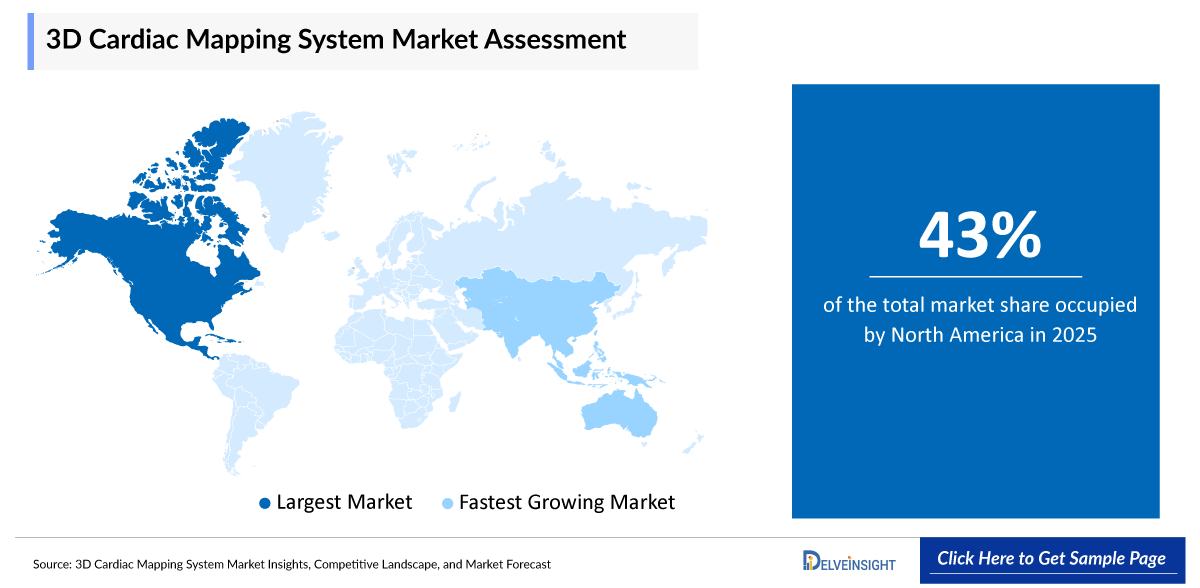
- North America dominated the global 3D Cardiac Mapping System market revenue with a 43% share in 2025, representing the highest regional market share globally.
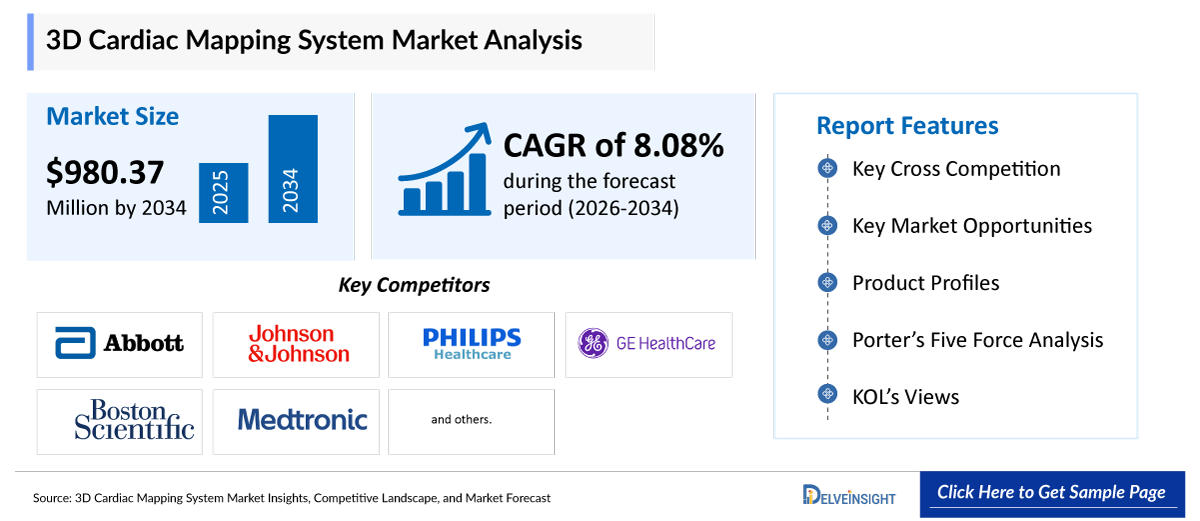
A 3D cardiac mapping system is an advanced medical technology used in the diagnosis and treatment of cardiac arrhythmias. It creates a detailed, three-dimensional anatomical and electrical map of the heart, allowing physicians to visualize the precise location and propagation of electrical signals within the cardiac chambers. By integrating real-time electrophysiological data with high-resolution anatomical models, these systems help identify abnormal conduction pathways, pinpoint arrhythmic foci, and guide catheter-based interventions such as ablation. Compared with conventional fluoroscopy, 3D cardiac mapping reduces radiation exposure, enhances procedural accuracy, and improves overall patient outcomes. The market is organized by type across electroanatomical mapping, basket catheter mapping, and hybrid/multi-modal mapping systems; by interface across invasive and non-invasive approaches; and by end-user across hospitals, specialty clinics, and others. Driven by the rising global burden of atrial fibrillation and ventricular tachycardia, an expanding population of patients with cardiovascular risk factors, and continuous technological innovation, including AI-assisted mapping and platforms compatible with pulsed field ablation, 3D cardiac mapping systems have become an essential tool in modern electrophysiology labs worldwide.
3D Cardiac Mapping System Market Key Growth Drivers
- The rising global prevalence of cardiovascular disorders, including atrial fibrillation and ventricular tachycardia, is driving demand, with DelveInsight estimating that more than half a billion people worldwide are currently living with cardiovascular disease.
- Escalating clinical and lifestyle risk factors, including hypertension, diabetes, obesity, smoking, and aging populations, are projected to push the global atrial fibrillation population beyond 12.5 million by 2030.
- Growing preference for minimally invasive electrophysiology procedures is accelerating adoption of 3D mapping platforms that reduce radiation exposure and improve procedural precision.
- Continuous technological innovation, including AI-assisted mapping algorithms and integration with pulsed field ablation systems, is improving procedural efficiency and expanding clinical utility.
- Accelerating regulatory approvals and new product launches, including Boston Scientific's FARAWAVE NAV Ablation Catheter and FARAVIEW Software in October 2024 and Biosense Webster's VARIPULSE Platform PMA submission in March 2024, are reinforcing commercial momentum.
- Rising capital investment and strategic expansion by major device manufacturers in electrophysiology infrastructure is broadening market access across established and emerging healthcare systems.
- The convergence of rising disease burden, risk-factor prevalence, minimally invasive adoption, and continuous product innovation is expected to sustain steady growth in the market through 2032.
Key Companies in 3D Cardiac Mapping System Market
The competitive landscape is led by the following active manufacturers:
- Abbott
- Johnson & Johnson Services, Inc.
- Koninklijke Philips N.V.
- GE HealthCare
- Boston Scientific Corporation
- Medtronic
- Siemens Healthineers AG
- Acutus Medical
- MicroPort Scientific
- Sichuan Jinjiang Electronic Science and Technology
For illustrative purposes, only the top 10 companies are listed in the Table of Contents. The report may include analysis and references to additional companies relevant to the market assessment.
3D Cardiac Mapping System Market Size
The following snapshot summarizes the principal report metrics for the 3D Cardiac Mapping System market.
|
Report Metrics |
Details |
|
2025 Market Size |
USD 527.41 million |
|
2034 Projected Market Size |
USD 980.37 million |
|
Growth Rate (2026-2034) |
8.08% CAGR |
|
Largest Market |
North America |
|
Fastest Growing Market |
Asia-Pacific |
|
Market Structure |
Moderately Consolidated |
All market values are expressed in USD and represent DelveInsight estimates synthesized from primary and secondary research.
Factors Contributing to the Growth of the 3D Cardiac Mapping System Market
Market Drivers
Rising Global Prevalence of Cardiovascular Disorders and Arrhythmias
The most powerful driver of the 3D Cardiac Mapping System market is the rising global burden of cardiovascular disorders, particularly atrial fibrillation, ventricular tachycardia, and other complex arrhythmias. According to DelveInsight, more than half a billion people worldwide are currently living with cardiovascular disease, and aging populations, urbanization, and lifestyle changes continue to expand the number of individuals affected. Cardiac arrhythmias require precise diagnosis and treatment, and 3D mapping systems create detailed anatomical and electrical reconstructions of the heart that are essential for guiding catheter ablation, now the gold-standard treatment for atrial fibrillation and ventricular tachycardia. As the global disease burden continues to climb, demand for advanced mapping capacity in hospitals and electrophysiology labs expands directly, anchoring market growth through 2032.
Escalating Risk-Factor Burden Widening the Patient Pool
The accumulation of lifestyle and clinical risk factors is widening the pool of patients who require advanced cardiac diagnostics and treatment. Hypertension, diabetes, obesity, smoking, high cholesterol, and sedentary lifestyles are key contributors, while genetic predisposition and age further elevate susceptibility to arrhythmias. DelveInsight projects that more than 12.5 million individuals globally will be affected by atrial fibrillation within the next five years. As these risk factors accumulate across both developed and emerging economies, disease incidence and complexity rise in step, driving sustained demand for precise, technology-enabled monitoring and treatment platforms across the forecast period.
Growing Demand for Minimally Invasive Electrophysiology Procedures
Healthcare providers and patients are increasingly favoring minimally invasive interventions for their reduced procedural risk, shorter recovery times, and improved clinical outcomes. In electrophysiology, this trend has accelerated adoption of 3D cardiac mapping systems, which guide catheter-based ablation and other procedures with high precision while minimizing complications and radiation exposure compared with conventional fluoroscopy. As minimally invasive techniques become the standard of care for atrial fibrillation and ventricular tachycardia management, hospitals and specialty clinics continue to expand their electrophysiology lab capacity and mapping-system utilization, reinforcing demand growth through 2032.
Continuous Technological Innovation and AI Integration in Mapping Platforms
Ongoing innovation in high-resolution anatomical mapping, real-time electrophysiological data integration, and artificial intelligence is improving procedural efficiency and clinical outcomes. Leading products such as Biosense Webster's CARTO 3 System, Abbott's EnSite X EP System, and Boston Scientific's OPAL HDx and RHYTHMIA HDx mapping systems integrate advanced algorithms, high-density mapping capabilities, and intuitive visualization tools. AI-driven mapping software is increasingly used to analyze complex electrical signals, identify abnormal conduction pathways, and predict arrhythmic foci with greater accuracy, while automation supports faster catheter navigation and more reproducible 3D anatomical reconstructions. This continuous wave of platform innovation strengthens clinical adoption and sustains competitive differentiation across the forecast period.
Accelerating Regulatory Approvals and New Product Launches
A steady cadence of regulatory approvals and product launches is reinforcing commercial momentum. In October 2024, Boston Scientific received FDA approval for its navigation-enabled FARAWAVE NAV Ablation Catheter and FDA 510(k) clearance for its FARAVIEW Software, both compatible with its OPAL HDx Mapping System. In March 2024, Biosense Webster, a Johnson & Johnson MedTech company, submitted its VARIPULSE Platform for FDA Premarket Approval, supported by findings from the ADMIRE study. Additional launches, including Biosense Webster's CARTO 3 System Version 8, its OPTRELL Mapping Catheter with TRUEref Technology, Abbott's EnSite X EP System, and Medtronic's Advisor HD Grid Mapping Catheter, continue to expand approved indications and clinical capability. Each approval and launch creates durable, recurring demand for compatible mapping hardware and software across hospitals and electrophysiology centers.
Rising Investment and Strategic Expansion by Device Manufacturers
Major device manufacturers continue to invest heavily in electrophysiology infrastructure, product development, and strategic transactions to strengthen their mapping-system portfolios. Medtronic's acquisition of Affera, Inc. added the Sphere-9 dual-energy mapping and ablation catheter to its electrophysiology franchise, while Boston Scientific, Abbott, and Biosense Webster continue to expand their mapping and pulsed field ablation-compatible product lines through internal R&D and targeted partnerships. This sustained investment expands installed capacity, broadens geographic reach, and accelerates the introduction of next-generation mapping technologies through the forecast period.
Market Restraints
Despite strong momentum, the 3D Cardiac Mapping System market faces material constraints. The high cost of these systems, including the initial capital investment as well as ongoing expenses related to maintenance, training, and consumable mapping catheters, poses a significant burden on smaller hospitals and diagnostic centers, particularly in emerging economies with limited healthcare budgets. Stringent and complex regulatory approval processes for cardiac mapping devices require extensive clinical validation and long timelines, delaying product launches and raising development costs for manufacturers. U.S. tariffs on imported components such as semiconductors, specialized sensors, and advanced materials are increasing manufacturing costs, which could raise device prices for hospitals and specialty clinics and slow adoption in smaller facilities. A shortage of skilled electrophysiologists and technicians trained on advanced mapping platforms further constrains scale-up, while reimbursement policies for high-cost electrophysiology procedures remain uneven across geographies. Together, these cost, regulatory, supply-chain, and workforce barriers temper the pace of growth, even as the underlying drivers of rising disease burden and minimally invasive adoption remain firmly intact.
3D Cardiac Mapping System Market Segment Analysis
The 3D cardiac mapping system market by type (electroanatomical mapping, basket catheter mapping, and hybrid/multi-modal mapping systems), interface (invasive and non-invasive), end-users (hospitals, specialty clinics, and others), and geography (North America, Europe, Asia-Pacific, and Rest of World).
By Type
Dominant Subsegment: Electroanatomical Mapping.
The electroanatomical mapping segment accounted for approximately 58% of the 3D Cardiac Mapping System market in 2025. Electroanatomical mapping is the leading type because it creates comprehensive, real-time, three-dimensional reconstructions of the heart's anatomy while simultaneously mapping its electrical activity, enabling physicians to accurately identify and localize abnormal conduction pathways. This precision is critical for guiding complex procedures such as catheter ablation, now the gold-standard treatment for atrial fibrillation and ventricular tachycardia. Leading products such as Biosense Webster's CARTO 3 System, Abbott's EnSite X EP System, and Boston Scientific's RHYTHMIA HDx Mapping System exemplify the segment's dominance, integrating advanced algorithms, high-density mapping capabilities, and intuitive visualization tools that improve procedural efficiency, safety, and outcomes. While basket catheter mapping and hybrid/multi-modal systems are gaining traction for complex and persistent arrhythmias, the established clinical role and continuous innovation in electroanatomical platforms secure their leadership across the forecast period.
By Interface
Dominant Subsegment: Invasive.
The invasive segment accounted for approximately 74% of the 3D Cardiac Mapping System market in 2025. Invasive mapping, performed through catheter-based procedures, is the leading interface because it enables electrophysiologists to obtain real-time, high-resolution electroanatomical data directly from the heart's chambers, precision that is indispensable for guiding catheter ablation. Hospitals and advanced electrophysiology laboratories across leading markets have integrated invasive mapping into routine practice due to its proven clinical efficacy in treating atrial fibrillation and ventricular tachycardia. Major industry players continue to prioritize innovation in this segment, launching next-generation catheters and advanced mapping software, while favorable reimbursement frameworks for invasive cardiac procedures further accelerate adoption. Non-invasive mapping is an emerging area of interest for pre-procedural planning and risk stratification, but the clinical indispensability of invasive mapping secures its leadership through the forecast period.
By End-Users
Dominant Subsegment: Hospitals.
The hospitals segment accounted for approximately 65% of the 3D Cardiac Mapping System market in 2025. Hospitals lead the end-user segment because they serve as primary centers for complex cardiac care, offering advanced infrastructure, specialized electrophysiology labs, and access to highly trained cardiologists and electrophysiologists. The rising prevalence of atrial fibrillation and other arrhythmias has led to a higher volume of hospital admissions, driving demand for advanced mapping systems that enable accurate visualization and treatment planning. Hospitals also benefit from favorable reimbursement policies and funding support for high-cost medical equipment, allowing them to adopt state-of-the-art technologies more readily than smaller clinics. Specialty clinics are expanding their electrophysiology capabilities as procedures become more standardized, but the concentration of patient volume, technological capability, and financial resources keeps hospitals the dominant end-user setting across the forecast period.
3D Cardiac Mapping System Market Region Analysis
Dominant Region: North America
North America, led by the United States, accounted for approximately 43% of the global 3D Cardiac Mapping System market revenue in 2025, representing the highest regional market share globally. This dominance is primarily attributed to the high burden of cardiovascular disorders, particularly atrial fibrillation, along with the region's well-established healthcare infrastructure and extensive network of specialized electrophysiology laboratories. The rising incidence of arrhythmias, exacerbated by an aging population and lifestyle-related risk factors such as hypertension, diabetes, and obesity, has fueled a substantial increase in demand for advanced 3D cardiac mapping systems. Ongoing product innovations and timely launches are accelerating growth across the region, including Biosense Webster's introduction of the OPTRELL Mapping Catheter with TRUEref Technology, integrated with the CARTO 3 System, in the United States. Strong R&D momentum, favorable reimbursement, and the continuous introduction of next-generation mapping technologies reinforce North America's continued leadership across the forecast period.
Fastest Growing Region: Asia-Pacific
Asia-Pacific is the fastest-growing region in the 3D Cardiac Mapping System market. The region's elevated CAGR is driven by the rising prevalence of cardiovascular diseases, increasing healthcare investments, and the rapid adoption of advanced electrophysiology technologies across China, Japan, India, and South Korea. Japan continues to lead in technological innovation, with strong adoption of navigation-enabled 3D mapping systems and AI-assisted ablation technologies, while China is rapidly expanding its domestic production capabilities to reduce dependence on imports. In India, the increasing incidence of atrial fibrillation and other cardiac arrhythmias, combined with improving access to advanced mapping solutions in urban healthcare centers, is creating substantial opportunities. The integration of AI-powered mapping software, real-time analytics, and tele-cardiology solutions is gaining momentum across the region, positioning Asia-Pacific as the principal source of incremental growth over the forecast period.
Regional Commentary
North America
North America accounted for approximately 43% of the global 3D Cardiac Mapping System market revenue in 2025. The United States dominates on the strength of its high cardiovascular disease burden, mature electrophysiology infrastructure, and continuous product innovation, with Biosense Webster's launch of the OPTRELL Mapping Catheter with TRUEref Technology reinforcing the region's leadership.
Europe
Europe is a large and advanced regional market, supported by expanding hospital infrastructure, supportive government initiatives, and growing awareness of cardiac health across Germany, France, the United Kingdom, Italy, and Spain. Germany continues to lead in technological innovation, with strong adoption of navigation-enabled 3D mapping systems and AI-assisted ablation procedures, while France and the United Kingdom are focusing on integrating advanced software solutions and real-time analytics to enhance procedural efficiency. In Italy and Spain, increasing incidences of arrhythmias, coupled with improving access to high-end electrophysiology labs in urban centers, are creating significant opportunities.
Asia-Pacific
Asia-Pacific is the fastest-growing region, propelled by rising cardiovascular disease prevalence, expanding hospital infrastructure, and government initiatives for early diagnosis and treatment of arrhythmias across China, Japan, India, and South Korea. Strategic collaborations between global device manufacturers and local healthcare providers, along with favorable regulatory policies and supportive medical tourism trends, are further shaping the region's growth outlook.
Rest of World
The Rest of World region, spanning the Middle East, Africa, and South America, is an emerging growth frontier. Expanding healthcare infrastructure, rising awareness of arrhythmia diagnosis and treatment, and gradually improving access to advanced electrophysiology labs are broadening adoption, while partnerships with global device manufacturers support the build-out of regional capacity.
3D Cardiac Mapping System Market Competitive Landscape
The 3D Cardiac Mapping System market is classified as Moderately Consolidated. A group of established medical device leaders with broad electrophysiology portfolios and global distribution, including Abbott, Johnson & Johnson (Biosense Webster), Medtronic, and Boston Scientific, collectively hold a significant share and anchor the top tier, leveraging strong research and development capabilities, brand recognition, and extensive distribution networks. Alongside these established companies, imaging and technology providers such as Koninklijke Philips N.V., GE HealthCare, and Siemens Healthineers AG, along with specialized and regional players such as Acutus Medical, MicroPort Scientific, and Sichuan Jinjiang Electronic Science and Technology, compete through focused innovation, regional manufacturing, and targeted product launches, sustaining a dynamic and competitive market environment.
The competitive landscape can be evaluated across the following dimensions:
- Market concentration: Moderately consolidated, with a handful of global electrophysiology leaders holding a significant share alongside specialized and regional challengers.
- Leading players: Abbott, Johnson & Johnson (Biosense Webster), Medtronic, and Boston Scientific anchor the top tier through broad electrophysiology portfolios and global distribution.
- Geographic reach: Leading players operate extensive global distribution and clinical-support networks spanning North America, Europe, and Asia-Pacific.
- Product portfolio strength: Top players offer end-to-end electroanatomical mapping platforms, high-density mapping catheters, and software integrated with ablation systems.
- Technology and innovation focus: AI-assisted mapping algorithms, high-density mapping catheters, and platforms compatible with pulsed field ablation are key competitive differentiators.
- Regulatory approvals: A steady cadence of FDA approvals, 510(k) clearances, and CE marks, such as those secured by Boston Scientific, Abbott, and Medtronic, sustains commercial momentum.
- Strategic partnerships: Collaborations between device manufacturers, hospital networks, and academic electrophysiology centers extend clinical evidence and market reach.
- M&A activity: Active consolidation, including Medtronic's acquisition of Affera, Inc. to add the Sphere-9 dual-energy mapping and ablation catheter to its electrophysiology franchise.
3D Cardiac Mapping System Market Recent Developmental Activities
In October 2024, Boston Scientific Corporation received U.S. FDA approval for its navigation-enabled FARAWAVE NAV Ablation Catheter for treating paroxysmal atrial fibrillation and FDA 510(k) clearance for its new FARAVIEW Software, both compatible with its OPAL HDx Mapping System. Strategic significance: Adds an integrated mapping-and-ablation workflow and strengthens Boston Scientific's pulsed field ablation portfolio.
In March 2024, Biosense Webster, Inc. (Johnson & Johnson MedTech) submitted its VARIPULSE Platform for Premarket Approval to the U.S. FDA, backed by findings from the ADMIRE study. Strategic significance: Advances Biosense Webster's pulsed field ablation-compatible mapping pipeline toward U.S. commercialization.
In 2024, Biosense Webster, Inc., introduced the CARTO 3 System Version 8, the latest evolution of its flagship three-dimensional heart mapping platform designed to enhance cardiac ablation procedures. Strategic significance: Strengthens CARTO's market-leading position through improved mapping resolution and procedural efficiency.
In 2024, Biosense Webster, Inc., launched the OPTRELL Mapping Catheter with TRUEref Technology in the United States, integrated with the CARTO 3 System. Strategic significance: Enhances mapping accuracy and reinforces North American commercial momentum.
In 2024, Medtronic completed its acquisition of Affera, Inc., adding the Sphere-9 dual-energy mapping and ablation catheter to its electrophysiology portfolio. Strategic significance: Expands Medtronic's mapping and pulsed field ablation capabilities through a single integrated catheter platform.
In 2024, Medtronic launched the Advisor HD Grid Mapping Catheter, sensor-enabled, for improved arrhythmia mapping, and received corresponding FDA clearance. Strategic significance: Strengthens Medtronic's high-density mapping catheter portfolio.
In 2024, Abbott introduced the EnSite X EP System, offering enhanced 3D mapping and visualization, and received CE mark approval for the platform. Strategic significance: Expands Abbott's electroanatomical mapping footprint in the United States and Europe.
In 2024, Boston Scientific Corporation rolled out the OPAL HDx Mapping System integrated with FARAPULSE Pulsed Field Ablation technology for cardiac ablation procedures. Strategic significance: Reinforces Boston Scientific's one-stop mapping-and-ablation offering for atrial fibrillation treatment.
3D Cardiac Mapping System Market Segmentation
3D Cardiac Mapping System Market by Type
- Electroanatomical Mapping
- Basket Catheter Mapping
- Hybrid/Multi-Modal Mapping Systems
3D Cardiac Mapping System Market by Interface
- Invasive
- Non-Invasive
3D Cardiac Mapping System Market by End-Users
- Hospitals
- Specialty Clinics
- Others
3D Cardiac Mapping System Market by Geography
- North America 3D Cardiac Mapping System Market
- United States 3D Cardiac Mapping System Market Size in USD million (2023-2034)
- Canada 3D Cardiac Mapping System Market Size in USD million (2023-2034)
- Mexico 3D Cardiac Mapping System Market Size in USD million (2023-2034)
- Europe 3D Cardiac Mapping System Market
- Germany 3D Cardiac Mapping System Market Size in USD million (2023-2034)
- United Kingdom 3D Cardiac Mapping System Market Size in USD million (2023-2034)
- France 3D Cardiac Mapping System Market Size in USD million (2023-2034)
- Italy 3D Cardiac Mapping System Market Size in USD million (2023-2034)
- Spain 3D Cardiac Mapping System Market Size in USD million (2023-2034)
- Rest of Europe 3D Cardiac Mapping System Market Size in USD million (2023-2034)
- Asia-Pacific 3D Cardiac Mapping System Market
- China 3D Cardiac Mapping System Market Size in USD million (2023-2034)
- Japan 3D Cardiac Mapping System Market Size in USD million (2023-2034)
- India 3D Cardiac Mapping System Market Size in USD million (2023-2034)
- Australia 3D Cardiac Mapping System Market Size in USD million (2023-2034)
- South Korea 3D Cardiac Mapping System Market Size in USD million (2023-2034)
- Rest of Asia-Pacific 3D Cardiac Mapping System Market Size in USD million (2023-2034)
- Rest of the World (RoW) 3D Cardiac Mapping System Market
- Middle East 3D Cardiac Mapping System Market Size in USD million (2023-2034)
- Africa 3D Cardiac Mapping System Market Size in USD million (2023-2034)
- South America 3D Cardiac Mapping System Market Size in USD million (2023-2034)
3D Cardiac Mapping System Market Recent Industry Trends and Milestones (2023-2026)
|
Category |
Key Developments |
|
3D Cardiac Mapping System Market Product Approval |
Abbott introduced the EnSite X EP System, offering enhanced 3D mapping and visualization; Medtronic launched the Advisor HD Grid Mapping Catheter for improved arrhythmia mapping; Boston Scientific rolled out the OPAL HDx Mapping System integrated with FARAPULSE Pulsed Field Ablation technology; Biosense Webster launched the CARTO 3 System Version 8 and the OPTRELL Mapping Catheter with TRUEref Technology. |
|
3D Cardiac Mapping System Market Expansion |
FDA approved Boston Scientific's FARAWAVE NAV Ablation Catheter and FARAVIEW Software; CE mark received by Abbott for the EnSite X system; Medtronic received FDA clearance for the Advisor HD Grid Mapping Catheter; Biosense Webster submitted the VARIPULSE Platform for FDA Premarket Approval. |
|
3D Cardiac Mapping System Market Investment |
Medtronic collaborated with academic electrophysiology centers to expand real-world clinical evidence for HD Grid mapping technology; Boston Scientific partnered with hospital networks to broaden access to FARAPULSE-compatible mapping systems. |
|
Company Strategy |
Medtronic completed its acquisition of Affera, Inc., adding the Sphere-9 dual-energy mapping and ablation catheter to its electrophysiology portfolio. |
|
Emerging Technologies |
Key players are focusing on AI integration, high-density mapping catheters, pulsed field ablation-compatible platforms, and expansion of global electrophysiology distribution networks. |
3D Cardiac Mapping System Market Startup Funding and Investment Trends
|
Company |
Total Funding |
Funding Stage |
Main Offering |
Core Technology |
|
Affera, Inc. |
Undisclosed acquisition value |
Acquired by Medtronic (2024) |
Cardiac mapping and ablation |
Sphere-9 dual-energy mapping and ablation catheter |
|
Request to unlock the report on the @ 3D Cardiac Mapping System Market | ||||
Investment in the 3D Cardiac Mapping System ecosystem has concentrated on AI-assisted mapping software, high-density mapping catheters, and platforms compatible with pulsed field ablation. The following companies illustrate recent funding and investment activity and technology focus.
Capital continues to flow toward providers that combine mapping precision with ablation compatibility. Medtronic's acquisition of Affera, Inc. underscores the strategic value of integrated mapping-and-ablation platforms, while venture-backed innovators such as Kardium and Catheter Precision continue to advance next-generation mapping and navigation technologies. Established players including Abbott, Boston Scientific, and Biosense Webster continue to reinvest in R&D to expand high-density mapping and AI-driven visualization capabilities. Collectively, these investments signal conviction that mapping precision, ablation integration, and AI-enabled analytics will define the next phase of competitive advantage in the global 3D Cardiac Mapping System market.
Key Takeaways from the 3D Cardiac Mapping System Market Report Study
- Market size analysis for the current 3D Cardiac Mapping System market size (2025), and market forecast for 9 years (2026 to 2034).
- Top key product/technology developments, mergers, acquisitions, partnerships, and joint ventures that have happened over the last 3 years.
- Key companies dominating the global 3D Cardiac Mapping System market.
- Various opportunities available for competitors in the 3D Cardiac Mapping System market space.
- What are the top-performing segments in 2025? How will these segments perform in 2034?
- Which are the top-performing regions and countries in the current 3D Cardiac Mapping System market scenario?
- Which are the regions and countries where companies should concentrate their opportunities for 3D Cardiac Mapping System market growth in the future?
Target audience who can benefit from this 3D Cardiac Mapping System market report study
- 3D Cardiac Mapping System product providers
- Research organizations and consulting companies
- 3D Cardiac Mapping System -related organizations, associations, forums, and other alliances
- Government and corporate offices
- Start-up companies, venture capitalists, and private equity firms
- Distributors and traders dealing in 3D Cardiac Mapping System
- Various end-users who want to know more about the 3D Cardiac Mapping System market and the latest technological developments in the 3D Cardiac Mapping System market.