
Ablation Devices Market Summary
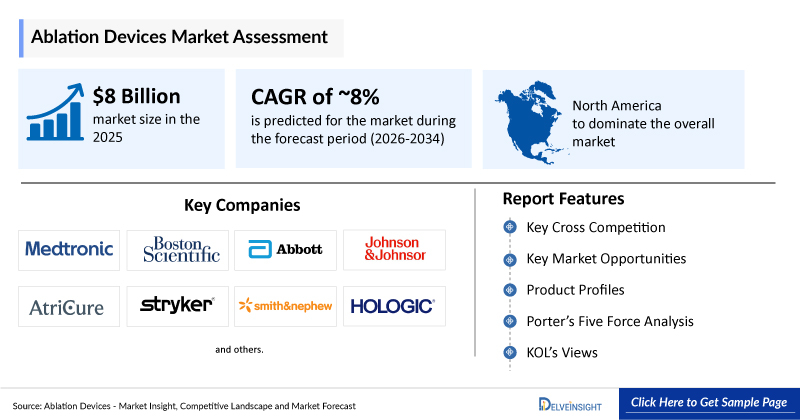
- The global ablation devices market size is expected to increase from USD 8,090.31 million in 2025 to USD 15,347.69 million by 2034, reflecting strong and sustained growth.
- The global ablation devices market is growing at a CAGR of 8.38% during the forecast period from 2026 to 2034.
Ablation Devices Market Trends & Insights
- The market of ablation device solutions is being primarily driven by the rising prevalence of chronic diseases such as cancer and cardiovascular diseases, and increasing technological advancements globally.
- The leading companies operating in the ablation devices market include Medtronic, Boston Scientific Corporation, Abbott, Johnson & Johnson Services Inc, AtriCure, Inc., Stryker, Smith & Nephew, Hologic, Inc., CONMED Corporation., Biotronik SE & Co. KG, AngioDynamics, Inc., BD, Terumo Corporation, Merit Medical Systems, Inc., Olympus Corporation, Karl Storz GmbH & Co. KG, Varian Medical Systems Inc, Integra LifeSciences, Japan Lifeline Co Ltd, Avanos Medical, Inc., and others.
- North America is expected to dominate the overall ablation devices market. The region's market growth is primarily driven by the rising instances of cancer and cardiac arrhythmias such as atrial fibrillation.
- In the technology segment of the ablation devices market, the radiofrequency category is estimated to account for the largest market share in 2025.
Request for unlocking the report of the @Ablation Devices Market
Ablation Devices Market Size and Forecasts
- 2025 Market Size: USD 8,090.31 million
- 2035 Projected Market Size: USD 15,347.69 million
- Growth Rate (2026-2034): 8.38% CAGR
- Largest Market: North America
- Fastest Growing Market: Asia-Pacific
- Market Structure: Moderately Concentrated
Key Factors Contributing to the Growth of the Ablation Devices Market
Market Driver - Rising Prevalence of Chronic Diseases
The increasing global burden of chronic diseases is a primary driver. Conditions such as cancer, cardiac arrhythmias (particularly atrial fibrillation), and chronic pain are becoming more common. Ablation offers a precise, targeted, and often curative treatment option for these diseases, leading to a surge in demand. For example, the aging global population is particularly susceptible to these conditions, creating a large patient pool.
Market Driver - Technological Advancements in Ablation Modalities Fueling Market Growth
Continuous innovations in energy-based technologies such as radiofrequency, microwave, cryoablation, and high-intensity focused ultrasound (HIFU) have significantly improved treatment precision, safety, and efficacy. The integration of real-time imaging and navigation systems further enhances accuracy in targeting diseased tissues while minimizing damage to surrounding healthy structures. For instance, next-generation microwave systems deliver higher and more uniform tissue temperatures, enabling faster ablation of larger tumors, while advanced cryoablation devices provide improved control over freeze cycles. These technological leaps are broadening the clinical applicability of ablation and driving strong adoption across oncology, cardiology, and pain management.
Market Driver - Rising Demand for Minimally Invasive Surgeries (MIS)
The growing global preference for minimally invasive procedures is a major driver of the ablation devices market. Compared to open surgeries, ablation procedures are associated with shorter hospital stays, reduced recovery times, fewer complications, and lower overall treatment costs. This patient-centric shift has accelerated the adoption of ablation therapies in treating cancers, atrial fibrillation, and chronic pain conditions. As healthcare systems increasingly prioritize cost-effectiveness and improved patient outcomes, the demand for ablation devices that enable precise, minimally invasive interventions continues to surge.
Ablation Devices Market Report Segmentation
This ablation devices market report offers a comprehensive overview of the global ablation devices market, highlighting key trends, growth drivers, challenges, and opportunities. It covers detailed market segmentation by Ablation Devices Market by Technology (Radiofrequency, Thermosphere, Microwave, Cryoablation, Ultrasonic, and Others), Application (Cardiovascular, Oncology, Gynecology, Orthopedic, and Others), End-User (Hospital, Ambulatory Surgical Centers, and Others), and geography. The report provides valuable insights into the competitive landscape, regulatory environment, and market dynamics across major markets, including North America, Europe, and Asia-Pacific. Featuring in-depth profiles of leading industry players and recent product innovations, this report equips businesses with essential data to identify market potential, develop strategic plans, and capitalize on emerging opportunities in the rapidly growing Ablation Devices market.
An ablation device is a medical instrument used in a minimally invasive procedure to destroy or remove a specific area of diseased tissue. Instead of traditional open surgery, these devices deliver a targeted source of energy, such as heat or cold, through a thin catheter or probe to ablate (or destroy) the problematic tissue without affecting surrounding healthy areas.
The growth of the global ablation devices market is primarily driven by the rising prevalence of chronic disorders such as cancer, cardiovascular diseases, and chronic pain, which is significantly increasing the need for advanced treatment options. Alongside this, the growing demand for minimally invasive procedures offering reduced complications, faster recovery, and cost-effectiveness is further propelling market adoption. Supported by ongoing technological advancements and expanding clinical applications, these factors collectively position ablation devices as a vital component of modern healthcare, driving robust growth during the forecast period from 2026 to 2034.
Get More Insights into the Report @ Ablation Devices Market
What are the latest Ablation Devices Market Dynamics and Trends?
The increasing global incidence of chronic disorders, particularly cancer and cardiovascular diseases, is a primary catalyst for the growth of the ablation devices market. Ablation technologies have become an indispensable tool in oncology as a minimally invasive alternative or complement to surgery for a wide range of tumors. For instance, techniques like radiofrequency, microwave, and cryoablation allow for the precise destruction of malignant tissues in organs such as the liver, lungs, and kidneys, offering patients a less traumatic option with shorter recovery times.
According to recent estimates from DelveInisght analysis, the number of new cancer cases globally is projected to rise significantly, reaching more than 30 million by 2050, primarily due to population growth and aging. Similarly, ablation devices play a crucial role in cardiology by treating heart rhythm disorders like atrial fibrillation, providing a curative alternative to long-term medication for a growing number of patients. This dual application in two of the world's most prevalent chronic diseases ensures that the demand for ablation devices will continue to accelerate.
The rising global burden of cardiovascular diseases, affecting a projected half a billion people, is a powerful and sustained driver of the ablation devices market. In cardiology, these devices have become a standard of care for treating arrhythmias, most notably atrial fibrillation (AFib). This targeted approach is highly effective in restoring a normal heart rhythm, dramatically improving patients' quality of life, and often reducing their dependence on long-term medication. The market is not just responding to this demand but is also being reshaped by it.
Recent innovations, such as the introduction of pulsed-field ablation (PFA), represent a major leap forward, offering a non-thermal, safer, and faster alternative to traditional methods. PFA systems, like Medtronic's PulseSelect, are gaining regulatory approval and commercial adoption, showcasing how technological advancements in ablation are directly addressing the massive patient need and solidifying their role as a key therapeutic option for cardiovascular diseases.
While the ablation devices market is experiencing robust growth, it is not without significant constraints that could limit its expansion. One of the primary barriers is the inherent risk associated with these procedures. Although minimally invasive, ablation is not risk-free. Complications can include damage to surrounding healthy tissue, blood clots, nerve injuries, and, in rare cases, more serious events like cardiac perforation. The potential for such adverse events can make both patients and physicians hesitant, particularly when alternative, non-invasive treatments are available.
This leads to the second major constraint: the availability and effectiveness of alternative treatment options. For many conditions, ablation is one of several therapeutic choices. In cardiology, for example, long-term medication for arrhythmia management can be a viable and less invasive alternative, even with its own set of side effects. In oncology, patients may opt for traditional chemotherapy, radiation, or surgical resection. The choice between these options often depends on a careful risk-benefit analysis, patient preference, and physician comfort. The presence of these proven alternatives provides a competitive challenge to the ablation devices market, as it requires a clear demonstration of superior long-term efficacy, safety, and cost-effectiveness to justify the procedure's risks and expense.
Ablation Devices Market Segment Analysis
Ablation Devices Market by Technology (Radiofrequency, Thermosphere, Microwave, Cryoablation, Ultrasonic, and Others), Application (Cardiovascular, Oncology, Gynecology, Orthopedic, and Others), End-User (Hospital, Ambulatory Surgical Centers, and Others), and Geography (North America, Europe, Asia-Pacific, and Rest of the World)
Ablation Devices Market Segmentation By Technology
By Technology: Radiofrequency Category Dominates the Market
Within the technology segment of the ablation devices market, radiofrequency (RF) ablation is a dominant force, projected to maintain a significant market share of around 44% in 2024. Its widespread adoption is rooted in a combination of its proven efficacy and inherent technological advantages. RF ablation delivers high-frequency electrical currents to generate controlled heat, enabling the precise destruction of targeted tissues. As a minimally invasive technique, it offers significant patient benefits, including shorter hospital stays, faster recovery, and reduced post-operative pain, making it a preferred choice across various medical specialties. Its versatility is particularly valuable in treating tumors in the liver, kidney, and lungs, where it provides an effective alternative to invasive surgery.
The market for RF ablation is further energized by continuous innovation and a steady flow of regulatory approvals. The focus is now on enhancing precision, safety, and workflow efficiency. For instance, recent advancements include integrated mapping and navigation systems that provide real-time guidance for more accurate electrode placement. This is exemplified by Medtronic's Affera Mapping and Ablation System, which received FDA approval in October 2024. This system is a significant step forward as it combines high-density mapping with a catheter capable of delivering both RF and pulsed-field (PF) ablation, offering physicians dual-energy capability. Such developments not only reinforce RF ablation's standing but also position the technology to complement newer modalities, ensuring its continued prominence and driving significant market growth through the forecast period.
Ablation Devices Market Segmentation By Application
By Application: Oncology Category Dominates the Market
In the application segment, the oncology category dominates the ablation devices market and serves as a key growth driver, driven by the rising global incidence of cancers such as liver, lung, kidney, and bone. Ablation techniques, including radiofrequency, microwave, cryoablation, and HIFU, offer a crucial, minimally invasive alternative for patients who are not candidates for traditional surgery. These methods provide targeted tumor destruction with minimal damage to healthy tissue. Recent advancements are further solidifying this trend, with innovations in non-thermal ablation like histotripsy and irreversible electroporation (IRE) gaining traction for their ability to spare critical structures like blood vessels and nerves. The increasing adoption of image-guided precision and the use of ablation in combination with systemic therapies are also enhancing its efficacy and broadening its clinical applications. With continuous technological advancements, including the integration of AI and robotics, oncology remains a highly promising and rapidly evolving application area for ablation devices.
Ablation Devices Market Segmentation By End-User
By End-User: Hospitals Category Dominates the Market
The hospital segment is the dominant end-user of ablation devices, driven by several key factors. Hospitals are the primary centers for performing a high volume of complex and high-risk procedures, such as those for cardiac arrhythmias, tumors, and chronic pain. The infrastructure required for these procedures, including specialized operating rooms, advanced imaging technologies, and comprehensive post-procedural care, is readily available in hospitals. Furthermore, these institutions house the multidisciplinary teams of highly skilled surgeons, interventional cardiologists, and radiologists necessary to safely and effectively perform ablation. Favorable reimbursement policies and the rising adoption of minimally invasive surgeries further solidify hospitals' position as the preferred setting. While ambulatory surgical centers (ASCs) are emerging as a growing segment, the complexity and high-acuity nature of a significant portion of ablation procedures ensure that hospitals will continue to hold the largest market share.
Ablation Devices Market Regional Analysis
North America Ablation Devices Market Trends
North America is projected to hold the largest share, accounting for approximately 40% of the global ablation devices market in 2024, driven by the high prevalence of cancer and cardiac arrhythmias, advanced healthcare infrastructure, and favorable reimbursement policies. The U.S. leads the region with widespread adoption of cutting-edge ablation technologies, supported by leading market players and robust R&D activities.
The United States, in particular, faces a significant and growing number of cancer cases. According to DelveInsight analysis, more than 1.9 million new cancer cases are expected to be diagnosed in the U.S. in 2025, and this number is projected to increase in the coming years due to an aging population and other demographic shifts. This steady rise in cancer incidence directly fuels the demand for minimally invasive treatment options, positioning ablation devices as a vital solution in oncology care.
Beyond oncology, the market is also propelled by North America's advanced healthcare infrastructure, high healthcare expenditure, and a strong preference for minimally invasive procedures. The presence of key market players, robust research and development activities, and favorable reimbursement policies further accelerate the adoption of innovative ablation technologies. These factors, combined with the increasing patient pool, ensure that the North American ablation devices market will continue to expand significantly through the forecast period.
Europe Ablation Devices Market Trends
The Europe ablation devices market trends reflect steady growth, supported by a well-established healthcare infrastructure, high awareness of advanced treatment options, and strong adoption of minimally invasive surgical procedures. Countries such as Germany, the United Kingdom, and France dominate the market due to their advanced hospital networks, favorable reimbursement frameworks, and early adoption of innovative ablation technologies. Meanwhile, Italy and Spain are emerging as promising markets with increasing procedural volumes and government support for modernizing healthcare systems. Key growth drivers include the rising prevalence of atrial fibrillation and oncology-related cases, growing demand for catheter-based ablation techniques, and the integration of advanced imaging modalities for enhanced treatment precision. Additionally, Europe’s emphasis on clinical research and medical technology innovation continues to attract investments from global manufacturers. As a result, the European Ablation Devices market is expected to maintain a strong growth trajectory, offering substantial opportunities for both established players and emerging innovators.
Asia-Pacific Ablation Devices Market Trends
The Asia-Pacific ablation devices market trends indicate robust growth, driven by expanding healthcare infrastructure, increasing prevalence of cardiac arrhythmias and cancer, and the rising demand for minimally invasive procedures. Countries such as China and Japan lead the market with advanced healthcare systems and strong adoption of cutting-edge ablation technologies, while India and South Korea are emerging as high-growth markets due to improving access to specialized treatments and growing patient awareness. Key growth drivers include the integration of advanced imaging and navigation systems, the adoption of innovative energy sources such as microwave and cryoablation, and the shift toward outpatient and ambulatory care settings. Furthermore, supportive government healthcare initiatives and the growing focus on early disease diagnosis are accelerating market expansion. As a result, the Asia-Pacific ablation devices market is positioned to be one of the fastest-growing regions globally, offering significant opportunities for medical device manufacturers and healthcare providers.
Who are the Key Ablation Devices Companies In The Market Landscape?
The following are the leading companies in the ablation devices market. These companies collectively hold the largest market share and dictate industry trends.
Ablation Devices Companies
- Medtronic
- Boston Scientific Corporation
- Abbott
- Johnson & Johnson Services Inc
- AtriCure, Inc.
- Stryker
- Smith & Nephew
- Hologic, Inc.
- CONMED Corporation.
- Biotronik SE & Co. KG
- AngioDynamics, Inc.
- BD
- Terumo Corporation
- Merit Medical Systems, Inc.
- Olympus Corporation
- Karl Storz GmbH & Co. KG
- Varian Medical Systems Inc
- Integra LifeSciences
- Japan Lifeline Co Ltd
- Avanos Medical, Inc., and others
How is the competitive landscape shaping the ablation devices Market?
The competitive landscape of the Ablation Devices market is moderately concentrated, with a few global leaders driving technology innovation and market share, while regional players and startups contribute to niche advancements. Leading companies are investing heavily in R&D to deliver next-generation solutions that incorporate advanced energy modalities, improved imaging guidance, and enhanced catheter designs, pushing the industry toward safer, faster, and more effective ablation procedures. Key competitive strategies include continuous product innovation, collaborations with hospitals and research institutions, and the development of patient-specific and minimally invasive treatment approaches. Meanwhile, regional players are strengthening their presence in emerging markets through cost-effective offerings. Overall, competition is intensifying as both established players and new entrants seek to capitalize on the growing demand for minimally invasive ablation therapies across cardiology, oncology, and pain management.
Recent Developmental Activities in the Ablation Devices Market
- In May 2025, Abbott launched a tactiflex sensor-enabled ablation catheter for atrial fibrillation treatment.
- In March 2025, NeuroOne Medical Technologies announced it had expedited its 510(k) submission timeline to the U.S. Food and Drug Administration (FDA) for trigeminal nerve ablation, now set for May 2025. The technology utilizes the company’s OneRF platform.
Scope of the Ablation Devices market | |
|
Report Metrics |
Details |
|
Study Period |
2023 to 2034 |
|
Base Year |
2025 |
|
Forecast Period |
2026 to 2034 |
|
Ablation Devices Market CAGR |
8.38% |
|
Key Companies in the Ablation Devices Market |
Medtronic, Boston Scientific Corporation, Abbott, Johnson & Johnson Services Inc., AtriCure, Inc., Stryker, Smith & Nephew, Hologic, Inc., CONMED Corporation, Biotronik SE & Co. KG, AngioDynamics, Inc., BD, Terumo Corporation, Merit Medical Systems, Inc., Olympus Corporation, Karl Storz GmbH & Co. KG, Varian Medical Systems Inc., Integra LifeSciences, Japan Lifeline Co., Ltd, Avanos Medical, Inc., and others |
|
Ablation Devices Market Segments |
by Technology, by Application, by End-user, and by Geography |
|
Ablation Devices Regional Scope |
North America, Europe, Asia Pacific, Middle East, Africa, and South America |
|
Ablation Devices Country Scope |
U.S., Canada, Mexico, Germany, United Kingdom, France, Italy, Spain, China, Japan, India, Australia, South Korea, and key Countries |
Ablation Devices Market Segmentation
Ablation Devices Technology Exposure
- Radiofrequency
- Thermosphere
- Microwave
- Cryoablation
- Ultrasonic, Others
Ablation Devices Application Exposure
- Cardiovascular
- Oncology
- Gynecology
- Orthopedic, Others
Ablation Devices End-Users Exposure
- Hospitals
- Ambulatory Surgical Centers, Others
Ablation Devices Geography Exposure
- North America Ablation Devices Market
- United States Ablation Devices Market
- Canada Ablation Devices Market
- Mexico Ablation Devices Market
- Europe Ablation Devices Market
- United Kingdom Ablation Devices Market
- Germany Ablation Devices Market
- France Ablation Devices Market
- Italy Ablation Devices Market
- Spain Ablation Devices Market
- Rest of Europe
- Asia-Pacific Ablation Devices Market
- China Ablation Devices Market
- Japan Ablation Devices Market
- India Ablation Devices Market
- Australia Ablation Devices Market
- South Korea Ablation Devices Market
- Rest of Asia-Pacific
- Rest of the World
- South America Ablation Devices Market
- Middle East Ablation Devices Market
- Africa Ablation Devices Market
Ablation Devices Market Recent Industry Trends and Milestones (2022-2025)
Ablation Devices Market Recent Industry Trends and Milestones (2022-2025) | |
|
Category |
Key Developments |
|
Ablation Devices Product Launches |
Medtronic launched Arctic Front™ Cryoablation Catheter (next-gen); AngioDynamics expanded its NanoKnife IRE system; Boston Scientific unveiled updated RF ablation catheters. |
|
Ablation Devices Regulatory Approvals |
NeuroOne Medical Technologies received FDA 510(k) clearance (2023) for its OneRF Ablation System; IceCure Medical gained approvals for the ProSense Cryoablation System in multiple geographies. |
|
Partnerships in the Ablation Devices Market |
Medtronic partnered with Philips Healthcare for imaging-integrated ablation procedures; Abbott’s Biosense Webster collaborated with academic institutions for AI-driven cardiac mapping. |
|
Acquisitions in the Ablation Devices Market |
Boston Scientific acquired Farapulse (2022) to expand into pulsed field ablation; AngioDynamics strengthened its oncology portfolio through technology acquisitions. |
|
Company Strategy |
Focus on geographic expansion in Asia-Pacific & Latin America, portfolio diversification (microwave, cryo, PFA), and integration of AI-driven navigation & imaging guidance. |
|
Setbacks in the Ablation Devices Market |
Product recalls and supply-chain disruptions post-pandemic; reimbursement challenges in emerging markets; training gaps in advanced ablation procedures. |
Impact Analysis
What is the impact of AI on the Ablation Devices Market?
AI-Powered Innovations and Applications:
Artificial Intelligence (AI) is revolutionizing ablation devices by enhancing their precision, adaptability, and clinical impact. AI-powered platforms can analyze procedural data in real time, offering actionable insights on accuracy, energy delivery, and treatment outcomes. These systems enable physicians to simulate complex and high-risk cases, optimize ablation strategies, and personalize therapies based on patient-specific anatomy and disease characteristics. Applications extend across preoperative planning, intraoperative guidance, robotic-assisted procedures, and post-procedural outcome assessment. By integrating AI into ablation technologies, healthcare providers can achieve greater consistency, reduce procedural risks, and improve overall patient safety, ultimately contributing to better therapeutic success and clinical outcomes.
U.S. Tariff Impact Analysis on Ablation Devices Market:
The U.S. tariffs on medical devices are creating a complex and challenging environment for the global ablation devices market, significantly impacting international trade, supply chains, and market competition. Many advanced ablation devices and their critical components, such as those for pulsed-field ablation (PFA) and radiofrequency (RF) systems, are manufactured or sourced from key trade partners like China and the European Union. The imposition of new and escalating tariffs on these imports directly increases production costs for both U.S.-based and international manufacturers. This cost burden is not always fully passed on to healthcare providers due to market pressures and reimbursement constraints, forcing companies to absorb the costs and, in some cases, impacting their profit margins.
The tariffs are also disrupting established global supply chains, creating uncertainty and logistical hurdles. In response, major players like Medtronic and Boston Scientific are actively re-evaluating their manufacturing strategies. This includes diversifying their supplier base to reduce dependency on a single region, exploring alternative, low-cost manufacturing locations, and even considering "reshoring" production to the U.S. to avoid import duties. While these strategic shifts are aimed at long-term resilience, they require significant investment and time, which could temporarily affect product availability and slow the introduction of innovations to the market. Furthermore, the tariffs can lead to retaliatory measures from other countries, potentially limiting U.S. exports of high-value ablation systems and challenging the global market dominance of American companies.
How This Analysis Helps Clients:
- Cost Management: By understanding the tariff landscape, clients can anticipate cost increases and adjust pricing strategies accordingly, ensuring profitability.
- Supply Chain Optimization: Clients can identify alternative sourcing options and diversify their supply chains to reduce dependency on high-tariff regions, enhancing resilience.
- Regulatory Navigation: Expert guidance on navigating the evolving regulatory environment helps clients maintain compliance and avoid potential legal challenges.
- Strategic Planning: Insights into tariff impacts enable clients to make informed decisions about manufacturing locations, partnerships, and market entry strategies.
StartUp Funding and Investment Trends in Ablation Devices | ||||
|
Company Name |
Total Funding |
Main Products |
Stage of Development |
Core Technology |
|
NeuroOne Medical Technologies |
$80M |
OneRF Ablation System |
Early Commercial |
Radiofrequency ablation for neurosurgical procedures |
|
HistoSonics |
$200M+ |
Edison® Histotripsy Ablation Platform |
Late-stage/Commercial |
Non-thermal focused ultrasound (histotripsy) ablation |
Key takeaways from the ablation devices market report study
- Market size analysis for the current ablation devices market size (2025), and market forecast for 8 years (2026 to 2034)
- Top key product/technology developments, mergers, acquisitions, partnerships, and joint ventures happened over the last 3 years.
- Key companies dominating the ablation devices market.
- Various opportunities available for the other competitors in the ablation devices market space.
- What are the top-performing segments in 2025? How these segments will perform in 2034?
- Which are the top-performing regions and countries in the current ablation devices market scenario?
- Which are the regions and countries where companies should have concentrated on opportunities for the ablation devices market growth in the future?