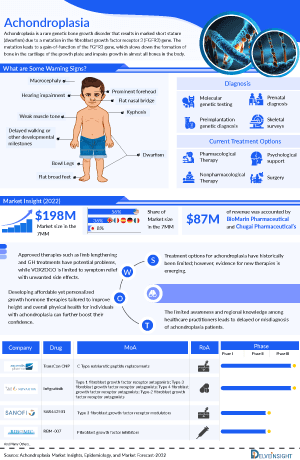
Achondroplasia Market Summary
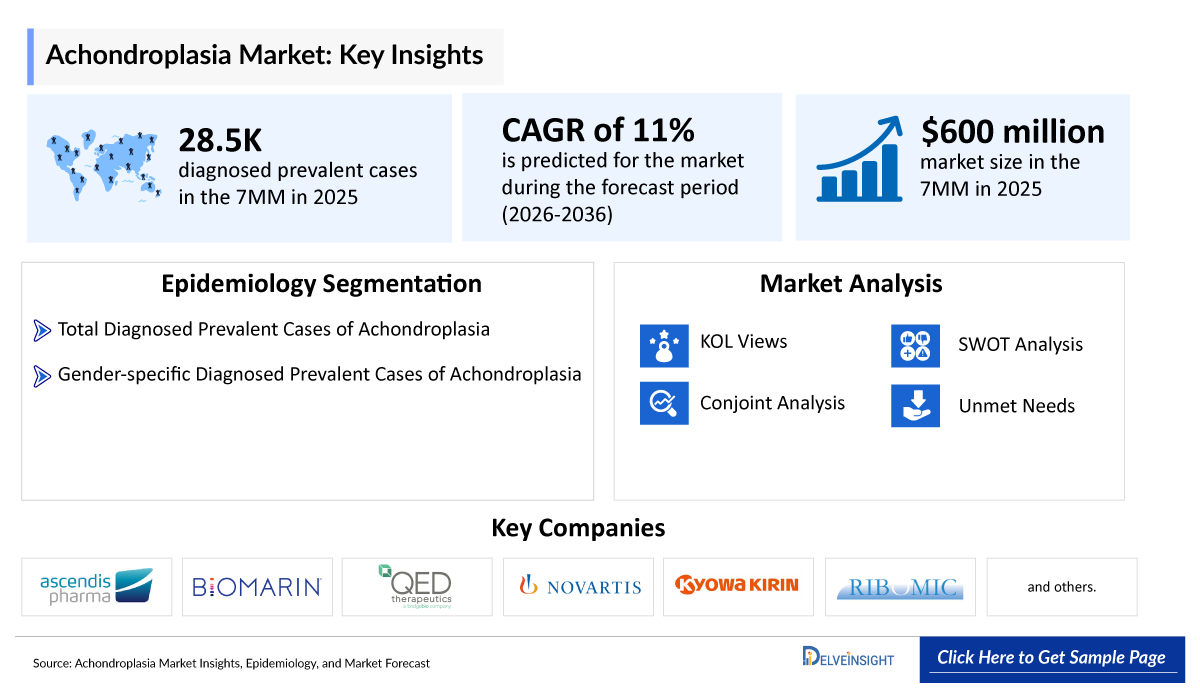
- According to DelveInsight’s analysis, the Achondroplasia Market Size was found to be ~USD 600 million in the leading markets (the United States, the EU4 (Germany, France, Italy, and Spain), the United Kingdom, and Japan) in 2025.
- The Achondroplasia Treatment paradigm is shifting from supportive care toward targeted, disease-modifying therapies that address underlying FGFR3 pathway dysregulation. This evolution is driven by improved disease understanding and the availability of novel agents such as Vosoritide (VOXZOGO) and Navepegritide; TransCon CNP (YUVIWEL).
Achondroplasia Market Insights and Trends
- Achondroplasia is typically identifiable early in life due to its distinct clinical and radiographic features; however, variability in presentation and gaps in awareness can lead to delays in diagnosis and referral. This underscores the importance of early genetic confirmation, longitudinal growth monitoring, and proactive management to mitigate complications and improve long-term outcomes.
- Disease management in achondroplasia remains centered on multidisciplinary care, including regular monitoring of skeletal and neurological complications, alongside supportive interventions such as physical therapy and surgical procedures when required, to optimize functional outcomes and quality of life.
- The current achondroplasia treatment landscape includes a broad range of marketed targeted therapies spanning multiple mechanisms of action, developed by leading pharmaceutical companies, including Ascendis Pharma (YUVIWEL) and BioMarin Pharmaceutical (VOXZOGO), reflecting continued innovation and competition in the JIA therapeutic space.
- Whereas the emerging achondroplasia pipeline continues to expand with mid- and late-stage assets such as QED Therapeutics (BridgeBio)/Novartis/Kyowa Kirin (BBP-831/BGJ398), RIBOMIC (RBM-007), and BioMarin Pharmaceutical (BMN 333) are being evaluated.
Achondroplasia Market Size and Forecast in the 7MM
- 2025 Achondroplasia Market Size: ~USD 600 million
- 2036 Projected Achondroplasia Market Size: XXXX million
- Achondroplasia Growth Rate (2026–2036): ~11% CAGR
Request for Unlocking the Sample Page of the "Achondroplasia Treatment Market"
Factors Contributing to the Growth of the Achondroplasia Market
-
Rising awareness and early diagnosis
Improved understanding of genetic disorders and better diagnostic capabilities are leading to earlier identification and intervention.
-
Advancements in targeted therapies
Innovative treatments, particularly those targeting underlying genetic pathways, are transforming disease management and driving market growth.
-
The increasing prevalence of rare genetic disorders focus
Greater attention toward rare diseases has accelerated research funding and development efforts.
-
Strong pipeline of emerging therapies
A robust clinical pipeline with novel drug candidates is expected to expand treatment options in the coming years.
-
Regulatory support and orphan drug incentives
Favorable policies, including orphan drug designations and expedited approvals, are encouraging pharmaceutical investments.
-
Growing healthcare expenditure
Increased spending on specialized treatments and rare disease management is supporting market expansion.
-
Improved patient access and support programs
Enhanced reimbursement policies and patient assistance programs are enabling wider adoption of therapies.
DelveInsight's ‘Achondroplasia Market Insights, Epidemiology and Market Forecast – 2036’ report delivers an in-depth understanding of Achondroplasia, historical and forecasted epidemiology, as well as the Achondroplasia market trends in the United States, EU4 (Germany, Spain, Italy, and France), the United Kingdom, and Japan.
The Achondroplasia Treatment Market Report delivers a comprehensive analysis of the current treatment landscape, including standards of care, clinical practices, and evolving therapeutic algorithms. It evaluates Achondroplasia patient burden trends, revenue & market share dynamics, peak patient share & therapy uptake analysis, and provides an in-depth market size assessment, and growth rate projections (Historical & Forecast 2022–2036) across global regions. The report highlights key unmet medical needs in Achondroplasia and maps the competitive and clinical landscape to uncover high‑value opportunities, providing a clear outlook on future market growth potential.
Scope of the Achondroplasia Market Report | |
|
Study Period |
2022–2036 |
|
Historical Year |
2022–2025 |
|
Forecast Period |
2026–2036 |
|
Base Year |
2026 |
|
Geographies Covered |
|
|
Achondroplasia Market CAGR | |
|
Achondroplasia Epidemiology Segmentation Analysis |
Patient Burden Assessment
|
|
Achondroplasia Companies |
|
|
Achondroplasia Therapies |
|
|
Achondroplasia Market |
Segmented by
|
|
Analysis |
|
Achondroplasia Understanding and Treatment Algorithm
Achondroplasia Overview
Achondroplasia is the most common form of disproportionate short stature, caused by a genetic mutation that affects bone growth and development, particularly in the long bones. It typically presents at birth and is characterized by shortened limbs, a relatively normal trunk, and distinctive facial features. While intelligence and life expectancy are generally normal, individuals may experience complications such as spinal stenosis, respiratory issues, and joint problems, especially in more severe cases. Achondroplasia is primarily caused by mutations in the FGFR3 gene that limit cartilage conversion to bone.
Achondroplasia Diagnosis
Achondroplasia is diagnosed through clinical evaluation and genetic testing, often identified at birth or during prenatal screening. Physical features such as disproportionate short stature, enlarged head, and characteristic facial features raise suspicion. Imaging (X-rays) supports the diagnosis by showing typical skeletal changes, while genetic testing confirms mutations in the FGFR3 gene.
Further details are provided in the report.
Achondroplasia Treatment
The primary goals of Achondroplasia management are to optimize linear growth, prevent and manage complications, improve functional outcomes, and support overall quality of life and psychosocial development. Care is multidisciplinary, involving pediatricians, geneticists, orthopedic surgeons, and neurologists, with regular monitoring for complications such as spinal stenosis, foramen magnum compression, and obstructive sleep apnea. Management includes supportive measures such as physical therapy and, when required, surgical interventions to address skeletal and neurological issues. Pharmacologic therapy has evolved with targeted treatments such as VOXZOGO and YUVIWEL, which act on the underlying FGFR3 pathway to promote endochondral bone growth, marking a shift toward disease-modifying approaches beyond symptomatic care.
Further details related to country-based variations are provided in the report.
Achondroplasia Unmet Needs
The section “unmet needs of Achondroplasia” outlines the critical gaps between the current state of patient care, diagnosis, and the ideal & effective management of the disease. It highlights the obstacles experienced by patients, clinicians, and researchers and identifies potential solutions for future progress.
- Limited disease-modifying therapies, with most treatments focused on symptom management
- High lifelong burden due to multiple comorbidities and complications
- Restricted access and high cost of emerging therapies
- Gaps in early diagnosis and optimal intervention timing, and others…
Comprehensive unmet needs insights in Achondroplasia and their strategic implications are provided in the full report.
Achondroplasia Epidemiology
Key Findings from Achondroplasia Epidemiological Analysis and Forecast
- According to DelveInsight’s estimates, the total diagnosed prevalent cases of Achondroplasia in the 7MM were approximately 28,500 in 2025, with the US accounting for the highest share.
- Among the EU4, France accounted for the highest number of diagnosed prevalent cases of Achondroplasia, followed by Germany, whereas Spain accounted for the lowest number of cases in 2025.
- The observed slight male predominance and earlier onset of Achondroplasia highlight the importance of early diagnosis, timely clinical intervention, and continuous monitoring to manage complications effectively.
Achondroplasia Epidemiological Segmentation in the 7MM
- Total Diagnosed Prevalent Cases of Achondroplasia
- Gender-specific Diagnosed Prevalent Cases of Achondroplasia
- Total Treated Cases of Achondroplasia
Achondroplasia Drug Analysis & Competitive Analysis
The Achondroplasia drug chapter provides a detailed, market-focused review of approved therapies and the emerging pipeline across Phase I–III clinical trials. It covers the mechanism of action, clinical trial data, regulatory approvals, patents, collaborations, and strategic partnerships for each therapy, along with their advantages, limitations, and recent developments. This section offers critical insights into the Achondroplasia treatment landscape, supporting market assessment, competitive analysis, and growth forecasting for the Achondroplasia therapeutics market.
Achondroplasia Approved Therapies
-
Navepegritide; TransCon CNP (YUVIWEL): Ascendis Pharma
YUVIWEL, developed by Ascendis Pharma, is a long-acting prodrug of C-type natriuretic peptide (CNP) designed to address the underlying cause of achondroplasia. It works by counteracting the overactive FGFR3 signaling pathway, which normally inhibits bone growth, thereby restoring balance in growth plate activity. Using TransCon technology, it provides sustained release of active CNP, enabling continuous stimulation of chondrocyte proliferation and differentiation, ultimately promoting more normalized endochondral bone growth.
-
Vosoritide (VOXZOGO): BioMarin Pharmaceutical
VOXZOGO, developed by BioMarin Pharmaceutical, is a C-type natriuretic peptide (CNP) analog designed to address the underlying pathology of Achondroplasia. It works by binding to natriuretic peptide receptor-B (NPR-B) and inhibiting the overactive FGFR3 signaling pathway, which suppresses bone growth. This restores normal growth plate function by promoting chondrocyte proliferation and differentiation. Unlike long-acting prodrugs, vosoritide is a short-acting therapy requiring daily administration, providing transient CNP activity to support endochondral bone growth.
Achondroplasia Marketed/Approved Therapies | ||||||
|
Drug/Therapy |
Company |
Indication |
Molecule Type |
RoA |
MoA |
Marketed Region |
|
Navepegritide; TransCon CNP (YUVIWEL) |
Ascendis Pharma |
Achondroplasia |
Long-acting CNP prodrug |
SC |
Binds NPR-B and counteracts overactive FGFR3 signaling, promoting endochondral bone growth |
US: 2026
|
|
Vosoritide (VOXZOGO) |
BioMarin Pharmaceutical |
Achondroplasia |
CNP analog peptide |
SC |
Activates NPR-B and inhibits FGFR3 signaling to restore growth plate function |
US: 2021 EU: 2021 JP: 2022 |
Note: Detailed marketed therapies assessment will be provided in the final report.
Achondroplasia Pipeline Analysis
-
Infigratinib (BBP-831/BGJ398): QED Therapeutics (BridgeBio)/Novartis/Kyowa Kirin
Infigratinib, developed by QED Therapeutics in collaboration with Novartis and Kyowa Kirin, is an oral, selective FGFR1–3 tyrosine kinase inhibitor designed to target the underlying genetic driver of Achondroplasia. It works by directly inhibiting the overactive FGFR3 signaling pathway responsible for impaired bone growth, thereby restoring downstream signaling balance in growth plate chondrocytes. This targeted mechanism aims to normalize endochondral ossification and promote skeletal growth, offering a precision-based approach that addresses the root cause of the disorder.
-
RBM-007 (umedaptanib pegol): RIBOMIC
RBM-007, developed by RIBOMIC, is a PEGylated anti-FGF2 aptamer designed to target fibroblast growth factor 2 (FGF2), a key regulator involved in abnormal bone growth signaling in Achondroplasia. By specifically binding to and inhibiting FGF2, RBM-007 aims to modulate downstream pathways associated with impaired chondrocyte proliferation and differentiation. This targeted mechanism is intended to restore more balanced endochondral bone growth while minimizing off-target effects through its high specificity and localized biological action.
Comparison of Emerging Drugs Under Development | |||||||
|
Drug Name |
Company |
Highest Phase |
Indication |
RoA |
MoA |
Molecule Type |
Anticipated Launch in the US |
|
Infigratinib (BBP-831/BGJ398) |
QED Therapeutics (BridgeBio)/ Novartis/ Kyowa Kirin |
II |
Achondroplasia |
Oral |
FGFR1–3 inhibitor |
Small molecule |
Information is available in the full report |
|
RBM-007 (umedaptanib pegol) |
RIBOMIC |
II |
Achondroplasia |
SC |
Anti-FGF2 aptamers |
PEGylated RNA aptamers |
Information is available in the full report |
|
BMN 333 |
BioMarin Pharmaceutical |
II |
Achondroplasia |
SC |
CNP analog targeting the FGFR3 pathway |
Peptide analog |
Information is available in the full report |
|
Note: Launch insights are provisional and may change with future report updates or the occurrence of major key catalysts. | |||||||
Note: A detailed emerging therapies assessment will be provided in the final report
Achondroplasia Companies, Market Leaders, and Emerging Companies
- Ascendis Pharma
- BioMarin Pharmaceutical
- QED Therapeutics (BridgeBio)
- Novartis
- Kyowa Kirin
- RIBOMIC, and others
Achondroplasia Drug Updates
- In June 2026, the FDA accepted BioMarin Pharmaceutical's supplemental New Drug Application (sNDA) seeking full approval for Voxzogo (vosoritide) to treat children with achondroplasia. Currently prescribed under accelerated approval, the drug stimulates bone growth in pediatric patients whose growth plates remain open. This submission is backed by robust long-term confirmatory data showing sustained efficacy and safety, with the FDA setting a standard review goal date to finalize the decision.
- In May 2026, At the Pediatric Endocrine Society’s 2026 Annual Meeting, BioMarin presented new long-term data regarding Voxzogo (vosoritide) for children with achondroplasia. The findings focus on the treatment’s impact beyond just height, showing positive effects on arm span, bone health, and overall growth proportionality. Achondroplasia, the most common form of dwarfism, is characterized by impaired endochondral bone growth; the data presented suggests that Voxzogo helps normalize the growth plate activity over extended periods. Importantly, the results indicate that long-term therapy is well-tolerated and contributes to improved skeletal health without compromising bone mineral density. This comprehensive look at growth metrics reinforces Voxzogo's role as a foundational therapy in pediatric endocrinology, providing families and clinicians with the evidence needed to support its use from an early age through the end of the growth period.
- In March 2026, RIBOMIC announced the summary report on the Phase II clinical trial of umedaptanib pegol (anti-FGF2 aptamer) in paediatric patients with achondroplasia.
- In March 2026, RIBOMIC submitted an IND application for a Phase III clinical trial in Japan to the Pharmaceuticals and Medical Devices Agency (PMDA), the regulatory authority, for umedaptanib pegol (antiFGF2 aptamer) in pediatric patients (ages 2 to 14) with achondroplasia.
- In February 2026, BridgeBio Pharma announced positive topline results from the global Phase III (PROPEL 3) study of oral infigratinib in children with achondroplasia, successfully meeting the primary endpoint of change in annualized height velocity (AHV) at Week 52 (p<0.0001).
- In August 2025, the company reported Phase I data showing that BMN 333 achieved over threefold higher AUC pharmacokinetic levels than other long-acting CNPs, with no safety concerns observed.
Achondroplasia Market Outlook
The Achondroplasia market is undergoing a significant transformation, shifting from a historically supportive care–focused approach toward targeted, disease-modifying therapies that address the underlying FGFR3-driven pathology. The approval and uptake of CNP analogs such as VOXZOGO (vosoritide) have established the first wave of mechanism-based treatment, while next-generation agents like TransCon CNP (navepegritide) aim to improve convenience and sustained efficacy through prolonged exposure. Additionally, emerging therapies such as Infigratinib highlight a growing focus on directly modulating FGFR3 signaling, further diversifying the therapeutic landscape.
With the continued advancement of late-stage pipeline candidates, including long-acting CNP formulations and oral FGFR inhibitors, the achondroplasia treatment landscape is becoming increasingly competitive and innovation-driven, aligning with broader trends in rare genetic disorders. The United States represents the largest market, driven by higher diagnosis rates, strong access to specialty care, favorable reimbursement frameworks, and increasing awareness among clinicians and caregivers, followed by Europe and Japan. Improved genetic testing and early diagnosis are also contributing to greater treatment uptake.
Overall, the introduction of differentiated disease-modifying therapies, expansion of pipeline assets with novel mechanisms, improving diagnostic capabilities, and growing awareness of long-term disease burden are expected to drive steady growth in the 7MM achondroplasia market from 2022 to 2036, creating significant commercial opportunities for both marketed therapies and emerging pipeline candidates.
- In 2025, the 7MM achondroplasia market reached an estimated USD 600 million, led by the United States, which dominated with the largest share.
- The Achondroplasia market is evolving as the treatment paradigm shifts from supportive and symptomatic management toward targeted disease-modifying therapies, with CNP analogs such as vosoritide and long-acting formulations like navepegritide (TransCon CNP) gaining traction due to their ability to address the underlying FGFR3 pathway dysregulation and promote more normalized bone growth.
- Regional market dynamics indicate that the United States leads in revenue generation, while Europe and Japan are witnessing steady growth, driven by improved diagnosis rates, increasing awareness of genetic disorders, and expanding access to novel targeted therapies that focus on long-term disease modification rather than symptomatic relief.
Further details will be provided in the report….
Achondroplasia Drug Class/Insights into Leading Emerging and Marketed Therapies (2022–2036 Forecast)
The Achondroplasia market comprises targeted growth-modifying therapies, emerging next-generation CNP analogs, and multidisciplinary non-drug management approaches, each addressing different aspects of impaired bone growth, skeletal complications, and patient quality of life.
- Targeted growth-modifying therapies: Agents such as VOXZOGO act as C-type natriuretic peptide (CNP) analogs, directly targeting the overactive FGFR3 signaling pathway to promote endochondral bone growth. These therapies represent the first disease-modifying approach but require long-term administration and early initiation for optimal outcomes.
- Emerging next-generation CNP analogs: Novel long-acting therapies such as navepegritide are being developed to provide sustained exposure and improved convenience (e.g., weekly dosing), aiming to enhance efficacy, adherence, and overall growth outcomes compared to earlier agents.
Targeted CNP-based therapies define the core innovation landscape in achondroplasia, shifting the paradigm from symptomatic and surgical management toward disease-modifying approaches, while next-generation long-acting agents and holistic care strategies are expected to drive future advancements.
Further details will be provided in the report….
Achondroplasia Drug Uptake
This section focuses on the uptake rate of potential drugs expected to be launched in the market during the forecast period (2026–2036). The analysis covers the Achondroplasia market's uptake by drugs, patient uptake by therapy, and sales of each drug.
The uptake of therapies in achondroplasia is expected to vary across CNP analogs, emerging long-acting peptide therapies, and supportive management approaches. Recently approved and emerging targeted therapies such as VOXZOGO and YUVIWEL are anticipated to demonstrate gradual to moderate uptake, supported by their disease-modifying mechanisms targeting the underlying FGFR3 pathway, defined pediatric patient populations, and increasing physician awareness. Their adoption is likely to be driven by the lack of curative options, limitations of traditional supportive care, and the need to improve long-term growth outcomes and quality of life.
In comparison, other emerging therapies targeting alternative pathways or gene-based approaches are expected to witness slower but progressive uptake as long-term safety and efficacy data mature and clinical experience expands in managing this rare genetic disorder.
Further detailed analysis of emerging therapies' drug uptake in the report…
Achondroplasia Market Access and Reimbursement
Reimbursement is a crucial factor that affects the drug’s access to the market. Often, the decision to reimburse comes down to the price of the drug relative to the benefit it produces in treated patients. To reduce the healthcare burden of these high-cost therapies, many payment models are being considered by payers and other industry insiders.
Further details are provided in the final report….
Achondroplasia Therapies Price Scenario & Trends
Pricing and analogue assessment of Achondroplasia therapies highlights evolving price dynamics structures. This section summarizes the cost of approved treatments, the closest and most appropriate analogue selection for emerging therapies, and the understanding of how pricing influences market access, adherence, and long-term uptake.
Further details are provided in the final report….
Achondroplasia Industry Experts and Physician Views
To keep up with Achondroplasia market trends, we take Key Opinion Leaders (KOLs) and Subject Matter Experts (SMEs) opinions working in the domain through primary research to fill the data gaps and validate our secondary research. Industry experts were contacted for insights on the Achondroplasia emerging therapies, evolving treatment landscape, patient adherence to conventional therapies, therapy switching trends, drug adoption and uptake, accessibility challenges, and epidemiology and real-world prescription patterns in Achondroplasia, including MD, PhD, Instructor, Postdoctoral Researcher, Professor, Researcher, and others.
DelveInsight’s analysts connected with 10+ KOLs to gather insights; however, interviews were conducted with 6+ KOLs in the 7MM. Centers such as the Harvard Medical School, University of Nottingham, and Japanese Red Cross Central Blood Institute, etc. were contacted. Their opinion helps understand and validate current and emerging Achondroplasia therapies, highlight unmet medical needs, provide epidemiological context, and support strategic decisions for market access, therapy adoption, and pipeline prioritization in Achondroplasia.
Region |
Key Opinion Leaders (KOLs) and Subject Matter Experts (SMEs) |
|
United States |
“The disruptive new treatments for children with achondroplasia have transformed the natural growth history in this condition and have the potential to enable better health and reduce morbidity and mortality for these children.” |
|
“A great deal has been learned about the consequences of achondroplasia on those who are affected. Although the future may include pathway-driven therapies, there will remain a need for quality clinical investigations regarding the natural history and optimal interventions for the sequelae of achondroplasia.” |
Achondroplasia Qualitative Analysis: SWOT and Conjoint Analysis
We perform qualitative and market Intelligence analysis using various approaches, such as SWOT analysis and conjoint analysis.
In the SWOT analysis of Achondroplasia, strengths, weaknesses, opportunities, and threats in terms of disease diagnosis, patient awareness, patient burden, competitive landscape, cost-effectiveness, and geographical accessibility of therapies are provided. Conjoint analysis analyzes emerging therapies based on relevant attributes such as safety, efficacy, frequency of administration, route of administration, and order of entry. Scoring is given based on these parameters to analyze the effectiveness of therapy.
The team of analysts analyzes promising emerging therapies based on relevant attributes such as safety, efficacy, frequency of administration, route of administration, and order of entry. In efficacy, the trial’s primary and secondary outcome measures are evaluated, whereas the therapies’ safety is evaluated, wherein the acceptability, tolerability, and adverse events are mainly observed. In addition, the scoring is also based on the route of administration, order of entry, probability of success, and the addressable patient pool for each therapy. According to these parameters, the final weightage score and the ranking of the emerging therapies are decided.
Scope of the Achondroplasia Market Report
- The Achondroplasia Therapeutics Market Report covers a segment of key events, an executive summary, a descriptive overview, explaining its causes, signs and symptoms, pathogenesis, and currently available treatments.
- Comprehensive insight has been provided into the epidemiology segments and forecasts, the future growth potential of the diagnosis rate, and disease progression along treatment guidelines.
- Additionally, an all-inclusive account of both the current and emerging treatments, along with the elaborative profiles of late-stage and prominent therapies, will have an impact on the current Achondroplasia Treatment landscape.
- A detailed review of the Achondroplasia Therapeutics Market, historical and forecasted Achondroplasia Treatment Market Size, Achondroplasia Market Share by therapies, detailed assumptions, and rationale behind our approach is included in the report, covering the 7MM drug outreach.
- The Achondroplasia Therapeutics Market Report provides an edge while developing business strategies by understanding trends through SWOT analysis and expert insights/KOL views, patient journey, and treatment preferences that help in shaping and driving the 7MM Achondroplasia Drugs Market.
Achondroplasia Market Report Insights
- Achondroplasia Patient Population Forecast
- Achondroplasia Therapeutics Market Size
- Achondroplasia Pipeline Analysis
- Achondroplasia Market Size and Trends
- Achondroplasia Market Opportunity (Current and forecasted)
Achondroplasia Market Report Key Strengths
- Epidemiology‑based (Epi‑based) Bottom‑up Forecasting
- Artificial Intelligence (AI)-enabled Market Research Report
- 11-year Forecast
- Achondroplasia Market Outlook (North America, Europe, Asia-Pacific)
- Patient Burden Trends (by geography)
- Achondroplasia Treatment Addressable Market (TAM)
- Achondroplasia Competitive Landscape
- Achondroplasia Major Companies Insights
- Achondroplasia Price Trends and Analogue Assessment
- Achondroplasia Therapies Drug Adoption/Uptake
- Achondroplasia Therapies Peak Patient Share analysis
Achondroplasia Market Report Assessment
- Achondroplasia Current Treatment Practices
- Achondroplasia Unmet Needs
- Achondroplasia Clinical Development Analysis
- Achondroplasia Emerging Drugs Product Profiles
- Achondroplasia Market Attractiveness
- Achondroplasia Qualitative Analysis (SWOT and Conjoint Analysis)
Key Questions Answered in the Achondroplasia Market Report
Achondroplasia Market Insights
- What was the Achondroplasia market size, the market size by therapies, market share (%) distribution in 2025, and what would it look like by 2036? What are the contributing factors for this growth?
- What are the anticipated pricing variations among different geographies for the emerging therapies in the future?
- What can be the future treatment paradigm of Achondroplasia?
- What are the disease risks, burdens, and unmet needs of Achondroplasia? What will be the growth opportunities across the 7MM concerning the patient population with Achondroplasia?
- Who is the major future competitor in the market, and how will the competitors affect their market share?
- What are the current options for the treatment of Achondroplasia? What are the current guidelines for treating Achondroplasia in the US, Europe, and Japan?
Reasons to Buy the Achondroplasia Market Report
- The Achondroplasia Therapeutics Market Report will help in developing business strategies by understanding the latest trends and changing treatment dynamics driving the Achondroplasia market.
- Bottom-up forecasting builds from the affected population to product forecasts, delivering a robust, data-driven approach ideal for new therapies and novel classes.
- Insights on patient burden/disease incidence, evolution in diagnosis, and factors contributing to the change in the epidemiology of the disease during the forecast years.
- Understand the existing market opportunities in varying geographies and the growth potential over the coming years.
- Identifying strong upcoming players in the market will help devise strategies to help get ahead of competitors.
- Detailed analysis and ranking of class-wise potential current and emerging therapies under the conjoint analysis section to provide visibility around leading classes.
- To understand KOLs’ perspectives on the accessibility, acceptability, and compliance-related challenges of existing treatment to overcome barriers in the future.
- Detailed insights into the unmet needs of the existing market so that the upcoming players can strengthen their development and launch strategy.
- This Artificial Intelligence (AI) - enabled report summarize and simplify complex datasets within the report into clear, actionable insights for stakeholders, investors, and healthcare providers, enabling faster, data-driven decisions.
Stay updated with us for Recent Articles