
Adrenoleukodystrophy Epidemiology
Adrenoleukodystrophy (ALD) Disease Insights and Trends
- Primary adrenal insufficiency affects a large proportion of males with ALD, frequently preceding neurological manifestations and contributing substantially to the overall disease burden.
- The clinical burden of ALD extends across the lifespan, with adrenomyeloneuropathy (AMN) representing the most common adult phenotype, while approximately 30–40% of affected boys develop cerebral ALD, the most severe form associated with rapid neurological decline and significant morbidity if left untreated.
- ALD demonstrates marked phenotypic variability, with disease manifestations ranging from isolated adrenal dysfunction to progressive spinal cord involvement and severe cerebral disease, contributing to a heterogeneous patient population and variable clinical burden.
- Expanding newborn screening and genetic testing initiatives are improving early identification of affected individuals, increasing detection of presymptomatic cases, and supporting earlier disease monitoring and intervention.
Adrenoleukodystrophy (ALD) Disease Epidemiology Forecast in the 7MM
- 2025 Diagnosed Prevalent Cases of ALD Disease: ~XX
- 2036 Projected Diagnosed Prevalent Cases of ALD Disease: ~XXX
- ALD Disease Growth Rate (2026–2036): ~XX% CAGR
DelveInsight's ‘Adrenoleukodystrophy (ALD) Disease Epidemiology Forecast – 2036’ report delivers an in-depth understanding of the ALD, historical and forecasted epidemiology, in the United States, EU4 (Germany, Spain, Italy, and France) and the United Kingdom, and Japan.
|
Study Period |
2022–2036 |
|
Historical Year |
2022–2025 |
|
Forecast Period |
2026–2036 |
|
Base Year |
2026 |
|
Geographies Covered |
|
|
ALD Epidemiology CAGR (Forecast period) |
~XX% (2026–2036) |
|
ALD Epidemiology Segmentation Analysis |
Patient Burden Assessment
|
Adrenoleukodystrophy (ALD) Disease Understanding and Diagnosis Algorithm
Adrenoleukodystrophy (ALD) Disease Overview
ALD is a rare X-linked peroxisomal disorder caused by mutations in the ABCD1 gene, leading to impaired degradation and accumulation of very-long-chain fatty acids. This results in progressive inflammatory demyelination in the central nervous system, spinal cord degeneration, and adrenal cortex dysfunction, producing a broad clinical spectrum. The disease commonly presents as childhood cerebral ALD, a rapidly progressive neurodegenerative form with severe cognitive and motor decline; adrenomyeloneuropathy, a slowly progressive adult-onset spinal cord disorder causing spastic paraparesis; and isolated adrenal insufficiency. Overall, it is a progressive multisystem disease with highly variable onset and severity driven by toxic lipid accumulation and neuroinflammation.
Further details are provided in the report.
Adrenoleukodystrophy (ALD) Disease Diagnosis
Diagnosis of ALD is based on biochemical testing, genetic confirmation, and neuroimaging assessment. The key screening test is elevated plasma very-long-chain fatty acids, reflecting impaired peroxisomal metabolism. Definitive diagnosis is established by identification of pathogenic variants in the ABCD1 gene. In cerebral disease, brain MRI is used to detect characteristic white matter demyelination, often with posterior predominance and contrast enhancement in active inflammatory lesions. Adrenal function testing is also performed to assess associated primary adrenal insufficiency. Together, these investigations enable early and accurate diagnosis, including presymptomatic detection through newborn screening programs.
Further details are provided in the report.
Adrenoleukodystrophy (ALD) Disease Epidemiology
Key Findings from Adrenoleukodystrophy (ALD) Disease Epidemiological Analysis and Forecast
- In 2025, the prevalence of ALD in the United States was estimated at nearly 21,000 cases, while the diagnosed patient population was approximately 6,000, according to DelveInsight.
- The most prevalent genetic disorder affecting peroxisomes has been reported in approximately 1 in 20,000 to 1 in 50,000 individuals worldwide, whereas N-ALD affects about 1 in 50,000 newborns.
- ALD affects approximately 1 in 18,000 individuals; 35–40% of boys carrying an ABCD1 mutation develop cerebral disease, while carrier mothers have a 50% risk of transmitting the mutation to their children.
- Childhood cerebral demyelinating ALD is the most common form, accounting for about 45% of cases, and is characterized by inflammatory destruction of myelin that leads to rapid neurological decline, often resulting in a vegetative state or death within five years.
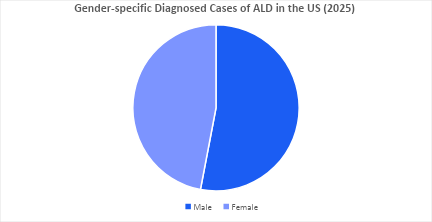
- About 1 in 20,000 males are born with ALD. Females are typically only carriers. Females may have no or very mild symptoms.
Scope of the Report
- The report covers a segment of a descriptive overview of ALD Disease, explaining its causes, signs and symptoms, and pathogenesis.
- Comprehensive insight has been provided into the epidemiology segments and forecasts, the future growth potential of the diagnosis rate, and disease progression.
Report Insights
ALD Disease Patient Population Forecast
Report Key Strengths
- Epidemiology‑based (Epi‑based) Bottom‑up Forecasting
- 11-year Forecast
- Patient Burden Trends (by geography)
FAQs
- What are the disease risks, burdens, and unmet needs of ALD disease? What will be the growth opportunities across the 7MM concerning the patient population with ALD disease?
- What is the historical and forecasted ALD Disease patient pool in the US, EU4 (Germany, France, Italy, and Spain), the UK, and Japan?
Reasons to Buy
- Insights on patient burden/disease prevalence, evolution in diagnosis, and factors contributing to the change in the epidemiology of the disease during the forecast years.
- To understand key opinion leaders’ perspectives on the diagnostic challenges to overcome barriers in the future.
- Detailed insights into various factors hampering disease diagnosis and other existing diagnostic challenges.