
Adrenoleukodystrophy Pipeline Summary
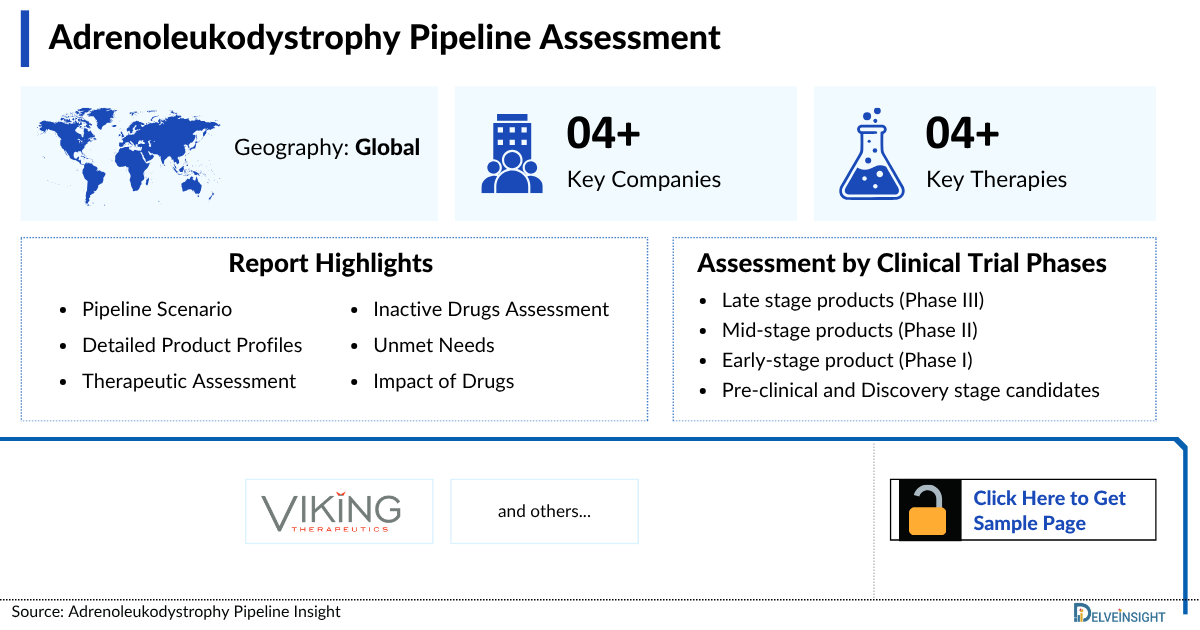
DelveInsight’s, “Adrenoleukodystrophy - Pipeline Insight, 2026” report provides comprehensive insights about 4+ companies and 4+ pipeline drugs in Adrenoleukodystrophy pipeline landscape. It covers the pipeline drug profiles, including clinical and nonclinical stage products. It also covers the therapeutics assessment by product type, stage, route of administration, and molecule type. It further highlights the inactive pipeline products in this space.
Geography Covered
- Global coverage
Adrenoleukodystrophy: Understanding
Adrenoleukodystrophy: Overview
Adrenoleukodystrophy (ALD) is a rare inherited peroxisomal disorder caused primarily by mutations in the ABCD1 gene, resulting in defective metabolism of very long-chain fatty acids (VLCFAs). The accumulation of VLCFAs in the brain, spinal cord, adrenal glands, and testes leads to progressive neurological impairment and adrenal dysfunction. ALD presents with a broad spectrum of clinical phenotypes, ranging from childhood cerebral disease to adult-onset adrenomyeloneuropathy, making early diagnosis and timely intervention essential to improve patient outcomes.
The signs and symptoms of Adrenoleukodystrophy (ALD) vary depending on the disease subtype and age of onset. Common manifestations include progressive muscle weakness and stiffness, difficulty walking, impaired balance and coordination, vision and hearing loss, cognitive or behavioral changes, and adrenal insufficiency, which can cause fatigue, weight loss, low blood pressure, and skin hyperpigmentation.
Adrenoleukodystrophy (ALD) is caused by mutations in the ABCD1 gene, which encodes the adrenoleukodystrophy protein (ALDP), a peroxisomal membrane transporter responsible for the uptake and degradation of very long-chain fatty acids (VLCFAs). Loss of ALDP function impairs peroxisomal β-oxidation, leading to the progressive accumulation of VLCFAs in the brain, spinal cord, adrenal cortex, and testes. This abnormal lipid accumulation disrupts cellular homeostasis, triggers oxidative stress and a neuroinflammatory response, and promotes progressive demyelination and axonal degeneration within the central nervous system. In addition, VLCFA deposition in the adrenal glands impairs steroid hormone production, resulting in adrenal insufficiency. The extent and distribution of tissue damage contribute to the diverse clinical phenotypes of ALD, ranging from cerebral inflammatory disease in children to the slowly progressive myelopathy observed in adults.
ALD is diagnosed through plasma very long-chain fatty acid (VLCFA) testing, ABCD1 gene mutation analysis, and brain MRI to detect cerebral involvement. Adrenal function tests, including cortisol and ACTH levels, are performed to identify associated adrenal insufficiency. Genetic confirmation helps differentiate ALD from other peroxisomal disorders, while early diagnosis enables timely monitoring and intervention to slow disease progression.
The treatment of Adrenoleukodystrophy (ALD) depends on the disease phenotype and stage of progression. Hematopoietic stem cell transplantation (HSCT) and gene therapy are effective treatment options for patients with early-stage cerebral ALD, helping to slow or halt neurological progression. Management also includes adrenal hormone replacement therapy for adrenal insufficiency, along with supportive care such as physical therapy, occupational therapy, speech therapy, and symptomatic management to improve functional outcomes and quality of life.
"Adrenoleukodystrophy- Pipeline Insight, 2026" report by DelveInsight outlays comprehensive insights of present scenario and growth prospects across the indication. A detailed picture of the Adrenoleukodystrophy pipeline landscape is provided which includes the disease overview and Adrenoleukodystrophy treatment guidelines. The assessment part of the report embraces, in depth Adrenoleukodystrophy commercial assessment and clinical assessment of the pipeline products under development. In the report, detailed description of the drug is given which includes mechanism of action of the drug, clinical studies, NDA approvals (if any), and product development activities comprising the technology, Adrenoleukodystrophy collaborations, licensing, mergers and acquisition, funding, designations and other product related details.
Report Highlights
- The companies and academics are working to assess challenges and seek opportunities that could influence Adrenoleukodystrophy R&D. The therapies under development are focused on novel approaches to treat/improve Adrenoleukodystrophy.
Adrenoleukodystrophy Emerging Drugs Chapters
This segment of the Adrenoleukodystrophy report encloses its detailed analysis of various drugs in different stages of clinical development, including phase II, I, preclinical and Discovery. It also helps to understand clinical trial details, expressive pharmacological action, agreements and collaborations, and the latest news and press releases.
Adrenoleukodystrophy Emerging Drugs
- VK0214: Viking Therapeutics
VK0214 is a novel, orally available, selective thyroid hormone receptor beta (TRβ) agonist being developed for the treatment of X-linked Adrenoleukodystrophy (X-ALD). The drug is designed to activate the TRβ receptor, which increases the expression of the ABCD2 gene encoding the adrenoleukodystrophy-related protein (ALDRP), a compensatory transporter that enhances the metabolism of very long-chain fatty acids (VLCFAs). By reducing the accumulation of toxic VLCFAs—the hallmark of X-ALD—VK0214 aims to address the underlying disease pathology, potentially slowing disease progression and preserving neurological function. Currently, the drug is in Phase I stage of its development for the treatment of Adrenoleukodystrophy.
Further product details are provided in the report……..
Adrenoleukodystrophy: Therapeutic Assessment
This segment of the report provides insights about the different Adrenoleukodystrophy drugs segregated based on following parameters that define the scope of the report, such as:
- Major Players in Adrenoleukodystrophy
There are approx. 4+ key companies which are developing the therapies Adrenoleukodystrophy. The companies which have their Adrenoleukodystrophy drug candidates in the most advanced stage, i.e. Phase I include, Viking Therapeutics, and others.
- Phases
DelveInsight’s report covers around 4+ products under different phases of clinical development like
- Late stage products (Phase III)
- Mid-stage products (Phase II)
- Early-stage product (Phase I) along with the details of
- Pre-clinical and Discovery stage candidates
- Discontinued & Inactive candidates
- Route of Administration
Adrenoleukodystrophy pipeline report provides the therapeutic assessment of the pipeline drugs by the Route of Administration. Products have been categorized under various ROAs such as
- Intra-articular
- Intraocular
- Intrathecal
- Intravenous
- Ophthalmic
- Oral
- Parenteral
- Subcutaneous
- Topical
- Transdermal
- Molecule Type
Products have been categorized under various Molecule types such as
- Oligonucleotide
- Peptide
- Small molecule
- Product Type
Drugs have been categorized under various product types like Mono, Combination and Mono/Combination.
Adrenoleukodystrophy: Pipeline Development Activities
The report provides insights into different therapeutic candidates in phase II, I, preclinical and discovery stage. It also analyses Adrenoleukodystrophy therapeutic drugs key players involved in developing key drugs.
Pipeline Development Activities
The report covers the detailed information of collaborations, acquisition and merger, licensing along with a thorough therapeutic assessment of emerging Adrenoleukodystrophy drugs.
Adrenoleukodystrophy Report Insights
- Adrenoleukodystrophy Pipeline Analysis
- Therapeutic Assessment
- Unmet Needs
- Impact of Drugs
Adrenoleukodystrophy Report Assessment
- Pipeline Product Profiles
- Therapeutic Assessment
- Pipeline Assessment
- Inactive drugs assessment
- Unmet Needs
Key Questions
Current Treatment Scenario and Emerging Therapies:
- How many companies are developing Adrenoleukodystrophy drugs?
- How many Adrenoleukodystrophy drugs are developed by each company?
- How many emerging drugs are in mid-stage, and late-stage of development for the treatment of Adrenoleukodystrophy?
- What are the key collaborations (Industry–Industry, Industry–Academia), Mergers and acquisitions, licensing activities related to the Adrenoleukodystrophy therapeutics?
- What are the recent trends, drug types and novel technologies developed to overcome the limitation of existing therapies?
- What are the clinical studies going on for Adrenoleukodystrophy and their status?
- What are the key designations that have been granted to the emerging drugs?
Key Players
- Viking Therapeutics
- Research Program
Key Products
- VK0214
- Rectify Pharma

