Ascites Epidemiology
Ascites Insights and Trends
- According to DelveInsight’s estimates, in 2025, Ascites cases were distributed across the 7MM, with the highest share observed in the United States, followed by the EU4 & UK, while Japan accounted for a comparatively smaller proportion of cases.
- Ascites is more prevalent in countries due to the high burden of chronic liver diseases, particularly cirrhosis caused by alcohol-related liver disease, viral hepatitis, and metabolic dysfunction-associated steatotic liver disease (MASLD).
- Males face a higher lifetime risk of developing ASCITES and experience a greater disease burden compared to females. This disparity is largely attributed to the higher prevalence of chronic liver diseases, alcohol-related liver injury, viral hepatitis, and other underlying risk factors among men, contributing to increased progression to decompensated cirrhosis and fluid accumulation.
- The growing global burden of chronic liver diseases, rising prevalence of cirrhosis, and increasing rates of liver decompensation are expected to sustain the Ascites market over the next decade. Improving early diagnosis and disease management, expanding access to advanced therapies, and the development of effective targeted treatments will remain key drivers of future market growth.
Ascites Epidemiology Forecast in the 7MM
- 2025 Prevalent Cases of Ascites: ~XXXX million
- Ascites Growth Rate (2026–2036): ~XX% CAGR
DelveInsight's ‘Ascites– Epidemiology Forecast – 2036’ report delivers an in-depth understanding of the Ascites, historical and forecasted epidemiology in the United States, EU4 (Germany, Spain, Italy, and France) and the United Kingdom, and Japan.
|
Study Period
|
2022–2036
|
|
Historical Year
|
2022–2025
|
|
Forecast Period
|
2026–2036
|
|
Base Year
|
2026
|
|
Geographies Covered
|
- North America : The US;
- Europe: Germany, France, Italy, and Spain and the UK;
- Asia-Pacific: Japan
|
|
Ascites Epidemiology CAGR
(Study period/Forecast period)
|
~ XX% (2026-2036)
|
|
Ascites Epidemiology Segmentation Analysis
|
Patient Burden Assesment
- Total Prevalent Cases of Ascites due to Cirrhosis
- Total Prevalent Cases of Ascites Cases by Malignancies
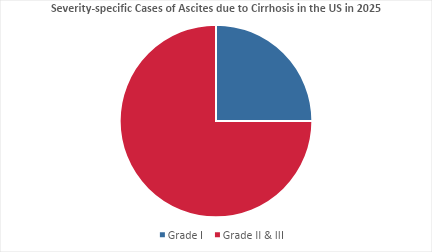
- Severity-specific Prevalent Cases of Ascites due to Cirrhosis
- Total Treated Cases of Ascites
|
Ascites Understanding and Diagnosis Algorithm
Ascites Overview
Ascites is a clinical condition characterized by the abnormal accumulation of fluid within the peritoneal cavity, most commonly resulting from underlying liver disease such as cirrhosis, portal hypertension, malignancies, heart failure, or infections. The condition develops due to imbalances in hydrostatic and oncotic pressures, along with sodium and water retention, leading to progressive fluid buildup in the abdomen. Ascites is most frequently associated with advanced chronic liver disease but can occur across a wide range of underlying systemic and intra-abdominal disorders. It primarily affects individuals with chronic hepatic conditions, alcohol-related liver injury, viral hepatitis, or malignancy, with severity influenced by the progression of the underlying disease and associated complications.
Ascites Diagnosis
Ascites is diagnosed through clinical examination supported by imaging and Ascitic fluid analysis. Key investigations include abdominal ultrasound and diagnostic paracentesis with fluid studies (SAAG, protein, cell count, and culture), along with liver and renal function tests to identify the underlying cause and guide management.
Note: Further details are provided in the report.
Ascites Epidemiology
Key Findings from Ascites Epidemiological Analysis and Forecast
- The total prevalent cases of Ascites due to cirrhosis across the 7MM is expected to increase throughout the study period (2022–2036), driven by the growing burden of chronic liver diseases, increasing rates of alcohol-related liver injury, MASLD, viral hepatitis, and improved survival of patients with advanced cirrhosis.
- Among the 7MM, the United States has the highest prevalent cases of Ascites due to cirrhosis of Ascites in 2025.
- Among the EU-4 & UK, Germany reported the highest prevalent cases of Ascites due to cirrhosis, followed by UK and France. Spain was found to have the least cases in 2025 among all European countries.
- In 2025, Malignant Ascites cases are calculated from ovarian cancer, stomach cancer, breast cancer, and colorectal cancer. Breast cancer accounted for the highest number of prevalent cases of Ascites from these cancers in the United States.
- The observed male predominance and earlier onset of Ascites highlight the importance of timely identification and management of underlying liver disease, targeted risk-reduction strategies, and early intervention to prevent disease progression and associated complications.
Scope of the Report
- The report covers a segment of an executive summary, a descriptive overview of Ascites, explaining its causes, signs and symptoms, and pathogenesis.
- Comprehensive insight has been provided into the epidemiology segments and forecasts, the future growth potential of the diagnosis rate, and disease progression.
Report Insights
Ascites Patient Population Forecast
Report Key Strengths
- Epidemiology‑based (epi‑based) Bottom‑up Forecasting
- 11-year Forecast
- Patient Burden Trends (by geography)
FAQs
- What are the disease risks, burdens, and unmet needs of Ascites? What will be the growth opportunities across the 7MM concerning the patient population with Ascites?
- What is the historical and forecasted Ascites patient pool in the US, EU4 (Germany, France, Italy, and Spain), the UK, and Japan?
Reasons to Buy
- Insights on patient burden/disease prevalence, evolution in diagnosis, and factors contributing to the change in the epidemiology of the disease during the forecast years.
- To understand key opinion leaders’ perspectives around the diagnostic challenges to overcome barriers in the future.
- Detailed insights on various factors hampering disease diagnosis and other existing diagnostic challenges.
1 Key Insights
2 Report Introduction
3 Executive Summary of Ascites
4 Epidemiology Forecast Methodology of Ascites
5 Ascites Epidemiology Overview at a Glance
5.1 Patient Share (%) Distribution by Country in 2025 in the 7MM
5.2 Patient Share (%) Distribution by Country in 2036 in the 7MM
6 Disease Background and Overview of Ascites
6.1 Introduction
6.2 Types of ascites and underlying primary diseases
6.3 Causes of Ascites
6.4 Symptoms of Ascites
6.5 Pathogenesis of Ascites
6.6 Diagnosis of Ascites
6.7 Diagnostic Guidelines of Ascites
6.7.1 British Society of Gastroenterology and the British Association for the Study of the Liver Guidelines
6.7.2 EASL Clinical Practice Guidelines for the management of patients with decompensated cirrhosis
6.7.3 American Association for the Study of Liver Diseases (AASLD) Management of Adult Patients with Ascites Due to Cirrhosis
7 Epidemiology and Patient Population of Ascites
7.1 Key Findings
7.2 Assumptions and Rationale
7.3 Total Prevalent Cases of Ascites due to Cirrhosis in the 7MM
7.4 The United States
7.4.1 Total Prevalent Cases of Ascites due to Cirrhosis in United States
7.4.2 Total Prevalent Cases of Ascites Cases by Malignancies in United States
7.4.3 Severity-specific Prevalent Cases of Ascites due to Cirrhosis in United States
7.4.4 Total Treated Cases of Ascites in United States
7.5 EU4 and the UK
7.5.1 Total Prevalent Cases of Ascites due to Cirrhosis in EU4 and the UK
7.5.2 Total Prevalent Cases of Ascites Cases by Malignancies in EU4 and the UK
7.5.3 Severity-specific Prevalent Cases of Ascites due to Cirrhosis in EU4 and the UK
7.5.4 Total Treated Cases of Ascitesin EU4 and the UK
7.6 Japan
7.6.1 Total Prevalent Cases of Ascites due to Cirrhosis in Japan
7.6.2 Total Prevalent Cases of Ascites Cases by Malignancies in Japan
7.6.3 Severity-specific Prevalent Cases of Ascites due to Cirrhosis in Japan
7.6.4 Total Treated Cases of Ascitesin Japan
8 Appendix
8.1 Bibliography
8.2 Report Methodology
9 DelveInsight Capabilities
10 Disclaimer
11 About DelveInsight
List of Tables:
List of Table
Table 1: Summary of Ascites, Epidemiology, and Key Events (2022–2036)
Table 2: Types of ascites and underlying primary diseases
Table 3: Grouping of etiology of ascites based on serum albumin ascites gradient (SAAG)
Table 4: Level of Evidence
Table 5: Grade of recommendations
Table 6: Grading system for recommendations
Table 7: Grade of Ascites and Management Strategy
Table 8: Total Cases of Ascites due to Cirrhosis in the 7MM (2022–2036)
Table 9: Number of Ascites Cases due to Cirrhosis in the United States (2022–2036)
Table 10: Number of Ascites Cases by Malignancies in the United States (2022–2036)
Table 11: Severity-specific Cases of Ascites due to Cirrhosis in the United States (2022–2036)
Table 12: Number of Ascites Cases due to Cirrhosis in Germany (2022–2036)
Table 13: Number of Ascites Cases by Malignancies in Germany (2022–2036)
Table 14: Severity-specific Cases of Ascites due to Cirrhosis in Germany (2022–2036)
Table 15: Number of Ascites Cases due to Cirrhosis in France (2022–2036)
Table 16: Number of Cases of Ascites by Malignancies in France (2022–2036)
Table 17: Severity-specific Cases of Ascites due to Cirrhosis in France (2022–2036)
Table 18: Number of Ascites Cases due to Cirrhosis in Italy (2022–2036)
Table 19: Number of Cases of Ascites by Malignancies in Italy (2022–2036)
Table 20: Severity-specific Cases of Ascites due to Cirrhosis in Italy (2022–2036)
Table 21: Number of Ascites Cases due to Cirrhosis in Spain (2022–2036)
Table 22: Number of Cases of Ascites by Malignancies in Spain (2022–2036)
Table 23: Severity-specific Cases of Ascites due to Cirrhosis in Spain (2022–2036)
Table 24: Number of Ascites Cases due to Cirrhosis in the UK (2022–2036)
Table 25: Number of Cases of Ascites by Malignancies in the United Kingdom (2022–2036)
Table 26: Severity-specific Cases of Ascites due to Cirrhosis in the United Kingdom (2022–2036)
Table 27: Number of Ascites Cases due to Cirrhosis in Japan (2022–2036)
Table 28: Number of Cases of Ascites by Malignancies in Japan (2022–2036)
Table 29: Severity-specific Cases of Ascites due to Cirrhosis in Japan (2022–2036)
List of Figures:
List of Figures
Figure 1: Ascites
Figure 2: Causes of Ascites
Figure 3: Symptoms of Ascites
Figure 4: Pathogenesis of ascites formation in the cirrhotic patient.
Figure 5: Diagnostic Approach to the patient with ascites
Figure 6: Diagnostic algorithm of ascites
Figure 7: Total Cases of Ascites due to Cirrhosis in the 7MM (2018–2030)
Figure 8: Number of Ascites Cases due to Cirrhosis in the United States (2018–2030)
Figure 9: Number of Ascites Cases by Malignancies in the United States (2018–2030)
Figure 10: Severity-specific Cases of Ascites due to Cirrhosis in the United States (2018–2030)
Figure 11: Number of Ascites Cases due to Cirrhosis in Germany (2018–2030)
Figure 12: Number of Ascites Cases By Malignancies in Germany (2018–2030)
Figure 13: Severity-specific Cases of Ascites due to Cirrhosis in Germany (2018–2030)
Figure 14: Number of Ascites Cases due to Cirrhosis in France (2018–2030)
Figure 15: Number of Cases of Ascites By Malignancies in France (2018–2030)
Figure 16: Severity-specific Cases of Ascites due to Cirrhosis in France (2018–2030)
Figure 17: Number of Ascites Cases due to Cirrhosis in Italy (2018–2030)
Figure 18: Number of Cases of Ascites by Malignancies in Italy (2018–2030)
Figure 19: Severity-specific Cases of Ascites due to Cirrhosis in Italy (2018–2030)
Figure 20: Number of Ascites Cases due to Cirrhosis in Spain (2018–2030)
Figure 21: Number of Cases of Ascites by Malignancies in Spain (2018–2030)
Figure 22: Severity-specific Cases of Ascites due to Cirrhosis in Spain (2018–2030)
Figure 23: Number of Ascites Cases due to Cirrhosis in the United Kingdom (2018–2030)
Figure 24: Number of Cases of Ascites by Malignancies in the United Kingdom (2018–2030)
Figure 25: Severity-specific Cases of Ascites due to Cirrhosis in the United Kingdom (2018–2030)
Figure 26: Number of Ascites Cases due to Cirrhosis in Japan (2018–2030)
Figure 27: Number of Cases of by Malignancies in Japan (2018–2030)
Figure 28: Severity-specific Cases of Ascites due to Cirrhosis in Japan (2018–2030)