Bradycardia Treatment Devices Market Summary
- The Bradycardia Treatment Devices market is estimated at USD 5.2 billion in 2025 and is projected to reach USD 7.7 billion by 2034. Growth is anchored in the rising prevalence of bradyarrhythmias in an aging population, the rapid adoption of leadless pacemakers, and continuous innovation in pacing technology.
- The global Bradycardia Treatment Devices market is growing at a CAGR of 4.5% during the forecast period from 2026 to 2034.
- By product, the conventional pacemakers segment dominated the Bradycardia Treatment Devices market with a 62% share in 2025.
- By type, the dual-chamber segment dominated the Bradycardia Treatment Devices market with a share of 55% in 2025.
- By end-user, the hospitals segment dominated the Bradycardia Treatment Devices market with a share of 72% in 2025.
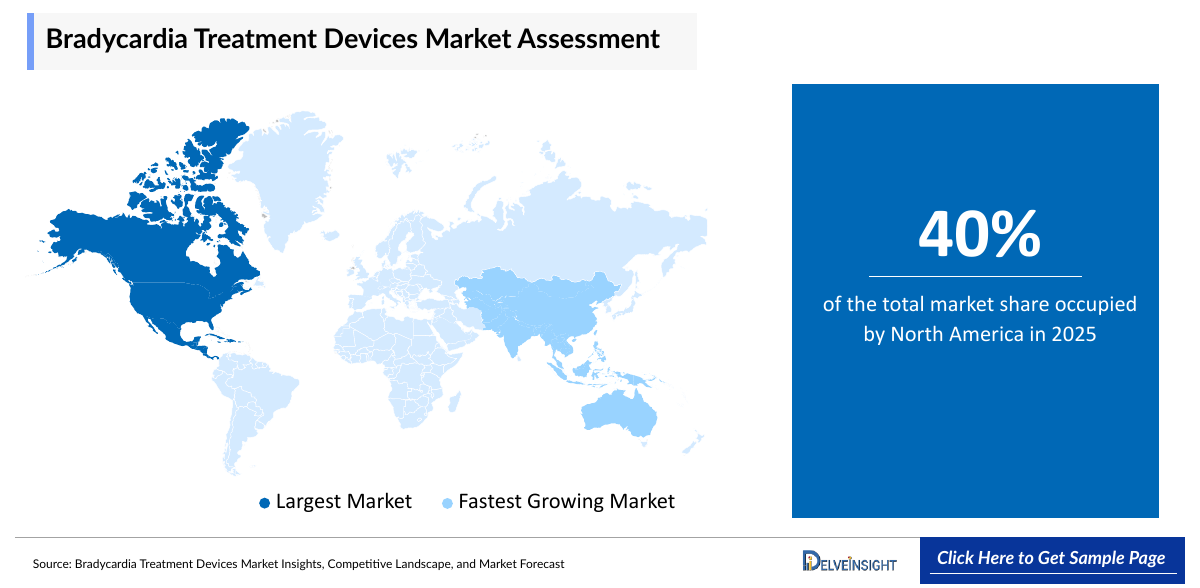
- North America dominated the global Bradycardia Treatment Devices market revenue with a share of 40% in 2025, representing the highest regional market share globally.
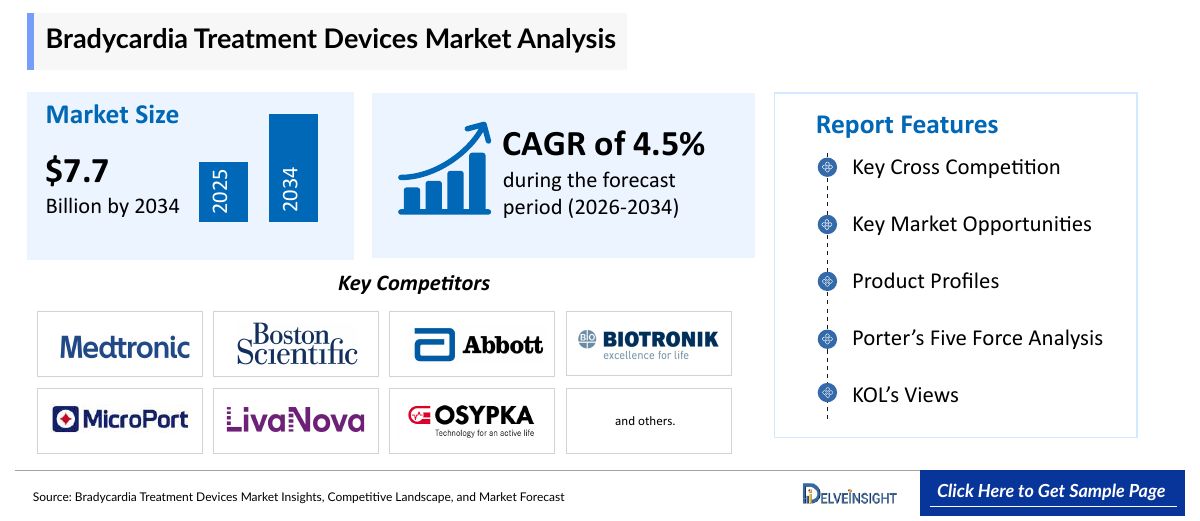
Bradycardia treatment devices are cardiac rhythm management devices used to treat bradycardia, an abnormally slow heart rate, by delivering electrical impulses to regulate the heartbeat. The category spans conventional transvenous pacemakers, including single-chamber and dual-chamber systems; leadless pacemakers implanted directly in the heart without leads or a surgical pocket; cardiac resynchronization therapy pacemakers for patients with heart failure and conduction disease; and external and temporary pacemakers used in acute and perioperative settings. These devices are supplied by leading cardiac rhythm management companies including Medtronic with its Micra leadless and conventional pacemakers, Abbott with its Aveir leadless and conventional systems, Boston Scientific, Biotronik, MicroPort, and LivaNova. Bradycardia devices treat conditions such as sinus node dysfunction, atrioventricular block, and other conduction disorders, predominantly in hospitals and cardiac centers. Over the past decade, the field has advanced with magnetic resonance-conditional systems, longer-lived batteries, remote monitoring, leadless pacing, the introduction of dual-chamber leadless systems, and conduction system pacing. Driven by the rising burden of bradyarrhythmias in an aging population and continuous technological innovation, bradycardia treatment devices remain an essential and steadily growing segment of the cardiac rhythm management market.
Bradycardia Treatment Devices Market Key Growth Drivers
- The rising prevalence of bradyarrhythmias, including sinus node dysfunction and atrioventricular block, in an aging global population is expanding demand for pacing devices.
- The rapid adoption of leadless pacemakers, including the introduction of dual-chamber leadless systems, is driving growth and premium value.
- Continuous technological advances, including magnetic resonance-conditional systems, longer battery life, remote monitoring, and conduction system pacing, are improving outcomes and adoption.
- The aging population and rising burden of cardiovascular disease are increasing the number of patients requiring pacing.
- The expansion of cardiac care infrastructure and electrophysiology capacity is increasing the number of implant procedures.
- Expanding healthcare access and cardiac device adoption in emerging markets are broadening the global demand for bradycardia treatment devices.
- The convergence of rising bradyarrhythmia prevalence, leadless adoption, and pacing innovation is expected to sustain steady growth in the global Bradycardia Treatment Devices market through 2034.
Key Companies in Bradycardia Treatment Devices Market
The competitive landscape is led by the following active developers and manufacturers of bradycardia treatment devices:
- Medtronic plc
- Abbott Laboratories
- Boston Scientific Corporation
- BIOTRONIK SE & Co. KG
- MicroPort Scientific Corporation
- LivaNova PLC
- Osypka Medical GmbH
- Lepu Medical Technology Co., Ltd.
- Pacetronix Ltd.
- Oscor Inc.
For illustrative purposes, only the top 10 companies are listed in the Table of Contents. The report may include analysis and references to additional companies relevant to the market assessment.
Bradycardia Treatment Devices Market Size
The following snapshot summarizes the principal report metrics for the Bradycardia Treatment Devices market.
|
Report Metrics |
Details |
|
2025 Market Size |
USD 5.2 billion |
|
2034 Projected Market Size |
USD 7.7 billion |
|
Growth Rate (2026-2034) |
4.5% CAGR |
|
Largest Market |
North America |
|
Fastest Growing Market |
Asia-Pacific |
|
Market Structure |
Consolidated |
All market values are expressed in USD and represent DelveInsight estimates synthesized from primary and secondary research.
Factors Contributing to the Growth of the Bradycardia Treatment Devices Market
Market Drivers
Rising Prevalence of Bradyarrhythmias
The rising prevalence of bradyarrhythmias is the foundational driver of the bradycardia treatment devices market. Bradycardia, including sinus node dysfunction and atrioventricular block, becomes increasingly common with age as the heart's conduction system degenerates, and the large and growing elderly population worldwide expands the pool of patients requiring pacing. Pacemakers are the standard and definitive treatment for symptomatic bradycardia, and the number of patients diagnosed with conduction disorders continues to rise with aging, improved detection, and the growing use of cardiac monitoring. Each patient requiring treatment receives an implantable pacing device, generating sustained demand, and device replacements at the end of battery life add recurring demand. As the prevalence of bradyarrhythmias continues to rise with population aging, demand for bradycardia treatment devices continues to grow, reinforcing sustained market growth throughout the forecast period.
Rapid Adoption of Leadless Pacemakers
The rapid adoption of leadless pacemakers is a defining driver of the bradycardia treatment devices market. Leadless pacemakers, implanted directly in the heart without transvenous leads or a surgical pocket, reduce lead- and pocket-related complications such as infection and lead failure, and have grown rapidly since the introduction of Medtronic's Micra. The introduction of dual-chamber leadless pacing, including Abbott's Aveir dual-chamber system and Medtronic's Micra AV, has expanded leadless pacing to a much larger share of patients who require atrioventricular synchrony, substantially enlarging the addressable population. Leadless pacemakers command premium value and are a key growth and innovation area. As leadless pacing continues to expand, particularly with dual-chamber systems, its adoption is expected to be a leading driver of market growth across the forecast period.
Technological Advancement in Pacing
Continuous technological innovation in pacing is improving outcomes and driving market growth. Magnetic resonance-conditional pacemakers allow patients to safely undergo magnetic resonance imaging, longer-lived batteries extend device longevity and reduce replacements, and remote monitoring enables continuous follow-up and earlier detection of issues. Conduction system pacing, including His-bundle and left bundle branch area pacing, offers more physiological pacing and is a growing approach, and improvements in device size, programming, and automation enhance performance. Leadless and dual-chamber leadless systems represent major innovations. These advances improve safety, convenience, and outcomes, and differentiate products, supporting adoption and premium pricing. As pacing technology continues to advance across leadless systems, conduction system pacing, imaging compatibility, and monitoring, technological innovation is expected to be a significant driver of market growth across the forecast period.
Aging Population and Rising Cardiovascular Disease Burden
The aging global population and rising burden of cardiovascular disease are powerful drivers of bradycardia device demand. Older adults carry a substantially higher prevalence of conduction disorders requiring pacing, and the number of people aged 60 and older is rising rapidly worldwide, directly expanding the population requiring pacemakers. The rising burden of cardiovascular disease, including conditions and procedures that can affect the conduction system, further increases demand, and the growing number of patients undergoing procedures such as transcatheter aortic valve replacement, which can necessitate pacing, adds demand. The chronic need for pacing and device replacements generates sustained demand. As populations age and cardiovascular disease burden grows, demographic and epidemiological trends are expected to be a significant driver of bradycardia device demand across the forecast period.
Expansion of Cardiac Care and Electrophysiology Capacity
The expansion of cardiac care infrastructure and electrophysiology capacity is a substantial driver of bradycardia device demand. The growth of cardiology and electrophysiology services, catheterization and implantation facilities, and trained implanting physicians increases the capacity to diagnose and treat bradyarrhythmias and perform pacemaker implantation. Improving detection of conduction disorders through cardiac monitoring and growing awareness increase the number of patients identified and treated. As health systems invest in cardiac care infrastructure and electrophysiology capacity, more patients receive pacing therapy. As cardiac care and electrophysiology capacity continue to expand globally, this growth is expected to be an important driver of bradycardia device demand across the forecast period.
Expanding Healthcare Access and Adoption in Emerging Markets
Expanding healthcare access and cardiac device adoption, particularly in emerging markets, is opening significant growth opportunities. Rising incomes, growing insurance coverage, and investment in cardiac care capacity across Asia-Pacific, Latin America, the Middle East, and Africa are increasing access to pacemakers, and many emerging markets have low pacemaker implantation rates relative to developed countries, creating substantial room for growth. The rising burden of cardiovascular disease and aging populations in these regions, together with growing awareness and diagnosis, broaden demand, and lower-cost devices and local manufacturers expand access. Both multinational and regional manufacturers are expanding their presence. Government investment in cardiac care further supports growth. As healthcare access expands and cardiac device adoption grows in emerging economies, this expansion is expected to be an important driver of bradycardia device market growth across the forecast period.
Market Restraints
Despite steady momentum, the Bradycardia Treatment Devices market faces material constraints. The market is mature in developed regions, where high pacemaker penetration limits growth to replacements, demographic growth, and technology upgrades, resulting in modest overall growth rates. The high cost of pacing devices and implantation procedures, together with the need for specialized electrophysiology infrastructure and trained implanting physicians, limits adoption, particularly in resource-limited settings. Reimbursement and cost-containment pressures can constrain device pricing and adoption, and pricing pressure affects established conventional pacemakers. Procedural and device-related risks, including infection, lead complications in conventional systems, and complications of implantation, require careful management, although leadless systems mitigate some of these risks. A shortage of trained electrophysiologists and limited access to implantation facilities constrain capacity in some regions. Rigorous and evolving regulatory requirements for implantable cardiac devices, including Food and Drug Administration pathways and the European Medical Device Regulation, add cost and complexity. Finally, uneven cardiac care infrastructure and affordability constraints in emerging markets can restrict adoption across parts of the forecast period, even as these markets offer the greatest growth potential.
Bradycardia Treatment Devices Market Segment Analysis
The Bradycardia Treatment Devices Market is segmented by product (conventional pacemakers, leadless pacemakers, cardiac resynchronization therapy pacemakers, external and temporary pacemakers), type (dual-chamber, single-chamber, biventricular), end-user (hospitals, ambulatory surgical centers and cardiac centers, others), and geography (North America, Europe, Asia-Pacific, Rest of World).
By Product
Dominant Subsegment: Conventional Pacemakers.
The conventional pacemakers segment accounted for 62% of the Bradycardia Treatment Devices market in 2025. Conventional transvenous pacemakers dominate because they remain the established standard of care for the majority of patients requiring pacing, comprising single-chamber and dual-chamber systems that are widely implanted worldwide and offered by all major manufacturers, including Medtronic, Abbott, Boston Scientific, and Biotronik. Their long track record, broad clinical applicability, dual-chamber capability, and established implantation practice drive the largest share of the market. Leadless pacemakers are the fastest-growing segment, reducing lead- and pocket-related complications, and the introduction of dual-chamber leadless systems such as Abbott's Aveir dual-chamber and Medtronic's Micra AV has substantially expanded the addressable leadless population and accelerated growth. Cardiac resynchronization therapy pacemakers serve patients with heart failure and conduction disease, and external and temporary pacemakers serve acute and perioperative settings. Nonetheless, the established standard-of-care position, broad applicability, and large installed base of conventional pacemakers secure the leadership of this segment across the forecast period, with leadless pacemakers growing most rapidly.
By Type
Dominant Subsegment: Dual-Chamber.
The dual-chamber segment accounted for 55% of the Bradycardia Treatment Devices market in 2025. Dual-chamber pacemakers dominate because they pace and sense in both the atrium and ventricle, providing atrioventricular synchrony that more closely mimics natural heart function and is preferred for the majority of patients, particularly those with atrioventricular block and intact or recoverable atrial function. Dual-chamber systems are the most commonly implanted pacemaker type in developed markets, driving the largest share, and the extension of dual-chamber capability to leadless systems further supports the segment. Single-chamber pacemakers, which pace a single chamber, remain important for specific indications such as permanent atrial fibrillation with slow ventricular response and in cost-sensitive settings, and early leadless systems were single-chamber. Biventricular pacemakers, used in cardiac resynchronization therapy for heart failure with conduction disease, represent a distinct and important segment. Nonetheless, the physiological benefit, clinical preference, and broad use of dual-chamber pacing, now extended to leadless systems, secure the leadership of the dual-chamber segment across the forecast period.
By End-User
Dominant Subsegment: Hospitals.
The hospitals segment accounted for 72% of the Bradycardia Treatment Devices market in 2025. Hospitals dominate because pacemaker implantation is a specialized cardiac procedure performed in catheterization laboratories and electrophysiology suites by trained implanting physicians, requiring the imaging, procedural, and monitoring infrastructure concentrated in hospitals. The majority of pacemaker implantations, including complex and leadless procedures, and the management of acute bradycardia with temporary pacing, occur in hospitals, driving the largest share of device use. Hospitals are the primary purchasers of pacing devices and house the electrophysiology programs central to bradycardia treatment. Ambulatory surgical centers and cardiac centers represent a smaller but growing end user as selected pacemaker implantations shift to outpatient and specialized settings, benefiting from efficiency, and other settings add limited demand. The concentration of implantation infrastructure and expertise in hospitals is structural. Nonetheless, the concentration of pacemaker implantation and acute bradycardia management in hospitals secures the leadership of the hospitals segment across the forecast period, with ambulatory and cardiac centers growing modestly.
Bradycardia Treatment Devices Market Region Analysis
North America accounted for 40% of the global Bradycardia Treatment Devices market revenue in 2025, representing the highest regional market share globally. The region's dominance reflects advanced cardiac care infrastructure, high pacemaker implantation rates, rapid adoption of leadless and advanced pacing technologies, strong reimbursement, and the presence of leading manufacturers. The United States leads on the strength of an extensive electrophysiology and cardiac care network, high implantation volumes, early and broad adoption of leadless and dual-chamber leadless pacemakers and conduction system pacing, and the presence of major players including Medtronic, Abbott, and Boston Scientific. Disease burden is substantial, with a large aging population and high prevalence of conduction disorders and cardiovascular disease. The regulatory environment is well established, with the Food and Drug Administration providing pathways and a track record of approving advanced pacing devices, including leadless and dual-chamber leadless systems. Reimbursement supports pacemaker implantation. This combination of infrastructure, adoption, and manufacturer presence reinforces North America's leadership in the global market.
Fastest Growing Region: Asia-Pacific
Asia-Pacific is the fastest-growing region in the Bradycardia Treatment Devices market. The region's elevated CAGR is driven by large and rapidly aging populations, a rising burden of cardiovascular and conduction disease, expanding cardiac care capacity, and growing healthcare investment across China, Japan, India, South Korea, and Southeast Asia. Many countries in the region have low pacemaker implantation rates relative to developed markets, creating substantial room for growth as electrophysiology capacity and access expand. Rising incomes, expanding insurance coverage, and growing healthcare investment are improving access to pacing therapy, and domestic manufacturers, particularly in China, are expanding pacemaker offerings and lowering costs. Rising detection and diagnosis of bradyarrhythmias further increase demand. Both multinational and regional manufacturers are expanding their presence. The combination of large aging populations, rising disease burden, low implantation rates, and expanding capacity positions Asia-Pacific as the highest-growth region over the forecast period.
Regional Commentary
North America
North America accounted for 40% of the global Bradycardia Treatment Devices market revenue in 2025. The United States dominates the region on the strength of advanced cardiac care infrastructure, high implantation rates, rapid adoption of leadless and advanced pacing, and the presence of leading manufacturers, while Canada contributes through its cardiac care system and Mexico expands access within its growing healthcare sector.
Europe
Europe represents the second-largest regional market, led by Germany, France, and the United Kingdom. Growth is supported by established electrophysiology infrastructure, high implantation rates, and the presence of major manufacturers such as Biotronik and LivaNova, while the European Medical Device Regulation shapes product requirements and market access across the region.
Asia-Pacific
Asia-Pacific is the fastest-growing region, propelled by large and rapidly aging populations, a rising burden of conduction and cardiovascular disease, low pacemaker implantation rates, and expanding cardiac care capacity across China, Japan, India, South Korea, and Southeast Asia. Expanding domestic manufacturing and growing access are broadening adoption.
Rest of World
The Rest of World region, spanning the Middle East, Africa, and South America, is an emerging growth frontier. A rising burden of cardiovascular and conduction disease, improving cardiac care infrastructure, and expanding access to pacing therapy are broadening adoption from a low base, while investment in cardiac care supports growth.
Bradycardia Treatment Devices Market Competitive Landscape
The Bradycardia Treatment Devices market is classified as Consolidated. A small group of large cardiac rhythm management companies holds the overwhelming majority of revenue, led by Medtronic, Abbott, and Boston Scientific, with Biotronik and MicroPort holding significant positions, while LivaNova, Osypka Medical, and regional manufacturers such as Lepu Medical, Pacetronix, and Oscor compete across the market, particularly in temporary pacing and emerging markets.
The competitive landscape can be evaluated across the following dimensions:
- Market concentration: Consolidated, with the overwhelming majority of revenue held by a few large cardiac rhythm management companies alongside specialized and regional players.
- Leading players: Medtronic, Abbott, and Boston Scientific anchor the top tier, with Biotronik and MicroPort holding significant positions and LivaNova, Osypka, Lepu, Pacetronix, and Oscor in specialized and regional segments.
- Geographic reach: Leaders operate global commercial and manufacturing networks, with strong positions across North America, Europe, and Asia-Pacific.
- Product portfolio strength: Top players hold broad portfolios spanning conventional single- and dual-chamber pacemakers, leadless and dual-chamber leadless systems, cardiac resynchronization therapy, and monitoring.
- Pipeline strength: Deep pipelines in leadless and dual-chamber leadless pacing, conduction system pacing, extended battery life, and remote monitoring.
- Strategic partnerships: Collaborations with electrophysiology programs and clinical research networks shape the competitive landscape.
- M&A activity: Consolidation and acquisitions continue, including acquisitions of leadless and novel pacing technology companies.
- Manufacturing capabilities: Specialized implantable device manufacturing and quality systems are key competitive strengths and barriers to entry.
- Innovation focus: Leadless and dual-chamber leadless pacing, conduction system pacing, magnetic resonance compatibility, extended longevity, and remote monitoring.
Bradycardia Treatment Devices Market Recent Developmental Activities
In 2023, Abbott received FDA approval for the Aveir dual-chamber leadless pacemaker, the first dual-chamber leadless pacing system. Strategic significance: Expands leadless pacing to patients requiring atrioventricular synchrony and substantially enlarges the addressable leadless market.
In 2023 and 2024, Medtronic advanced its Micra leadless pacemaker portfolio, including the Micra AV2 and VR2 with extended battery life. Strategic significance: Strengthens Medtronic's leadless leadership and improves device longevity.
In 2023 and 2024, Abbott expanded its Aveir leadless platform, including single-chamber and dual-chamber systems. Strategic significance: Advances Abbott's leadless position and competition in dual-chamber leadless pacing.
In 2023 and 2024, conduction system pacing, including left bundle branch area pacing, expanded across manufacturers as a more physiological pacing approach. Strategic significance: Advances physiological pacing and expands the clinical approach to bradycardia treatment.
In 2023 and 2024, Boston Scientific and Biotronik expanded their pacemaker portfolios, including magnetic resonance-conditional and remote monitoring-enabled systems. Strategic significance: Strengthens competition and advances imaging compatibility and connectivity.
In 2023 and 2024, remote monitoring and connectivity expanded across pacing devices to enable continuous follow-up. Strategic significance: Improves patient management and earlier detection of device and rhythm issues.
In 2023 and 2024, the growing use of procedures such as transcatheter aortic valve replacement, which can necessitate pacing, contributed to pacemaker demand. Strategic significance: Adds a source of pacing demand linked to structural heart procedure growth.
In 2023 and 2024, MicroPort and other manufacturers expanded pacemaker offerings, including in emerging markets. Strategic significance: Broadens access and intensifies competition, particularly in Asia-Pacific.
In 2023 and 2024, extended-longevity batteries and smaller device designs advanced across manufacturers. Strategic significance: Reduces replacement frequency and improves patient experience.
In 2023 and 2024, wireless and novel pacing technologies, including wireless cardiac pacing approaches, advanced in development and early use. Strategic significance: Points toward future innovation in pacing beyond conventional and leadless systems.
In 2023 and 2024, regional manufacturers expanded lower-cost pacemaker offerings to broaden access in emerging markets. Strategic significance: Expands access in high-growth, underpenetrated regions.
In 2023 and 2024, the European Medical Device Regulation continued to reshape requirements and market access for implantable cardiac devices in Europe. Strategic significance: Raises compliance requirements and influences portfolio and market-entry strategies.
Bradycardia Treatment Devices Market Segmentation
Bradycardia Treatment Devices Market by Product
- Conventional Pacemakers
- Leadless Pacemakers
- Cardiac Resynchronization Therapy Pacemakers
- External and Temporary Pacemakers
Bradycardia Treatment Devices Market by Type
- Dual-Chamber
- Single-Chamber
- Biventricular
Bradycardia Treatment Devices Market by End-User
- Hospitals
- Ambulatory Surgical Centers and Cardiac Centers
- Others
Bradycardia Treatment Devices Market by Geography
- North America Bradycardia Treatment Devices Market
- United States Bradycardia Treatment Devices Market Size in USD million (2023-2034)
- Canada Bradycardia Treatment Devices Market Size in USD million (2023-2034)
- Mexico Bradycardia Treatment Devices Market Size in USD million (2023-2034)
- Europe Bradycardia Treatment Devices Market
- Germany Bradycardia Treatment Devices Market Size in USD million (2023-2034)
- United Kingdom Bradycardia Treatment Devices Market Size in USD million (2023-2034)
- France Bradycardia Treatment Devices Market Size in USD million (2023-2034)
- Italy Bradycardia Treatment Devices Market Size in USD million (2023-2034)
- Spain Bradycardia Treatment Devices Market Size in USD million (2023-2034)
- Rest of Europe Bradycardia Treatment Devices Market Size in USD million (2023-2034)
- Asia-Pacific Bradycardia Treatment Devices Market
- China Bradycardia Treatment Devices Market Size in USD million (2023-2034)
- Japan Bradycardia Treatment Devices Market Size in USD million (2023-2034)
- India Bradycardia Treatment Devices Market Size in USD million (2023-2034)
- Australia Bradycardia Treatment Devices Market Size in USD million (2023-2034)
- South Korea Bradycardia Treatment Devices Market Size in USD million (2023-2034)
- Rest of Asia-Pacific Bradycardia Treatment Devices Market Size in USD million (2023-2034)
- Rest of the World (RoW) Bradycardia Treatment Devices Market
- Middle East Bradycardia Treatment Devices Market Size in USD million (2023-2034)
- Africa Bradycardia Treatment Devices Market Size in USD million (2023-2034)
- South America Bradycardia Treatment Devices Market Size in USD million (2023-2034)
Bradycardia Treatment Devices Market Recent Industry Trends and Milestones (2023-2026)
|
Category |
Key Developments |
|
Bradycardia Treatment Devices Market Product Approval |
Abbott received FDA approval for the Aveir dual-chamber leadless pacemaker, the first of its kind (2023); Medtronic advanced Micra AV2 and VR2; manufacturers secured approvals for MRI-conditional and remote monitoring-enabled pacemakers; the European Medical Device Regulation continued to shape requirements. |
|
Bradycardia Treatment Devices Market Product Expansion |
Medtronic and Abbott expanded leadless and dual-chamber leadless portfolios; Boston Scientific and Biotronik expanded conventional and MRI-conditional pacemakers; conduction system pacing expanded; MicroPort and regional manufacturers expanded offerings in emerging markets. |
|
Bradycardia Treatment Devices Market Product Investment |
Companies invested in leadless and dual-chamber leadless pacing, conduction system pacing, extended-longevity batteries, and remote monitoring; acquisitions of novel pacing technologies continued; regional manufacturers invested in lower-cost devices. |
|
Bradycardia Treatment Devices Market Company Strategy |
Medtronic plc and Abbott Laboratories: Leadless and dual-chamber leadless leadership. Boston Scientific Corporation and BIOTRONIK SE & Co. KG: Conventional, MRI-conditional, and connected pacemakers. MicroPort Scientific Corporation, LivaNova PLC, Osypka Medical GmbH, Lepu Medical, Pacetronix, and Oscor: Conventional, temporary, and regional pacing devices. |
|
Bradycardia Treatment Devices Market Emerging Technologies |
Leadless and dual-chamber leadless pacemakers; conduction system pacing including left bundle branch area pacing; magnetic resonance-conditional systems; extended-longevity batteries; remote monitoring and connectivity; and emerging wireless and novel pacing approaches. |
Bradycardia Treatment Devices Market Startup Funding and Investment Trends
Investment in the cardiac pacing ecosystem has concentrated on novel and wireless pacing technologies and next-generation leadless and conduction system approaches. The following companies illustrate recent activity and technology focus.
|
Company |
Total Funding |
Funding Stage |
Main Product |
Core Technology |
|
EBR Systems, Inc. |
Public and venture funding |
Public / growth-stage |
WiSE wireless cardiac pacing system |
Wireless, leadless endocardial pacing technology |
|
Pacertool AS |
Venture funding |
Early to growth-stage venture |
Pacing lead placement and diagnostic technology |
Technology to optimize pacing site selection and delivery |
|
Request for unlocking the report of the @ Bradycardia Treatment Devices Market | ||||
EBR Systems is developing wireless, leadless cardiac pacing technology, including for applications in cardiac resynchronization, while Pacertool develops technology to optimize pacing site selection and lead placement. Additional capital continues to flow toward wireless and leadless pacing, conduction system pacing, and next-generation device technologies, reflecting conviction that less invasive, more physiological, and more durable pacing is the next source of competitive advantage. Collectively, these efforts signal sustained investment in improving the safety, convenience, and outcomes of bradycardia treatment and in advancing the pacing field beyond conventional systems.
Key Takeaways from the Bradycardia Treatment Devices Market Report Study
- Market size analysis for the current bradycardia treatment devices market size (2025), and market forecast for 9 years (2026 to 2034).
- Top key product/technology developments, mergers, acquisitions, partnerships, and joint ventures that happened over the last 3 years.
- Key companies dominating the global bradycardia treatment devices market.
- Various opportunities available for competitors in the bradycardia treatment devices market space.
- What are the top-performing segments in 2025? How will these segments perform in 2034?
- Which are the top-performing regions and countries in the current bradycardia treatment devices market scenario?
- Which are the regions and countries where companies should concentrate their opportunities for bradycardia treatment devices market growth in the future?
Target audience who can benefit from this bradycardia treatment devices market report study
- Bradycardia Treatment Devices product providers
- Research organizations and consulting companies
- Bradycardia Treatment Devices-related organizations, associations, forums, and other alliances
- Government and corporate offices
- Start-up companies, venture capitalists, and private equity firms
- Distributors and traders dealing in bradycardia treatment devices
- Various end-users who want to know more about the bradycardia treatment devices market and the latest technological developments in the bradycardia treatment devices market