Congenital Ichthyosis Pipeline
DelveInsight’s, “Congenital Ichthyosis Pipeline Insight, 2026” report provides comprehensive insights about 4+ companies and 4+ pipeline drugs in Congenital Ichthyosis pipeline landscape. It covers the pipeline drug profiles, including clinical and nonclinical stage products. It also covers the therapeutics assessment by product type, stage, route of administration, and molecule type. It further highlights the inactive pipeline products in this space.
Geography Covered
- Global coverage
Congenital Ichthyosis Understanding
Congenital Ichthyosis Overview
Congenital ichthyosis is a group of rare inherited skin disorders present at birth or appearing shortly thereafter. These disorders are characterized by generalized dry, thickened, scaly skin resulting from abnormal keratinization (the process by which skin cells mature and form the protective outer layer of the skin). The severity varies widely, ranging from mild scaling to severe forms such as harlequin ichthyosis, which can be life-threatening in newborns. Major forms include lamellar ichthyosis, congenital ichthyosiform erythroderma, and harlequin ichthyosis.
Congenital ichthyosis is primarily caused by inherited genetic mutations affecting proteins involved in skin barrier formation, lipid transport, and epidermal differentiation. Multiple genes have been implicated, including ABCA12, TGM1, ALOX12B, ALOXE3, CYP4F22, NIPAL4, and others. These mutations disrupt normal skin development and desquamation (shedding of skin cells). Most forms are inherited in an autosomal recessive manner, although some subtypes follow autosomal dominant or X-linked inheritance patterns. The underlying pathophysiology involves defects in the epidermal barrier, particularly within the stratum corneum and stratum granulosum. Genetic mutations impair lipid transport, keratinocyte differentiation, or formation of the cornified envelope, leading to abnormal skin-cell maturation and shedding. As a result, skin cells accumulate on the surface rather than being shed normally, producing thick scales and hyperkeratosis. The impaired skin barrier also causes excessive transepidermal water loss, dehydration, increased susceptibility to infections, inflammation, and difficulties with temperature regulation.
Diagnosis is based on clinical evaluation, family history, and genetic testing. Newborns may present with a collodion membrane, generalized scaling, erythroderma, or the characteristic appearance of harlequin ichthyosis. Dermatologic examination assesses the pattern and severity of scaling, erythema, ectropion, and other associated features. Molecular genetic testing, including multigene panels, exome sequencing, or genome sequencing, is considered the preferred method for confirming the diagnosis and identifying the specific subtype, which helps guide prognosis and genetic counseling.
There is currently no cure for congenital ichthyosis; treatment focuses on lifelong symptom management and skin-barrier maintenance. Standard therapy includes frequent use of emollients and moisturizers, keratolytic agents (such as urea or lactic acid preparations), gentle skin care, and prevention of dehydration and infections. Severe cases may require systemic retinoids to reduce hyperkeratosis. Newborns with severe disease often need specialized neonatal care to manage fluid loss, temperature instability, and infection risk. Emerging therapies under investigation include biologic agents, enzyme replacement approaches, and gene-based treatments targeting the underlying molecular defects.
"Congenital Ichthyosis Pipeline Insight, 2026" report by DelveInsight outlays comprehensive insights of present scenario and growth prospects across the indication. A detailed picture of the Congenital Ichthyosis pipeline landscape is provided which includes the disease overview and Congenital Ichthyosis treatment guidelines. The assessment part of the report embraces, in depth Congenital Ichthyosis commercial assessment and clinical assessment of the pipeline products under development. In the report, detailed description of the drug is given which includes mechanism of action of the drug, clinical studies, NDA approvals (if any), and product development activities comprising the technology, Congenital Ichthyosis collaborations, licensing, mergers and acquisition, funding, designations and other product related details.
Congenital Ichthyosis Pipeline Report Highlights
The Congenital Ichthyosis companies and academics are working to assess challenges and seek opportunities that could influence Congenital Ichthyosis R&D. The therapies under development are focused on novel approaches to treat/improve Congenital Ichthyosis.
Congenital Ichthyosis Emerging Drugs Analysis
This segment of the Congenital Ichthyosis report encloses its detailed analysis of various drugs in different stages of clinical development, including phase II, I, preclinical and Discovery. It also helps to understand clinical trial details, expressive pharmacological action, agreements and collaborations, and the latest news and press releases.
Congenital Ichthyosis Emerging Drugs
QRX003: Quoin Pharmaceuticals
QRX003 is an investigational topical lotion containing a broad-spectrum serine protease inhibitor formulated with Quoin’s proprietary delivery technology. The drug is being developed primarily for Netherton Syndrome, a rare genetic form of congenital ichthyosis caused by mutations in the SPINK5 gene. the mechanism of action of QRX003 is to replace the function of the missing LEKTI (Lympho-Epithelial Kazal-Type Related Inhibitor) protein. In Netherton Syndrome, the absence of LEKTI results in excessive protease activity, abnormal skin shedding, and a severely compromised skin barrier. QRX003 is designed to normalize skin shedding and restore skin-barrier integrity by inhibiting these proteases. QRX003 has received multiple designations for Netherton Syndrome, including Orphan Drug Designation (FDA, U.S.), Orphan Drug Designation (EMA, Europe), Rare Pediatric Disease Designation (FDA), Fast Track Designation (FDA), and Orphan Drug Designation from Japan’s MHLW. Currently, the drug is being evaluated in the Phase II/III stage of its development for the treatment of Netherton Syndrome which is a type of Congenital Ichthyosis.
Further product details are provided in the report……..
Congenital Ichthyosis Drug Therapeutic Assessment
This segment of the report provides insights about the different Congenital Ichthyosis drugs segregated based on following parameters that define the scope of the report, such as:
Major Congenital Ichthyosis Players in Congenital Ichthyosis
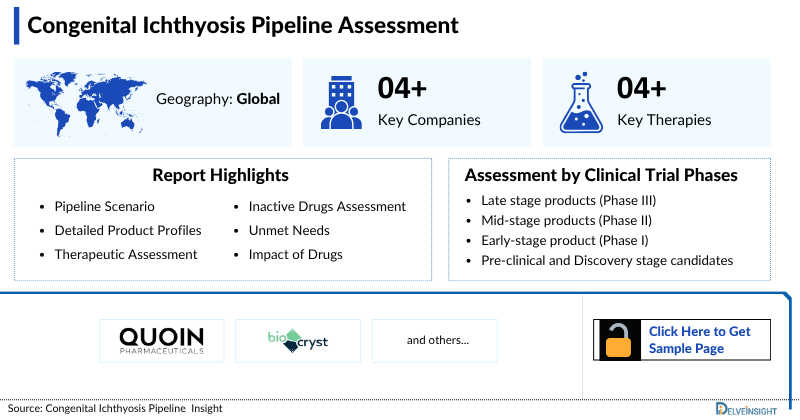
There are approx. 4+ key companies which are developing the therapies Congenital Ichthyosis. The companies which have their Congenital Ichthyosis drug candidates in the most advanced stage, i.e. Phase II/III include, Quoin Pharmaceuticals, and others.
Congenital Ichthyosis Clinical Trial Phases
DelveInsight’s report covers around 4+ products under different phases of clinical development like
- Late stage products (Phase III)
- Mid-stage products (Phase II)
- Early-stage product (Phase I) along with the details of
- Pre-clinical and Discovery stage candidates
- Discontinued & Inactive candidates
Congenital Ichthyosis Drug Route of Administration
Congenital Ichthyosis pipeline report provides the therapeutic assessment of the pipeline drugs by the Route of Administration. Products have been categorized under various ROAs such as
- Intra-articular
- Intraocular
- Intrathecal
- Intravenous
- Ophthalmic
- Oral
- Parenteral
- Subcutaneous
- Topical
- Transdermal
Congenital Ichthyosis Product Molecule Type
Products have been categorized under various Molecule types such as
- Oligonucleotide
- Peptide
- Small molecule
Congenital Ichthyosis Product Type
Drugs have been categorized under various product types like Mono, Combination and Mono/Combination.
Congenital Ichthyosis Clinical Trial Activities
The Congenital Ichthyosis pipeline report provides insights into different Congenital Ichthyosis clinical trials within phase II, I, preclinical and discovery stage. It also analyses Congenital Ichthyosis therapeutic drugs key players involved in developing key drugs.
Congenital Ichthyosis Pipeline Development Activities
The Congenital Ichthyosis clinical Trial analysis report covers the detailed information of collaborations, acquisition and merger, licensing along with a thorough therapeutic assessment of emerging Congenital Ichthyosis drugs.
Congenital Ichthyosis Pipeline Report Insights
- Congenital Ichthyosis Pipeline Analysis
- Congenital Ichthyosis Therapeutic Assessment
- Congenital Ichthyosis Unmet Needs
- Impact of Congenital Ichthyosis Drugs
Congenital Ichthyosis Pipeline Report Assessment
- Congenital Ichthyosis Pipeline Product Profiles
- Congenital Ichthyosis Therapeutic Assessment
- Congenital Ichthyosis Pipeline Assessment
- Congenital Ichthyosis Inactive drugs assessment
- Congenital Ichthyosis Market Unmet Needs
Key Questions Answered In The Congenital Ichthyosis Pipeline Report:
- Current Treatment Scenario and Emerging Therapies:
- How many companies are developing Congenital Ichthyosis drugs?
- How many Congenital Ichthyosis drugs are developed by each company?
- How many emerging drugs are in mid-stage, and late-stage of development for the treatment of Congenital Ichthyosis?
- What are the key collaborations (Industry–Industry, Industry–Academia), Mergers and acquisitions, licensing activities related to the Congenital Ichthyosis therapeutics?
- What are the recent trends, drug types and novel technologies developed to overcome the limitation of existing therapies?
- What are the clinical studies going on for Congenital Ichthyosis and their status?
- What are the key designations that have been granted to the emerging drugs?
Congenital Ichthyosis Key Players
- Quoin Pharmaceuticals
- BioCryst Pharmaceuticals
Congenital Ichthyosis Key Products
- QRX003
- BCX-17725