
Dental Implants and Prosthesis Market Summary
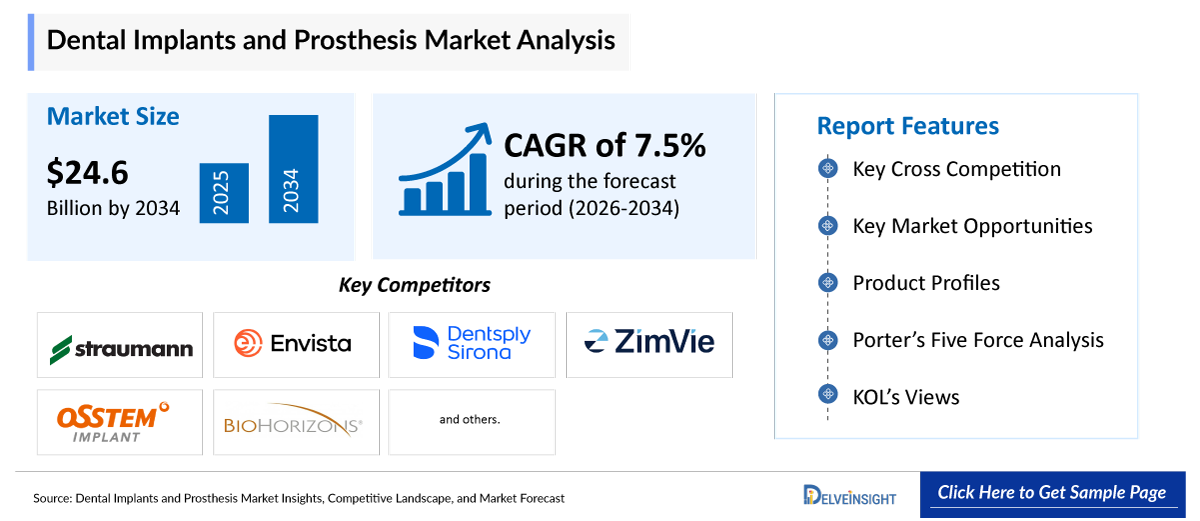
• The global dental implants and prosthesis market was valued at USD 12.8 billion in 2025 and is projected to reach USD 24.6 billion by 2034.
• The market is expected to expand at a CAGR of 7.5% during the forecast period 2026-2034, supported by the rising global prevalence of dental caries, periodontal disease, and edentulism, the aging global population, expanding clinical evidence and regulatory clearance for zygomatic and full-arch implant systems, and the accelerating shift toward digital, CAD/CAM, and 3D-printed prosthesis manufacturing.
• By implant type, the endosteal implants segment dominated the dental implants and prosthesis market with an 88% share in 2025, while zygomatic implants represented the fastest-growing implant type.
• By implant material, the titanium implants segment dominated the dental implants and prosthesis market with an 82% share in 2025.
• By prosthesis type, the dentures segment dominated the dental implants and prosthesis market with a 29% share in 2025.
• By manufacturing technology, conventional/traditional fabrication accounted for the largest share of the market in 2025, while 3D-printed/digitally manufactured prosthetics represented the fastest-growing manufacturing technology.
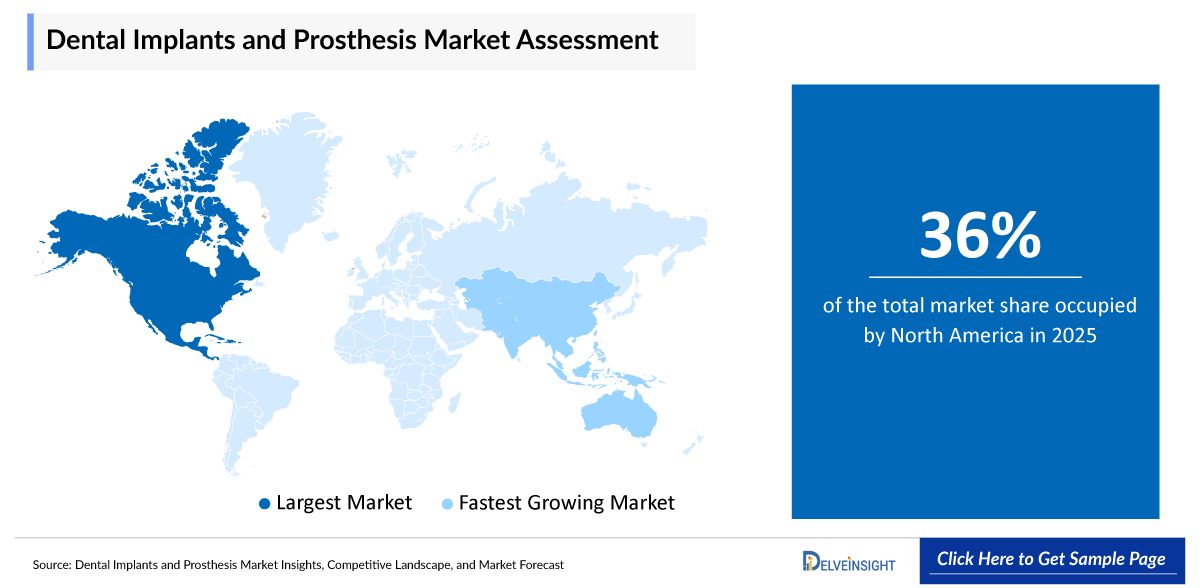
• North America accounted for the largest share of the dental implants and prosthesis market at 36% in 2025, while Europe is anticipated to register the fastest growth through 2034.
Dental implants and prostheses encompass the surgical devices placed to replace missing tooth roots and the restorative components that attach to them to restore chewing function and appearance. The scope encompasses endosteal (root-form) implants, the standard screw-form implant placed directly into the jawbone, including Straumann's BLX and Nobel Biocare's NobelActive systems; subperiosteal implants, custom-designed frameworks that rest on the jawbone beneath the gum tissue for patients with insufficient bone volume, increasingly fabricated using 3D-printing and computer-aided design workflows; zygomatic implants, longer implants anchored in the zygomatic (cheekbone) bone for patients with severe maxillary bone loss, including Nobel Biocare's NobelZygoma system and Straumann's ZAGA-protocol implants; titanium and zirconia implant materials; tapered and parallel-walled implant designs; and prosthetic components including dentures, crowns, bridges, veneers, abutments, and inlays and onlays. The market spans hospital, dental clinic, and dental laboratory settings.
Dental Implants and Prosthesis Market Key Growth Drivers
• Rising global prevalence of dental caries, periodontal disease, and tooth loss, with the World Health Organization estimating that oral diseases affect approximately 3.5 billion people globally and that more than 1 billion adults are affected by severe periodontal disease.
• An aging global population, with tooth decay, gum disease, and tooth loss disproportionately affecting older adults, is driving demand for both implant-based and conventional prosthetic tooth replacement.
• Expanding clinical evidence and regulatory clearance for zygomatic and full-arch implant systems, exemplified by the FDA's August 2025 510(k) clearance of Nobel Biocare's NobelZygoma TiUltra implant system, extending treatment options to patients with severe maxillary bone loss.
• Accelerating shift toward digital, CAD/CAM, and 3D-printed prosthesis manufacturing that reduces production time and improves fit accuracy relative to conventional fabrication methods.
• Growing demand for metal-free, esthetic zirconia implant options among patients seeking alternatives to titanium implants for anterior tooth replacement.
• Rising incidence of oral cancer requiring surgical treatment that results in tooth loss, creating additional demand for dental prosthetics to restore function and appearance.
• Increasing integration of intraoral scanning and guided surgery technology into implant treatment planning, improving surgical precision and patient outcomes.
Key Companies in Dental Implants and Prosthesis Market
The leading participants in the dental implants and prosthesis market include the following:
• Straumann Holding AG
• Envista Holdings Corporation (Nobel Biocare Systems)
• Dentsply Sirona Inc.
• ZimVie Inc.
• Osstem Implant Co., Ltd.
• BioHorizons (Henry Schein, Inc.)
• MegaGen Implant Co., Ltd.
• Southern Implants (Pty) Ltd.
• Neoss Limited
• DIO Corporation
Factors Contributing to the Growth of the Dental Implants and Prosthesis Market
Market Drivers
Rising Global Prevalence of Dental Caries, Periodontal Disease, and Tooth Loss
The foundational driver of the dental implants and prosthesis market is the rising global prevalence of oral disease, with the World Health Organization's Global Oral Health Status Report estimating that oral diseases affect approximately 3.5 billion people globally, including an estimated 514 million children with primary tooth caries and approximately 2 billion adults with caries of permanent teeth. More than 1 billion adults, approximately 19% of the global population, are affected by severe periodontal disease, a leading cause of tooth loss. As the global burden of untreated dental caries and periodontal disease continues to drive tooth loss, the population requiring implant-based or conventional prosthetic tooth replacement expands correspondingly, sustaining demand across the full range of implant and prosthesis categories throughout the forecast period.
Aging Global Population
The aging global population is a powerful structural driver of the dental implants and prosthesis market, as tooth decay, gum disease, and tooth loss disproportionately affect older adults due to a lifetime of dental wear, altered salivary composition, and reduced salivary flow. In the United States alone, the population aged 65 and older grew by 47% to reach 58 million people in 2022, and is projected to reach 82 million by 2050. As the global population continues to age, particularly across North America, Europe, and East Asia, the population experiencing age-related tooth loss and requiring dentures, implants, and other prosthetic tooth replacement solutions grows correspondingly, sustaining demand across the forecast period.
Market Restraints
The dental implants and prosthesis market faces several interrelated restraints that temper its growth. Irregular and infrequent routine dental health checkups among large segments of the global population, particularly in low- and middle-income countries, delay diagnosis of conditions requiring implant or prosthetic treatment and limit market penetration. The availability of lower-cost alternative procedures, including conventional bridges, removable partial dentures, and, in some cases, forgoing treatment entirely, constrains adoption of premium implant-based solutions among cost-sensitive patients. The high cost of dental implant treatment, particularly complex full-arch and zygomatic implant procedures that can range from USD 15,000 to USD 40,000 per arch in North America, combined with limited insurance coverage that in many plans excludes implant treatment outside of cancer, congenital defect, or trauma indications, constrains broader adoption. Pricing pressure and competitive discounting among established implant manufacturers, reflected in Dentsply Sirona's reported year-on-year decline in implant segment revenue in 2024, alongside the growing presence of lower-priced manufacturers from South Korea and Israel gaining share in price-sensitive markets, create margin pressure across the competitive landscape. The steep surgical learning curve associated with advanced techniques such as zygomatic implant placement limits the specialist base capable of performing these procedures, constraining the pace of adoption for the fastest-growing implant categories. Together, these factors moderate the pace of adoption and require manufacturers to demonstrate value, expand surgeon training capacity, and support financing options to sustain growth.
Dental Implants and Prosthesis Market Segment Analysis
The global dental implants and prosthesis market is segmented by implant material (titanium and zirconia), implant design (tapered and parallel-walled/cylindrical), implant type (endosteal, subperiosteal, zygomatic, and others), prosthesis type (dentures, crowns, bridges, veneers, abutments, and inlays and onlays), manufacturing technology (conventional/traditional fabrication, CAD/CAM milled, and 3D-printed/digitally manufactured), end-user (hospitals, dental clinics, dental laboratories, and others), and geography (North America, Europe, Asia-Pacific, and the Rest of the World).
By Implant Type
Dominant Subsegment: Endosteal Implants.
The endosteal implants category is expected to dominate the market. The endosteal implants segment accounted for an 88% share of the dental implants and prosthesis market in 2025. Endosteal, or root-form, implants, including Straumann's BLX system and Nobel Biocare's NobelActive system, are the leading implant type because they are the standard, most extensively studied, and most widely used implant design for patients with adequate jawbone volume, representing the default treatment approach for the large majority of tooth replacement cases. The dominance of the segment reflects the breadth of clinical evidence, surgeon familiarity, and product variety available across virtually every major manufacturer. Zygomatic implants, including Nobel Biocare's NobelZygoma system, cleared by the FDA in August 2025, represented the fastest-growing implant type in 2025, driven by expanding regulatory clearance, growing surgeon training capacity through academies such as Straumann's ZAGA Academy, and rising demand for fixed full-arch solutions among patients with severe maxillary bone loss who would otherwise require extensive bone grafting. Subperiosteal implants, increasingly fabricated using 3D-printing and computer-aided design workflows, serve a smaller but clinically important niche for patients with insufficient bone volume who are not candidates for zygomatic implants.
By Implant Material
Dominant Subsegment: Titanium.
The titanium category is expected to dominate the market. The titanium implants segment accounted for an 82% share of the dental implants and prosthesis market in 2025. Titanium, used in the large majority of implant systems from Straumann, Nobel Biocare, Dentsply Sirona, ZimVie, and Osstem Implant, is the leading material because of its decades-long clinical track record of osseointegration, mechanical strength, and biocompatibility, supported by the deepest body of long-term clinical evidence among implant materials. The dominance of the segment reflects the breadth of titanium implant product lines and surface technologies, including anodized surfaces such as Nobel Biocare's TiUltra, available across the industry. Zirconia implants, including Straumann's PURE ceramic implant system, represent a smaller but growing category driven by patient demand for metal-free, esthetic alternatives, particularly for anterior tooth replacement, and are expected to continue gaining share as clinical evidence supporting long-term zirconia implant durability accumulates across the forecast period.
Dental Implants and Prosthesis Market Region Analysis
Dominant Region: North America
North America accounted for a 36% share of the global dental implants and prosthesis market in 2025, representing the highest regional market share globally. The leadership of the region reflects a high prevalence of oral disease driven by unhealthy dietary habits, an aging population, and strong reimbursement and financing infrastructure supporting elective dental procedures. The United States is the largest national market, supported by high rates of dental visits, with the Centers for Disease Control and Prevention reporting that approximately 64.1% of adults visited a dental health provider in 2019, the concentration of leading manufacturers, and rising oral cancer incidence requiring prosthetic rehabilitation. The concentration of vendors, favorable reimbursement and financing structures, and disease prevalence reinforce the position of North America as the largest regional market across the forecast period.
Fastest Growing Region: Europe
Europe is projected to register the fastest compound annual growth rate through 2034. The region combines a rapidly aging population with a well-established base of specialist oral and maxillofacial surgery training, exemplified by the concentration of zygomatic implant surgical academies, including Straumann's ZAGA Academy and Nobel Biocare's Zygoma Academy, both of which credential thousands of surgeons across the region annually. Germany, the United Kingdom, France, Italy, and Spain are the principal national markets, supported by strong private dental financing options, growing patient demand for fixed full-arch and esthetic zirconia implant solutions, and the concentration of leading European manufacturers including Straumann and Nobel Biocare. As specialist training capacity for advanced implant techniques continues to expand and as demand for esthetic and full-arch rehabilitation solutions grows, Europe is positioned as the fastest-growing regional market across the forecast period.
Regional Commentary
North America
North America leads the market, supported by high disease prevalence, an aging population, and strong reimbursement and financing infrastructure. The United States dominates the region through its concentration of manufacturers and high rates of routine dental care utilization.
Europe
Europe is the fastest-growing market, driven by an aging population, the concentration of specialist zygomatic and full-arch implant training academies, and strong patient demand for esthetic and fixed prosthetic solutions. Germany, the United Kingdom, France, Italy, and Spain are the principal national markets, and Switzerland anchors the region's implant manufacturing base through Straumann and Nobel Biocare.
Asia-Pacific
Asia-Pacific is a substantial and growing market, driven by rising disposable income, expanding dental care infrastructure, and the growing presence of regional manufacturers including Osstem Implant, MegaGen Implant, and DIO Corporation, offering more affordable implant systems across China, Japan, India, and South Korea.
Rest of World
The Rest of World, spanning Latin America, the Middle East, and Africa, represents an emerging opportunity as dental care infrastructure expands, though adoption of advanced implant and prosthetic solutions remains concentrated in leading urban centers and private dental clinics.
Dental Implants and Prosthesis Market Competitive Landscape
The global dental implants and prosthesis market is classified as Moderately Consolidated. Straumann, Envista Holdings' Nobel Biocare, Dentsply Sirona, and ZimVie collectively account for a substantial majority of global market share, while a growing number of South Korean and Israeli manufacturers, including Osstem Implant and Noris Medical, compete aggressively on price in cost-sensitive markets. Competition centers on implant surface technology and osseointegration performance, breadth of the implant and prosthetic product portfolio, digital workflow integration, surgeon training and academy infrastructure, and geographic distribution reach. The competitive landscape is evaluated across the following dimensions:
• Market concentration: Moderately consolidated, with Straumann, Envista Holdings (Nobel Biocare), Dentsply Sirona, and ZimVie collectively accounting for an estimated 75% to 80% of global market share in 2024, alongside Osstem Implant, BioHorizons, MegaGen Implant, Southern Implants, Neoss, and DIO Corporation.
• Leading players: Straumann and Nobel Biocare lead in premium implant systems and zygomatic implant technology, supported by dedicated surgical training academies; Dentsply Sirona leads in integrated digital dentistry and denture manufacturing workflows; and Osstem Implant and other South Korean manufacturers lead in value-tier implant systems gaining share in price-sensitive markets.
• Geographic reach: Straumann, Envista Holdings, Dentsply Sirona, and ZimVie operate global commercial and regulatory organizations, while manufacturers including MegaGen Implant, DIO Corporation, and Osstem Implant maintain strong footprints concentrated in Asia-Pacific and price-sensitive emerging markets.
• Product portfolio strength: Competitive advantage rests on the breadth across implant materials, designs, and types, including specialized zygomatic and subperiosteal systems, and on integrated digital workflow and prosthetic manufacturing capability.
• Pipeline strength: Development is concentrated in advanced implant surface technology for improved osseointegration, digital and 3D-printed prosthesis manufacturing, and expanded zygomatic and full-arch implant system indications.
• Strategic partnerships: Collaboration spans digital dentistry distribution partnerships, exemplified by Nobel Biocare's 2025 partnership with 3Shape for TRIOS intraoral scanner distribution, and specialist surgical training academy programs operated jointly with academic institutions.
• M&A activity: The competitive landscape has been shaped by corporate restructuring, including Danaher's 2019 spin-off of its dental business, including Nobel Biocare, into the independent, publicly traded Envista Holdings Corporation, and Zimmer Biomet's 2022 spin-off of its dental and spine businesses into the independent, publicly traded ZimVie Inc.
• Innovation focus: Innovation is concentrated in anodized and advanced implant surface technology for faster osseointegration, digital and 3D-printed prosthesis manufacturing, and expanded zygomatic implant system designs supporting immediate loading.
• Regulatory standing: FDA 510(k) clearance and CE marking for new implant systems, exemplified by Nobel Biocare's August 2025 clearance for its NobelZygoma TiUltra system, are decisive competitive credentials that determine access to new procedure categories and geographic markets.
Dental Implants and Prosthesis Market Recent Developmental Activities
• In August 2025, the FDA granted 510(k) clearance for Nobel Biocare's NobelZygoma TiUltra implant system, covering both straight and 45-degree angulated variants with anodized TiUltra surface technology for extra-maxillary placement. Strategic significance: the clearance validated indications for severe maxillary resorption cases and expanded Nobel Biocare's addressable market in complex full-arch rehabilitation.
• In September 2025, Southern Implants advanced its zygomatic implant system offerings. Strategic significance: the development reinforced specialist competition in the zygomatic and pterygoid implant category alongside Nobel Biocare and Straumann.
Dental Implants and Prosthesis Market Segmentation
Dental Implants and Prosthesis Market Assessment by Implant Material
• Titanium Implants
• Zirconia Implants
Dental Implants and Prosthesis Market Assessment by Implant Design
• Tapered Dental Implants
• Parallel-Walled (Cylindrical) Dental Implants
Dental Implants and Prosthesis Market Assessment by Implant Type
• Endosteal Implants
• Subperiosteal Implants
• Zygomatic Implants
• Others
Dental Implants and Prosthesis Market Assessment by Prosthesis Type
• Dentures
◦ Complete/Full Dentures
◦ Partial Dentures
◦ Implant-Supported Overdentures
• Crowns
• Bridges
• Veneers
• Abutments
• Inlays and Onlays
Dental Implants and Prosthesis Market Assessment by Manufacturing Technology
• Conventional/Traditional Fabrication
• CAD/CAM Milled
• 3D-Printed/Digitally Manufactured
Dental Implants and Prosthesis Market Assessment by End-User
• Hospitals
• Dental Clinics
• Dental Laboratories
• Others
Dental Implants and Prosthesis Market Assessment by Geography
• North America
United States Dental Implants and Prosthesis Market Size in USD million (2023-2034)
Canada Dental Implants and Prosthesis Market Size in USD million (2023-2034)
Mexico Dental Implants and Prosthesis Market Size in USD million (2023-2034)
• Europe
Germany Dental Implants and Prosthesis Market Size in USD million (2023-2034)
United Kingdom Dental Implants and Prosthesis Market Size in USD million (2023-2034)
France Dental Implants and Prosthesis Market Size in USD million (2023-2034)
Italy Dental Implants and Prosthesis Market Size in USD million (2023-2034)
Spain Dental Implants and Prosthesis Market Size in USD million (2023-2034)
Rest of Europe Dental Implants and Prosthesis Market Size in USD million (2023-2034)
• Asia-Pacific
China Dental Implants and Prosthesis Market Size in USD million (2023-2034)
Japan Dental Implants and Prosthesis Market Size in USD million (2023-2034)
India Dental Implants and Prosthesis Market Size in USD million (2023-2034)
Australia Dental Implants and Prosthesis Market Size in USD million (2023-2034)
South Korea Dental Implants and Prosthesis Market Size in USD million (2023-2034)
Rest of Asia-Pacific Dental Implants and Prosthesis Market Size in USD million (2023-2034)
• Rest of the World
Middle East Dental Implants and Prosthesis Market Size in USD million (2023-2034)
Africa Dental Implants and Prosthesis Market Size in USD million (2023-2034)
South America Dental Implants and Prosthesis Market Size in USD million (2023-2034)
Key Takeaways from the Dental Implants and Prosthesis Market Report Study
• Market size analysis for the current dental implants and prosthesis market size (2025), and market forecast for 9 years (2026 to 2034).
• Top key product and technology developments, mergers, acquisitions, partnerships, and joint ventures that happened over the last 3 years.
• Key companies dominating the global dental implants and prosthesis market.
• Various opportunities available for competitors in the dental implants and prosthesis market space.
• What are the top-performing segments in 2025? How will these segments perform in 2034?
• Which are the top-performing regions and countries in the current dental implants and prosthesis market scenario?
• Which are the regions and countries where companies should concentrate their opportunities for dental implants and prosthesis market growth in the future?
Target audience who can benefit from this dental implants and prosthesis market report study
• Dental implants and prosthesis providers
• Research organizations and consulting companies
• Dental Implants and Prosthesis-related organizations, associations, forums, and other alliances
• Government and corporate offices
• Start-up companies, venture capitalists, and private equity firms
• Distributors and traders dealing in dental implants and prosthesis
• Various end-users who want to know more about the dental implants and prosthesis market and the latest technological developments in the dental implants and prosthesis market.