Digital Wound Measurement Devices Market Summary
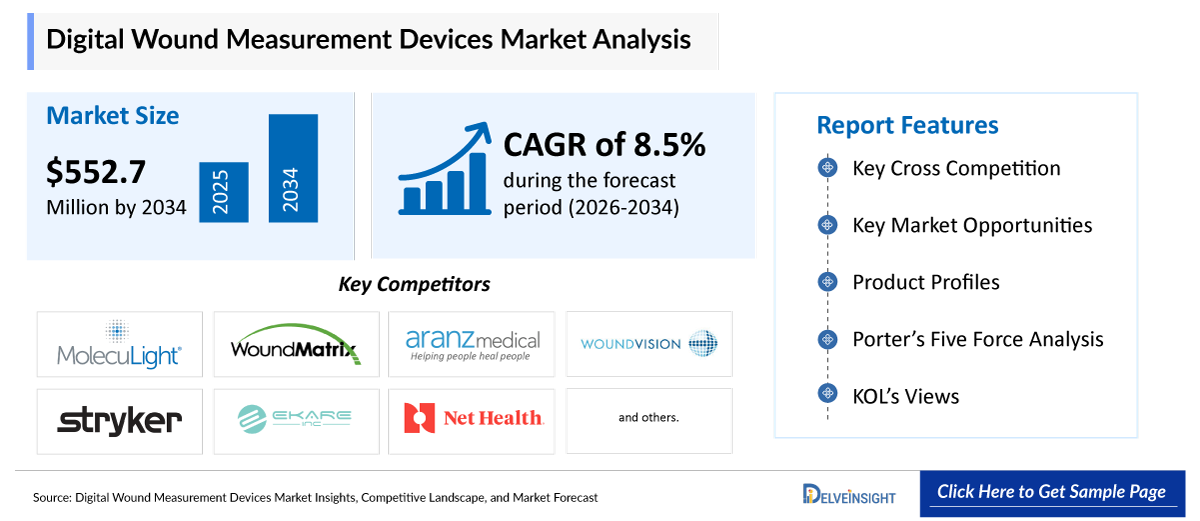
- The Digital Wound Measurement Devices market is estimated at USD 260.5 million in 2025 and is projected to reach USD 552.7 million by 2034. Growth is anchored in the rising global burden of chronic and complex wounds, the shift from manual to imaging-led digital assessment, and expanding adoption of AI-enabled wound analytics across hospitals and specialty wound-care settings.
- The global Digital Wound Measurement Devices market is growing at a CAGR of 8.5% during the forecast period from 2026 to 2034.
- By product type, the software segment dominated the Digital Wound Measurement Devices market with a 58% share in 2025.
- By measurement technology, the 2D imaging segment dominated the Digital Wound Measurement Devices market with a 50% share in 2025.
- By wound type, the diabetic foot ulcers segment dominated the Digital Wound Measurement Devices market with a 38% share in 2025.
- By modality, the non-contact segment dominated the Digital Wound Measurement Devices market with a 60% share in 2025.
- By end-user, the hospitals & clinics segment dominated the Digital Wound Measurement Devices market with a 56% share in 2025.
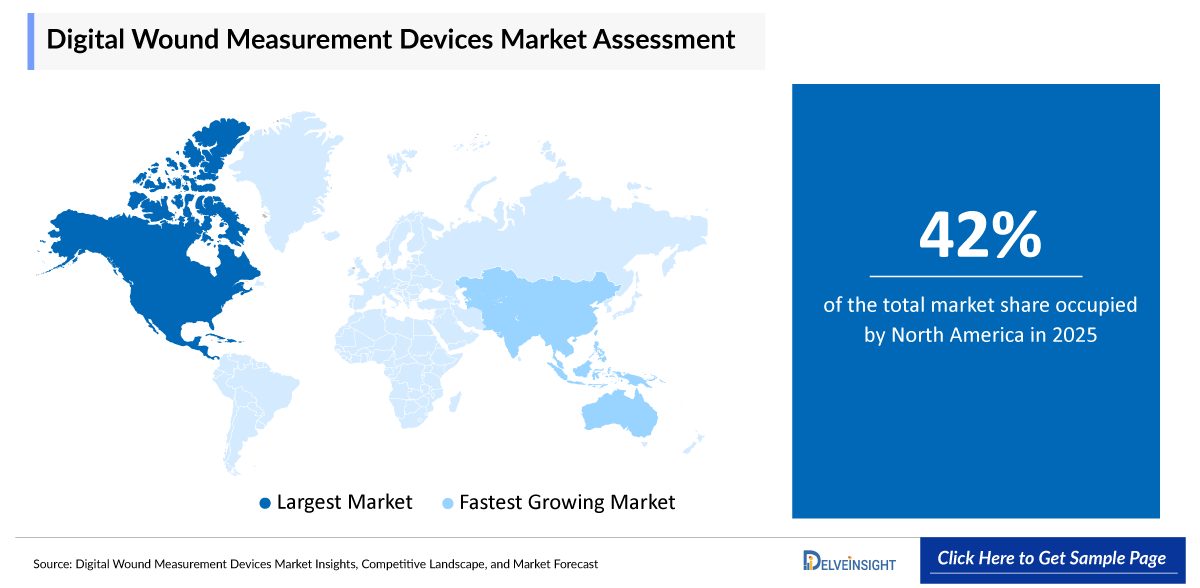
- North America dominated the global Digital Wound Measurement Devices market revenue with a 42% share in 2025, representing the highest regional market share globally.
A digital wound measurement device is a hardware- or software-enabled system that captures, quantifies, and documents wound dimensions, such as length, width, depth, area, and volume, with greater accuracy and consistency than manual methods such as rulers, acetate tracing, or visual estimation. Because chronic wounds, including diabetic foot ulcers, pressure injuries, and venous leg ulcers, require repeated evaluation over weeks or months, clinicians increasingly rely on digital measurement platforms that combine imaging sensors, structured light, laser scanning, or computer-vision algorithms to build a standardized, traceable visual history of healing progress. These solutions span dedicated hardware devices and standalone software applications, use technologies including 2D imaging, 3D imaging, AI and computer vision, and laser-based imaging, and are deployed across contact-based and non-contact modalities to assess diabetic foot ulcers, pressure ulcers and injuries, burns, and other wound types. The market is organized by product type across devices and software; by measurement technology, including 2D imaging, 3D imaging, AI and computer vision, laser-based imaging, and others; by wound type, led by diabetic foot ulcers, pressure ulcers/injuries, and burns; by modality across contact-based and non-contact systems; and by end-user, led by hospitals and clinics. Driven by the rising global prevalence of chronic wounds, the shift toward standardized, infection-control-friendly non-contact assessment, and the integration of AI-enabled analytics and EHR connectivity, digital wound measurement devices have become an increasingly essential component of modern, data-driven wound-care programs.
Digital Wound Measurement Devices Market Key Growth Drivers
- The rising global burden of chronic and complex wounds, including diabetic foot ulcers, pressure injuries, and venous leg ulcers, is expanding demand for tools that support repeated, standardized assessment over long treatment cycles.
- A structural shift away from manual, contact-based measurement toward non-contact, imaging-led assessment is accelerating adoption, as non-contact systems support infection control, reduce patient discomfort, and produce reviewable visual records.
- Growing integration of artificial intelligence and computer vision into wound imaging platforms is improving measurement speed, consistency, and clinical decision support, exemplified by Swift Medical's AI-based Skin & Wound 2 platform launched in October 2024.
- Rising investor and strategic interest in digital wound-care platforms is accelerating capacity build-out, including MolecuLight's USD 27.5 million investment from Hayfin Capital Management in January 2025.
- Healthcare systems are pushing for better documentation quality, standardized wound assessment across clinicians, and stronger reimbursement support, favoring digital tools over rulers, paper notes, and subjective estimation.
- Expanding digital transformation of wound care, including telehealth, remote patient monitoring, and EHR/EMR interoperability, is broadening the addressable market beyond hospitals into specialty clinics and home-based care.
- The convergence of chronic-disease prevalence, non-contact and AI-enabled imaging adoption, and connected-care investment is expected to sustain steady growth in the market through 2034.
Key Companies in Digital Wound Measurement Devices Market
The competitive landscape is led by the following active device manufacturers:
- MolecuLight Inc.
- WoundMatrix, Inc.
- Kent Imaging Inc.
- ARANZ Medical Limited
- WoundVision LLC
- Stryker
- eKare Inc.
- Net Health
- Perceptive Solutions, Inc.
- BioVisual Technologies LLC
- Smith & Nephew
For illustrative purposes, only the top 10 companies are listed in the Table of Contents. The report may include analysis and references to additional companies relevant to the market assessment.
Digital Wound Measurement Devices Market Size
The following snapshot summarizes the principal report metrics for the digital wound measurement devices market.
|
Report Metrics |
Details |
|
2025 Market Size |
USD 260.5 million |
|
2034 Projected Market Size |
USD 552.7 million |
|
Growth Rate (2026-2034) |
8.5% CAGR |
|
Largest Market |
North America |
|
Fastest Growing Market |
Asia-Pacific |
|
Market Structure |
Moderately Fragmented |
All market values are expressed in USD and represent DelveInsight estimates synthesized from primary and secondary research.
Factors Contributing to the Growth of the Digital Wound Measurement Devices Market
Market Drivers
Rising Global Burden of Chronic and Complex Wounds
The most powerful driver of the Digital Wound Measurement Devices market is the steady increase in patients living with wounds that require repeated follow-up rather than one-time evaluation. Chronic wounds are closely tied to diabetes, immobility, vascular insufficiency, and advanced age, and they are becoming more visible as populations age and long-term disease management becomes more demanding. In the United States alone, over 6.5 million individuals live with chronic wounds, generating annual healthcare costs of approximately USD 25 billion, while similar burdens are reported across Germany, Australia, and other developed markets. In these cases, wound assessment is not a single measurement but an ongoing process of tracking progress, identifying delayed healing, and supporting timely changes in treatment. Digital measurement devices meet this need by creating a visual history of the wound and reducing variation between caregivers, particularly in settings where multiple clinicians see the same patient across several visits. As wound-care pathways become more structured, providers increasingly value tools that improve consistency and reduce guesswork, anchoring market growth through 2034.
Shift Toward Non-Contact, Imaging-Led Assessment
A structural shift away from manual and contact-based measurement toward non-contact, imaging-led assessment is reshaping the market. Non-contact systems allow clinicians to assess wounds without physically touching the site while capturing images that support measurement and documentation, which matters in modern wound care where infection control, patient comfort, and repeatable follow-up carry real weight. Providers increasingly value systems that support standardization across clinicians, especially in large hospitals and multi-site wound programs, helping imaging-based platforms that combine measurement with photo capture, software analysis, and structured documentation gain ground over rulers and acetate tracing.
Growing Integration of AI and Computer Vision
The expansion from simple dimension tracking toward AI-enabled wound assessment workflows is a significant growth driver. Platforms increasingly combine computer vision, machine learning, and structured light to automate wound-border delineation, tissue classification, and healing-trajectory prediction, reducing measurement time and inter-observer variability. Illustrative of this trend, Swift Medical launched Skin & Wound 2, a next-generation AI-based digital wound-care platform with FHIR support, in October 2024, while eKare's inSight platform uses computer vision to deliver wound measurement within seconds at the point of care. As hospitals and clinics become more comfortable with technology-enabled documentation, demand is shifting from basic measurement tools toward solutions that build a more complete and defensible clinical record.
Rising Investor and Strategic Interest in Digital Wound-Care Platforms
Growing investor confidence is accelerating capacity build-out and platform consolidation across the sector. MolecuLight secured a USD 27.5 million investment from Hayfin Capital Management in January 2025 to expand its point-of-care fluorescence imaging platform, while Net Health, backed by The Carlyle Group, Level Equity, and Silversmith Capital Partners, acquired Limber Health in June 2025 to broaden its restorative-care software footprint. Swift Medical secured a USD 9 million AI co-investment with DIGITAL and consortium partners in March 2024 to commercialize tools such as SmartTissue and AutoDepth. This capital inflow validates the sector's long-term growth and channels sustained investment toward providers with proven imaging accuracy and workflow integration.
Push for Standardized Documentation and Reimbursement Support
Healthcare systems are placing growing emphasis on documentation quality, standardized assessment, and defensible clinical records to support reimbursement and quality monitoring. Digital wound measurement platforms with EHR and EMR integration, such as ARANZ Medical's Silhouette and eKare's inSight, allow providers to feed structured wound data directly into records systems using HL7 and FHIR protocols, reducing transcription error and supporting audit readiness. As reimbursement pathways increasingly reward demonstrable, standardized documentation, providers are placing greater value on tools that reduce guesswork and streamline clinical workflows.
Expansion of Telehealth, Remote Monitoring, and Connected Care
The broader digital transformation of wound care, including telehealth, remote patient monitoring, and connected documentation, is creating new growth opportunities beyond the initial hardware sale. Vendors are positioning offerings around image archiving, wound-progression tracking, and interoperability with electronic records, particularly attractive in home-based care and post-acute settings where consistent wound monitoring is difficult but increasingly necessary. Solutions that make wound data easier to capture, share, and interpret across care locations are gaining traction as healthcare providers seek continuity of care beyond hospital walls.
Market Restraints
Despite steady momentum, the Digital Wound Measurement Devices market faces material constraints. Budget pressure and uneven clinical adoption remain a practical restraint, as many providers, particularly smaller facilities, outpatient centers, and institutions in cost-constrained markets, remain price-sensitive and may view digital measurement tools as appropriate but not essential when manual tools remain familiar and inexpensive. Workflow disruption is a further barrier: even when a device improves documentation quality, clinicians may hesitate to adopt it if it adds steps, requires training, or does not integrate smoothly with existing records systems. The market includes a fragmented mix of imaging, measurement, and documentation solutions, complicating purchasing decisions and requiring vendors to prove value not only in clinical terms but also in time savings and operational efficiency. Proving consistent clinical value across highly varied care settings, from hospitals and ambulatory surgical centers to specialty clinics and home-based care, remains a core challenge, since a device that performs well in a specialized wound center may not be readily adopted in a general hospital ward or resource-limited outpatient setting. Reimbursement variability across geographies, limited digital infrastructure in emerging markets, and the need to translate technical capability into measurable outcomes further temper the pace of adoption, even as the underlying drivers of chronic-wound prevalence and digital transformation remain firmly intact.
Digital Wound Measurement Devices Market Segment Analysis
The Digital Wound Measurement Devices by Market by Product Type (Devices and Software), Measurement Technology (2D Imaging, 3D Imaging, AI & Computer Vision, Laser-Based Imaging, and Others), Wound Type (Diabetic Foot Ulcers, Pressure Ulcers/Injuries, Burns, and Others), Modality (Contact-Based and Non-Contact), End-User (Hospitals & Clinics, Ambulatory Surgical Centers, and Others), and Geography (North America, Europe, Asia-Pacific, and Rest of World).
By Product Type
Dominant Subsegment: Software.
Dominant: Software ~ 58%
The software segment accounted for 58% of the Digital Wound Measurement Devices market in 2025. Software is the leading product type because wound-care providers increasingly value the analytics, documentation, and EHR-integration layer as much as the underlying imaging hardware. Software platforms such as ARANZ Medical's Silhouette, eKare's inSight, and Net Health's Tissue Analytics deliver automated measurement, wound-progression tracking, and structured clinical records on top of standard smartphones or tablets, lowering the incremental hardware cost of adoption while enabling recurring, subscription-based revenue for vendors. The proliferation of smartphone-based imaging and cloud-hosted analytics has expanded software's reach into specialty clinics and home-based settings where dedicated hardware purchases are harder to justify.
While dedicated devices, including near-infrared and fluorescence-imaging hardware such as Kent Imaging's SnapshotNIR and MolecuLight's point-of-care imaging systems, continue to grow steadily on the strength of differentiated clinical capability, the breadth, scalability, and recurring-revenue economics of software platforms secure the segment's leadership across the forecast period.
By Measurement Technology
Dominant Subsegment: 2D Imaging.
Dominant: 2D Imaging ~ 50%
The 2D imaging segment accounted for 50% of the Digital Wound Measurement Devices market in 2025. 2D imaging is the leading measurement technology because it balances utility, cost, and ease of use. Two-dimensional imaging platforms give clinicians a fast, low-cost way to capture wound images, estimate dimensions, and build a visual timeline without the capital investment or learning curve associated with more advanced 3D or laser-based systems, making them the practical default across hospitals, specialty clinics, and lower-resource care settings.
AI and computer vision are the fastest-growing measurement technology, as platforms increasingly combine machine learning with structured light and photogrammetry to automate wound-border delineation and tissue classification, while 3D imaging is also expanding quickly on the strength of its ability to capture depth and volume, both critical for tracking healing in cavity wounds and deep pressure injuries. Laser-based imaging remains a smaller, specialized category valued for measurement precision in dedicated wound-care centers.
By Wound Type
Dominant Subsegment: Diabetic Foot Ulcers.
Dominant: Diabetic Foot Ulcers ~ 38%
The diabetic foot ulcers segment accounted for 38% of the Digital Wound Measurement Devices market in 2025. Diabetic foot ulcers are the leading wound type because they require some of the most intensive, longitudinal monitoring of any wound category, with a high risk of infection, delayed healing, and lower-limb amputation if progress is not tracked closely. The rising global prevalence of diabetes and the clinical emphasis on early detection of non-healing ulcers is driving strong, sustained demand for digital measurement and perfusion-imaging tools, including Kent Imaging's SnapshotNIR near-infrared platform, in podiatry clinics, endocrinology practices, and hospital wound centers.
Pressure ulcers and injuries represent the second-largest wound type and are supported by hospital quality-of-care and reimbursement programs that require standardized staging and documentation, while burns, though a smaller share, are a fast-growing category as 3D and non-contact imaging reduce the discomfort of repeated assessment in sensitive tissue. The depth and recurrence of diabetic wound-care pathways secure the segment's leadership across the forecast period.
By Modality
Dominant Subsegment: Non-Contact.
Dominant: Non-Contact ~ 60%
The non-contact segment accounted for 60% of the Digital Wound Measurement Devices market in 2025. Non-contact devices are the leading modality because they allow clinicians to assess wounds without physically touching the site, aligning with modern infection-control practices, reducing patient discomfort in sensitive or painful wounds, and producing visual records that can be reviewed later by other members of the care team. This is particularly valuable in immunocompromised patients, pediatric burns, and multi-site wound programs where standardization across clinicians is a priority.
Contact-based devices, including probes and mechanical tracing tools, continue to serve applications requiring direct depth or tunneling assessment, but the practical, hygienic, and documentation advantages of non-contact imaging are expected to sustain its leadership through 2034.
By End-User
Dominant Subsegment: Hospitals & Clinics.
Dominant: Hospitals & Clinics ~ 56%
The hospitals & clinics segment accounted for 56% of the Digital Wound Measurement Devices market in 2025. Hospitals and clinics are the leading end-user because they combine high patient volume, broad wound case mixes, and more formal documentation requirements than smaller facilities. These settings typically have stronger procurement capabilities, better access to digital infrastructure, and a clearer pathway for integrating wound-assessment tools into existing clinical workflows and EHR systems.
Ambulatory surgical centers are the fastest-growing end-user segment as outpatient wound and post-surgical care volumes expand, while other settings, including specialty wound-care clinics, long-term care facilities, and home health agencies, are gradually adopting digital tools as connected-care and remote-monitoring capabilities mature.
Digital Wound Measurement Devices Market Region Analysis
Dominant Region: North America
North America accounted for 42% of the global Digital Wound Measurement Devices market revenue in 2025, representing the highest regional market share globally. The region's leadership reflects advanced healthcare infrastructure, high adoption of medical imaging and digital documentation tools, and a strong presence of wound-care specialists across hospitals and outpatient settings. North America hosts the largest concentration of digital wound-care platform vendors, including ARANZ Medical, MolecuLight, eKare, Kent Imaging, and Net Health, and benefits from established reimbursement pathways and regulatory clarity through the FDA. The rising burden of chronic wounds, including diabetic foot ulcers and pressure injuries, combined with strong institutional purchasing power and EHR interoperability standards, drives substantial outsourced-imaging and software adoption. Continued investment, including MolecuLight's USD 27.5 million capital raise and Net Health's acquisition activity, is reinforcing the region's leadership across the forecast period.
Fastest Growing Region: Asia-Pacific
Asia-Pacific is the fastest-growing region in the Digital Wound Measurement Devices market. The region's elevated CAGR is driven by expanding healthcare infrastructure, rising diabetes and chronic-wound prevalence, and growing awareness of digital wound-assessment tools across China, Japan, India, South Korea, and Australia. China is expanding hospital digitization and imaging infrastructure, Japan is integrating advanced wound-care technologies into its aging-population health strategy, and India is emerging as a growth market on the back of a large and rising diabetic population and expanding private hospital networks. Government healthcare investment, growing wound-care awareness, and the entry of global vendors into regional distribution partnerships are accelerating adoption, positioning Asia-Pacific as the principal source of incremental growth over the forecast period.
Regional Commentary
North America
North America accounted for 42% of the global Digital Wound Measurement Devices market revenue in 2025. The United States dominates on the strength of its advanced wound-care infrastructure, digital-health adoption, FDA regulatory clarity, and concentration of leading device and software vendors, while continued capital investment and EHR-integration initiatives reinforce the region's leadership.
Europe
Europe is a large and advanced regional market, supported by an aging population, rising chronic-wound incidence affecting up to 14.9 million people, and growing institutional focus on standardized wound-care quality. Vendors such as ARANZ Medical are expanding regional partnerships, while providers such as Smith & Nephew are showcasing integrated wound-care innovation at forums including the European Wound Management Association conference, reinforcing the region's role as a mature, quality-driven market across Germany, the United Kingdom, France, Italy, and Spain.
Asia-Pacific
Asia-Pacific is the fastest-growing region, propelled by expanding healthcare infrastructure, rising diabetes and chronic-wound prevalence, and growing digital-health investment across China, Japan, India, South Korea, and Australia. Expanding hospital networks and rising awareness of standardized, non-contact wound assessment are accelerating regional adoption and clinical-partnership activity.
Rest of World
The Rest of World region, spanning Latin America, the Middle East, and Africa, is an emerging growth frontier. Expanding hospital infrastructure, rising diabetes prevalence, and gradual adoption of digital documentation practices are broadening access, while international distribution partnerships support the build-out of regional wound-care imaging capacity.
Digital Wound Measurement Devices Market Competitive Landscape
The Digital Wound Measurement Devices market is classified as Moderately Fragmented. A group of established medical-technology players with broad wound-care portfolios and global distribution, including Smith & Nephew and Stryker, compete alongside specialized imaging and software innovators such as MolecuLight, ARANZ Medical, eKare, Kent Imaging, WoundVision, and Net Health, which differentiate through measurement accuracy, AI-enabled analytics, and EHR integration. Emerging players including WoundMatrix, Perceptive Solutions, and BioVisual Technologies compete through focused product innovation and channel partnerships, increasing competition in the fastest-growing non-contact and AI-enabled segments.
The competitive landscape can be evaluated across the following dimensions:
- Market concentration: Moderately fragmented, with diversified medical-technology leaders and a fast-growing field of specialized imaging and software innovators.
- Leading players: ARANZ Medical, MolecuLight, Net Health, Smith & Nephew, and eKare anchor the top tier through installed base, distribution reach, and clinical validation.
- Geographic reach: Leaders operate multi-country distribution networks; Kent Imaging's December 2025 exclusive U.S. distribution agreement with New Horizon Medical Solutions spans all 48 contiguous states.
- Product portfolio strength: Top players offer end-to-end imaging hardware, AI-enabled software, telehealth integration, and EHR/EMR connectivity through HL7 and FHIR protocols.
- Technology differentiation: Near-infrared and fluorescence imaging (Kent Imaging, MolecuLight), structured-light 3D imaging (eKare), and cloud-based documentation platforms (ARANZ Medical, Net Health) are key competitive moats.
- Strategic partnerships: Tie-ups with distributors and care-delivery networks, such as ARANZ Medical's partnership with Wound Care Plus and Kent Imaging's agreement with New Horizon Medical Solutions, extend market reach.
- M&A and investment activity: Active investment, including MolecuLight's USD 27.5 million Hayfin Capital raise and Net Health's acquisitions of Limber Health and Keet Health, is reshaping platform capabilities.
- Clinical validation: Peer-reviewed inter-rater and intra-rater reliability studies, such as those supporting eKare's inSight platform, are an increasingly important competitive differentiator.
- Innovation focus: AI-enabled measurement, non-contact and multimodal imaging, telehealth-enabled remote monitoring, and deeper EHR interoperability define the next wave of competitive advantage.
Digital Wound Measurement Devices Market Recent Developmental Activities
In December 2025, Kent Imaging Inc. signed an exclusive U.S. distribution agreement with New Horizon Medical Solutions covering all 48 contiguous states for its Snapshot family of near-infrared and bacterial-autofluorescence imaging devices, including SnapshotNIR and SnapshotGLO. Strategic significance: Expands U.S. commercial reach and strengthens Kent Imaging's position in point-of-care perfusion and bioburden imaging.
In January 2026, Net Health opened registration for its NEXT client conference and continued expanding its AI-native wound-care and outcomes-analytics platform across its restorative-care software portfolio. Strategic significance: Reinforces Net Health's software leadership and deepens client engagement across its wound-care EHR ecosystem.
In June 2025, Net Health acquired Limber Health, a digital health company focused on hybrid musculoskeletal solutions, to extend its reach across the care continuum from hospital to home. Strategic significance: Broadens Net Health's connected-care and remote-monitoring capabilities adjacent to its wound-care platform.
In January 2025, MolecuLight Inc. secured a USD 27.5 million investment from Hayfin Capital Management LLP to support its global point-of-care fluorescence imaging platform for measuring bacterial load in wounds. Strategic significance: Strengthens capital position and accelerates commercial expansion of MolecuLight's differentiated imaging technology.
In October 2024, Swift Medical launched Skin & Wound 2, a next-generation AI-based digital wound-care platform with FHIR support and tighter EMR integration. Strategic significance: Advances AI-enabled measurement and interoperability standards across the competitive landscape.
In September 2024, ARANZ Medical Limited released Silhouette 4.18, adding new features and expanding platform functionality for its 3D wound-imaging and documentation system. Strategic significance: Strengthens ARANZ Medical's core software platform and sustains its installed-base leadership.
In August 2024, ARANZ Medical Limited highlighted a trans-Tasman partnership with iAgeHealth using virtual health technologies and diagnostic devices to improve wound care for older people. Strategic significance: Extends ARANZ Medical's reach into virtual and remote wound-care delivery models.
In April 2024, Wound Care Plus, LLC, announced a partnership with ARANZ Medical to integrate the Silhouette wound-assessment solution into its wound-care management practice. Strategic significance: Expands ARANZ Medical's clinical-channel distribution and reinforces adoption of standardized 3D wound imaging.
In March 2024, Swift Medical announced a USD 9 million AI co-investment project with DIGITAL and consortium partners to commercialize tools such as SmartTissue, AutoDepth, and HealingIndex. Strategic significance: Accelerates development of next-generation AI-enabled wound-assessment capabilities.
In 2024 and 2025, Smith & Nephew continued to expand its Advanced Wound Management portfolio, including showcasing integrated wound-care innovations at the European Wound Management Association conference. Strategic significance: Reinforces Smith & Nephew's broad wound-care platform and European market presence.
Digital Wound Measurement Devices Market Segmentation
Digital Wound Measurement Devices Market by Product Type
- Devices
- Software
Digital Wound Measurement Devices Market by Measurement Technology
- 2D Imaging
- 3D Imaging
- AI & Computer Vision
- Laser-Based Imaging
- Others
Digital Wound Measurement Devices Market by Wound Type
- Diabetic Foot Ulcers
- Pressure Ulcers/Injuries
- Burns
- Others
Digital Wound Measurement Devices Market by Modality
- Contact-Based
- Non-Contact
Digital Wound Measurement Devices Market by End-User
- Hospitals & Clinics
- Ambulatory Surgical Centers
- Others
Digital Wound Measurement Devices Market by Geography
- North America Digital Wound Measurement Devices Market
- United States Digital Wound Measurement Devices Market Size in USD million (2023-2034)
- Canada Digital Wound Measurement Devices Market Size in USD million (2023-2034)
- Mexico Digital Wound Measurement Devices Market Size in USD million (2023-2034)
- Europe Digital Wound Measurement Devices Market
- Germany Digital Wound Measurement Devices Market Size in USD million (2023-2034)
- United Kingdom Digital Wound Measurement Devices Market Size in USD million (2023-2034)
- France Digital Wound Measurement Devices Market Size in USD million (2023-2034)
- Italy Digital Wound Measurement Devices Market Size in USD million (2023-2034)
- Spain Digital Wound Measurement Devices Market Size in USD million (2023-2034)
- Rest of Europe Digital Wound Measurement Devices Market Size in USD million (2023-2034)
- Asia-Pacific Digital Wound Measurement Devices Market
- China Digital Wound Measurement Devices Market Size in USD million (2023-2034)
- Japan Digital Wound Measurement Devices Market Size in USD million (2023-2034)
- India Digital Wound Measurement Devices Market Size in USD million (2023-2034)
- Australia Digital Wound Measurement Devices Market Size in USD million (2023-2034)
- South Korea Digital Wound Measurement Devices Market Size in USD million (2023-2034)
- Rest of Asia-Pacific Digital Wound Measurement Devices Market Size in USD million (2023-2034)
- Rest of the World (RoW) Digital Wound Measurement Devices Market
- Middle East Digital Wound Measurement Devices Market Size in USD million (2023-2034)
- Africa Digital Wound Measurement Devices Market Size in USD million (2023-2034)
- South America Digital Wound Measurement Devices Market Size in USD million (2023-2034)
Digital Wound Measurement Devices Market Recent Industry Trends and Milestones (2023-2026)
|
Category |
Key Developments |
|
Digital Wound Measurement Devices Market Product Approval |
Regulatory clearances and product enhancements continue to expand clinical adoption. ARANZ Medical released Silhouette 4.18 in September 2024, expanding its FDA-cleared 3D wound-imaging platform, while eKare's inSight remains an FDA-registered, CE-marked Class I device used across multi-center clinical trials. Kent Imaging's SnapshotNIR and SnapshotGLO near-infrared and bacterial-autofluorescence devices continue to expand indications for perfusion and bioburden assessment, supporting broader adoption of point-of-care diagnostic imaging alongside measurement. |
|
Digital Wound Measurement Devices Market Expansion |
Vendors broadened platform capability and distribution reach across the value chain. Kent Imaging secured exclusive U.S. distribution through New Horizon Medical Solutions in December 2025, ARANZ Medical expanded partnerships with Wound Care Plus and iAgeHealth through 2024, and Net Health broadened its software footprint through the Limber Health and Keet Health acquisitions. Swift Medical extended AI-based measurement and FHIR-enabled EMR integration with its Skin & Wound 2 platform, while providers increasingly bundled imaging with telehealth and remote-monitoring capability. |
|
Digital Wound Measurement Devices Market Investment |
Capital investment accelerated across the sector. MolecuLight secured a USD 27.5 million investment from Hayfin Capital Management in January 2025, Swift Medical secured a USD 9 million AI co-investment with DIGITAL and consortium partners in March 2024, and Net Health, backed by The Carlyle Group, Level Equity, and Silversmith Capital Partners, pursued acquisitions of Limber Health (2025) and Keet Health (2026) to broaden its restorative-care platform. |
|
Company Strategy |
MolecuLight Inc.: Point-of-care fluorescence imaging leadership reinforced by new capital investment. ARANZ Medical Limited: Installed-base leadership through Silhouette platform upgrades and clinical-channel partnerships. eKare Inc.: AI and computer-vision-based measurement with deep EHR interoperability. Kent Imaging Inc.: Near-infrared perfusion and bioburden imaging expansion through exclusive U.S. distribution. Net Health: Software-led consolidation of wound-care and adjacent restorative-care platforms. Smith & Nephew and Stryker: Broad wound-care portfolios reinforced by global distribution and clinical-evidence generation. WoundVision LLC, WoundMatrix, Inc., Perceptive Solutions, Inc., and BioVisual Technologies LLC: Focused imaging and documentation innovation competing on accuracy and workflow simplicity. |
|
Emerging Technologies |
AI and computer vision are the leading edge of innovation, with platforms increasingly automating wound-border delineation, tissue classification, and healing-trajectory prediction. Non-contact, multimodal imaging that combines visible-light, near-infrared, and 3D structured-light data is expanding, supported by growing FHIR and HL7-based EHR interoperability. Telehealth-enabled remote wound monitoring is gaining traction in home-based and post-acute care, while academic and industry collaborations, including university-led radar-based imaging research, are exploring next-generation, dressing-penetrating wound-monitoring approaches. |
Digital Wound Measurement Devices Market Startup Funding and Investment Trends
Investment in the Digital Wound Measurement Devices ecosystem has concentrated on AI-enabled imaging, non-contact assessment technology, and software platforms that integrate with electronic health records. The following companies illustrate recent funding and investment activity and technology focus.
|
Company |
Total Funding |
Funding Stage |
Main Offering |
Core Technology |
|
MolecuLight Inc. |
USD 27.5 million (2025) |
Growth / Debt Financing |
Point-of-care fluorescence wound imaging |
Bacterial autofluorescence imaging |
|
Request for unlocking the report of the @ Digital Wound Measurement Devices Market | ||||
Capital is flowing toward providers that combine imaging accuracy with software scalability and EHR interoperability. MolecuLight's USD 27.5 million investment from Hayfin Capital Management underscores continued strategic interest in point-of-care wound-imaging technology, while Swift Medical's USD 9 million AI co-investment with DIGITAL and consortium partners signals continued conviction in AI-enabled measurement tools such as SmartTissue and AutoDepth. Net Health's acquisitions of Limber Health and Keet Health, backed by private-equity ownership, illustrate ongoing platform consolidation in adjacent restorative-care software. Collectively, these investments signal that AI-enabled imaging, non-contact assessment, and deep EHR integration will define the next phase of competitive advantage in the global Digital Wound Measurement Devices market.
Key Takeaways from the Digital Wound Measurement Devices Market Report Study
- Market size analysis for the current digital wound measurement devices market size (2025), and market forecast for 9 years (2026 to 2034).
- Top key product/technology developments, mergers, acquisitions, partnerships, and joint ventures that happened over the last 3 years.
- Key companies dominating the global digital wound measurement devices market.
- Various opportunities available for competitors in the digital wound measurement devices market space.
- What are the top-performing segments in 2025? How will these segments perform in 2034?
- Which are the top-performing regions and countries in the current digital wound measurement devices market scenario?
- Which are the regions and countries where companies should concentrate their opportunities for digital wound measurement devices market growth in the future?
Target audience who can benefit from this Digital Wound Measurement Devices market report study
- Digital wound measurement devices product providers
- Research organizations and consulting companies
- Digital wound measurement devices-related organizations, associations, forums, and other alliances
- Government and corporate offices
- Start-up companies, venture capitalists, and private equity firms
- Distributors and traders dealing in digital wound measurement devices
- Various end-users who want to know more about the digital wound measurement devices market and the latest technological developments in the digital wound measurement devices market.