Drug Resistant Epilepsy Market Summary
- The Drug-Resistant Epilepsy Market is expected to strengthen as awareness of the disease increases, and more effective interventions are being developed.
- The leading Drug-Resistant Epilepsy Companies, such as LivaNova, Neurona Therapeutics, IAMA Therapeutics, and others.
Drug-Resistant Epilepsy Market Insights & Forecast
- Drug-Resistant Epilepsy, also referred to as refractory epilepsy, is identified when seizures continue despite the use of two suitable and well-tolerated anti-seizure medications. It occurs in approximately one-third of individuals with epilepsy, highlighting the persistence of seizures even after standard medication trials.
- A 2024 real-world analysis in the UK estimated that the prevalence of Drug-Resistant Epilepsy was 26.6%. It also highlighted a significant disease burden among individuals with Drug-Resistant Epilepsy.
- The rise in Drug-Resistant Epilepsy cases in the US is attributed to increased epilepsy prevalence, improved diagnosis, longer life expectancy, and better awareness. These factors contribute to identifying more patients who fail to respond to standard anti-seizure medications.
- Vagus Nerve Stimulation (VNS) is FDA-approved for Drug-Resistant Epilepsy, offering non-pharmacologic seizure control. This underscores an urgent need for novel antiepileptic drugs with improved mechanisms of action and better tolerability to enhance outcomes and personalize Drug-Resistant Epilepsy management strategies
- The leading Drug-Resistant Epilepsy Companies such as Neurona Therapeutics with NRTX-1001, IAMA Therapeutics with IAMA-6, among others. These innovative treatments target unmet clinical needs and offer promising efficacy. Regulatory approval of such therapies could significantly expand the Drug-Resistant Epilepsy treatment landscape, drive market growth, and generate substantial revenue through improved patient outcomes and broader adoption.
- Current treatments for Drug-Resistant Epilepsy offer limited seizure control in many patients, underscoring the need for advanced therapies with improved efficacy and tolerability. The market continues to seek innovative solutions that can address Drug-Resistant Epilepsy's persistent seizures, where standard medications fall short.
Request for Unlocking the Sample Page of the "Drug-Resistant Epilepsy Treatment Market"
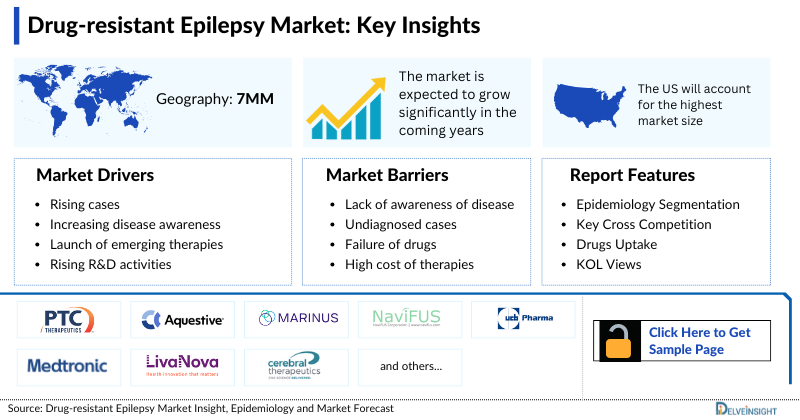
Factors contributing to the Growth of the "Drug-Resistant Epilepsy Market
-
Rising Prevalence of Epilepsy
The increasing global burden of epilepsy and the high proportion of patients who fail to achieve seizure control with existing anti-seizure medications are expanding the drug-resistant epilepsy patient pool.
-
High Unmet Medical Need
Approximately one-third of epilepsy patients develop resistance to standard therapies, driving strong demand for innovative and more effective treatment options.
-
Advancements in Disease Understanding
Improved insights into genetic, molecular, and neurobiological mechanisms underlying drug resistance are enabling the development of targeted and precision-based therapies.
-
Robust Clinical Pipeline
Pharmaceutical and biotechnology companies are actively investing in novel antiseizure drugs, gene therapies, biologics, and disease-modifying approaches, strengthening the future market outlook.
-
Growing Adoption of Neuromodulation Therapies
Increased use of vagus nerve stimulation, deep brain stimulation, and responsive neurostimulation is improving seizure management in patients unresponsive to pharmacological treatments.
-
Improved Diagnostic Capabilities
Advances in neuroimaging, long-term ECG Monitoring, and access to specialized epilepsy centers are supporting early identification and better management of drug-resistant cases.
-
Favorable Regulatory Support
Orphan drug designations, fast-track approvals, and increased research funding are accelerating innovation and product development in the drug-resistant epilepsy space.
-
Rising Awareness and Healthcare Access
Greater awareness among clinicians and patients, along with improved access to advanced care, is enhancing diagnosis rates and treatment uptake.
-
Impact on Quality of Life and Healthcare Costs
The significant physical, psychological, and economic burden of drug-resistant epilepsy continues to drive the need for effective long-term treatment solutions, supporting market growth.
DelveInsight’s comprehensive report titled “Drug-Resistant Epilepsy Market Insights, Epidemiology, and Market Forecast – 2036” offers a detailed analysis of Drug-Resistant Epilepsy. The report presents historical and projected epidemiological data covering diagnosed prevalent cases of epilepsy, diagnosed prevalent cases of Drug-Resistant Epilepsy, type-specific diagnosed prevalent cases of Drug-Resistant Epilepsy and gender-specific diagnosed prevalent cases of Drug-Resistant Epilepsy. In addition to epidemiology, the market report encompasses various aspects related to the patient population. These aspects include the diagnosis process, prescription patterns, physician perspectives, market accessibility, treatment options, and prospective developments in the market across 7MM: the United States, EU4 (Germany, France, Italy, and Spain), the United Kingdom, and Japan, spanning from 2022 to 2036.
The Drug-Resistant Epilepsy Treatment Market Report analyzes the existing treatment practices and unmet medical requirements in Drug-Resistant Epilepsy. It evaluates the market potential and identifies potential business prospects for enhancing therapies or interventions. This valuable information enables stakeholders to make well-informed decisions regarding product development and strategic planning for the market.
Scope of the Drug-Resistant Epilepsy Market | |
|
Study Period |
2022–2036 |
|
Forecast Period |
2026–2036 |
|
Geographies Covered |
US, EU4 (Germany, France, Italy, and Spain), the UK, and Japan |
|
Drug-Resistant Epilepsy Epidemiology |
|
|
Drug-Resistant Epilepsy Market |
|
|
Market Analysis |
|
|
Drug-Resistant Epilepsy Companies |
|
|
Future Opportunity |
The future of Drug-Resistant Epilepsy treatment lies in precision medicine, novel drug development, and advanced neuromodulation techniques. Emerging therapies like NRTX-1001 and IAMA-6 offer targeted approaches with potential for long-term seizure control. As regulatory approvals expand, these innovations could unlock significant market growth, improve patient outcomes, and reduce the global burden of uncontrolled epilepsy. |
Drug-Resistant Epilepsy Understanding
Drug-Resistant Epilepsy, also known as intractable or refractory epilepsy, refers to the inability to achieve sustained seizure freedom despite adequate trials of two well-tolerated, correctly selected antiepileptic drugs—either alone or in combination. Drug-Resistant Epilepsy may arise from poor treatment adherence, incorrect drug choice or dosage, or misdiagnosis, such as nonepileptic seizures resembling epilepsy. Risk factors for progression to Drug-Resistant Epilepsy include early-onset epilepsy, intellectual disability, symptomatic causes, and abnormal neurological findings. Epilepsy itself can stem from brain injury, developmental structural abnormalities, or genetic influences. A single seizure from causes like high fever or head trauma does not equate to Drug-Resistant Epilepsy. It is only diagnosed after two or more unprovoked seizures. Seizures are broadly classified into generalized onset, focal onset, and unknown onset types, each with further subdivisions. Understanding these distinctions is vital for accurate diagnosis and treatment planning.
Drug-Resistant Epilepsy Diagnosis and Treatment Overview
Drug-Resistant Epilepsy involves a comprehensive approach, beginning with neurological examination and brain imaging techniques such as Computed Tomography or Magnetic Resonance Imaging scans to detect structural abnormalities like tumors or hemorrhages. Seizure classification also plays a critical role in guiding diagnosis. Once Drug-Resistant Epilepsy is identified—typically after two ineffective Automated External Defibrillator trials—treatment pivots to more specialized strategies.
Management includes pharmacotherapy, often with Sodium Channel Modulators or Synaptic Vesicle Glycoprotein 2A (SV2a) vesicle inhibitors, though success is limited with additional AEDs. Surgical intervention may be considered for localized seizure foci. Alternative therapies such as neurostimulation, ketogenic diets, and lifestyle modifications offer additional avenues. Agents like phenytoin and carbamazepine remain standard options—phenytoin modulates sodium channels post-depolarization, while carbamazepine’s carbamyl moiety is vital for its anticonvulsant effects. A tailored, multidisciplinary approach is essential for optimizing outcomes in Drug-Resistant Epilepsy Patients.
Drug-Resistant Epilepsy Epidemiology
The epidemiology section of the Drug-Resistant Epilepsy market report offers information on the patient populations, including historical and projected trends for each of the 7MM. Examining Key Opinion Leader (KOL) views from physicians or clinical experts can assist in identifying the reasons behind historical and projected trends. The diagnosed patient pool, their trends, and the underlying assumptions are all included in this section of the report. This section also presents the data with relevant tables and graphs, offering a clear and concise view of the prevalence of Drug-Resistant Epilepsy. Additionally, the report discloses the assumptions made during the analysis, ensuring data interpretation and presentation transparency. This epidemiological data is valuable for understanding the disease burden and its impact on the patient population across various regions.
Key findings from the Drug- Resistant Epilepsy Epidemiological Analysis
- According to the secondary analysis, Drug-Resistant Epilepsy affects approximately one-third of the epilepsy patients in the 7MM. Several factors were linked to a higher likelihood of developing Drug-Resistant Epilepsy, such as an early age of seizure onset, epilepsy caused by an identifiable structural or metabolic cause (symptomatic epilepsy), abnormal findings on brain scans or EEG tests, intellectual disability, neuropsychiatric conditions, a history of febrile seizures, and episodes of status epilepticus.
- A retrospective cohort study reported that the prevalence of focal Drug-Resistant Epilepsy ranged from 8.8% in Italy and 18.2% in Germany.
- A US study found that during a one-year follow-up, women were 27% more likely than men to develop treatment-resistant epilepsy, regardless of age.
Drug-Resistant Epilepsy Epidemiology Segmentation in the 7MM
- Diagnosed Prevalent Cases of Epilepsy
- Drug-Resistant Epilepsy Diagnosed Prevalent Cases
- Type-specific Diagnosed Prevalent Cases
- Gender-specific Diagnosed Prevalent Cases
Drug-Resistant Epilepsy Market Outlook
The Drug-Resistant Epilepsy therapeutics market is further expected to increase by the major drivers, such as the rising prevalent population, technological advancements, and upcoming therapies in the forecast period (2026–2036). Drug-Resistant Epilepsy presents ongoing therapeutic challenges, impacting nearly one-third of individuals with epilepsy. While no drug based therapies are specifically approved for Drug-Resistant Epilepsy, several antiseizure medications—such as clobazam, perampanel, cenobamate, and the recently introduced XEN1101—are used in cases where conventional options fail.
For individuals unresponsive to these treatments, alternatives include off-label use of agents like felbamate and vigabatrin, dietary approaches such as the ketogenic diet, and neuromodulation techniques like VNS and responsive neurostimulation (RNS). Surgical resection may be considered for focal epilepsy. Continued development of more targeted and well-tolerated options remains a key focus of current research. With ongoing research and continued dedication, the future holds hope for even more effective treatments and, ultimately, a cure for this challenging condition. According to DelveInsight, the Drug-Resistant Epilepsy market in the 7MM is expected to change significantly during the forecast period (2026–2036).
Drug-Resistant Epilepsy Drug Analysis
Drug-Resistant Epilepsy Marketed Drugs
-
Vagus Nerve Stimulation (VNS) Therapy: LivaNova
VNS Therapy, developed by LivaNova, is an established neuromodulation treatment specifically designed for individuals with Drug-Resistant Epilepsy, particularly those experiencing partial or generalized seizures who are not candidates for resective brain surgery.
-
In June 2025, LivaNova took a strategic step by beginning the formal process with the US Centers for Medicare and Medicaid Services (CMS) to revisit and potentially expand Medicare coverage of its VNS Therapy—this time aiming to include individuals with unipolar treatment-resistant depression.
-
In June 2017, the US FDA expanded approval of VNS Therapy to include Drug-Resistant Epilepsyn as young as four with partial-onset seizures unresponsive to medication—making it the first and only device approved for pediatric Drug-Resistant Epilepsy. Prior to this, it was only approved for patients aged 12 and older.
|
Drug |
MoA |
RoA |
Company |
Logo |
|
VNS Therapy |
Neuromodulation |
Implant |
LivaNova |
|
|
XX |
XX |
X |
XXX |
Note: Detailed marketed therapies assessment will be provided in the final report.
Drug-Resistant Epilepsy Emerging Drugs
-
NRTX-1001: Neurona Therapeutics
NRTX-1001 is derived from human stem cells that are engineered into interneurons, similar to those naturally found in the brain. These cells release GAMMA-AMINOBUTYRIC ACID (GABA) Inhibitor, a key neurotransmitter believed to help suppress seizure activity by inhibiting excessive neural signaling.
-
-
In June 2025, Neurona Therapeutics reported that it had dosed the first patient in its Phase I/II clinical trial evaluating NRTX-1001, a regenerative cell therapy, in adults with drug-resistant, bilateral mesial temporal lobe epilepsy (MTLE).
-
In April 2025, Neurona Therapeutics shared fresh results from their early-stage clinical trial of NRTX-1001, an experimental treatment for adults with drug-resistant MLTE. The data was presented at this year’s American Academy of Neurology, offering a glimpse into potential progress for patients with limited treatment options.
-
-
IAMA-6: IAMA Therapeutics
IAMA-6, an orally administered small molecule therapeutics, is designed to selectively inhibit NKCC1 and restore neuronal excitability. The elevated activity of NKCC1 is implicated in various pathological conditions, underscoring the significant potential of NKCC1 inhibition in the treatment of refractory epilepsy and other neurological disorders.
-
The company has successfully completed a first-in-human Phase I clinical study (NCT06300398), which demonstrated that IAMA-6 is safe and well tolerated in healthy volunteers, with a favorable pharmacokinetic profile.
|
Drug |
MoA |
RoA |
Company |
Logo |
Phase |
|
NRTX-1001 |
Cell replacements |
Intrahippocampal |
Neurona Therapeutics |
|
I/II |
|
IAMA-6 |
Sodium-potassium-chloride symporter inhibitors |
Oral |
IAMA Therapeutics |
|
I |
|
XX |
XX |
X |
XXX |
XXX |


Note: Detailed marketed therapies assessment will be provided in the final report.
Drug-Resistant Epilepsy Market Segmentation
DelveInsight’s ‘Drug-Resistant Epilepsy – Market Insights, Epidemiology, and Market Forecast – 2036’ report provides a detailed outlook of the current and future Drug-Resistant Epilepsy market, segmented within countries, by therapies, and by classes. Further, the market of each region is then segmented by each therapy to provide a detailed view of the current and future market share of all therapies.
Drug-Resistant Epilepsy Market Size by Countries
The Drug-Resistant Epilepsy market size is assessed separately for various countries, including the United States, EU4 (Germany, France, Italy, and Spain), the United Kingdom, and Japan. In 2024, the United States held a significant share of the overall 7MM Drug-Resistant Epilepsy market, primarily attributed to the country’s higher prevalence of the condition and the elevated cost of the available treatments. This dominance is projected to persist, especially with the potential early introduction of new products.
Drug-Resistant Epilepsy Market Size by Therapies
Drug-Resistant Epilepsy Market Size by Therapies is categorized into current and emerging markets for the study period 2022–2036.
Drug-Resistant Epilepsy Drugs Uptake
This section focuses on the sales uptake of potential Drug-Resistant Epilepsy drugs that have recently been launched or are anticipated to be launched in the Drug-Resistant Epilepsy market between 2022 and 2036. It estimates the market penetration of Drug-Resistant Epilepsy drugs for a given country, examining their impact within and across classes and segments. It also touches upon the financial and regulatory decisions contributing to the probability of success (PoS) of the drugs in the Drug-Resistant Epilepsy market. The emerging Drug-Resistant Epilepsy therapies are analyzed based on various attributes such as safety and efficacy in randomized clinical trials, order of entry and other market dynamics, and the unmet need they fulfill in the Drug-Resistant Epilepsy market.
Drug-Resistant Epilepsy Market Access and Reimbursement
DelveInsight’s ‘Drug-Resistant Epilepsy Market Insights, Epidemiology, and Market Forecast – 2036’ report provides a descriptive overview of the market access and reimbursement scenario of Drug-Resistant Epilepsy. This section includes a detailed analysis of the country-wise healthcare system for each therapy, enlightening the market access, reimbursement policies, and health technology assessments.
Drug-Resistant Epilepsy KOL Views
To keep up with current Drug-Resistant Epilepsy market trends and fill gaps in secondary findings, we interview KOLs and SMEs’ working in the Drug-Resistant Epilepsy domain. Their opinion helps understand and validate current and emerging therapies and treatment patterns or Drug-Resistant Epilepsy market trends. This will support the clients in potential upcoming novel treatments by identifying the overall scenario of the market and the Drug-Resistant Epilepsy unmet needs.
Drug-Resistant Epilepsy: KOL Insights
DelveInsight’s analysts connected with 20+ KOLs to gather insights; however, interviews were conducted with 10+ KOLs in the 7MM. These KOLs were from organizations, institutes, and hospitals, such as, CDC, National Center for Chronic Disease Prevention and Health Promotion, US, University Hospital Frankfurt, Goethe University, Frankfurt am Main, Germany; Hospices Civils De Lyon and University of Lyon, Lyon, France; Sapienza University, Rome, Italy; Hospital Universitario Virgen de la Arrixaca, Murcia, Spain; University of Sheffield, UK; Hiroshima University Hospital, Japan, among others.
"As per KOL from the US, Drug-Resistant Epilepsy poses significant challenges due to its complex nature, making it difficult to manage with conventional antiepileptic drugs. The condition often leads to frequent and severe seizures, adversely affecting patients' quality of life. Moreover, the lack of effective treatment options and the unpredictability of seizures contribute to the burden on patients and healthcare systems."
"As per KOL from the UK, treatment for Drug-Resistant Epilepsy typically involves a combination of multiple antiepileptic drugs, but success rates are often low. Surgical interventions, like resective surgery or neuromodulation techniques (e.g., vagus nerve stimulation), offer alternatives when medication fails. Emerging therapies, such as gene therapy and novel pharmacological agents, are under investigation to provide more effective and targeted treatment options."
"As per KOL from Japan, significant unmet needs remain in Drug-Resistant Epilepsy management, including the development of more effective and less invasive treatments. Improved diagnostic tools to identify Drug-Resistant Epilepsy earlier and more accurately are crucial. Additionally, there is a need for personalized medicine approaches to tailor treatments to individual patients, reducing the trial-and-error process currently prevalent in Drug-Resistant Epilepsy management.”
Note: Detailed assessment of KOL Views will be provided in the full report on Drug-Resistant Epilepsy.
Drug-Resistant Epilepsy Competitive Intelligence Analysis
We conduct a Competitive and Market Intelligence analysis of Drug-Resistant Epilepsy. Market, utilizing various competitive intelligence tools such as SWOT analysis and Market entry strategies. The inclusion of these analyses is contingent upon data availability, ensuring a comprehensive and well-informed assessment of the market landscape and competitive dynamics.
Major Drug-Resistant Epilepsy Companies
LivaNova, Neurona Therapeutics, IAMA Therapeutics, and others.
Drug-Resistant Epilepsy Clinical Trials Activities
The Drug-Resistant Epilepsy Therapeutics Market Report offers an analysis of therapeutic candidates in Phase II and III stages and examines Drug-Resistant Epilepsy Companies involved in developing targeted therapeutics for Drug-Resistant Epilepsy. It provides valuable insights into the advancements and progress of potential treatments in clinical development for this condition.
Drug-Resistant Epilepsy Pipeline Development Activities
The Drug-Resistant Epilepsy Therapeutics Market Report covers information on collaborations, acquisition and merger, licensing, patent details, and other information for emerging Drug-Resistant Epilepsy therapies.
Drug-Resistant Epilepsy Market Report Insights
- Drug-Resistant Epilepsy Patient Population
- Therapeutic Approaches
- Drug-Resistant Epilepsy Pipeline Analysis
- Drug-Resistant Epilepsy Market Size and Trends
- Drug-Resistant Epilepsy Market Opportunities
- Impact of Upcoming Therapies
Drug-Resistant Epilepsy Market Report Key Strengths
- 11-Year Drug-Resistant Epilepsy Market Forecast
- The 7MM Coverage
- Drug-Resistant Epilepsy Epidemiology Segmentation
- Key Cross Competition
- Highly Analyzed Drug-Resistant Epilepsy Market
- Drug-Resistant Epilepsy Drugs Uptake
Drug-Resistant Epilepsy Market Report Assessment
- Current Drug-Resistant Epilepsy Treatment Practices
- Drug-Resistant Epilepsy Unmet Needs
- Drug-Resistant Epilepsy Product Profiles
- Drug-Resistant Epilepsy Market Attractiveness
Key Questions Answered in the Drug-Resistant Epilepsy Market Report
Drug-Resistant Epilepsy Market Insights
- How common is Drug-Resistant Epilepsy?
- What are the key findings of Drug-Resistant Epilepsy epidemiology across the 7MM, and which country will have the highest number of patients during the study period (2022–2036)?
- What are the currently available treatments for Drug-Resistant Epilepsy?
- What are the disease risk, burden, and unmet needs of Drug-Resistant Epilepsy?
- At what CAGR is the Drug-Resistant Epilepsy market and its epidemiology is expected to grow in the 7MM during the forecast period (2026–2036)?
- How would the unmet needs impact the Drug-Resistant Epilepsy market dynamics and subsequently influence the analysis of the related trends?
- What would be the forecasted patient pool of Drug-Resistant Epilepsy in the 7MM covering the United States, EU4 (Germany, France, Italy, and Spain), the United Kingdom, and Japan?
- Among EU4 and the UK, which country will have the highest number of patients during the forecast period (2026–2036)?
- How many companies are currently developing therapies for the treatment of Drug-Resistant Epilepsy?
Reasons to Buy the Drug-Resistant Epilepsy Market
- The Drug-Resistant Epilepsy Therapeutics Market Report will help in developing business strategies by understanding the latest trends and changing treatment dynamics driving the Drug-Resistant Epilepsy Drugs Market.
- Insights on patient burden/disease: Drug-Resistant Epilepsy Prevalence, evolution in diagnosis, and factors contributing to the change in the epidemiology of the disease during the forecast years.
- To understand the existing market opportunity in varying geographies and the growth potential over the coming years.
- Distribution of historical and current patient share based on real-world prescription data along with reported sales of current treatment in the US, EU4 (Germany, France, Italy, and Spain), the UK, and Japan.
- Identification of strong upcoming players in the Drug-Resistant Epilepsy Drugs Market will help in devising strategies that will help in getting ahead of competitors.
- Detailed analysis and ranking of class-wise potential current and emerging therapies under the attribute analysis section to provide visibility around leading classes.
- Highlights of Drug-Resistant Epilepsy Drugs Market access and reimbursement policies of approved therapies, barriers to accessibility of off-label expensive therapies, and patient assistance programs.
- To understand the perspective of KOL around the accessibility, acceptability, and compliance-related challenges of existing treatment to overcome barriers in the future.
- Detailed insights on the unmet needs of the existing Drug-Resistant Epilepsy Drugs Market so that the upcoming players can strengthen their development and launch strategy.
Stay updated with us for Recent Articles