
FTase Inhibitors Market Outlook
- The FTase inhibitor market in the 7MM is projected to grow at a significant CAGR by 2034 in leading countries (US, EU4, UK and Japan).
FTase Inhibitor Market and Epidemiology Analysis
- Farnesyltransferase (FTase) is a key enzyme that catalyzes the farnesylation of Ras protein. It is used to bind the RAS protein to the plasma membrane to complete signal transduction.
- FTase inhibitors work by blocking the activity of farnesyltransferase, thereby preventing the prenylation of Ras and other target proteins. This inhibition disrupts the proper functioning of these proteins, leading to impaired cell growth and survival, particularly in cancer cells.
- While originally developed for oncology, the therapeutic potential of FTIs has expanded into the realm of rare genetic disorders. Notably, ZOKINVY (lonafarnib) became the first approved FTase inhibitor, offering a disease-modifying benefit in Hutchinson-Gilford Progeria Syndrome (HGPS) and processing-deficient progeroid laminopathies (PL)—ultra-rare disorders marked by premature aging and high mortality
- In January 2024, ZOKINVY secured marketing approval in Japan (via Eiger and partner AnGes Inc.), broadening access for HGPS and PL patients globally. Despite a small eligible population—approximately 20 identified patients in the US.
- Given the nature of these fatal conditions, sales volumes may vary, reflecting both the ultra-orphan status and disease-related mortality.
- In oncology, tipifarnib (Kura Oncology) is running a trial of tipifarnib in combination with Novartis’s alpelisib in patients with HNSCC whose tumors have HRAS overexpression and/or PIK3CA mutation and/or amplification. This shift reflects the dynamic evolution of the FTI landscape, where monotherapy limitations are giving way to next-generation strategies, including rational combinations targeting resistance mechanisms in RAS/PI3K-driven tumors.
- As scientific insights into RAS biology deepen and biomarker-driven precision medicine advances, FTase inhibitors are poised to retain relevance, particularly in rare diseases and synergistic oncology regimens, where targeted disruption of farnesylation can translate into meaningful clinical impact.
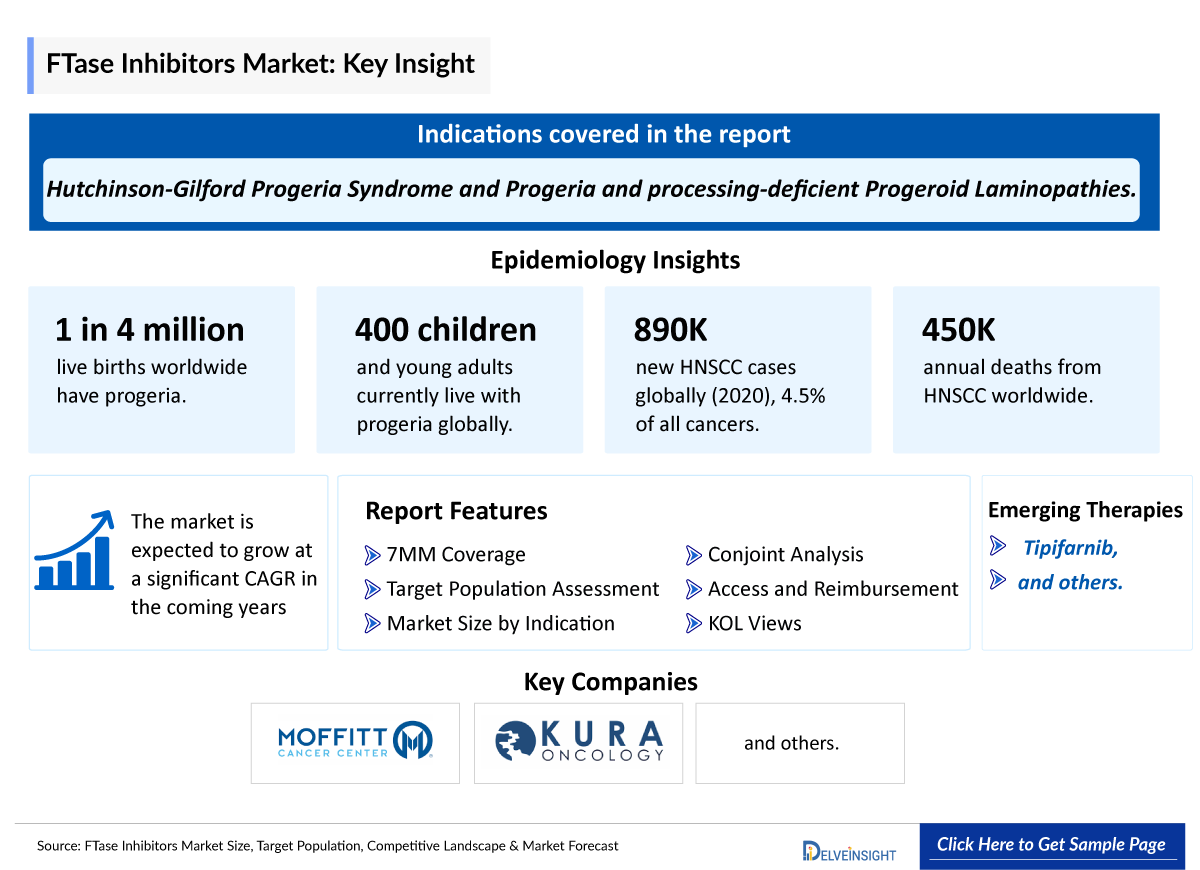
DelveInsight’s “FTase Inhibitors Market Size, Target Population, Competitive Landscape, and Market Forecast – 2034” report delivers an in-depth understanding of the FTase inhibitor, historical and Competitive Landscape as well as the FTase inhibitors’ market trends in the United States, EU4 (Germany, France, Italy, and Spain) and the United Kingdom, and Japan.
The FTase Inhibitors Market Report provides current treatment practices, emerging drugs, market share of individual therapies, and current and forecasted FTase inhibitor market size from 2020 to 2034 across 7MM. The report also covers current FTase inhibitor treatment practices/algorithms and unmet medical needs to curate the best opportunities and assess the FTase Inhibitor market’s potential.
|
Study Period |
2020 to 2034 |
|
Forecast Period |
2025-2034 |
|
Geographies Covered |
|
|
FTase Inhibitors Market |
|
|
FTase Inhibitors Market Size |
FTase Inhibitors Market: Overview
Farnesyltransferase is an enzyme that facilitates the attachment of a farnesyl group to specific proteins, a process called prenylation. This modification is crucial for the proper functioning and localization of these proteins within the cell. Among these proteins are members of the Ras superfamily, which play a pivotal role in cell growth, differentiation, and survival. Mutations in Ras proteins are common in many cancers, making them a prime target for cancer therapy.
FTase inhibitors work by blocking the activity of farnesyltransferase, thereby preventing the prenylation of Ras and other target proteins. This inhibition disrupts the proper functioning of these proteins, leading to impaired cell growth and survival, particularly in cancer cells. By hindering the prenylation process, FTase inhibitors can effectively reduce the oncogenic potential of mutated Ras proteins, thereby slowing down or even halting the progression of cancer.
The FTase inhibitors Market is emerging as a promising niche within the broader targeted therapy landscape, driven by validated use in ultra-rare genetic disorders and expanding applications in oncology. FTase inhibitors block the post-translational modification of key proteins, most notably HRAS and progerin, disrupting pathways that drive tumor growth and cellular instability. ZOKINVY (lonafarnib), the first FDA-approved FTase inhibitor, marked a historic milestone for the class. Approved in 2020 for Hutchinson-Gilford Progeria Syndrome (HGPS) and processing-deficient progeroid laminopathies, it demonstrated a statistically significant survival benefit in a population with no prior approved treatment options.
Further details related to country-based variations are provided in the report…
FTase Inhibitors Target Patient Pool
The FTase inhibitors epidemiology chapter in the report provides historical as well as forecasted epidemiology segmented as total cases of selected indications for FTase inhibitors, total eligible patient pool of selected indication for FTase inhibitors, total treated cases in selected indications for FTase inhibitors in the 7MM covering the United States, EU4 (Germany, France, Italy, and Spain), and the United Kingdom, and Japan from 2020 to 2034.
- Progeria cases are extremely rare. It occurs in 1 in every 4 million live births worldwide. About 400 children and young adults around the world currently live with progeria.
- Per the latest GLOBOCAN estimates (2020), Head and neck squamous cell carcinoma is the seventh most common cancer globally, accounting for an estimated 890,000 new HNSCC cases (roughly 4.5% of all cancer diagnoses around the world) and 450,000 deaths per year
FTase Inhibitor Drugs Market Chapters
The drug chapter segment of the FTase inhibitor Drugs Market Reports encloses a detailed analysis of approved FTase inhibitors late-stage (Phase III and Phase II) FTase inhibitors pipeline drugs. It also helps understand the FTase inhibitor’s clinical trials details, expressive pharmacological action, agreements and collaborations, approval and patent details, advantages and disadvantages of each included drug and the latest news and press releases.
FTase Inhibitors Marketed Drugs
- ZOKINVY (lonafarnib): Eiger BioPharmaceuticals/ Sentynl Therapeutics
ZOKINVY is a first-in-class disease-modifying agent that blocks the accumulation of defective progerin and progerin-like proteins which leads to cellular instability and premature aging in children and young adults with progeria. ZOKINVY has demonstrated a statistically significant survival benefit in children and young adults with Hutchinson-Gilford Progeria Syndrome (HGPS).
In November 2020, Eiger BioPharmaceuticals received FDA approval for ZOKINVY to reduce the risk of mortality in Hutchinson-Gilford Progeria Syndrome (HGPS) and to treat processing-deficient PL. Collectively known as progeria, these are ultra-rare and rapidly fatal genetic conditions of accelerated aging in children. ZOKINVY is our first approved product, and the first approved therapy for these indications
In May 2024, Sentynl Therapeutics, wholly-owned by Zydus Lifesciences, and Eiger BioPharmaceuticals, announced the closing of the sale of Eiger’s ZOKINVY (lonafarnib) program to Sentynl.
FTase Inhibitors Emerging Drugs
- Tipifarnib: Kura Oncology
Tipifarnib is an oral, investigational drug candidate and highly selective inhibitor of farnesyltransferase. Farnesyl transferase inhibitors (FTI) – such as tipifarnib – have multiple potential therapeutic applications, including direct inhibition of oncogenic proteins; overcoming drug resistance; and preventing emergence of resistance. Tipifarnib is currently being evaluated in patients with PIK3CA-dependent HNSCC.
In February 2021, the FDA granted tipifarnib Breakthrough Therapy Designation for the treatment of patients with recurrent or metastatic HRAS mutant HNSCC with variant allele frequency ≥ 20% after disease progression on platinum-based chemotherapy, or high VAF. In July 2021, Kura Oncology announced a clinical collaboration with Novartis, to evaluate the combination of tipifarnib and alpelisib, a PI3 kinase alpha inhibitor, in patients with HNSCC whose tumors have HRAS overexpression and/or PIK3CA mutation and/or amplification.
FTase Inhibitor Market Outlook
The FTase inhibitor market is drawing renewed interest, driven by its validated use in rare diseases and expanding potential in oncology. FTase inhibitors like lonafarnib and tipifarnib target farnesylation, a key post-translational modification essential for the activity of oncogenic and disease-driving proteins such as HRAS and progerin. ZOKINVY (lonafarnib), developed by Eiger BioPharmaceuticals and now owned by Sentynl Therapeutics (Zydus Lifesciences), is the first FDA-approved FTase inhibitor for HGPS and related laminopathies, offering a survival benefit in these ultra-rare, fatal pediatric conditions. This approval underscores FTase inhibition as a viable therapeutic strategy in genetic diseases.
Meanwhile, tipifarnib (Kura Oncology) is advancing in HRAS-mutant HNSCC, with promising clinical activity and expanded evaluation in biomarker-defined populations. Its combination with agents like alpelisib (a PI3Kα Inhibitor) further positions FTase inhibition as a versatile approach to overcome or delay resistance in targeted cancer therapies, particularly in RAS- and PI3K-driven malignancies. Together, these developments highlight FTase inhibitors’ potential across rare disease and precision oncology, supported by ongoing clinical validation and rational combination strategies.
FTase inhibitor Drugs Uptake
This section focuses on the uptake rate of potential approved and emerging FTase inhibitors expected to be launched in the market during 2020–2034.
FTase Inhibitor Pipeline Development Activities
The FTase Inhibitors Therapeutics Market Report provides insights into different FTase Inhibitor therapeutic candidates in Phase III, Phase II, and Phase I. It also analyzes key FTase Inhibitors Companies involved in developing targeted therapeutics. The presence of numerous drugs at different stages is expected to generate immense opportunities for the FTase inhibitors Market Growth over the forecasted period.
Pipeline Development Activities
The FTase Inhibitors Therapeutics Market Report covers information on collaborations, acquisitions and mergers, licensing, and patent details for FTase inhibitor therapies.
KOL Views
To keep up with current and future market trends, we take Industry Experts’ opinions working in the domain through primary research to fill the data gaps and validate our secondary research. Industry experts were contacted for insights on FTase inhibitors' evolving treatment landscape, patient reliance on conventional therapies, patient therapy switching acceptability, drug uptake, along challenges related to accessibility.
DelveInsight’s analysts connected with 20+ KOLs to gather insights; however, interviews were conducted with 10+ KOLs in the 7MM. Centers such as Johns Hopkins Sidney Kimmel Cancer Center and others. Their opinion helps understand and validate current and emerging therapy treatment patterns or FTase inhibitor market trends. This will support the clients in potential upcoming novel treatments by identifying the overall scenario of the market and the FTase Inhibitors unmet needs.
|
KOL Views |
|
“Despite their promising potential, the development and clinical application of FTase inhibitors have faced challenges. The redundancy and compensation by other prenylation pathways, such as geranylgeranylation, can reduce the effectiveness of FTase inhibitors.” |
Qualitative Analysis
We perform Qualitative and market Intelligence analysis using various approaches, such as SWOT analysis. In the SWOT analysis, strengths, weaknesses, opportunities, and threats in terms of disease diagnosis, patient awareness, patient burden, competitive landscape, cost-effectiveness, and geographical accessibility of therapies are provided. These pointers are based on the analyst’s discretion and assessment of the patient burden, cost analysis, and existing and evolving treatment landscape.
FTase Inhibitors Therapeutics Market Access and Reimbursement
Reimbursement may be referred to as the negotiation of a price between a manufacturer and a payer that allows the manufacturer access to the market. It is provided to reduce the high costs and make the essential drugs affordable. Health technology assessment (HTA) plays an important role in reimbursement decision-making and recommending the use of a drug. These recommendations vary widely throughout the seven major markets, even for the same drug.
In the US healthcare system, both Public and Private health insurance coverage are included. Also, Medicare and Medicaid are the largest government-funded programs in the US. The major healthcare programs including Medicare, Continuing Medical Education (CME) program, the Children's Health Insurance Program (CHIP), and the state and federal health insurance marketplaces are overseen by the Centers for Medicare & Medicaid Services (CMS). Other than these, Pharmacy Benefit Managers (PBMs), and third-party organizations that provide services, and educational programs to aid patients are also present.
The FTase Inhibitors Therapeutics Market Report further provides detailed insights on the country-wise accessibility and reimbursement scenarios, cost-effectiveness scenario of approved therapies, programs making accessibility easier and out-of-pocket costs more affordable, insights on patients insured under federal or state government prescription drug programs, etc.
Key Updates on FTase Inhibitor
- In January 2024, ZOKINVY secured marketing approval in Japan (via Eiger and partner AnGes Inc.), broadening access for HGPS and PL patients globally. Despite a small eligible population—approximately 20 identified patients in the US.
FTase Inhibitors Market Report Scope
- The FTase Inhibitors Market Report covers a segment of key events, an executive summary, and a descriptive overview, explaining its mechanism and therapies (current and emerging).
- Comprehensive insight into the competitive landscape, and forecasts, the future growth potential of treatment rate, drug uptake, and drug information have been provided.
- Additionally, an all-inclusive account of the current and emerging therapies and the elaborate profiles of late-stage and prominent therapies will impact the current landscape.
- A detailed review of the FTase inhibitor Treatment Market, historical and forecasted FTase Inhibitors Market Size, FTase Inhibitors Drugs Market Share by therapies, detailed assumptions, and rationale behind our approach is included in the report, covering the 7MM drug outreach.
- The FTase Inhibitors Therapeutics Market Report provides an edge while developing business strategies, by understanding trends, through SWOT analysis, expert insights/KOL views, and treatment preferences that help shape and drive the 7MM FTase inhibitor Market.
FTase Inhibitor Market Report Insights
- FTase inhibitors Targeted Patient Pool
- Therapeutic Approaches
- FTase Inhibitor Pipeline Drugs Analysis
- FTase Inhibitor Market Size and Trends
- Existing and future FTase Inhibitor Drugs Market Opportunity
FTase Inhibitor Market Report Key Strengths
- 10 years FTase Inhibitors Market Forecast
- The 7MM Coverage
- Key Cross Competition
- FTase Inhibitor Drugs Uptake
- Key FTase Inhibitors Market Forecast Assumptions
FTase Inhibitor Market Report Assessment
- Current FTase Inhibitors Treatment Practices
- FTase Inhibitors Unmet Needs
- FTase Inhibitors Pipeline Drugs Profiles
- FTase Inhibitors Market Attractiveness
- Qualitative Analysis (SWOT)
Key Questions
- What was the FTase inhibitor Treatment Market Size, the FTase Inhibitors Market Size by therapies, FTase Inhibitors Drugs Market Share (%) distribution, and what would it look like in 2034? What are the contributing factors for this growth?
- Which drug is going to be the largest contributor in 2034?
- Which is the most lucrative FTase inhibitor Market?
- What are the pricing variations among different geographies for approved therapies?
- How has the reimbursement landscape for FTase inhibitors evolved since the first one was approved? Do patients have any access issues that are driven by reimbursement decisions?
- What are the risks, burdens, and unmet needs of the FTase inhibitors treatment? What will be the growth opportunities across the 7MM for the patient population of FTase inhibitors?
- What are the key factors hampering the growth of the FTase inhibitor market?
- What are the indications for which recent novel therapies and technologies have been developed to overcome the limitations of existing treatments?
- What key designations have been granted to the therapies for FTase inhibitors?
- What is the cost burden of approved therapies on the patient?
- Patient acceptability in terms of preferred therapy options as per real-world scenarios?
- What are the country-specific accessibility issues of expensive, recently approved therapies?
Reasons to Buy
- The FTase Inhibitors Market Report will help develop business strategies by understanding the latest trends and changing dynamics driving the FTase inhibitor Market.
- Understand the existing FTase Inhibitors Drugs Market opportunities in varying geographies and the growth potential over the coming years.
- Distribution of historical and current patient share based on real-world prescription data along with reported sales of approved products in the US, EU4 (Germany, France, Italy, and Spain) the United Kingdom, and Japan.
- Identifying strong upcoming players in the FTase Inhibitors Drugs Market will help devise strategies to help get ahead of competitors.
- Detailed analysis and ranking of indication-wise current and emerging therapies under the conjoint analysis section to provide visibility around leading indications.
- Highlights of Access and Reimbursement policies of approved therapies, barriers to accessibility of expensive off-label therapies, and patient assistance programs.
- To understand Key Opinion Leaders’ perspectives around the accessibility, acceptability, and compliance-related challenges of existing treatment to overcome barriers in the future.
- Detailed insights on the unmet needs of the existing FTase Inhibitors Drugs Market so that the upcoming players can strengthen their development and launch strategy.
Stay updated with us for Recent Articles @ Latest DelveInsight Blogs

