
Graft versus host disease Pipeline
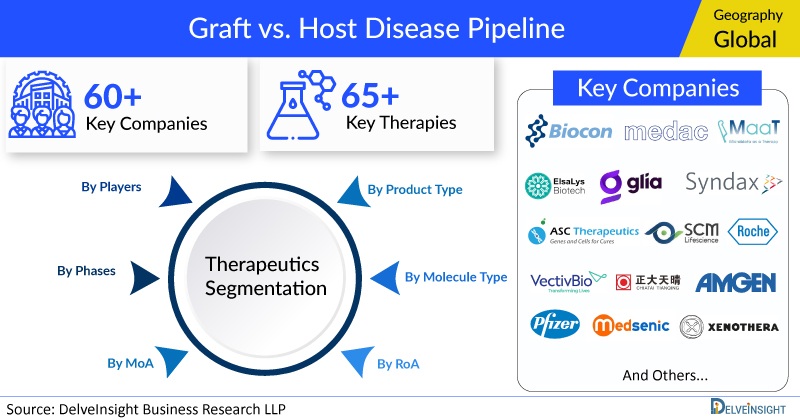
DelveInsight’s, "Graft versus host disease (GVHD) Pipeline Insight, 2026,” report provides comprehensive insights about 45+ GvHD companies and 50+ pipeline drugs in Graft versus host disease (GVHD) pipeline landscape. It covers the pipeline drug profiles, including clinical and nonclinical stage products. It also covers the therapeutics assessment by product type, stage, route of administration, and molecule type. It further highlights the inactive pipeline products in this space.
Geography Covered
- Global coverage
Graft versus host disease (GVHD) Understanding
Graft versus host disease (GVHD): Overview
Graft versus host disease (GVHD) is a serious complication that occurs when donor immune cells attack the recipient’s body following an allogeneic stem cell or bone marrow transplant. This condition arises because the donor's immune cells, recognizing the recipient's cells as foreign, initiate an immune response against them. GVHD primarily involves T-cells from the donor graft and can be classified into two main types: acute and chronic. Acute GVHD typically develops within the first 100 days post-transplant, manifesting through symptoms like skin rashes, jaundice, liver enzyme abnormalities, and diarrhea. Chronic GVHD, on the other hand, occurs after 100 days and can affect multiple organs, leading to symptoms such as skin thickening, joint contractures, dry eyes, and lung dysfunction.
The risk of developing GVHD is influenced by several factors, including the degree of HLA matching between donor and recipient, the type of donor, and the recipient’s age. Mismatched HLA significantly increases the risk, as does the use of unrelated or haploidentical donors and cord blood transplants compared to matched sibling donors. Older recipients are also more prone to GVHD, and the intensity of the conditioning regimen (pre-transplant chemotherapy or radiation) plays a critical role in the disease's development. Diagnosis is based on clinical presentation, biopsy of affected tissues, and the exclusion of other potential causes of symptoms.
Preventive measures are crucial in managing GVHD, with prophylactic immunosuppressive therapies such as cyclosporine, tacrolimus, methotrexate, and mycophenolate mofetil commonly used. Treatment of acute GVHD generally involves high-dose corticosteroids, with additional immunosuppressive agents like ruxolitinib and antithymocyte globulin (ATG) used for steroid-refractory cases. Chronic GVHD treatment also includes corticosteroids and calcineurin inhibitors, with newer therapies such as ibrutinib and ruxolitinib for refractory cases. Despite these treatments, GVHD can lead to significant morbidity and mortality due to direct organ damage and increased infection risk from prolonged immunosuppression.
The prognosis for GVHD varies widely; acute GVHD presents an immediate risk of severe outcomes, while chronic GVHD can cause long-term health issues. Effective prevention and treatment strategies are essential to improving patient outcomes and quality of life. Complications of GVHD include chronic infections, secondary cancers, and debilitating organ dysfunction, underscoring the importance of ongoing management and monitoring.
Research is continuously advancing to better understand the mechanisms underlying GVHD and to develop more targeted therapies. Innovations in immunotherapy and personalized medicine approaches hold promise for reducing the incidence and severity of GVHD. These advancements are crucial for enhancing the success rates of transplants and improving the overall prognosis for patients affected by this challenging condition.
"Graft versus host disease (GVHD) Pipeline Insight, 2026" report by DelveInsight outlays comprehensive insights of present scenario and growth prospects across the indication. A detailed picture of the Graft versus host disease pipeline landscape is provided which includes the disease overview and Graft versus host disease (GVHD) treatment guidelines. The assessment part of the report embraces, in depth Graft versus host disease (GVHD) commercial assessment and clinical assessment of the pipeline products under development. In the report, detailed description of the drug is given which includes mechanism of action of the drug, clinical studies, NDA approvals (if any), and product development activities comprising the technology, Graft versus host disease (GVHD) collaborations, licensing, mergers and acquisition, funding, designations and other product related details.
Report Highlights
The GvHD companies and academics are working to assess challenges and seek opportunities that could influence R&D Graft versus host disease (GVHD). The therapies under development are focused on novel approaches for Graft versus host disease (GVHD) treatment.
Graft versus host disease (GVHD) Emerging Drugs
Itolizumab: Equillium
Itolizumab is a clinical-stage, first-in-class monoclonal antibody that selectively targets the CD6-ALCAM pathway. This pathway plays a central role in modulating the activity and trafficking of T cells that drive a number of immuno-inflammatory diseases. Itolizumab was launched in India in 2013 under the brand name ALZUMAB. Itolizumab received emergency use approval in India to treat cytokine release syndrome in COVID-19 patients with moderate to severe acute respiratory distress syndrome. The drug is currently in Phase III clinical development for the treatment of acute graft-versus-host disease (aGVHD).
ABSK021: Abbisko Therapeutics
Pimicotinib (ABSK021), which was independently developed by Abbisko Therapeutics, is a novel, orally administered, highly selective and potent small-molecule inhibitor of CSF-1R. Abbisko is actively exploring the potential of pimicotinib in treating other indications including many types of solid tumors in clinic, and has obtained approval from NMPA to conduct a Phase II clinical study in chronic graft-versus-host disease. Currently, the drug is in the Phase II stage of its development for the treatment of Chronic Graft Versus Host Disease.
SYN-004: Theriva Biologics
SYN-004 (ribaxamase) is an oral prophylactic therapy designed to degrade certain IV beta-lactam antibiotics within the GI tract and maintain the natural balance of the gut microbiome for acute graft-versus-host-disease (aGVHD) in allogeneic hematopoietic cell transplant (HCT) recipients. Allogeneic HCT recipients routinely receive long courses of IV beta-lactam antibiotics to treat infection. Antibiotic-mediated damage of the gut microbiome in allogeneic HCT recipients has been strongly associated with adverse outcomes including CDI, vancomycin-resistant enterococci (VRE) colonization and potentially fatal bacteremia and aGVHD. Currently, the drug is in the Phase I/II stage of its development for the treatment of Graft versus host disease.
SER-155: Seres Therapeutics
SER-155 is an oral, investigational therapeutic comprising a fermented consortium of commensal bacteria, specifically designed to support immunocompromised patients. Its primary mechanism of action involves augmenting crucial microbiome functions that contribute to improved survival and reduced risks of infections and graft versus host disease (GvHD) in patients undergoing allogeneic hematopoietic stem cell transplantation (allo-HSCT). By leveraging insights from human clinical data, SER-155 aims to fortify the gut microbiome, enhance immune function, and protect against gastrointestinal infections and bacteremia. This multifaceted approach may offer a promising solution for patients facing the challenges of stem cell transplantation. Currently, the drug is in Phase I stage of its clinical trial for the treatment of GvHD.
Further product details are provided in the report……..
Graft versus host disease (GVHD): Therapeutic Assessment
This segment of the GVHD pipeline report provides insights about the Graft versus host disease drugs segregated based on following parameters that define the scope of the report, such as:
Major Players in Graft versus host disease (GVHD)
There are approx. 45+ key companies which are developing the Graft versus host disease (GVHD) therapies. The GVHD companies which have their drug candidates in the most advanced stage, i.e Phase III include Equillium.
Phases of GVHD Drugs
DelveInsight’s Graft versus host disease pipeline report covers around 50+ products under different phases of clinical development like
- Late stage products (Phase III)
- Mid-stage products (Phase II)
- Early-stage product (Phase I) along with the details of
- Pre-clinical and Discovery stage candidates
- Discontinued & Inactive candidates
Route of Administration
GVHD pipeline report provides the therapeutic assessment of the pipeline drugs by the Route of Administration. Graft versus host disease products have been categorized under various ROAs such as
- Intravenous
- Subcutaneous
- Oral
- Intramuscular
Molecule Type
Graft versus host disease Products have been categorized under various Molecule types such as
- Monoclonal antibody
- Small molecule
- Peptide
Product Type
Graft versus host disease drugs have been categorized under various product types like Mono, Combination and Mono/Combination.
|
|
|
|
|
|
|
|
|
|
|
|
|
|
Xenikos |
|
T lymphocyte inhibitors; Protein synthesis inhibitors |
|
|
|
|
|
|
|
|
|
|
|
Macrophage colony stimulating factor receptor antagonists |
|
|
|
|
|
|
|
Graft versus host disease (GVHD) Pipeline Development Activities
The Graft versus host disease pipeline report provides insights into different therapeutic candidates in phase II, I, preclinical and discovery stage. It also analyses GVHD therapeutic drugs key players involved in developing key drugs.
GVHD Pipeline Development Activities
The report covers the detailed information of collaborations, acquisition and merger, licensing along with a thorough therapeutic assessment of emerging Graft versus host disease (GVHD) drugs.
Explore the key factors, trends, innovations, and developments driving the market growth, at: Graft Versus Host Disease Market
Graft versus host disease (GVHD) Report Insights
- Graft versus host disease (GVHD) Analysis
- Therapeutic Assessment
- Unmet Needs
- Impact of GVHD Drugs
Graft versus host disease (GVHD) Report Assessment
- GVHD Pipeline Product Profiles
- Therapeutic Assessment
- Graft versus host disease Pipeline Assessment
- Inactive GVHD drugs assessment
- Unmet Needs
Key Questions
Current Treatment Scenario and Emerging Therapies:
- How many GVHD companies are developing Graft versus host disease drugs?
- How many GVHD drugs are developed by each Graft versus host disease company?
- How many emerging drugs are in mid-stage, and late-stage of development for the treatment of Graft versus host disease (GVHD)?
- What are the key collaborations (Industry–Industry, Industry–Academia), Mergers and acquisitions, licensing activities related to the Graft versus host disease therapeutics?
- What are the recent trends, drug types and novel technologies developed to overcome the limitation of existing GVHD therapies?
- What are the clinical studies going on for Graft versus host disease (GVHD) and their status?
- What are the key designations that have been granted to the emerging drugs?