Graves Ophthalmopathy Market Summary
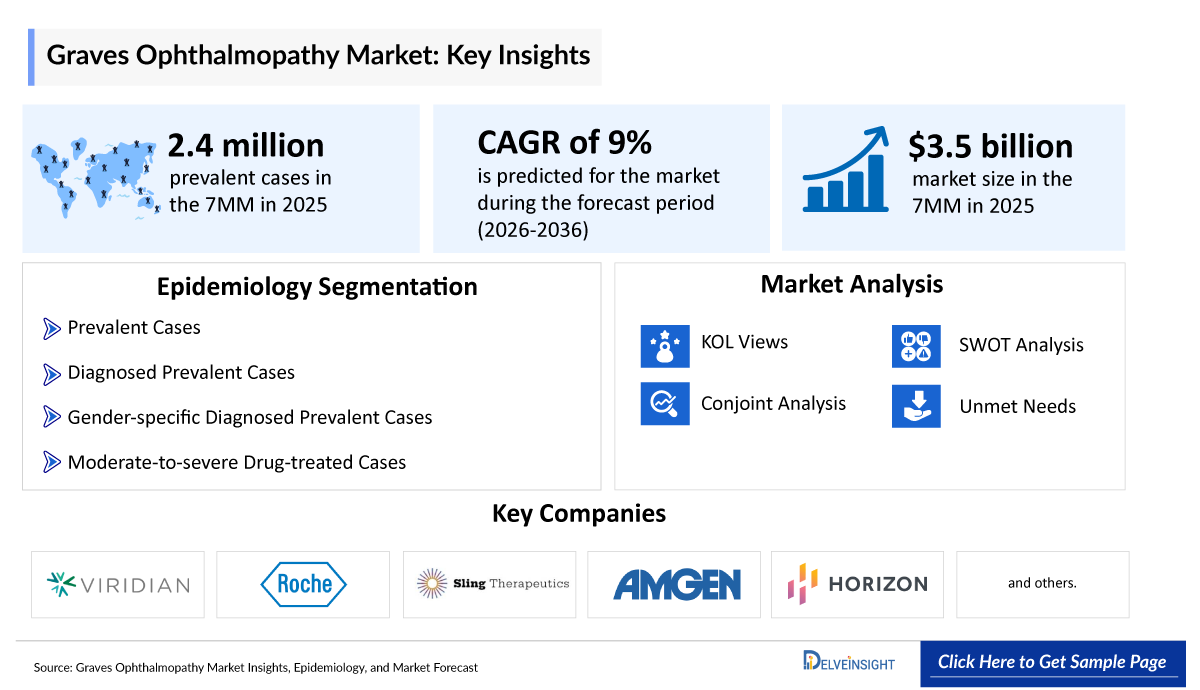
- The Graves’ Ophthalmopathy market size was valued at approximately USD 3,500 million in 2025 and is expected to expand at a CAGR of 9% during 2026–2036, reaching a substantially larger market size by 2036.
- The leading Graves Ophthalmopathy companies developing therapies in the treatment market include - Viridian Therapeutics, Roche, Sling Therapeutics, Amgen, Horizon Therapeutics, and others.
Graves Ophthalmopathy Market & Epidemiology Insights
- Graves' ophthalmopathy is generally considered a rare to infrequent disease, although it affects about 25–50% of patients with Graves' disease.
- According to the European Group on Graves Orbitopathy (EUGOGO) clinical practice guidelines 2021, IV methylprednisolone in combination with oral mycophenolate sodium (or mofetil) represents the first-line treatment for moderate-to-severe and acute Graves ophthalmopathy.
- The only FDA-approved disease-specific therapy is Teprotumumab (TEPEZZA), marketed by Amgen. It is an IGF-1 inhibitor and represents the first targeted therapy that directly addresses disease pathology, showing strong efficacy in reducing proptosis and diplopia in clinical trials.
- Linsitinib’s oral administration offers greater convenience than SC and IV therapies, while its approval in Graves' ophthalmopathy supports its established clinical utility and safety profile.
- The pipeline for Graves' ophthalmopathy is highly active and competitive. Key companies include Viridian Therapeutics (elegrobart), Roche (satralizumab), and Sling Therapeutics (linsitinib).
Graves Ophthalmopathy Market Size and Forecast in the 7MM
- 2025 Graves Ophthalmopathy Market Size: ~USD 3,500 million
- 2036 Projected Graves Ophthalmopathy Market Size: ~USD XXX million
- Graves Ophthalmopathy Growth Rate (2026–2036): 9% CAGR
DelveInsight's “Graves Ophthalmopathy Market Insights, Epidemiology and Market Forecast – 2036” report delivers an in-depth understanding of the Graves ophthalmopathy, historical and forecasted epidemiology, as well as the Graves ophthalmopathy therapeutics market trends in the United States, EU4 (Germany, Spain, Italy, and France), and the United Kingdom, and Japan.
The Graves Ophthalmopathy market report delivers a comprehensive analysis of the current treatment landscape, including standards of care, clinical practices, and evolving therapeutic algorithms. It evaluates Graves' ophthalmopathy patient burden trends, revenue & market share dynamics, peak patient share & therapy uptake analysis, and provides an in-depth market size assessment, and growth rate projections (Historical & Forecast 2022–2036) across global regions. The report highlights key unmet medical needs in Graves' ophthalmopathy and maps the competitive and clinical landscape to uncover high‑value opportunities, providing a clear outlook on future market growth potential.
Key Factors Driving the Graves Ophthalmopathy Market
- Rising Disease Prevalence & Awareness: The increasing prevalence of Graves' ophthalmopathy and better diagnostic practices are expanding the patient pool, with improved awareness among clinicians, leading to earlier detection and treatment.
- Increased R&D and Strategic Collaborations: Companies like Roche, Amgen, and Sling Therapeutics are investing in innovative delivery methods (subcutaneous, oral) and new drug development.
Scope of the Graves Ophthalmopathy Market Report
| |
|
Study Period |
2022–2036 |
|
Historical Year |
2022–2025 |
|
Forecast Period |
2026–2036 |
|
Base Year |
2026 |
|
Geographies Covered |
ü North America: The US; ü Europe: Germany, France, Italy, Spain, and the UK; ü Asia-Pacific: Japan |
|
Graves Ophthalmopathy Market CAGR (Forecast period) |
9% (2026–2036) |
|
Graves Ophthalmopathy Epidemiology Segmentation Analysis |
Patient Burden Assessment · Total Prevalent Cases of Graves Ophthalmopathy · Diagnosed Prevalent Cases of Graves Ophthalmopathy · Gender-specific Prevalent Cases of Graves Ophthalmopathy · Diagnosed Prevalent Cases of Graves Ophthalmopathy by Chronicity · Acute Diagnosed Prevalent Cases of Graves Ophthalmopathy by Severity · Acute moderate-to-severe Drug-treated Cases of Graves Ophthalmopathy |
|
Graves Ophthalmopathy Companies |
· Viridian Therapeutics · Roche · Sling Therapeutics · Amgen · Horizon Therapeutics, and others |
|
Graves Ophthalmopathy Therapies |
· TEPEZZA · Elegrobart (VRDN-003) · Satralizumab (RG6168) · Linsitinib, and others |
|
Graves Ophthalmopathy Market |
Segmented by · Region/Geographies · Drugs/Therapies |
|
Analysis |
· Addressable Patient Population · Market Drivers and Market Barriers · Cost Assumptions and Pricing Analogues · KOL Views · SWOT Analysis · Reimbursement · Conjoint Analysis · Unmet Need |
Graves Ophthalmopathy Disease Understanding
Graves Ophthalmopathy Overview
Graves' ophthalmopathy, also known as Thyroid Eye Disease (TED), is an autoimmune inflammatory condition associated with Graves' disease in which immune-mediated activation of orbital fibroblasts leads to expansion of extraocular muscles and orbital fat. This results in characteristic features such as proptosis (eye bulging), eyelid retraction, periorbital edema, and, in severe cases, optic nerve compression. The disease typically follows an active inflammatory phase followed by a chronic fibrotic phase, and its severity can range from mild discomfort to vision-threatening complications. Risk factors include smoking, thyroid dysfunction, and high levels of thyroid-stimulating immunoglobulins.
Graves Ophthalmopathy Diagnosis
Diagnosis of Graves' ophthalmopathy is primarily clinical, supported by laboratory and imaging findings. Patients commonly present with eye irritation, redness, diplopia, and progressive proptosis. Thyroid function tests (TSH, free T4, T3) and thyroid antibody levels, particularly TSH receptor antibodies, help confirm the underlying autoimmune thyroid disorder. Imaging studies such as CT or MRI of the orbits are used to assess enlargement of extraocular muscles and orbital tissue involvement, and to rule out other orbital pathologies. Disease activity and severity are often graded using clinical activity scores (CAS), which guide treatment decisions.
Further details are provided in the report...
Current Graves Ophthalmopathy Treatment Landscape
Management depends on disease severity and activity, combining supportive, medical, and surgical approaches. Mild cases may be managed with lubricants and risk factor control, like smoking cessation, while moderate-to-severe active disease often requires immunosuppression, typically with intravenous corticosteroids such as Methylprednisolone. The only disease-specific approved therapy is TEPEZZA, marketed by Amgen, which targets the IGF-1 receptor and has shown significant efficacy in reducing proptosis and diplopia. Surgical interventions, including orbital decompression, strabismus surgery, or eyelid procedures, are typically reserved for the inactive phase or vision-threatening disease.
Further details related to country-based variations are provided in the report...
Graves' Ophthalmopathy Unmet Needs
The section “unmet needs of Graves' ophthalmopathy” outlines the critical gaps between the current state of patient care, diagnosis, and the ideal & effective management of the disease. It highlights the obstacles experienced by patients, clinicians, and researchers and identifies potential solutions for future progress.
- Limited treatment options
- Limitations of guidelines
- Disease burden
- Access barriers, and others…..
Note: Comprehensive unmet needs insights in Graves Ophthalmopathy and their strategic implications are provided in the full report…
Graves Ophthalmopathy Epidemiology
The Graves Ophthalmopathy epidemiology section provides insights about the historical and current Graves Ophthalmopathy patient pool and forecasted trends for individual seven major countries. It helps to recognize the causes of current and forecasted trends by exploring numerous studies and views of key opinion leaders. This part of the Graves Ophthalmopathy market report also provides the diagnosed patient pool and their trends along with assumptions undertaken.
Key Findings from Graves Ophthalmopathy Epidemiological Analysis and Forecast
- According to DelveInsight’s estimates, in 2025, the total prevalent cases of Graves' ophthalmopathy in the 7MM were ~2,408,800.
- In 2025, the United States accounted for approximately 1.03 million diagnosed prevalent cases of Graves' ophthalmopathy, representing the highest disease burden among major markets, followed by the EU4 and the UK, and Japan.
- Graves' ophthalmopathy is significantly more prevalent in females, accounting for approximately 80% of cases, compared with 20% in males.
Graves Ophthalmopathy Epdidemiology Segmentation
- Total Prevalent Cases of Graves Ophthalmopathy
- Diagnosed Prevalent Cases of Graves Ophthalmopathy
- Gender-specific Prevalent Cases of Graves Ophthalmopathy
- Diagnosed Prevalent Cases of Graves Ophthalmopathy by Chronicity
- Acute Diagnosed Prevalent Cases of Graves Ophthalmopathy by Severity
- Acute moderate-to-severe Drug-treated Cases of Graves Ophthalmopathy
Recent Developments in the Graves Ophthalmopathy Drug Updates
- In March 2026, Viridian Therapeutics announced positive topline data from the elegrobart REVEAL-1 phase III clinical trial in patients with active thyroid eye disease (TED). REVEAL-1 met the primary endpoint of Q4W proptosis responder rate (PRR) and Complete resolution of diplopia in 51% of patients treated Q4W versus 16% placebo at week 24.
- In January 2025, Sling Therapeutics announced topline efficacy and safety data from the Phase II/III LIDS trial of linsitinib in patients with active, moderate to severe TED. The trial met the primary endpoint of proptosis reduction with statistical significance at the 150mg BID dose.
- In October 2023, Amgen announced that it had completed its acquisition of Horizon Therapeutics.
Graves Ophthalmopathy Drug Analysis & Competitive Landscape
The Graves' ophthalmopathy drug chapter provides a detailed, market-focused review of approved therapies and the emerging pipeline across Phase III–I Graves Ophthalmopathy clinical trials. It covers the mechanism of action, clinical trial data, regulatory approvals, patents, collaborations, and strategic partnerships for each therapy, along with their advantages, limitations, and recent developments. This section offers critical insights into the graves ophthalmopathy treatment landscape, supporting market assessment, competitive analysis, and growth forecasting for the graves ophthalmopathy therapeutics market.
Approved Therapies for Graves Ophthalmopathy
Teprotumumab (TEPEZZA): Amgen
Teprotumumab, marketed as TEPEZZA, is an insulin-like growth factor-1 receptor (IGF-1R) inhibiting monoclonal antibody originally developed by Horizon Therapeutics and now part of Amgen following its 2023 acquisition. It is the first and only FDA-approved therapy specifically for TED, targeting the underlying autoimmune pathway rather than just symptoms. TEPEZZA has demonstrated strong efficacy in reducing proptosis and diplopia in clinical trials.
Graves Ophthalmopathy Marketed/Approved Therapies | ||||||
|
Company |
Indication |
Molecule Type |
MoA |
RoA |
Marketed Region |
|
|
Amgen |
TED |
IgG1 monoclonal antibody |
IGF-1R inhibitor |
IV |
US: 2020 |
|
Note: Detailed marketed therapies assessment will be provided in the final report...
Graves Ophthalmopathy Pipeline Analysis
Elegrobart (VRDN-003): Viridian Therapeutics
Elegrobart is an investigational monoclonal antibody developed by Viridian Therapeutics for the treatment of TED. It targets and blocks the IGF-1R, a key pathway involved in the disease process. It is being developed as a potential best-in-class subcutaneous anti-IGF-1R therapy for self-administration at home using a low‑volume autoinjector, with every-4-week or every-8-week dosing. The company, in its SEC filing, anticipated that Elegrobart is on track for a BLA submission anticipated in Q1 2027.
Linstinitb: Sling Therapeutics
Linsitinib is developed for TED that will ease the treatment burden for patients, caregivers, and physicians. Linsitinib is the first and only oral small-molecule therapy to establish statistical and clinical significance in TED. Linsitinib works by inhibiting the IGF-1R target, which is the only validated clinical target in TED and the only target for current FDA-approved therapies. Activation of the IGF-1R target leads to inflammation and proptosis seen in TED. Linsitinib has an established safety profile through treatment of more than 900 patients in fifteen clinical trials in multiple diseases.
Competitive Landscape of Graves Ophthalmopathy Pipeline Drugs | ||||||
|
Drug Name |
Company |
Highest Phase |
Indication |
RoA |
MoA |
Anticipated Launch in the US |
|
Elegrobart (VRDN-003) |
Viridian Therapeutics |
III |
Active TED |
SC |
IGF-1R Inhibitor |
Information is available in the full report |
|
Satralizumab (RG6168) |
Roche |
III |
TED |
SC |
IL-6 Inhibitor |
Information is available in the full report |
|
Linsitinib |
Sling Therapeutics |
II/III |
TED |
Oral |
IGF-1R inhibitor |
Information is available in the full report |
|
Note: Launch insights are provisional and may change with future report updates or the occurrence of major key catalysts. | ||||||
Note: Detailed emerging therapies assessment will be provided in the final report...
Graves Ophthalmopathy Key Players, Market Leaders, and Emerging Companies
- Viridian Therapeutics
- Roche
- Sling Therapeutics
- Amgen
- Horizon Therapeutics, and others
Graves Ophthalmopathy Market Outlook
The treatment landscape of Graves' ophthalmopathy has shifted from mainly supportive care and surgery toward disease-modifying immunotherapy. Conventional management includes high-dose intravenous corticosteroids such as Methylprednisolone for active disease. In addition, several off-label biologics, such as Tocilizumab and Rituximab, are used in refractory patients, although they are not specifically approved for TED.
A breakthrough came with the approval of Teprotumumab (TEPEZZA) by Amgen, the first targeted therapy for TED. It inhibits IGF-1R, leading to significant reductions in proptosis and diplopia. The pipeline is expanding with targeted approaches, including IGF-1R antibodies like elegrobart, IL-6 inhibitors such as satralizumab, and oral small molecules like linsitinib.
- Overall, the advancements in targeted treatments are expected to drive steady growth in the 7MM Graves' Ophthalmopathy market from 2022–2036, with strong commercial implications for both marketed products and emerging pipelines.
- Among the 7MM, the US accounted for the largest market size of Graves' ophthalmopathy. i.e., USD ~3000 million in 2025.
- Among approved therapies, TEPEZZA is expected to remain the primary revenue driver, supported by its strong efficacy in reducing proptosis and its position as the only disease-specific approved treatment.
- The entry of late to mid-stage candidates such as elegrobart (VRDN-003), satralizumab (RG6168), and linsitinib is anticipated to intensify competition and accelerate the shift toward more convenient subcutaneous and oral targeted therapies over the forecast period.
Further details will be provided in the report...
Drug Class/Insights into Leading Emerging and Marketed Therapies in Graves Ophthalmopathy (2022–2036 Forecast)
The Graves' ophthalmopathy market comprises targeted immunotherapies, each targeting different aspects of Graves' ophthalmopathy.
Targeted immunotherapies: Approved therapies such as TEPEZZA and emerging therapies such as elegrobart and linsitnib target the IGF-1R receptor pathway, a key driver of orbital fibroblast activation and tissue expansion in TED, and satralizumab (IL-6 receptor inhibitor) targets inflammatory signaling pathways. Linsitinib is an oral targeted therapy candidate, representing a non-biologic alternative to monoclonal antibodies, and is being developed to improve patient convenience compared to intravenous IGF-1R therapies.
Targeted Immunotherapy defines the core innovation landscape driving market growth.
Graves Ophthalmopathy Drug Uptake
This section focuses on the uptake rate of potential Graves Ophthalmopathy drugs expected to be launched in the market during the forecast period (2026–2036). The analysis covers the graves ophthalmopathy drug’s uptake, performance at peak, factors affecting performance during the prime years of growth, patient uptake by therapy, and anticipated sales generated by each drug.
The uptake of therapies in Graves' ophthalmopathy is expected to vary based on clinical positioning, mechanism of action, and stage of development. One approved therapy, TEPEZZA, is set to experience moderate but meaningful uptake. Its targeted IGF-1R inhibiting mechanism and demonstrated efficacy in reducing proptosis and diplopia support its use in active moderate-to-severe and refractory cases of Thyroid Eye Disease.
In contrast, pipeline candidates such as elegrobart (VRDN-003), satralizumab (RG6168), and linsitinib are likely to demonstrate progressive uptake upon approval, as these therapies are designed to improve upon existing treatment options by targeting key disease pathways such as IGF-1R signaling and IL-6–mediated inflammatory pathways.
Detailed insights into emerging therapies' drug uptake are included in the report...
Graves Ophthalmopathy Market Access and Reimbursement of Approved Therapies
The United States
US Reimbursement of Therapies Approved for Graves Ophthalmopathy | |
|
Drug/Therapy |
Access Program |
|
TEPEZZA |
Amgen By Your Side |
Reimbursement is a crucial factor that affects the drug’s access to the market. Often, the decision to reimburse comes down to the price of the drug relative to the benefit it produces in treated patients. To reduce the healthcare burden of these high-cost therapies, many payment models are being considered by payers and other industry insiders.
NOTE: Further Details are provided in the final report...
Graves Ophthalmopathy Therapies Price Scenario & Trends
Pricing and analogue assessment of Graves' ophthalmopathy therapies highlights evolving price dynamics structures. This section summarizes the cost of approved treatments, the closest and most appropriate analogue selection for emerging therapies, and understanding of how pricing influences market access, adherence, and long-term uptake.
- Pricing of Graves Ophthalmopathy Approved Drugs
The recommended dosing regimen for TEPEZZA consists of an initial intravenous infusion of 10 mg/kg, followed by 20 mg/kg administered every three weeks for a total of seven additional infusions. The total treatment cost is approximately USD 350,000 for a 75 kg patient.
Industry Experts and Physician Views for Graves Ophthalmopathy
To keep up with Graves' ophthalmopathy market trends, we take Key Opinion Leaders (KOLs) and Subject Matter Experts (SMEs) opinions working in the domain through primary research to fill the data gaps and validate our secondary research. Industry experts were contacted for insights on the Graves' ophthalmopathy emerging therapies, evolving treatment landscape, patient adherence to conventional therapies, therapy switching trends, drug adoption and uptake, accessibility challenges, and epidemiology and real-world prescription patterns in Graves' ophthalmopathy, including MD, PhD, Instructor, Postdoctoral Researcher, Professor, Researcher, and others.
DelveInsight’s analysts connected with 15+ KOLs to gather insights at the country level. Centers such as the Institute for Genomic Sciences, Florida International University, and Essen University Hospital, etc. were contacted. Their opinion helps understand and validate current and emerging Graves' ophthalmopathy therapies, highlight unmet medical needs, provide epidemiological context, and support strategic decisions for market access, therapy adoption, and pipeline prioritization in Graves ophthalmopathy.
|
Region |
Key Opinion Leaders (KOLs) and Subject Matter Experts (SMEs) |
|
United States |
“While teprotumumab is the only FDA-approved medication for TED, a rapidly growing industry is focusing on developing agents to block the IGF-1R pathway. Introducing such agents that could address the wide-reaching effects of TED may redefine the treatment landscape.” |
|
Germany |
“Proptosis is the primary symptom that comes to mind when most optometrists think about TED. Though proptosis is an obvious symptom of the condition, it is not the only symptom to look out for. Unfortunately, other symptoms are often so subtle that they are easy to miss. One such symptom is dry eyes. In one study, 72% of TED patients say dry eyes are their most frequent source of eye discomfort; however, this symptom is often misdiagnosed as allergies or conjunctivitis.” |
Graves Ophthalmopathy Report Qualitative Analysis: SWOT and Conjoint Analysis
We perform qualitative and market Intelligence analysis using various approaches, such as SWOT analysis and conjoint analysis.
In the SWOT analysis of Graves' ophthalmopathy, strengths, weaknesses, opportunities, and threats in terms of disease diagnosis, patient awareness, patient burden, competitive landscape, cost-effectiveness, and geographical accessibility of therapies are provided.
Conjoint analysis analyzes emerging therapies based on relevant attributes such as safety, efficacy, frequency of administration, route of administration, and order of entry. Scoring is given based on these parameters to analyze the effectiveness of therapy.
The team of analysts analyzes promising emerging therapies based on relevant attributes such as safety, efficacy, frequency of administration, route of administration, and order of entry. In efficacy, the trial’s primary and secondary outcome measures are evaluated, whereas the therapies’ safety is evaluated, wherein the acceptability, tolerability, and adverse events are mainly observed. In addition, the scoring is also based on the route of administration, order of entry, probability of success, and the addressable patient pool for each therapy. According to these parameters, the final weightage score and the ranking of the emerging therapies are decided.
Scope of the Graves Ophthalmopathy Market Report
- The report covers a segment of key events, an executive summary, a descriptive overview of Graves' ophthalmopathy, explaining its causes, signs and symptoms, pathogenesis, and currently available treatments.
- Comprehensive insight has been provided into the epidemiology segments and forecasts, the future growth potential of the diagnosis rate, and disease progression along treatment guidelines.
- Additionally, an all-inclusive account of both the current and emerging treatments, along with the elaborative profiles of late-stage and prominent therapies, will have an impact on the current treatment landscape.
- A detailed review of the Graves' ophthalmopathy market, historical and forecasted market size, market share by therapies, detailed assumptions, and rationale behind our approach is included in the report, covering the 7MM drug outreach.
- The report provides an edge while developing business strategies by understanding trends through SWOT analysis and expert insights/KOL views, patient journey, and treatment preferences that help in shaping and driving the 7MM Graves' Ophthalmopathy market.
Graves Ophthalmopathy Market Report Insights
- Graves Ophthalmopathy Patient Population Forecast
- Graves Ophthalmopathy Therapeutics Market Size
- Graves Ophthalmopathy Pipeline Analysis
- Graves Ophthalmopathy Market Size and Trends
- Graves Ophthalmopathy Market Opportunity (Current and forecasted)
Graves Ophthalmopathy Market Report Key Strengths
- Graves Ophthalmopathy Epidemiology‑based (Epi‑based) Bottom‑up Forecasting
- Artificial Intelligence (AI)-Enabled Market Research Report
- 11-Year Forecast
- Graves Ophthalmopathy Market Outlook (North America, Europe, Asia-Pacific)
- Graves Ophthalmopathy Patient Burden Trends (By Geography)
- Graves Ophthalmopathy Treatment Addressable Market (TAM)
- Graves Ophthalmopathy Competitive Landscape
- Graves Ophthalmopathy) Major Companies Insights
- Graves Ophthalmopathy Price Trends and Analogue Assessment
- Graves Ophthalmopathy Therapies Drug Adoption/Uptake
- Graves Ophthalmopathy Therapies Peak Patient Share Analysis
Graves Ophthalmopathy Market Report Assessment
- Graves Ophthalmopathy Current Treatment Practices
- Graves' Ophthalmopathy Unmet Needs
- Graves Ophthalmopathy Clinical Development Analysis
- Graves Ophthalmopathy Emerging Drugs Product Profiles
- Graves Ophthalmopathy Market Attractiveness
- Graves Ophthalmopathy Qualitative Analysis (SWOT and conjoint analysis)
- Graves Ophthalmopathy Market Drivers
- Graves Ophthalmopathy Market Barriers
FAQs Related to the Graves Ophthalmopathy Market Report:
Graves Ophthalmopathy Market Insights
- What was the Graves' ophthalmopathy market size, the market size by therapies, market share (%) distribution in 2025, and what would it look like by 2036? What are the contributing factors for this growth?
- What are the anticipated pricing variations among different geographies for the emerging therapies in the future?
- What can be the future treatment paradigm of Graves' ophthalmopathy?
- What are the disease risks, burdens, and unmet needs of Graves' ophthalmopathy? What will be the growth opportunities across the 7MM concerning the Graves Ophthalmopathy patient population?
- Who is the major future competitor in the market, and how will the competitors affect their market share?
- What are the current options for the treatment of Graves' ophthalmopathy? What are the current guidelines for treating Graves' ophthalmopathy in the US, Europe, and Japan?
Reasons to Buy Graves Ophthalmopathy Market Forecast Report
- The report will help in developing business strategies by understanding the latest trends and changing treatment dynamics driving the Graves' ophthalmopathy market.
- Bottom up forecasting builds from the affected population to product forecasts, delivering a robust, data driven approach ideal for new therapies and novel classes.
- Insights on patient burden/disease incidence, evolution in diagnosis, and factors contributing to the change in the epidemiology of the disease during the forecast years.
- Understand the existing market opportunities in varying geographies and the growth potential over the coming years.
- Identifying strong upcoming players in the market will help devise strategies to help get ahead of competitors.
- Detailed analysis and ranking of class-wise potential current and emerging therapies under the conjoint analysis section to provide visibility around leading classes.
- To understand KOLs’ perspectives on the accessibility, acceptability, and compliance-related challenges of existing treatment to overcome barriers in the future.
- Detailed insights into the unmet needs of the existing market so that the upcoming players can strengthen their development and launch strategy.
- This Artificial Intelligence (AI) enabled report summarizes and simplifies complex datasets within the report into clear, actionable insights for stakeholders, investors, and healthcare providers, enabling faster, data driven decisions.