Hyperbaric Oxygen Therapy Equipment Market Summary
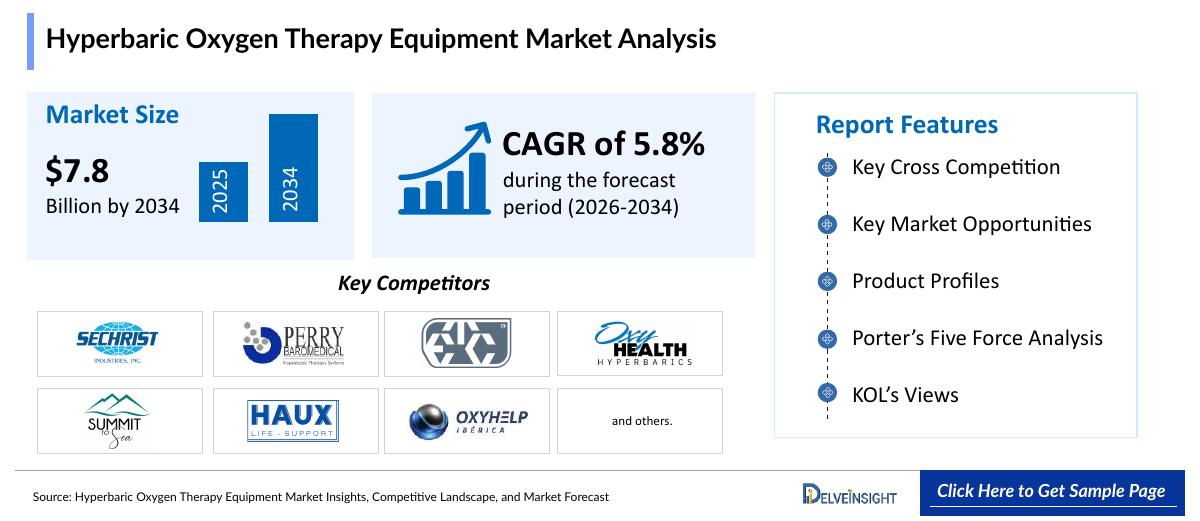
- The Hyperbaric Oxygen Therapy Equipment Market is estimated at USD 4.25 billion in 2025 and is projected to reach USD 7.08 billion by 2034. Growth is anchored in the rising burden of diabetic and other chronic non-healing wounds, expanding use of hyperbaric oxygen therapy for radiation-induced tissue injuries, and the steady build-out of hospital, clinic, and outpatient wound-care capacity.
- The global Hyperbaric Oxygen Therapy Equipment Market is growing at a CAGR of 5.8% during the forecast period from 2026 to 2034.
- By product type, the hyperbaric chambers segment dominated the Hyperbaric Oxygen Therapy Equipment Market with an 81% share in 2025.
- By chamber type, the monoplace chambers segment dominated the Hyperbaric Oxygen Therapy Equipment Market with a 41% share in 2025.
- By system type, the oxygen-filled systems segment dominated the Hyperbaric Oxygen Therapy Equipment Market with a 53% share in 2025.
- By application, the wound healing segment dominated the Hyperbaric Oxygen Therapy Equipment Market with a 36% share in 2025.
- By end user, the hospitals segment dominated the Hyperbaric Oxygen Therapy Equipment Market with a 47% share in 2025.
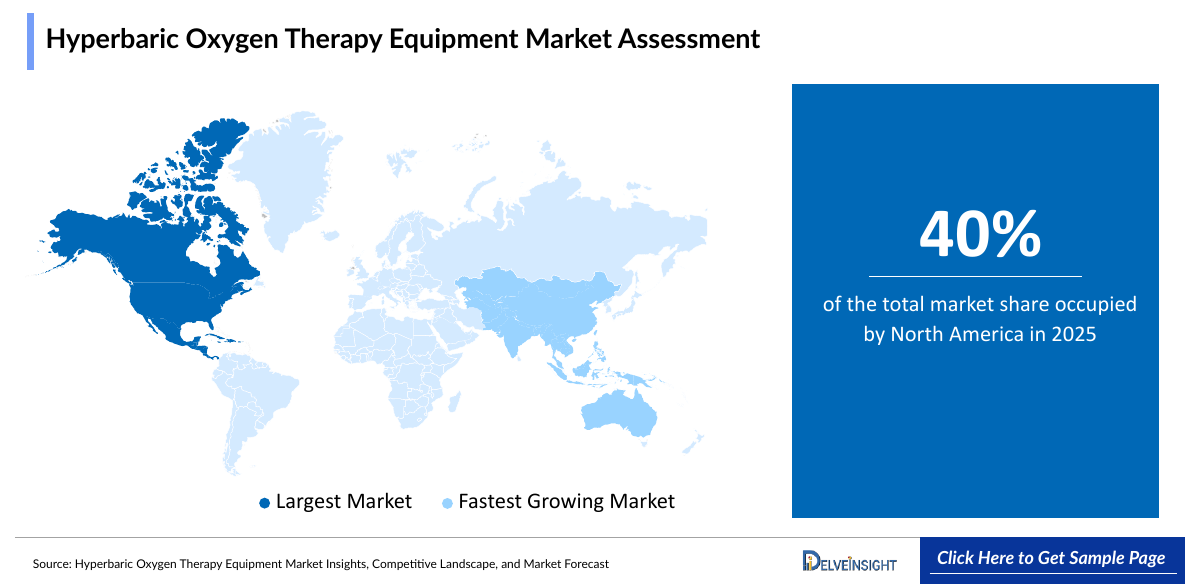
- North America dominated the global Hyperbaric Oxygen Therapy Equipment Market revenue with a 40% share in 2025, representing the highest regional market share globally.
Hyperbaric oxygen therapy (HBOT) equipment comprises the pressure chambers, gas-delivery and control systems, and supporting accessories used to deliver oxygen at pressures above normal atmospheric pressure, increasing the amount of oxygen dissolved in blood plasma and driving it into oxygen-deprived tissue. The therapy is used to promote healing of chronic and compromised wounds, to treat decompression sickness, arterial gas embolism, and carbon monoxide poisoning, and to manage delayed radiation injury, among other indications. Equipment is deployed as monoplace chambers that treat one patient at a time, multiplace chambers that treat several patients and permit an attendant inside, and portable chambers used in clinics, wellness settings, and the home. Systems are further distinguished by atmosphere, with oxygen-filled systems pressurized directly with pure oxygen and air-filled systems pressurized with air while the patient breathes oxygen through a mask or hood. The market is organized by product type across hyperbaric chambers and HBOT accessories and components; by chamber type across monoplace, multiplace, and portable chambers; by system type across oxygen-filled and air-filled systems; by application, led by wound healing; and by end user, led by hospitals. Driven by the growing chronic wound and diabetes burden, the expansion of outpatient hyperbaric capacity, and ongoing advances in chamber safety, digital monitoring, and portability, HBOT equipment has become core infrastructure for advanced wound care and emergency hyperbaric medicine.
Hyperbaric Oxygen Therapy Equipment Market Key Growth Drivers
- The rising global burden of diabetes and chronic non-healing wounds is expanding demand for adjunctive wound therapy, with the International Diabetes Federation estimating 589 million adults living with diabetes in 2024 and projecting 853 million by 2050.
- A growing population of cancer survivors with late effects of radiation therapy is increasing demand for hyperbaric treatment of radiation-induced tissue injuries.
- The expansion of hospital-based and outpatient wound-care and hyperbaric centers is moving equipment purchasing from opportunistic buys to long-term capacity planning.
- The established role of hyperbaric chambers in emergency and diving medicine, including decompression sickness, gas embolism, and carbon monoxide poisoning, sustains a stable base of multiplace and monoplace demand.
- Technological advancement, including touchscreen controls, digital safety monitoring, remote diagnostics, and improved chamber design, is driving replacement cycles and upgrades of installed systems.
- The rise of portable and mild hyperbaric chambers for clinic, wellness, sports medicine, and home use is widening the addressable customer base.
- The convergence of wound-care demand, radiation-injury treatment, outpatient capacity build-out, and product innovation is expected to sustain steady growth in the market through 2034.
Key Companies in Hyperbaric Oxygen Therapy Equipment Market
The competitive landscape is led by the following active manufacturers and suppliers:
- Sechrist Industries
- Perry Baromedical
- Environmental Tectonics Corporation (ETC)
- OxyHealth
- Summit to Sea
- Fink Engineering
- HAUX-LIFE-SUPPORT
- Oxyhelp
- OxyNova Hyperbaric
- MACY-PAN
For illustrative purposes, only the top 10 companies are listed in the Table of Contents. The report may include analysis and references to additional companies relevant to the market assessment.
Hyperbaric Oxygen Therapy Equipment Market Size
The following snapshot summarizes the principal report metrics for the Hyperbaric Oxygen Therapy Equipment Market.
|
Report Metrics |
Details |
|
2025 Market Size |
USD 4.25 billion |
|
2034 Projected Market Size |
USD 7.08 billion |
|
Growth Rate (2026-2034) |
5.8% CAGR |
|
Largest Market |
North America |
|
Fastest Growing Market |
Asia-Pacific |
|
Market Structure |
Moderately Fragmented |
All market values are expressed in USD and represent DelveInsight estimates synthesized from primary and secondary research.
Factors Contributing to the Growth of the Hyperbaric Oxygen Therapy Equipment Market
Market Drivers
Rising Burden of Diabetes and Chronic Non-Healing Wounds
The most important driver of the HBOT equipment market is the rising burden of diabetes and the chronic wounds that accompany it. The International Diabetes Federation estimates that 589 million adults were living with diabetes in 2024 and projects 853 million by 2050, and people with diabetes face a substantial lifetime risk of developing foot ulcers, a large share of which become chronic, infected, or limb-threatening. Hyperbaric oxygen therapy is an established adjunct for selected problem wounds, including diabetic foot ulcers, compromised grafts and flaps, and refractory osteomyelitis, because it raises tissue oxygen levels, supports new blood vessel formation, and aids infection control. As wound-care programs expand in hospitals and outpatient centers, providers add and replace chambers to meet treatment demand, anchoring equipment sales across the forecast period.
Growing Use for Radiation-Induced Tissue Injuries
A growing population of cancer survivors is expanding demand for treatment of late radiation effects. The International Agency for Research on Cancer recorded 20 million new cancer cases in 2022 and projects 35 million by 2050, and a significant proportion of patients receive radiation therapy as part of their care. Delayed radiation injury, including soft-tissue and bony necrosis such as osteoradionecrosis, is a recognized hyperbaric indication, and treatment typically requires a long course of repeated sessions. As survivorship improves and awareness among oncology, head-and-neck, and urology specialists grows, referral volumes for radiation-injury treatment rise, increasing utilization of chambers and supporting purchases by hospitals and specialty hyperbaric centers.
Expansion of Outpatient Wound-Care and Hyperbaric Treatment Capacity
Healthcare providers are increasingly embedding hyperbaric units within broader wound-care infrastructure strategies, signaling a shift from opportunistic equipment purchases to long-term capacity planning. Dedicated hyperbaric oxygen therapy clinics, hospital outpatient departments, and ambulatory settings are adding monoplace systems because they are comparatively easy to operate, require lower installation costs than multiplace facilities, and fit patient-flow models built around scheduled daily sessions. Manufacturers are responding with outpatient-focused monoplace systems, expanded partnerships with wound-care chains, and training and maintenance programs. This decentralization of hyperbaric capacity from large hospitals to community and clinic settings broadens the buyer base and creates recurring demand for chambers, accessories, and service.
Established Demand from Emergency, Diving, and Critical-Care Medicine
Core hyperbaric indications such as decompression sickness, arterial gas embolism, and carbon monoxide poisoning provide a durable foundation of demand. These conditions require rapid access to recompression and oxygen therapy, and they are managed in hospital-based facilities, regional referral centers, and military and commercial diving operations, where multiplace chambers allow patients to be treated alongside medical attendants. Even though case volumes are modest compared with wound care, the clinical necessity of these indications supports sustained investment in chamber capacity, safety systems, and maintenance by hospitals, public health systems, and defense and diving organizations, and ensures a stable replacement and upgrade cycle.
Technological Advancement in Chamber Safety, Controls, and Monitoring
Continuous product innovation is stimulating upgrades of older installed chambers. Manufacturers have introduced touchscreen control interfaces, upgraded digital safety controls, remote diagnostics, improved patient-comfort features, and enhanced fire-safety and gas-management systems. Market participants highlight digital monitoring integration as an emerging inflection point, enabling better session tracking, safer operation, and data-supported clinical documentation. Because hyperbaric chambers are long-lived capital assets subject to strict inspection and safety standards, advances that reduce operating costs, improve reliability, and simplify compliance encourage facilities to replace aging units and add accessories, components, and service contracts, supporting growth across product categories.
Rising Adoption of Portable and Mild Hyperbaric Chambers
The rise of portable and mild hyperbaric chambers is opening new customer segments beyond traditional hospitals. Soft-sided and compact chambers operating at lower pressures, such as those cleared for use up to about 1.3 atmospheres absolute, are being adopted by wellness centers, sports medicine and rehabilitation practices, physician offices, and consumers seeking home-based options. Their lower price point, easier installation, and small footprint widen the addressable market, and manufacturers continue to expand product lines to serve clinics and personal users. While regulatory scrutiny of unproven therapeutic claims remains a consideration, portable systems are among the fastest-growing product categories and are expected to contribute meaningfully to incremental market growth through 2034.
Market Restraints
Despite steady momentum, the Hyperbaric Oxygen Therapy Equipment Market faces material constraints. The high cost of acquiring, installing, and maintaining hyperbaric systems is a significant barrier, as chambers require specialized facility construction, pressure-vessel certification, medical gas and fire-suppression infrastructure, and ongoing inspection and service, which limits adoption among smaller providers and in cost-sensitive emerging economies. Reimbursement remains inconsistent: coverage is generally limited to specific approved indications and subject to strict criteria, and variation across payers and countries constrains utilization and capital investment. Safety concerns tied to high-pressure oxygen exposure, including barotrauma, oxygen toxicity, and fire risk, require trained personnel, standardized protocols, and strict adherence to pressure-vessel and fire-safety standards, and a shortage of trained hyperbaric technicians and physicians limits capacity expansion. Regulatory requirements for medical devices and pressure vessels for human occupancy lengthen development and approval timelines and raise compliance costs, while regulators and clinicians scrutinize marketing of hyperbaric treatment for unproven conditions, creating uncertainty for portable and wellness-oriented products. The limited number of conditions with strong clinical evidence and, in some regions, low awareness of hyperbaric medicine further temper demand. Together, these cost, reimbursement, safety, workforce, and regulatory barriers moderate the pace of growth, even as the underlying drivers of chronic wound burden, radiation-injury treatment, and outpatient capacity expansion remain firmly intact.
Hyperbaric Oxygen Therapy Equipment Market Segment Analysis
The Hyperbaric Oxygen Therapy Equipment Market is segmented by product type (hyperbaric chambers, hyperbaric oxygen therapy accessories and components), chamber type (monoplace chambers, multiplace chambers, portable hyperbaric chambers), system type (oxygen-filled systems, air-filled systems), application (wound healing, decompression sickness, carbon monoxide poisoning, radiation-induced tissue injuries, gas embolism, and others), end user (hospitals, hyperbaric oxygen therapy clinics, ambulatory surgical centers, specialty clinics, and others), and geography (North America, Europe, Asia-Pacific, Rest of World).
By Product Type
Dominant Subsegment: Hyperbaric Chambers.
The hyperbaric chambers segment accounted for 81% of the Hyperbaric Oxygen Therapy Equipment Market in 2025. Hyperbaric chambers are the leading product category because the chamber is the primary, high-value capital asset in every hyperbaric facility, and each new treatment site, replacement, or capacity addition begins with a chamber purchase. Chambers span monoplace, multiplace, and portable designs and carry substantially higher unit prices than the components that support them, which concentrates market value in this category. Demand is supported by expanding wound-care programs, new outpatient hyperbaric clinics, and replacement of aging hospital systems. Accessories and components, including compressors, gas supply and control consoles, monitoring and communication systems, patient hoods and masks, stretchers, acrylic cylinders, and replacement parts, form a smaller but recurring revenue stream that grows with the installed base, preventive-maintenance cycles, and safety-driven upgrades. While accessories and components provide steady aftermarket demand, the capital intensity and unit value of chambers secure their leadership across the forecast period.
By Chamber Type
Dominant Subsegment: Monoplace Chambers.
The monoplace chambers segment accounted for 41% of the Hyperbaric Oxygen Therapy Equipment Market in 2025. Monoplace chambers are the leading chamber type because they are efficient, relatively easy to operate, and less costly to install than multiplace systems, making them well suited to the single-patient, scheduled-session treatment model used in hospital wound centers, outpatient departments, and dedicated hyperbaric clinics. Their compact footprint allows facilities to add capacity incrementally, and the widespread adoption of wound-care and radiation-injury programs has made monoplace systems the default choice for most new sites. Multiplace chambers remain essential in hospitals, referral centers, and diving and military settings that treat several patients at once, manage critically ill patients with attendants inside, or handle emergency cases, but their higher capital and facility costs limit the pace of new installations. Portable hyperbaric chambers are the fastest-growing category, driven by lower price points and adoption in clinics, wellness and sports settings, and the home. Nonetheless, the combination of operational simplicity, lower cost, and broad clinical fit secures monoplace leadership across the forecast period.
By System Type
Dominant Subsegment: Oxygen-Filled Systems.
The oxygen-filled systems segment accounted for 53% of the Hyperbaric Oxygen Therapy Equipment Market in 2025. Oxygen-filled systems are the leading system type because they are the standard design for monoplace chambers, in which the entire chamber is pressurized with pure oxygen so that the patient breathes oxygen directly without a mask or hood. This design delivers high oxygen concentration with simple patient interfaces and is widely used in wound-care centers and hospital outpatient programs, where monoplace chambers dominate installations. Because an oxygen-enriched environment raises fire risk, these systems rely on strict safety design, grounding, and operating protocols, which supports demand for compliant, certified equipment from established manufacturers. Air-filled systems, in which the chamber is pressurized with compressed air while patients breathe oxygen through masks, hoods, or other delivery devices, are used in multiplace chambers and in many portable and mild chambers. Growth in multiplace installations and portable chambers is supporting steady expansion of air-filled systems, but the installed base and ongoing adoption of monoplace chambers secure the leadership of oxygen-filled systems across the forecast period.
By Application
Dominant Subsegment: Wound Healing.
The wound healing segment accounted for 36% of the Hyperbaric Oxygen Therapy Equipment Market in 2025. Wound healing is the leading application because chronic and non-healing wounds, particularly diabetic foot ulcers, represent the largest and most consistently treated indication in hyperbaric medicine, and wound-care programs generate high, recurring session volumes that drive equipment utilization and purchases. Hyperbaric oxygen therapy is used as an adjunct for selected problem wounds, compromised grafts and flaps, and related conditions, supported by the rising burden of diabetes and an aging population. Decompression sickness, gas embolism, and carbon monoxide poisoning remain clinically critical emergency indications that sustain demand for multiplace and hospital-based chambers, though with lower overall volumes. Radiation-induced tissue injuries are the fastest-growing application as the population of cancer survivors with late radiation effects expands, while the other category includes conditions such as refractory osteomyelitis, necrotizing soft-tissue infections, and thermal burns. The scale and recurrence of wound-care treatment secure the leadership of wound healing across the forecast period.
By End User
Dominant Subsegment: Hospitals.
The hospitals segment accounted for 47% of the Hyperbaric Oxygen Therapy Equipment Market in 2025. Hospitals are the leading end user because they combine the largest capital budgets, the broadest range of hyperbaric indications, and the infrastructure required for multiplace chambers and emergency treatment of decompression sickness, gas embolism, and carbon monoxide poisoning. Hospital-based wound-care and hyperbaric departments treat a high volume of diabetic and chronic wound patients and benefit from established referral networks and reimbursement pathways, supporting regular purchases and replacement of both monoplace and multiplace systems. Hyperbaric oxygen therapy clinics are the fastest-growing end user as dedicated outpatient providers and wound-care chains expand capacity, while ambulatory surgical centers and specialty clinics, including sports medicine, rehabilitation, and wellness practices, are adopting compact monoplace and portable chambers. The other category includes military, diving, research, and home-care users. The scale, clinical breadth, and purchasing power of hospitals secure their leadership across the forecast period.
Hyperbaric Oxygen Therapy Equipment Market Region Analysis
Dominant Region: North America
North America accounted for 40% of the global Hyperbaric Oxygen Therapy Equipment Market revenue in 2025, representing the highest regional market share globally. The region's dominance reflects advanced healthcare infrastructure, a large base of hospital-based wound-care and hyperbaric centers, favorable reimbursement for approved indications, and a high prevalence of diabetes and chronic wounds, particularly in the United States. North America is home to several of the market's leading manufacturers, including Sechrist Industries, Perry Baromedical, Environmental Tectonics Corporation, and Summit to Sea, which supports local service, training, and rapid adoption of new chamber technology. FDA clearance pathways, strong clinical awareness, and a growing network of outpatient hyperbaric clinics and wound-care chains drive continued equipment purchases and upgrades, while rising demand for radiation-injury treatment and for portable chambers in clinic and wellness settings adds incremental growth. Strong reimbursement, regulatory clarity, and the presence of established manufacturers anchor the region's continued leadership across the forecast period.
Fastest Growing Region: Asia-Pacific
Asia-Pacific is the fastest-growing region in the Hyperbaric Oxygen Therapy Equipment Market. The region's elevated CAGR is driven by a rapidly growing diabetes and chronic wound population, expanding hospital and specialty-center infrastructure, rising healthcare spending, and growing awareness of hyperbaric medicine across China, Japan, India, South Korea, and Australia. Governments and private providers are investing in advanced wound care and emergency medicine capacity, while local and international manufacturers expand distribution, training, and service networks. Rising medical tourism, growing wellness and sports-medicine markets, and increasing availability of cost-competitive and portable chambers are accelerating adoption, and regional manufacturers are scaling production to serve domestic demand. The combination of high disease burden, healthcare infrastructure build-out, and expanding manufacturing and distribution positions Asia-Pacific as the principal source of incremental growth over the forecast period.
Regional Commentary
North America
North America accounted for 40% of the global Hyperbaric Oxygen Therapy Equipment Market revenue in 2025. The United States dominates on the strength of its wound-care infrastructure, reimbursement framework, FDA regulatory pathway, and concentration of leading manufacturers, while Canada and Mexico contribute through expanding hospital and clinic capacity and growing awareness of hyperbaric medicine.
Europe
Europe is a large and advanced regional market, supported by a long tradition of hyperbaric and diving medicine, established clinical networks, and a well-developed medical device regulatory framework under the EU Medical Device Regulation. Demand across Germany, the United Kingdom, France, Italy, and Spain is driven by hospital-based multiplace chambers, growing chronic wound and radiation-injury treatment programs, and the presence of regional manufacturers such as HAUX-LIFE-SUPPORT, which supply both domestic and export markets.
Asia-Pacific
Asia-Pacific is the fastest-growing region, propelled by rising diabetes prevalence, expanding hospital and clinic infrastructure, and growing healthcare investment across China, Japan, India, South Korea, and Australia. Increasing awareness of hyperbaric medicine, rising wellness and sports-medicine demand, and the expansion of local and international manufacturers and distributors are accelerating regional adoption of monoplace, multiplace, and portable chambers.
Rest of World
The Rest of World region, spanning Latin America, the Middle East, and Africa, is an emerging growth frontier. Expanding hospital infrastructure, rising chronic disease burden, medical tourism, and increasing investment in emergency and diving medicine are gradually broadening access, while distribution expansion by international manufacturers, including in Latin America and the Middle East, supports the build-out of regional hyperbaric capacity.
Hyperbaric Oxygen Therapy Equipment Market Competitive Landscape
The Hyperbaric Oxygen Therapy Equipment Market is classified as Moderately Fragmented. A group of established manufacturers with hospital-grade, regulator-cleared chamber portfolios, including Sechrist Industries, Perry Baromedical, and Environmental Tectonics Corporation (ETC), anchors the top tier, while a broader field of regional and specialized suppliers such as OxyHealth, Summit to Sea, Fink Engineering, HAUX-LIFE-SUPPORT, Oxyhelp, OxyNova Hyperbaric, and MACY-PAN compete through chamber type, portability, price, regional presence, and service capability, increasing competition in the fastest-growing portable and outpatient segments.
The competitive landscape can be evaluated across the following dimensions:
- Market concentration: Moderately fragmented, with a small set of established hospital-grade manufacturers and a larger field of regional, portable-focused, and emerging suppliers.
- Leading players: Sechrist Industries, Perry Baromedical, and Environmental Tectonics Corporation anchor the hospital and clinical segments through long-established monoplace and multiplace chamber portfolios and installed bases.
- Geographic reach: North American manufacturers serve global markets through distributor networks, while European, Australian, and Asian suppliers compete regionally and increasingly export, with distribution expansion in Latin America and the Middle East.
- Product portfolio strength: Leading players offer monoplace, dual-place, and multiplace chambers together with control consoles, gas systems, accessories, and replacement components; portable-focused players such as Summit to Sea and OxyHealth emphasize portable and mild chambers.
- Regulatory standing: FDA clearance, CE marking under EU MDR, and registrations in markets such as Australia, together with compliance with pressure-vessel and fire-safety standards, are decisive for hospital and clinic procurement.
- Service and aftermarket: Preventive maintenance, emergency service, acrylic cylinder replacement, equipment relocation, and clinical staff training create recurring revenue and deepen customer relationships.
- Strategic partnerships: Partnerships with wound-care chains, hospital joint ventures, distributors, and construction firms for turnkey hyperbaric suites extend reach and support outpatient expansion.
- Manufacturing capabilities: Pressure-vessel fabrication, acrylic and steel chamber manufacturing, control-system engineering, and quality systems certified to medical device standards are key competitive moats.
- Innovation focus: Touchscreen and digital safety controls, remote diagnostics, digital monitoring integration, lower operating cost monoplace systems, and portable mild chambers for clinic and home use.
Hyperbaric Oxygen Therapy Equipment Market Recent Developmental Activities
In 2025-2026, Perry Baromedical expanded original-equipment partnerships with wound-care chains, upgraded digital safety controls on its chamber systems, and intensified training programs for clinical staff. Strategic significance: Strengthens Perry's position with outpatient wound-care operators and reinforces safety and service as differentiators in the hospital-grade segment.
In 2025-2026, Sechrist Industries introduced upgraded touchscreen interfaces for its monoplace chamber systems, expanded distribution in Latin America, and invested in remote diagnostics capabilities. Strategic significance: Improves usability and serviceability of installed chambers and extends the company's international reach.
In October 2024, OxyHealth introduced an upgraded monoplace system targeting outpatient wound centers, designed to lower operating costs and support decentralized adoption of hyperbaric therapy. Strategic significance: Positions OxyHealth to capture growth in clinic-based and outpatient hyperbaric capacity.
Currently, Summit to Sea offers its FDA-cleared portable mild hyperbaric chambers, with models ranging from 26 to 60 inches in diameter, operating at pressures up to 4.4 psi (1.3 ATA), and manufactured in the United States. Strategic significance: Supports adoption of portable chambers across clinical, wellness, and home settings and reinforces the company's position in the fastest-growing chamber category.
Hyperbaric Oxygen Therapy Equipment Market Segmentation
Hyperbaric Oxygen Therapy Equipment Market by Product Type
- Hyperbaric Chambers
- Hyperbaric Oxygen Therapy Accessories and Components
Hyperbaric Oxygen Therapy Equipment Market by Chamber Type
- Monoplace Chambers
- Multiplace Chambers
- Portable Hyperbaric Chambers
Hyperbaric Oxygen Therapy Equipment Market by System Type
- Oxygen-Filled Systems
- Air-Filled Systems
Hyperbaric Oxygen Therapy Equipment Market by Application
- Wound Healing
- Decompression Sickness
- Carbon Monoxide Poisoning
- Radiation-Induced Tissue Injuries
- Gas Embolism
- Others
Hyperbaric Oxygen Therapy Equipment Market by End User
- Hospitals
- Hyperbaric Oxygen Therapy Clinics
- Ambulatory Surgical Centers
- Specialty Clinics
- Others
Hyperbaric Oxygen Therapy Equipment Market by Geography
- North America Hyperbaric Oxygen Therapy Equipment Market
- United States Hyperbaric Oxygen Therapy Equipment Market Size in USD million (2023-2034)
- Canada Hyperbaric Oxygen Therapy Equipment Market Size in USD million (2023-2034)
- Mexico Hyperbaric Oxygen Therapy Equipment Market Size in USD million (2023-2034)
- Europe Hyperbaric Oxygen Therapy Equipment Market
- Germany Hyperbaric Oxygen Therapy Equipment Market Size in USD million (2023-2034)
- United Kingdom Hyperbaric Oxygen Therapy Equipment Market Size in USD million (2023-2034)
- France Hyperbaric Oxygen Therapy Equipment Market Size in USD million (2023-2034)
- Italy Hyperbaric Oxygen Therapy Equipment Market Size in USD million (2023-2034)
- Spain Hyperbaric Oxygen Therapy Equipment Market Size in USD million (2023-2034)
- Rest of Europe Hyperbaric Oxygen Therapy Equipment Market Size in USD million (2023-2034)
- Asia-Pacific Hyperbaric Oxygen Therapy Equipment Market
- China Hyperbaric Oxygen Therapy Equipment Market Size in USD million (2023-2034)
- Japan Hyperbaric Oxygen Therapy Equipment Market Size in USD million (2023-2034)
- India Hyperbaric Oxygen Therapy Equipment Market Size in USD million (2023-2034)
- Australia Hyperbaric Oxygen Therapy Equipment Market Size in USD million (2023-2034)
- South Korea Hyperbaric Oxygen Therapy Equipment Market Size in USD million (2023-2034)
- Rest of Asia-Pacific Hyperbaric Oxygen Therapy Equipment Market Size in USD million (2023-2034)
- Rest of the World (RoW) Hyperbaric Oxygen Therapy Equipment Market
- Middle East Hyperbaric Oxygen Therapy Equipment Market Size in USD million (2023-2034)
- Africa Hyperbaric Oxygen Therapy Equipment Market Size in USD million (2023-2034)
- South America Hyperbaric Oxygen Therapy Equipment Market Size in USD million (2023-2034)
Hyperbaric Oxygen Therapy Equipment Market Recent Industry Trends and Milestones (2023-2026)
|
Category |
Key Developments |
|
Hyperbaric Oxygen Therapy Equipment Market Product Approval |
Regulatory clearance underpins every hyperbaric purchase. Hyperbaric chambers are regulated as medical devices in major markets, including as Class II devices in the United States, where they are cleared for a defined set of conditions that include air or gas embolism, carbon monoxide poisoning, decompression sickness, delayed radiation injury, compromised grafts and flaps, refractory osteomyelitis, and selected problem wounds. Perry Baromedical has been FDA-cleared for over 60 years, and its chambers are also registered in Australia as Class IIb devices, while portable mild chambers such as those from Summit to Sea are FDA-cleared for use up to 1.3 ATA. Clearance, CE marking under EU MDR, and compliance with pressure-vessel and fire-safety standards remain the gateway to hospital and clinic procurement. |
|
Hyperbaric Oxygen Therapy Equipment Market Product Innovation |
Manufacturers upgraded chamber usability, safety, and operating economics. Sechrist Industries introduced upgraded touchscreen interfaces and remote diagnostics, Perry Baromedical upgraded digital safety controls, and OxyHealth launched an upgraded monoplace system aimed at outpatient wound centers in October 2024. Portable mild chambers expanded in size and capacity, with Summit to Sea offering horizontal and vertical models from 26 to 60 inches in diameter equipped with redundant electric compressors and integrated safety systems. Industry observers identify digital monitoring integration as the next structural inflection point for the market. |
|
Hyperbaric Oxygen Therapy Equipment Market Expansion |
Hyperbaric capacity is decentralizing from large hospitals to outpatient and clinic settings. Providers are embedding hyperbaric units within wound-care infrastructure, manufacturers are expanding partnerships with wound-care chains and hospital joint ventures, and distribution has widened in Latin America and the Middle East. Turnkey hyperbaric suite offerings, facility design and set-up services, preventive maintenance programs, and acrylic cylinder replacement support the growing installed base and generate recurring aftermarket revenue. |
|
Company Strategy |
Sechrist Industries: Touchscreen control upgrades, remote diagnostics, and Latin American distribution. Perry Baromedical: Broad monoplace, dual-place, and multiplace portfolio, OEM partnerships with wound-care chains, and service programs. Environmental Tectonics Corporation (ETC): Multiplace chambers for hospital, military, and diving customers. OxyHealth: Outpatient-focused monoplace systems and portable chambers. Summit to Sea: FDA-cleared portable mild chambers for clinical, wellness, and home use. Fink Engineering, HAUX-LIFE-SUPPORT, Oxyhelp, OxyNova Hyperbaric, and MACY-PAN: Regional and specialized chamber supply, price-competitive offerings, and expanding export and distribution networks. |
|
Emerging Technologies |
Innovation is concentrated on digital monitoring integration, touchscreen and automated pressure control, remote diagnostics and telehealth-enabled follow-up, and AI-assisted monitoring of treatment sessions. Portable and mild chambers with lower pressures, quieter electric compressors, in-line air filtration, and optional oxygen concentrators are widening access in clinic, wellness, and home settings. Enhanced fire-safety design, improved patient comfort and visibility, and lower-cost operation are shaping next-generation monoplace and multiplace systems, while research into new indications continues to build the clinical evidence base for hyperbaric oxygen therapy. |
Hyperbaric Oxygen Therapy Equipment Market Startup Funding and Investment Trends
Investment in the Hyperbaric Oxygen Therapy Equipment Market has centered on outpatient-focused chamber designs, portable and mild chambers, digital monitoring, and expanded service and distribution capacity. The following companies illustrate recent activity and technology focus; most manufacturers in the market are privately held and do not publicly disclose funding.
|
Company |
Total Funding |
Funding Stage |
Main Offering |
Core Technology |
|
OxyHealth |
Not publicly disclosed |
Privately held |
Monoplace and portable hyperbaric chambers |
Outpatient-focused monoplace and portable chamber systems |
|
Summit to Sea |
Not publicly disclosed |
Privately held |
FDA-cleared portable mild hyperbaric chambers |
Inflatable mild chambers up to 1.3 ATA with redundant electric compressors |
|
Request for unlocking the report of the @ Hyperbaric Oxygen Therapy Equipment Market | ||||
Capital in this market flows primarily through manufacturer investment in product development, distribution, and service capacity, and through clinic operators and wound-care chains purchasing equipment to add treatment capacity. Industry participants point to outpatient hyperbaric expansion, upgraded monoplace systems for wound centers, portable mild chambers, and digital monitoring as the areas attracting investment. Established manufacturers such as Sechrist Industries, Perry Baromedical, and Environmental Tectonics Corporation continue to invest in safety, controls, and service, while emerging and regional suppliers including OxyHealth, Summit to Sea, Fink Engineering, HAUX-LIFE-SUPPORT, Oxyhelp, OxyNova Hyperbaric, and MACY-PAN broaden choice and price competition. Collectively, these investments signal that outpatient capacity expansion, portability, and digital safety and monitoring will define the next phase of competitive advantage in the global Hyperbaric Oxygen Therapy Equipment Market.
Key Takeaways from the Hyperbaric Oxygen Therapy Equipment Market Report Study
- Market size analysis for the current hyperbaric oxygen therapy equipment market size (2025), and market forecast for 9 years (2026 to 2034).
- Top key product/technology developments, mergers, acquisitions, partnerships, and joint ventures that happened over the last 3 years.
- Key companies dominating the global hyperbaric oxygen therapy equipment market.
- Various opportunities available for competitors in the hyperbaric oxygen therapy equipment market space.
- What are the top-performing segments in 2025? How will these segments perform in 2034?
- Which are the top-performing regions and countries in the current hyperbaric oxygen therapy equipment market scenario?
- Which are the regions and countries where companies should concentrate their opportunities for hyperbaric oxygen therapy equipment market growth in the future?
Target audience who can benefit from this hyperbaric oxygen therapy equipment market report study
- Hyperbaric oxygen therapy equipment manufacturers and suppliers
- Research organizations and consulting companies
- Hyperbaric medicine-related organizations, associations, forums, and other alliances
- Government and corporate offices
- Start-up companies, venture capitalists, and private equity firms
- Distributors and traders dealing in hyperbaric oxygen therapy equipment
- Various end-users who want to know more about the hyperbaric oxygen therapy equipment market and the latest technological developments in the hyperbaric oxygen therapy equipment market.