inflammatory breast cancer market
Key Highlights
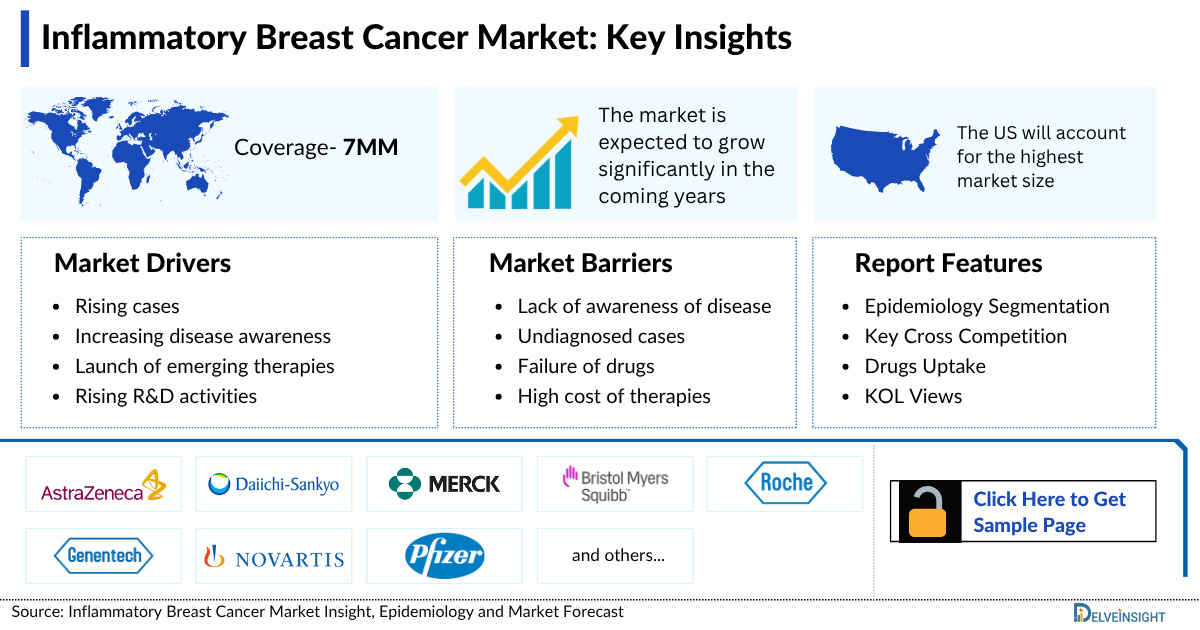
- The market is expected to grow significantly by 2036 in the 7MM.
- The US will capture the highest market share.
- Approximately one-third of women with IBC have metastatic disease when diagnosed.
- Key companies active in the market include AstraZeneca; Daiichi Sankyo; Merck & Co.; Bristol Myers Squibb; Roche/Genentech; Novartis; Pfizer; Eli Lilly; Gilead Sciences; Immunomedics; Seagen; Eisai; AbbVie; MacroGenics; Dana-Farber Cancer Institute; The Ohio State University Comprehensive Cancer Center; Inflammatory Breast Cancer Research Foundation.
IBC is often diagnosed at a younger age and is more common among Black women and women with overweight or obesity.
DelveInsight's "Inflammatory Breast Cancer Market Insights, Epidemiology, and Market Forecast-2036" report delivers an in-depth understanding of the Inflammatory Breast Cancer, historical and forecasted epidemiology as well as the Inflammatory Breast Cancer market trends in the United States, EU5 (Germany, Spain, Italy, France, and United Kingdom) and Japan.
The Inflammatory Breast Cancer market report provides current treatment practices, emerging drugs, Inflammatory Breast Cancer market share of the individual therapies, current and forecasted Inflammatory Breast Cancer market Size from 2022 to 2036 segmented by seven major markets. The Report also covers current Inflammatory Breast Cancer treatment practice/algorithm, market drivers, market barriers and unmet medical needs to curate the best of the opportunities and assesses the underlying potential of the Inflammatory Breast Cancer market.
Geography Covered
- The United States
- EU5 (Germany, France, Italy, Spain, and the United Kingdom)
- Japan
Study Period: 2022-2036
Key Factors Driving the Inflammatory Breast Cancer Market Growth
- High Unmet Medical Need: IBC is aggressive, frequently diagnosed at an advanced stage, and has poorer outcomes than many non-inflammatory breast cancers. The need for therapies that reduce recurrence and improve survival continues to support pharmaceutical R&D.
- Frequent Advanced-Stage Presentation: IBC is diagnosed as stage III or IV, creating demand for intensive systemic treatment, multimodal therapy and therapies capable of controlling both locoregional and metastatic disease.
- Expansion of Targeted Therapies: Molecular characterization based on HER2, hormone-receptor and other biomarkers is expanding opportunities for HER2-directed therapies, antibody-drug conjugates, endocrine therapies and other precision-treatment approaches.
- Growth of Immunotherapy: Increasing investigation of PD-1/PD-L1 and CTLA-4 inhibitors in IBC is creating opportunities for immunotherapy-based combinations, particularly in triple-negative and high-risk disease.
- Development of Antibody-Drug Conjugates: ADCs such as trastuzumab deruxtecan are being evaluated in IBC-specific settings, offering targeted delivery of potent cytotoxic payloads and expanding treatment possibilities for HER2-expressing tumors.
Inflammatory Breast Cancer Disease Understanding and Treatment Algorithm
Inflammatory breast cancer (IBC) is a rare, aggressive form of breast cancer in which cancer cells block lymphatic vessels in the skin of the breast, producing rapid-onset redness, swelling, warmth, tenderness, skin thickening, and a characteristic peau d’orange appearance. Unlike many breast cancers, IBC often does not present as a discrete palpable lump and can develop between routine screening intervals. Most IBCs are invasive ductal carcinomas. In the U.S., IBC accounts for approximately 1%–5% of breast cancers and is more frequently diagnosed at a younger age, with a higher incidence among Black women and women with obesity.
Inflammatory Breast Cancer Diagnosis
Diagnosis of IBC relies heavily on its rapid clinical presentation together with pathological confirmation. Evaluation generally includes a clinical breast examination and imaging such as diagnostic mammography, breast ultrasound, and breast MRI, followed by a breast or skin biopsy to confirm invasive carcinoma. Biomarker testing for estrogen receptor (ER), progesterone receptor (PR), and HER2 is important for treatment selection, while CT or PET imaging may be used to evaluate regional and distant disease. IBC is classified as stage III or stage IV at diagnosis, because the disease involves the skin of the breast; approximately one-third of patients may already have distant metastases at diagnosis.
Inflammatory Breast Cancer Treatment
Treatment depends on stage and tumor biology and generally uses a multimodal approach. For stage III IBC, the standard strategy is neoadjuvant systemic chemotherapy followed by modified radical mastectomy and postmastectomy radiation therapy, with HER2-targeted therapy, immunotherapy, or endocrine therapy added according to biomarkers. For HER2-positive disease, trastuzumab-based treatment can be incorporated, while pembrolizumab may be used in appropriate triple-negative disease. Hormone receptor-positive tumors can receive endocrine therapy. Stage IV IBC is generally treated according to metastatic breast cancer subtype, using systemic chemotherapy, antibody-drug conjugates, targeted therapies, immunotherapy, endocrine therapy, or combinations based on HER2, hormone-receptor, PD-L1 and other molecular characteristics.
Inflammatory Breast Cancer Epidemiology
The Inflammatory Breast Cancer epidemiology section provides insights about the historical and current Inflammatory Breast Cancer patient pool and forecasted trends for individual seven major countries. It helps to recognize the causes of current and forecasted trends by exploring numerous studies and views of key opinion leaders. This part of the Inflammatory Breast Cancer market report also provides the diagnosed patient pool and their trends along with assumptions undertaken.
Key Findings
The disease epidemiology covered in the report provides historical as well as forecasted Inflammatory Breast Cancer epidemiology scenario in the 7MM covering the United States, EU5 countries (Germany, Spain, Italy, France, and the United Kingdom), and Japan from 2022 to 2036.
Inflammatory Breast Cancer Drug Chapters
The drug chapter segment of the Inflammatory Breast Cancer report encloses the detailed analysis of Inflammatory Breast Cancer marketed drugs and late-stage (Phase-III and Phase-II) Inflammatory Breast Cancer pipeline drugs. It also helps to understand the Inflammatory Breast Cancer clinical trial details, expressive pharmacological action, agreements and collaborations, approval and patent details, advantages and disadvantages of each included drug and the latest news and press releases.
Inflammatory Breast Cancer Marketed Drugs
The report provides the details of the marketed products/off-label treatments available for Inflammatory Breast Cancer treatment.
Inflammatory Breast Cancer Emerging Drugs
Trastuzumab deruxtecan (T-DXd) + durvalumab: This combination is being investigated in the TRUDI Phase II study for previously untreated stage III HER2-positive or HER2-low IBC. T-DXd is a HER2-directed antibody-drug conjugate, while durvalumab is a PD-L1 inhibitor; the study is evaluating whether combining targeted cytotoxic delivery with immune checkpoint blockade can improve neoadjuvant responses in HER2-expressing IBC. Neither drug is FDA-approved specifically for IBC, making the regimen an important investigational approach for this population.
Olaparib + radiotherapy: Olaparib, a PARP inhibitor, is being studied with radiotherapy versus radiotherapy alone in an IBC-specific Phase II trial. The approach is based on the potential for PARP inhibition to increase tumor sensitivity to DNA-damaging radiation and is particularly relevant to IBC because of its aggressive biology and substantial risk of locoregional recurrence. Dana-Farber lists this study among its current IBC-specific clinical trials.
Inflammatory Breast Cancer Market Outlook
The Inflammatory Breast Cancer market outlook of the report helps to build a detailed comprehension of the historic, current, and forecasted Inflammatory Breast Cancer market trends by analyzing the impact of current Inflammatory Breast Cancer therapies on the market, unmet needs, drivers and barriers, and demand for better technology.
This segment gives a thorough detail of Inflammatory Breast Cancer market trend of each marketed drug and late-stage pipeline therapy by evaluating their impact based on the annual cost of therapy, inclusion and exclusion criteria's, mechanism of action, compliance rate, growing need of the market, increasing patient pool, covered patient segment, expected launch year, competition with other therapies, brand value, their impact on the market and view of the key opinion leaders. The calculated Inflammatory Breast Cancer market data are presented with relevant tables and graphs to give a clear view of the market at first sight.
According to DelveInsight, the Inflammatory Breast Cancer market in 7MM is expected to witness a major change in the study period 2022-2036.
Inflammatory Breast Cancer Drugs Uptake
This section focuses on the rate of uptake of the potential Inflammatory Breast Cancer drugs recently launched in the Inflammatory Breast Cancer market or expected to get launched in the market during the study period 2022-2036. The analysis covers Inflammatory Breast Cancer market uptake by drugs; patient uptake by therapies; and sales of each drug.
Inflammatory Breast Cancer Drugs Uptake helps in understanding the drugs with the most rapid uptake, reasons behind the maximal use of new drugs, and allow the comparison of the drugs on the basis of Inflammatory Breast Cancer market share and size which again will be useful in investigating factors important in market uptake and in making financial and regulatory decisions.
Inflammatory Breast Cancer Pipeline Development Activities
The Inflammatory Breast Cancer report provides insights into different therapeutic candidates in Phase II, and Phase III stage. It also analyses Inflammatory Breast Cancer key players involved in developing targeted therapeutics.
Pipeline Development Activities
The Inflammatory Breast Cancer report covers the detailed information of collaborations, acquisition, and merger, licensing, patent details, and other information for Inflammatory Breast Cancer emerging therapies.
Reimbursement Scenario in Inflammatory Breast Cancer
Approaching reimbursement proactively can have a positive impact both during the late stages of product development and well after product launch. In a report, we take reimbursement into consideration to identify economically attractive indications and market opportunities. When working with finite resources, the ability to select the markets with the fewest reimbursement barriers can be a critical business and price strategy.
KOL- Views
To keep up with current Inflammatory Breast Cancer market trends, we take KOLs and SMEs ' opinion working in the Inflammatory Breast Cancer domain through primary research to fill the data gaps and validate our secondary research. Their opinion helps to understand and validate current and emerging therapies treatment patterns or Inflammatory Breast Cancer market trends. This will support the clients in potential upcoming novel treatment by identifying the overall scenario of the market and the unmet needs.
Competitive Intelligence Analysis
We perform Competitive and Market Intelligence analysis of the Inflammatory Breast Cancer Market by using various Competitive Intelligence tools that include - SWOT analysis, PESTLE analysis, Porter's five forces, BCG Matrix, Market entry strategies etc. The inclusion of the analysis entirely depends upon the data availability.
Scope of the Inflammatory Breast Cancer Market Report
- The Inflammatory Breast Cancer Therapeutics Market Report covers a segment of key events, an executive summary, a descriptive overview, explaining their causes, signs and symptoms, pathogenesis, and currently available treatments.
- Comprehensive insight has been provided into the epidemiology segments and forecasts, the future growth potential of the diagnosis rate, and disease progression along Inflammatory Breast Cancer Treatment guidelines.
- Additionally, an all-inclusive account of both the current and emerging treatments, along with the elaborative profiles of late-stage and prominent therapies, will have an impact on the current Inflammatory Breast Cancer Treatment landscape.
- A detailed review of the Inflammatory Breast Cancer Therapeutics Market, historical and forecasted Inflammatory Breast Cancer Treatment Market Size, Inflammatory Breast Cancer Drugs Market Share by therapies, detailed assumptions, and rationale behind our approach is included in the report, covering the 7MM drug outreach.
- The Inflammatory Breast Cancer Therapeutics Market Report provides an edge while developing business strategies by understanding trends through SWOT analysis and expert insights/KOL views, patient journey, and treatment preferences that help in shaping and driving the 7MM Inflammatory Breast Cancer Drugs Market.
Inflammatory Breast Cancer Market Report Insights
- Inflammatory Breast Cancer Patient Population Forecast
- Inflammatory Breast Cancer Therapeutics Market Size
- Inflammatory Breast Cancer Pipeline Drugs Analysis
- Inflammatory Breast Cancer Market Size and Trends
- Inflammatory Breast Cancer Therapeutics Market Opportunity (Current and Forecasted)
Inflammatory Breast Cancer Market Report Key Strengths
- Epidemiology-based (Epi-based) Bottom-up Forecasting
- Artificial Intelligence (AI) - enabled Market Research Report
- 11-year forecast
- Inflammatory Breast Cancer Market Outlook (North America, Europe, Asia-Pacific)
- Patient Burden Trends (by geography)
- Inflammatory Breast Cancer Treatment Addressable Market (TAM)
- Inflammatory Breast Cancer Competitive Landscape
- Inflammatory Breast Cancer Major Companies Insights
- Inflammatory Breast Cancer Price Trends and Analogue Assessment
- Inflammatory Breast Cancer Therapies Drug Adoption/Uptake
- Inflammatory Breast Cancer Therapies Peak Patient Share Analysis
Inflammatory Breast Cancer Market Report Assessment
- Inflammatory Breast Cancer Current Treatment Practices
- Inflammatory Breast Cancer Unmet Needs
- Inflammatory Breast Cancer Clinical Development Analysis
- Inflammatory Breast Cancer Emerging Drugs Product Profiles
- Inflammatory Breast Cancer Market Attractiveness
- Inflammatory Breast Cancer Qualitative Analysis (SWOT and Attribute analysis)
Key Questions Answered in the Inflammatory Breast Cancer Treatment Market Report
Inflammatory Breast Cancer Therapeutics Market Insights
- What was the Inflammatory Breast Cancer Treatment Market Size, the Inflammatory Breast Cancer Market Size by therapies, Inflammatory Breast Cancer Drugs Market Share (%) distribution in 2025, and what would it look like by 2036? What are the contributing factors for this growth?
- What are the anticipated pricing variations among different geographies for the emerging therapies in the future?
- What can be the future treatment paradigm of Inflammatory Breast Cancer?
- What are the disease risks, burdens, and unmet needs of Inflammatory Breast Cancer?
- What will be the growth opportunities across the 7MM concerning the patient population with Inflammatory Breast Cancer?
- Who is the major future competitor in the market, and how will the competitors affect their market share?
- What are the current options for the treatment of Inflammatory Breast Cancer? What are the current guidelines for treating Inflammatory Breast Cancer in the US, Europe, and Japan?
Reasons to Buy the Inflammatory Breast Cancer Therapeutics Market Report
- The Inflammatory Breast Cancer Therapeutics Market Report will help in developing business strategies by understanding the latest trends and changing treatment dynamics driving the Inflammatory Breast Cancer Drugs Market.
- Bottom up forecasting builds from the affected population to product forecasts, delivering a robust, data driven approach ideal for new therapies and novel classes.
- Insights on patient burden/disease Inflammatory Breast Cancer Prevalence, evolution in diagnosis, and factors contributing to the change in the epidemiology of the disease during the forecast years.
- Understand the existing Inflammatory Breast Cancer Drugs Market opportunities in varying geographies and the growth potential over the coming years.
- Identifying strong upcoming players in the Inflammatory Breast Cancer Drugs Market will help devise strategies to help get ahead of competitors.
- Detailed analysis, ranking of class-wise potential current, and emerging therapies under the attribute analysis section to provide visibility around leading classes.
- To understand KOLs’ perspectives on the accessibility, acceptability, and compliance-related challenges of existing treatment to overcome barriers in the future.
- Detailed insights on the unmet needs of the existing Inflammatory Breast Cancer Drugs Market so that the upcoming players can strengthen their development and launch strategy.
- This Artificial Intelligence (AI) enabled report summarize and simplify complex datasets with in the report into clear, actionable insights for stakeholders, investors, and healthcare providers, enabling faster, data driven decisions.
Stay Updated with us for Recent Articles:-
- Metastatic HER2-Positive Breast Cancer
- Estrogen Receptor Positive Breast Cancer: Market Outlook
- Global HR+/ HER2- Breast Cancer Market Scenario
- How HR+/ HER2- Breast Cancer Emerging Drugs Will Transform the Market?
- HR-positive/ HER2-negative Breast Cancer Market Insights: Upcoming Therapies and Market Analysis
- Breast Cancer: Understand Your Breasts, Recognize the Symptoms
- Key Facts To Know About Triple-Negative Breast Cancer In The Breast Cancer Awareness Month
- 7 Most Common Myths About Breast Cancer Demystified
- Roche’s HER2-Positive Breast Cancer Treatment Franchise
- Latest DelveInsight Blogs