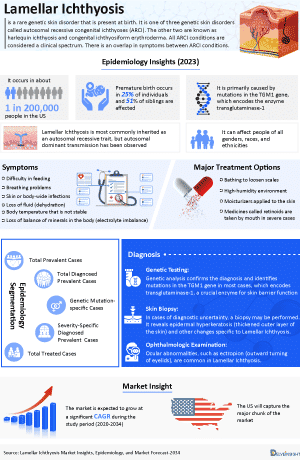
Lamellar Ichthyosis Market Summary
- The Lamellar ichthyosis Market Size is anticipated to grow with a significant CAGR during the study period (2022-2036).
- The leading Lamellar ichthyosis companies developing therapies in the treatment market include - Timber Pharmaceuticals, Galderma, Mayne Pharma, Krystal Biotech, and others.
Lamellar ichthyosis Market and Epidemiology Analysis
- Lamellar ichthyosis is a rare genetic skin disorder present at birth and is one of three types of autosomal recessive congenital ichthyoses (ARCI). Babies born with LI are often referred to as "collodion babies" due to the distinctive collodion membrane covering their skin at birth. It occurs in about one in 200,000 people. The condition can affect people of all genders, races, and ethnicities.
- The most common gene associated with LI is TGM1, but other genes such as NIPAL4, ALOX12B, and CYP4F22 are also implicated in the condition.
- It is typically managed with topical treatments aimed at repairing the skin barrier. Doctors often prescribe creams containing ceramides or cholesterol. Moisturizers with petrolatum or lanolin are also commonly used to maintain skin hydration. Additionally, mild keratolytics or topical retinoids are sometimes applied to reduce scaling and promote exfoliation.
- Currently, there are no FDA-approved therapies specifically for lamellar ichthyosis.
- Emerging treatments include TMB-001, a topical form of isotretinoin, which has shown promising results in clinical trials. In Q4 2021, Timber Pharmaceuticals announced positive top-line results from its Phase IIb CONTROL Study,
- Research and development are ongoing to identify and develop new treatments for lamellar ichthyosis. Advances in genetic research are paving the way for more targeted therapies that address the underlying genetic mutations causing the condition.
- The future market for lamellar ichthyosis treatments is expected to grow as new therapies are developed. But still there is a critical need of The pipeline for lamellar ichthyosis treatments is quite limited, underscoring a significant unmet need for effective therapies.
Request for unlocking the Sample Page of the "Lamellar Ichthyosis Market Insights"
Key Factors Driving the Lamellar Ichthyosis Market
- Increasing Awareness and Early Diagnosis: Growing awareness among healthcare professionals and patients about rare genetic skin disorders is improving early diagnosis of lamellar ichthyosis. Educational initiatives and better access to dermatology specialists are helping identify cases earlier, thereby increasing demand for effective treatment options.
- Advancements in Genetic and Molecular Research: Progress in genetic research has enhanced the understanding of mutations responsible for lamellar ichthyosis, particularly in genes affecting skin barrier function. This has encouraged the development of targeted therapies and innovative treatment approaches aimed at improving disease management.
- Development of Novel and Targeted Therapies: Pharmaceutical companies and research organizations are investing in the development of new topical and systemic therapies for rare dermatological conditions. Emerging treatments, including gene-based and enzyme-targeted approaches, are expected to expand the therapeutic landscape for lamellar ichthyosis.
- Growing Support for Rare Disease Research: Government initiatives, orphan drug incentives, and funding programs aimed at rare diseases are encouraging pharmaceutical companies to invest in treatments for lamellar ichthyosis. Regulatory benefits such as orphan drug designation are accelerating drug development and market entry.
- Expanding Healthcare Infrastructure and Access to Dermatology Care: Improved healthcare infrastructure and access to specialized dermatology services are enabling better disease management and treatment availability. As healthcare systems strengthen globally, more patients are expected to receive appropriate diagnosis and long-term care for lamellar ichthyosis.
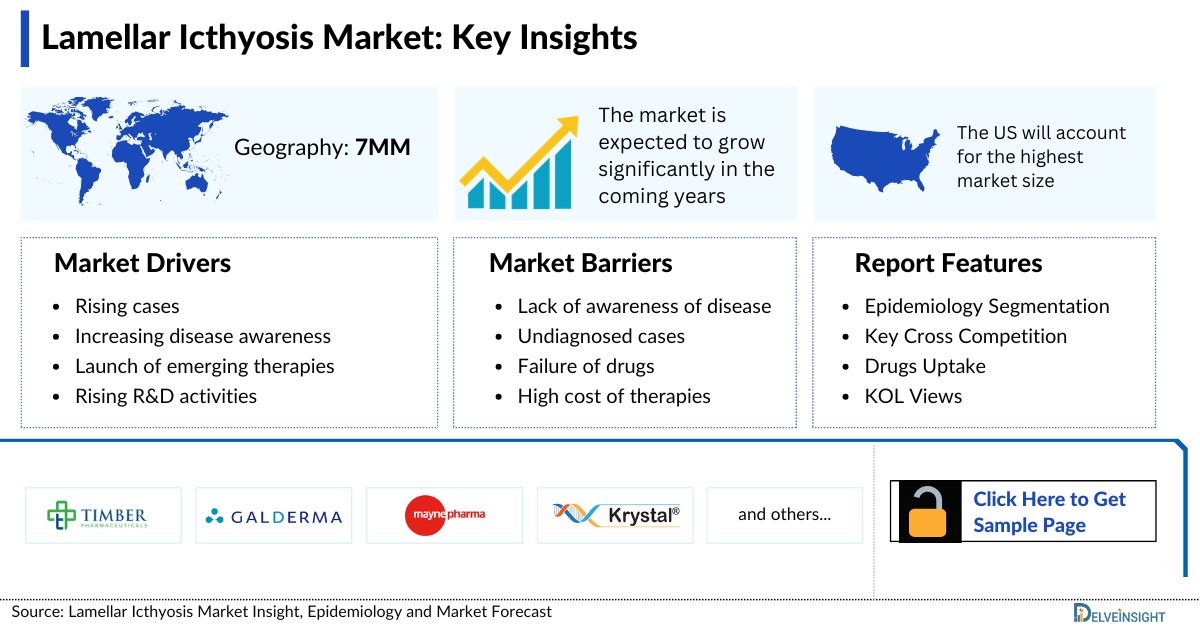
DelveInsight's “Lamellar Ichthyosis Market Insights, Epidemiology and Market Forecast – 2036” report delivers an in-depth understanding of lamellar ichthyosis, historical and forecasted epidemiology as well as the lamellar ichthyosis market trends in the United States, EU4 (Germany, Spain, Italy, and France) and the United Kingdom, and Japan.
Lamellar Ichthyosis market report provides real-world prescription pattern analysis, emerging drugs, market share of individual therapies, and historical and forecasted 7MM lamellar ichthyosis market size from 2022 to 2036. The report also covers current lamellar ichthyosis treatment practices/algorithms and unmet medical needs to curate the best opportunities and assess the market’s underlying potential.
Scope of the Lamellar Ichthyosis Market | |
|
Study Period |
2022 to 2036 |
|
Forecast Period |
2025-2036 |
|
Geographies Covered |
|
|
Lamellar Ichthyosis Market |
|
|
Lamellar Ichthyosis Market Size | |
|
Lamellar Ichthyosis Companies |
Timber Pharmaceuticals, Galderma, Mayne Pharma, Krystal Biotech, and others |
|
Lamellar Ichthyosis Epidemiology Segmentation |
|
Lamellar Ichthyosis Understanding
Lamellar Ichthyosis Overview
Lamellar ichthyosis is a skin condition that primarily affects infants, who are typically born with a tight, clear sheath covering their skin known as a collodion membrane. This membrane usually dries and peels off within the first few weeks of life, revealing scaly skin and outwardly turned eyelids and lips. The condition is characterized by large, dark, plate-like scales covering most of the body. Infants with lamellar ichthyosis may face several complications, including infections, dehydration due to excessive fluid loss, and respiratory issues. Additional symptoms include hair loss (alopecia), abnormal fingernails and toenails (nail dystrophy), decreased sweating (hypohidrosis), increased heat sensitivity, and thickened skin on the palms and soles (keratoderma). In some cases, individuals may also experience reddened skin (erythema) and joint deformities (contractures).
Lamellar Ichthyosis Diagnosis
Prenatal diagnosis of lamellar ichthyosis can be achieved by electron microscopic examination of fetal skin biopsies or amniotic fluid cells obtained via fetoscopy. DNA-based molecular genetic testing is commercially available for TGM1, ABCA12, ALOXE3 and ALOX12B.22 Alternatively, skin biopsies may be examined by light microscopy and electron microscopy for histological features, or for detection of in situ TGM1 expression and activity.
The lamellar ichthyosis report provides an overview of lamellar ichthyosis pathophysiology, diagnostic approaches, and detailed treatment algorithm along with a real-world scenario of a patient’s journey beginning from the first symptom, the time taken for diagnosis to the entire treatment process.
Further details related to country-based variations in diagnosis are provided in the report...
Lamellar Ichthyosis Treatment
Lamellar ichthyosis has no cure, so treatment focuses on alleviating symptoms and improving skin condition through a combination of topical and systemic therapies. Topical treatments include emollients such as petrolatum and lanolin to maintain skin hydration, and keratolytics like alpha-hydroxy acids and urea to reduce scale thickness and promote exfoliation. Topical retinoids, such as tretinoin, can also be beneficial. In more severe cases, systemic treatments like oral retinoids are used to enhance epidermal turnover and manage hyperkeratosis, though these can have potential side effects and are used with caution.
Lamellar Ichthyosis Epidemiology
The lamellar ichthyosis epidemiology chapter in the report provides historical as well as forecasted in the 7MM covering the United States, EU4 countries (Germany, France, Italy, and Spain), the United Kingdom, and Japan from 2024 to 2036. The lamellar ichthyosis epidemiology is segmented with detailed insights into Total Prevalent Cases of Lamellar Ichthyosis, Total Diagnosed Prevalent Cases of Lamellar Ichthyosis, Genetic Mutation-specific Cases of Lamellar Ichthyosis, Severity-Specific Diagnosed Prevalent Cases of Lamellar Ichthyosis, and Total Treated Cases of Lamellar Ichthyosis.
Key Findings from Lamellar Ichthyosis Epidemiological Analyses and Forecast
- Lamellar ichthyosis is the most common variant of autosomal recessive congenital ichthyosis (ARCI). Prevalence in Europe is estimated at approximately 1/100,000-1/300,000 individuals.
- It is primarily inherited in an autosomal recessive manner, meaning both parents must carry a copy of the mutated gene for their child to be affected. There are also rare cases of autosomal dominant inheritance.
- The condition is present at birth. Newborns with lamellar ichthyosis are often referred to as “collodion babies” due to the presence of a shiny, waxy layer of skin that is typically shed within the first two weeks of life.
- While specific prevalence rates can vary, lamellar ichthyosis is recognized globally. However, detailed epidemiological data may be more readily available in regions with advanced genetic research and healthcare infrastructure.
- Lamellar ichthyosis is associated with mutations in several genes, including TGM1, ABCA12, ALOX12B, and NIPAL4. These genes are involved in skin cell development and function.
Lamellar Ichthyosis Epidemiology Segmentation
- Total Prevalent Cases of Lamellar Ichthyosis
- Diagnosed Prevalent Cases of Lamellar Ichthyosis
- Age-Specific Cases of Lamellar Ichthyosis
- Gender-Specific Cases of Lamellar Ichthyosis
- Severity-Specific Cases of Lamellar Ichthyosis
Lamellar Ichthyosis Drug Analysis
The drug chapter segment of the lamellar ichthyosis report encloses a detailed analysis of lamellar ichthyosis marketed drugs and late-stage (Phase III and Phase II) Lamellar Ichthyosis pipeline drugs. It also deep dives into the lamellar ichthyosis pivotal clinical trial details, recent and expected market approvals, patent details, the latest news, and recent deals and collaborations.
Lamellar Ichthyosis Emerging Drugs
TMB-001: Timber Pharmaceuticals/ LEO Pharma
TMB-001, a topical form of isotretinoin, is currently being developed for the treatment of moderate to severe subtypes of congenital ichthyosis (CI). In the fourth quarter of 2021, Timber Pharmaceuticals announced positive top-line results from its Phase IIb CONTROL Study. The study demonstrated that TMB-001 has clinically meaningful efficacy and a favorable safety profile, highlighting its potential as an important treatment option for CI. This is especially significant given the lack of FDA-approved treatments and the limited options available in the standard of care for this condition. Timber initiated the Phase III ASCEND clinical trial in Quarter2 2022. TMB-001, has received an orphan and breakthrough designation by the FDA.
KB105: Krystal Biotech
KB105 is an investigational topical gene therapy developed by Krystal Biotech for the treatment of autosomal recessive congenital ichthyosis (ARCI), specifically targeting lamellar ichthyosis. The therapy aims to address the underlying genetic defect associated with LI by delivering a functional copy of the TGM1 gene, which is crucial for proper skin barrier function. Currently, KB105 is undergoing Phase II clinical trials to evaluate its safety and efficacy.
Note: Detailed emerging therapies assessment will be provided in the final report...
Lamellar Ichthyosis Market Outlook
Key players, including Timber Pharmaceuticals and Krystal Biotech, are actively advancing their lead candidates through various stages of clinical development to address lamellar ichthyosis. Timber Pharmaceuticals is progressing with TMB-001, a topical form of isotretinoin, which has shown promising results in early trials. Meanwhile, Krystal Biotech is exploring gene therapy approaches to target the underlying genetic causes of lamellar ichthyosis. These efforts are part of a broader trend in the market, where pharmaceutical companies are focusing on innovative solutions to meet the significant unmet needs in LI treatment. As these therapies progress through clinical trials, the future market for lamellar ichthyosis treatments is expected to expand, offering new hope and improved outcomes for patients.
Lamellar Ichthyosis Competitive Landscape
The competitive landscape of the Lamellar Ichthyosis market is moderately fragmented, consisting of both established pharmaceutical companies and emerging biotechnology firms focused on rare dermatological disorders. Companies are actively investing in research and development to introduce innovative therapies, including advanced topical formulations, systemic treatments, and gene-based therapies aimed at improving skin barrier function and reducing symptoms.
Several key players are involved in the market, including Galderma, Krystal Biotech, Novartis, Pfizer, and LEO Pharma, along with other pharmaceutical manufacturers producing retinoid-based therapies and supportive dermatology products.
Competition in the market is largely driven by clinical research, product development, and strategic collaborations between biotech firms, pharmaceutical companies, and academic institutions. Emerging therapies such as topical isotretinoin formulations and investigational gene therapies are expected to significantly influence the future competitive dynamics of the lamellar ichthyosis treatment market.
Key Lamellar Ichthyosis Companies
The Key Lamellar Ichthyosis companies actively involved in the Lamellar Ichthyosis treatment landscape include -
- Timber Pharmaceuticals
- Galderma
- Mayne Pharma
- Krystal Biotech, and others
Lamellar Ichthyosis Drugs Uptake
This section focuses on the uptake rate of potential drugs expected to be launched in the market during 2024–2036, which depends on the competitive landscape, safety, and efficacy data along with order of entry. It is important to understand that the key players evaluating their novel therapies in the pivotal and confirmatory trials should remain vigilant when selecting appropriate comparators to stand the greatest chance of a positive opinion from regulatory bodies, leading to approval, smooth launch, and rapid uptake.
Further detailed analysis of emerging therapies drug uptake in the report…
Lamellar Ichthyosis Clinical Trial Activities
The Lamellar Ichthyosis pipeline report provides insights into Lamellar Ichthyosis clinical trials within Phase III and Phase II stages. It also analyzes key players involved in developing targeted therapeutics.
Lamellar Ichthyosis Pipeline Development Activities
The Lamellar Ichthyosis clinical trials analysis report covers information on collaborations, acquisitions and mergers, licensing, and patent details for lamellar ichthyosis emerging therapies.
Latest KOL Views on Lamellar Ichthyosis Market Report
To keep up with the real-world scenario in current and emerging market trends, we take opinions from Key Industry leaders working in the domain through primary research to fill the data gaps and validate our secondary research. Industry Experts were contacted for insights on the evolving treatment landscape, patient reliance on conventional therapies, patient therapy switching acceptability, and drug uptake along with challenges related to accessibility.
DelveInsight’s analysts connected with 10+ KOLs to gather insights; however, interviews were conducted with 5+ KOLs in the 7MM. Their opinion helps understand and validate current and emerging treatment patterns of lamellar ichthyosis. This will support the clients in potential upcoming novel treatments by identifying the overall scenario of the market and the unmet needs.
Lamellar Ichthyosis Report Qualitative Analysis
We perform Qualitative and market Intelligence analysis using various approaches, such as SWOT analysis and Conjoint Analysis. In the SWOT analysis, strengths, weaknesses, opportunities, and threats in terms of gaps in disease diagnosis, patient awareness, physician acceptability, competitive landscape, cost-effectiveness, and geographical accessibility of therapies are provided.
Conjoint Analysis analyzes multiple approved and emerging therapies based on relevant attributes such as safety, efficacy, frequency of administration, route of administration, and order of entry. Scoring is given based on these parameters to analyze the effectiveness of therapy.
In efficacy, the trial’s primary and secondary outcome measures are evaluated; for instance, in event-free survival, one of the most important primary outcome measures is event-free survival and overall survival.
Further, the therapies’ safety is evaluated wherein the acceptability, tolerability, and adverse events are majorly observed, and it sets a clear understanding of the side effects posed by the drug in the trials. In addition, the scoring is also based on the probability of success, and the addressable patient pool for each therapy. According to these parameters, the final weightage score and the ranking of the emerging therapies are decided.
Lamellar Ichthyosis Market Access and Reimbursement Scenario
The report provides detailed insights on the country-wise accessibility and reimbursement scenarios, cost-effectiveness scenario of currently used therapies, programs making accessibility easier and out-of-pocket costs more affordable, insights on patients insured under federal or state government prescription drug programs, etc.
Scope of the Lamellar Ichthyosis Market Report
- The report covers a segment of key events, an executive summary, descriptive overview of lamellar ichthyosis, explaining its causes, signs and symptoms, pathogenesis, and currently available therapies.
- Comprehensive insight has been provided into the epidemiology segments and forecasts, the future growth potential of diagnosis rate, and disease progression along with country specific treatment guidelines.
- Additionally, an all-inclusive account of both the current and emerging therapies, along with the elaborative profiles of late-stage and prominent therapies, will have an impact on the current treatment landscape.
- A detailed review of the lamellar ichthyosis market, historical and forecasted market size, market share by therapies, detailed assumptions, and rationale behind our approach is included in the report, covering the 7MM drug outreach.
- The report provides an edge while developing business strategies, by understanding trends, through SWOT analysis and expert insights/KOL views, patient journey, and treatment preferences that help in shaping and driving the 7MM lamellar ichthyosis market.
Lamellar Ichthyosis Market Report Insights
- Lamellar Ichthyosis Patient Population
- Lamellar Ichthyosis Therapeutic Approaches
- Lamellar Ichthyosis Pipeline Analysis
- Lamellar Ichthyosis Market Size and Trends
- Existing and future Market Opportunity
Lamellar Ichthyosis Market Report Key Strengths
- Eleven Years Forecast
- 7MM Coverage
- Lamellar Ichthyosis Epidemiology Segmentation
- Inclusion of Country specific treatment guidelines
- KOL’s feedback on approved and emerging therapies
- Key Cross Competition
- Conjoint analysis
- Lamellar Ichthyosis Drugs Uptake
- Key Lamellar Ichthyosis Market Forecast Assumptions
Lamellar Ichthyosis Market Report Assessment
- Current Lamellar Ichthyosis Treatment Practices
- Lamellar Ichthyosis Unmet Needs
- Lamellar Ichthyosis Pipeline Product Profiles
- Lamellar Ichthyosis Market Attractiveness
- Qualitative Analysis (SWOT and Conjoint Analysis)
- Lamellar Ichthyosis Market Drivers
- Lamellar Ichthyosis Market Barriers
FAQs Realted to Lamellar Ichthyosis Market Report:
- What is the growth rate of the 7MM lamellar ichthyosis treatment market?
- What was the Lamellar Ichthyosis total market size, the market size by therapies, market share (%) distribution in 2022, and what would it look like in 2036? What are the contributing factors/key catalysts for this growth?
- Is there any unexplored patient setting that can open the window for growth in the future?
- What are the pricing variations among different geographies for approved and off-label therapies?
- How would the market drivers, barriers, and future opportunities affect the market dynamics and subsequent analysis of the associated trends? Although multiple expert guidelines recommend testing for targetable mutations before therapy initiation, why do barriers to testing remain high?
- What are the current and emerging options for the treatment of lamellar ichthyosis ?
- How many companies are developing therapies for the treatment of lamellar ichthyosis ?
- What are the recent novel therapies, targets, mechanisms of action, and technologies developed to overcome the limitations of existing therapies?
- Patient/physician acceptability in terms of preferred treatment options as per real-world scenarios?
- What are the country-specific accessibility issues of expensive, recently approved therapies?
Reasons to buy Lamellar Ichthyosis Market Forecast Report
- The report will help in developing business strategies by understanding the latest trends and changing treatment dynamics driving the Lamellar Ichthyosis Market.
- Insights on patient burden/disease prevalence, evolution in diagnosis, and factors contributing to the change in the epidemiology of the disease during the forecast years
- Understand the existing market opportunities in varying geographies and the growth potential over the coming years.
- Distribution of historical and current patient share based on real-world prescription data along with reported sales of approved products in the US, EU4 (Germany, France, Italy, and Spain), the United Kingdom, and Japan.
- Identifying strong upcoming players in the market will help devise strategies to help get ahead of competitors.
- Detailed analysis and ranking of class-wise potential current and emerging therapies under the conjoint analysis section to provide visibility around leading classes.
- Highlights of access and reimbursement policies of approved therapies, barriers to accessibility of expensive off-label therapies, and patient assistance programs.
- To understand Key Opinion Leaders’ perspectives around the accessibility, acceptability, and compliance-related challenges of existing treatment to overcome barriers in the future.
- Detailed insights on the unmet needs of the existing market so that the upcoming players can strengthen their development and launch strategy.