Neurological Biomarkers Market
The neurological biomarkers market by Type (Genomic, Proteomic, Metabolomic, and Others), Application (Alzheimer's Disease, Parkinson’s Disease, Autism, and Others), and Geography (North America, Europe, Asia-Pacific, and Rest of the World) is expected to grow at a steady CAGR forecast till 2030 owing to the increasing prevalence of neurological disorders and growing research and development in biomarker discovery technologies.
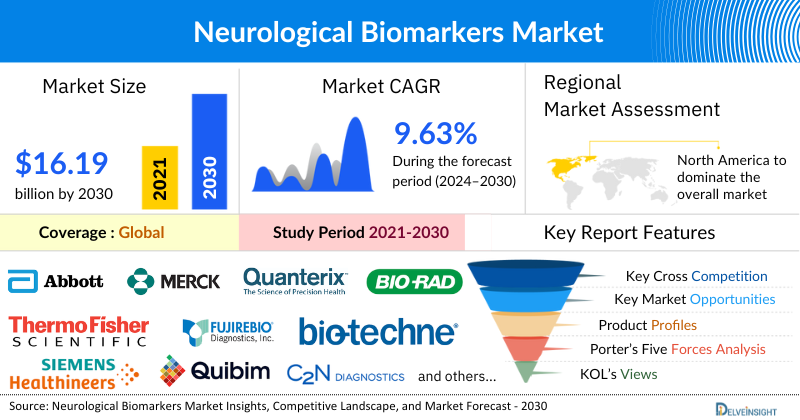
The neurological biomarkers market was valued at USD 8.53 billion in 2023, growing at a CAGR of 9.63% during the forecast period from 2024 to 2030 to reach USD 16.19 billion by 2030. The Neurological Biomarkers Market Size is growing due to the increasing prevalence of neurological disorders, particularly dementia and Parkinson's disease, as the global population ages. Advancements in biomarker discovery technologies, such as genomics and imaging techniques, are enhancing the accuracy of diagnoses and enabling personalized treatment approaches. Additionally, rising investments in neuroscience research and collaborations among academic and industry players are accelerating the development of new biomarkers. The aging population further contributes to this demand, as older adults are more susceptible to these conditions. Collectively, these factors highlight the essential role of neurological biomarkers in improving the diagnosis and management of neurological disorders driving the market growth during the forecast period from 2024 to 2030.
|
Study Period |
2020 to 2034 |
|
Forecast Period |
2024-2034 |
|
Geographies Covered |
|
|
Neurological biomarkers Market |
|
|
Neurological Biomarkers Market Size |
~16.19 billion by 2030 |
|
Neurological biomarkers CAGR |
9.63% during the forecast period |
|
Neurological biomarkers Companies |
Abbott, Merck KGaA, Quanterix, Bio-Rad Laboratories, Inc., Banyan Biomarkers, Inc., Quanterix, Thermo Fisher Scientific, Fujirebio, Bio-Techne, ADx NeuroSciences NV, F. Hoffmann-La Roche Ltd., BIOMÉRIEUX, Siemens Healthineers, Quibim, and C₂N Diagnostics. |
Neurological Biomarkers Treatment Market Dynamics
According to Alzheimer’s Disease International, the global prevalence of Alzheimer’s disease is expected to double every 20 years, reaching an estimated 82 million cases by 2030 and 152 million by 2050. The World Health Organization (WHO) reported in 2023 that over 55 million people worldwide currently live with dementia, with more than 60% residing in low- and middle-income countries. Additionally, nearly 10 million new dementia cases are diagnosed each year, highlighting a significant and growing global health challenge.
A recent study conducted with the support of the WHO, published in The Lancet Neurology in 2024, revealed that more than 3 billion people globally had some form of neurological illness in 2021. Early detection of these conditions is crucial for effective management and treatment, as neurological biomarkers can identify diseases before clinical symptoms manifest, allowing for timely interventions that can significantly improve patient outcomes. The increasing prevalence of neurological disorders, particularly Alzheimer’s and Parkinson’s disease, is expected to drive significant growth in the neurological biomarkers market during the forecast period.
Another vital factor contributing to the Neurological Biomarkers Market Growth is the rising number of partnerships and collaborations among industry players aimed at developing neurological biomarkers for various disorders. These collaborations enable companies to pool their financial, technological, and human resources, accelerating the research and development process and leading to quicker discovery and validation of new biomarkers. For instance, in September 2022, QIAGEN and Neuron23 Inc. entered a Master Collaboration Agreement to develop a companion diagnostic for Neuron23’s brain-penetrant leucine-rich repeat kinase (LRRK2) inhibitor for Parkinson’s disease. Under this agreement, QIAGEN will create and validate a clinical trial assay designed to detect a combination of biomarkers identified by Neuron23 that can predict patient responsiveness to the LRRK2 inhibitor. Such partnerships enhance innovation by allowing academic institutions, biotech companies, and pharmaceutical firms to leverage their collective strengths in basic research, clinical development, and commercialization.
Furthermore, the increasing focus on personalized medicine is propelling the demand for neurological biomarkers, as they can help tailor treatment plans to individual patients based on their unique biomarker profiles. The integration of artificial intelligence and machine learning in biomarker discovery is also paving the way for more efficient and accurate identification of potential biomarkers, enhancing the overall landscape of neurological research.
However, the neurological biomarkers treatment market faces several challenges that could hinder its growth. The high costs associated with the development and validation of biomarkers pose significant financial barriers for many organizations. Additionally, the stringent regulatory approval processes for new biomarkers can slow down market entry, complicating the pathway from discovery to clinical application. Addressing these constraints will be crucial for unlocking the full potential of neurological biomarkers in improving the diagnosis and management of neurological disorders.
Neurological Biomarkers Market Segment Analysis
Neurological biomarkers market by Type (Genomic, Proteomic, Metabolomic, and Others), Application (Alzheimer's Disease, Parkinson’s Disease, Autism, and Others), and Geography (North America, Europe, Asia-Pacific, and Rest of the World).
In the application segment of the neurological biomarkers treatment market, the Alzheimer’s disease category is projected to capture a significant revenue share in 2023. This growth can be primarily attributed to the rising global prevalence of Alzheimer’s and an increasing geriatric population. According to the Centers for Disease Control and Prevention (CDC) in 2023, approximately 6.7 million people in the United States are living with Alzheimer’s disease, a number expected to nearly triple to 14 million by 2060.
Furthermore, the World Health Organization (WHO) reported in 2021 that the global Neurological Biomarkers Market population aged 60 years and older is set to double from 12% to 22% between 2015 and 2050, reaching approximately 2.1 billion people by 2050. By 2030, it is projected that 1 in 6 individuals will be aged 60 or older. As people age, natural brain changes occur, including the shrinkage of brain cells and decreased blood flow, which can impair cognitive function and increase susceptibility to conditions like dementia.
Additionally, ongoing clinical research activities focused on Alzheimer’s are expected to further boost revenue in this category. For instance, in April 2024, Acumen Pharmaceuticals, Inc. presented promising clinical and biomarker results from its Phase 1 INTERCEPT-AD study of sabirnetug (ACU193), a novel therapeutic targeting toxic soluble amyloid beta oligomers for early Alzheimer’s disease, at the American Academy of Neurology (AAN) Annual Meeting.
These factors collectively indicate that the Alzheimer’s disease application category will experience substantial growth, driving the overall expansion of the neurological biomarkers market. As awareness of Alzheimer’s and its impacts grows, along with advancements in research and therapeutic development, the demand for relevant biomarkers will continue to rise, solidifying this category's importance within the broader neurological biomarkers market.
NORTH AMERICA IS EXPECTED TO DOMINATE THE OVERALL NEUROLOGICAL BIOMARKERS MARKET:
North America is projected to hold the largest share of the neurological biomarkers market in 2023, driven by several key factors, including the increasing prevalence of neurological disorders in the region. The growing geriatric population, ongoing research and development activities, and a robust market for product development and launches further contribute to this growth.
According to the Parkinson’s Foundation, nearly one million people in the U.S. are currently living with Parkinson's disease (PD), a figure expected to rise to 1.2 million by 2030. Additionally, approximately 90,000 new PD diagnoses occur each year in the U.S., underscoring the increasing burden of neurological conditions and their impact on the demand for biomarkers.
The market for neurological biomarkers in North America is also bolstered by recent product launches and approvals. For example, in July 2023, Quanterix Corporation introduced LucentAD, a test designed to assist in the evaluation of patients showing cognitive symptoms associated with the early signs of Alzheimer’s disease. Such advancements in diagnostic tools are critical for enhancing early detection and management of neurological disorders.
Given these factors, the neurological biomarkers market in North America is expected to experience a positive growth trajectory during the forecast period from 2024 to 2030, fueled by rising awareness of neurological disorders, technological innovations, and a commitment to improving patient outcomes through effective diagnostics.
Neurological Biomarkers Market Companies
Some of the key market players operating in the neurological biomarkers market include Abbott, Merck KGaA, Quanterix, Bio-Rad Laboratories, Inc., Banyan Biomarkers, Inc., Quanterix, Thermo Fisher Scientific, Fujirebio, Bio-Techne, ADx NeuroSciences NV, F. Hoffmann-La Roche Ltd., BIOMÉRIEUX, Siemens Healthineers, Quibim, and C₂N Diagnostics.
Recent Development activities in Neurological Biomarkers Market:
- In April 2024 Labcorp launched a first-of-its-kind test for glial fibrillary acidic protein (GFAP), a critical blood-based biomarker for the early detection of neurodegenerative diseases and neurological injuries. The new GFAP test offered physicians a more efficient pathway to assess the presence and progression of neurodegenerative diseases such as Alzheimer's disease, multiple sclerosis, glioblastoma, and injuries like traumatic brain injury (TBI).
- In March 2024, Merck, joined the observational LEARNS study to investigate the potential of digital biomarkers to evaluate and predict disease progression in Parkinson’s disease patients.
- In February 2024, Abbott and Fujirebio announced that they are partnering to develop a research-use-only test for the neurofilament-light chain (NfL). The neurology biomarker assay will be available for use on Abbott's Alinity I instrument and will be offered to researchers conducting studies demonstrating the utility of the NfL biomarker, the companies said in a statement. The firms are aiming to make the test available by 2025, and it will be the first RUO assay for the Alinity I system, they added.
Key Takeaways from the Neurological Biomarkers Market Forecast Report
- Market size analysis for current Neurological Biomarkers Market Size (2023), and market forecast for 6 years (2024 to 2030)
- Top key product/technology developments, mergers, acquisitions, partnerships, and joint ventures happened over the last 3 years in Neurological Biomarkers Market.
- Key companies dominating the neurological biomarkers market outlook.
- Various opportunities available for the other competitors in the neurological biomarkers treatment market space.
- What are the top-performing segments in 2023? How these segments will perform in 2030?
- Which are the top-performing regions and countries in the current neurological biomarkers market scenario?
- Which are the regions and countries where companies should have concentrated on opportunities for neurological biomarkers market growth in the coming future?
Taget Audience that can benefit from the Neurological Biomarkers Market Outlook Report
- Neurological Biomarkers product providers
- Research organizations and consulting companies in Neurological Biomarkers Market
- Neurological Biomarkers - related organizations, associations, forums, and other alliances
- Government and corporate offices
- Start-up companies, venture capitalists, and private equity firms
- Distributors and traders dealing in neurological biomarkers market
- Various end-users who want to know more about the neurological biomarkers market and the latest technological developments in the neurological biomarkers market.
Learn more @ Delveinsight Latest Blogs

