
Next Generation Surgical Robotics Market Summary
- The Next Generation Surgical Robotics Market Size is estimated at USD 11.20 billion in 2025 and is projected to reach USD 38.50 billion by 2034. Growth is anchored in the rising demand for minimally invasive surgery, a wave of new competitive platforms challenging long-standing market dominance, and the integration of AI, force feedback, and digital surgery ecosystems.
- The Global Next Generation Surgical Robotics Market Size is growing at a CAGR of 14.7% during the forecast period from 2026 to 2034.
Next Generation Surgical Robotics Market Trends & Insights
- By component, the instruments and accessories segment dominated the Next Generation Surgical Robotics market with a 52% share in 2025.
- By application, the general surgery segment dominated the Next Generation Surgical Robotics market with a 31% share in 2025.
- By technology, the AI-assisted robotic systems segment dominated the Next Generation Surgical Robotics market with a 58% share in 2025.
- By end user, the hospitals segment dominated the Next Generation Surgical Robotics market with a 72% share in 2025.
- North America dominated the global Next Generation Surgical Robotics market revenue with a 56% share in 2025, representing the highest regional market share globally.
Request to unlock the sample page of the "Next Generation Surgical Robotics Market"
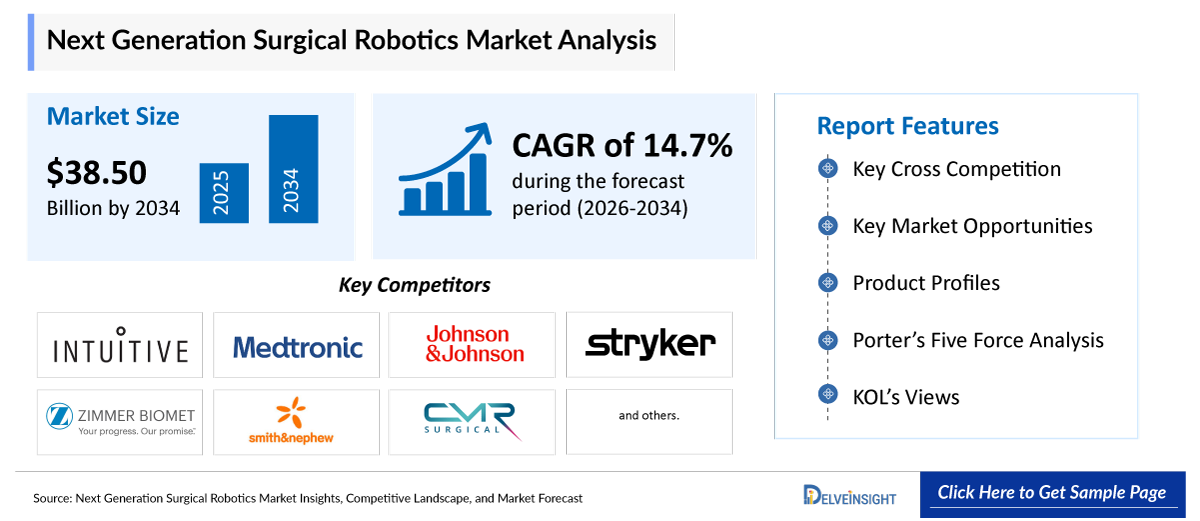
Next Generation Surgical Robotics Market Size
The following snapshot summarizes the principal report metrics for the Next Generation Surgical Robotics market.
|
Report Metrics |
Details |
|---|---|
|
2025 Market Size | |
|
2034 Projected Market Size | |
|
Growth Rate (2026-2034) | |
|
Largest Market |
North America |
|
Fastest Growing Market |
Asia-Pacific |
|
Market Structure |
Consolidated |
All market values are expressed in USD and represent DelveInsight estimates synthesized from primary and secondary research.
Factors Contributing to the Growth of the Next Generation Surgical Robotics Market
Next Generation Surgical Robotics Market Drivers
-
Rising Demand for Minimally Invasive Surgery
The most powerful driver of the Next Generation Surgical Robotics market is the rising demand for minimally invasive surgery. Robotic-assisted platforms deliver superior precision, dexterity, three-dimensional visualization, and ergonomics compared with open and conventional laparoscopic techniques, enabling smaller incisions, less blood loss, reduced complication rates, shorter hospital stays, and faster recovery. Patients increasingly prefer minimally invasive options, and surgeons benefit from reduced fatigue and physical strain over long, complex procedures.
Robotic surgery is now well established in urology, gynecology, and general surgery, with steady increases in robotically performed prostatectomies, hysterectomies, and colorectal procedures. As clinical evidence accumulates and outcomes improve, hospitals expand robotic programs and broaden the range of procedures performed robotically. This durable shift toward minimally invasive, technology-enabled surgery, reinforced by patient and surgeon preference, anchors sustained market growth through the forecast period.
-
Low Penetration and Large Untapped Surgical Volume
A central growth driver is the low current penetration of robotics in total surgical volume, which leaves a vast runway for expansion. Industry analyses indicate that of the millions of major operating-room procedures performed each year in the United States alone, only a small share are robot-assisted, and penetration is lower still in many international markets. As next-generation platforms lower cost, reduce footprint, and broaden procedure menus, a growing proportion of soft-tissue, orthopedic, and specialty procedures becomes addressable.
Expanding clinical indications, accumulating outcomes data, and improving reimbursement steadily convert conventional procedures to robotic approaches. This combination of low penetration and large untapped volume means that even incremental adoption translates into substantial market growth, supporting strong double-digit expansion across the forecast period as robotics moves from a minority of complex cases toward a standard surgical modality.
-
Surge of New Competitive Platforms and FDA Clearances
A surge of new competitive platforms is intensifying competition and accelerating adoption after two decades of single-player dominance in soft-tissue robotics. In December 2025, Medtronic received FDA clearance for its Hugo robotic-assisted surgery system in urologic procedures, becoming the first large medtech company to introduce a soft-tissue robot in the United States since the da Vinci, while CMR Surgical's Versius Plus gained clearance for cholecystectomy and Distalmotion's Dexter secured clearance for outpatient hernia repair.
Johnson & Johnson advanced its Ottava platform toward an FDA submission, and Intuitive Surgical's da Vinci 5 introduced force feedback and enhanced AI. This wave of clearances expands hospital and surgeon choice, drives innovation in interfaces, modularity, and pricing, and accelerates the movement of procedures into new settings, broadening the overall market and reinforcing growth across the forecast period.
-
Rising Burden of Cancer, Chronic Disease, and Aging Populations
The growing burden of cancer, chronic disease, and aging populations is expanding the pool of patients requiring surgery. The International Agency for Research on Cancer recorded 20 million new cancer cases in 2022 and projects 35 million by 2050, while rising rates of Obesity, cardiovascular disease, and degenerative joint and spine conditions increase demand for oncologic, bariatric, cardiac, and orthopedic procedures. Older patients particularly benefit from minimally invasive robotic surgery, which reduces surgical trauma and supports faster recovery.
As surgical demand rises across oncology, urology, gynecology, and orthopedics, next-generation robotic platforms that improve precision, consistency, and outcomes become increasingly valuable. This sustained clinical demand, driven by demographic and epidemiological trends, directly expands robotic surgery volumes and the associated market for systems, instruments, and services across the forecast period.
-
Integration of AI, Force Feedback, and Digital Surgery
The integration of artificial intelligence, force feedback, and digital-surgery ecosystems is enhancing the capability and value of next-generation surgical robots. Intuitive Surgical's da Vinci 5 introduced force feedback and expanded AI, and Medtronic's Touch Surgery platform applies AI algorithms to postoperative analysis and surgical training. AI supports real-time imaging, navigation, tissue characterization, and decision support, while haptic and force feedback improve control and safety.
Cloud-connected analytics benchmark performance, optimize workflows, and support remote observation and training, and digital twins and simulation accelerate surgeon proficiency. These capabilities position the robot as a data-driven surgical partner rather than a mechanical tool, improving outcomes, standardizing care, and supporting premium positioning. As AI and digital surgery mature, they deepen the clinical and operational value of robotic platforms, reinforcing adoption and market growth across the forecast period.
-
Shift Toward Ambulatory Surgical Centers and Robot-as-a-Service
The migration of procedures to ambulatory surgical centers is broadening adoption beyond large hospitals. A Medicare reimbursement change effective in 2026 is accelerating the movement of procedures into outpatient settings, and next-generation platforms designed for portability, fast setup, and smaller operating-room footprints, such as Distalmotion's Dexter and Moon Surgical's Maestro, target this outpatient opportunity.
Robot-as-a-service and leasing commercial models lower the capital barrier, converting large upfront purchases into operating expenses and enabling mid-tier hospitals, ambulatory centers, and emerging-market providers to adopt robotics. Compact, modular, and procedure-specific systems expand the range of feasible settings and applications. As surgery shifts toward decentralized, cost-efficient delivery, this expansion of suitable sites and flexible commercial models enlarges the addressable market and accelerates installations across the forecast period.
-
Expansion into New Specialties and Emerging Markets
Expansion into new surgical specialties and emerging markets is opening fresh growth avenues. Beyond established soft-tissue and orthopedic applications, robotics is advancing into endoluminal, endovascular, ophthalmic, and ear, nose, and throat procedures, with novel single-use and palm-sized systems lowering barriers to entry. In parallel, manufacturers are expanding aggressively into Asia-Pacific, Latin America, and other emerging regions through partnerships, training centers, and lower-cost platforms, with strong government support in markets such as China and India accelerating adoption.
Training programs and surgical-education partnerships build the workforce required for sustained growth, while procedure-specific robots address high-volume niches. This combination of specialty expansion and geographic broadening multiplies the number of addressable procedures and settings, supporting durable, diversified market growth across the forecast period.
Next Generation Surgical Robotics Overview
Next-generation surgical robotics refers to the latest wave of robot-assisted surgical platforms that combine multi-arm or modular manipulators, high-definition three-dimensional visualization, AI-driven imaging and navigation, force and haptic feedback, and connected digital-surgery software to perform minimally invasive procedures with enhanced precision, dexterity, and control. Distinct from earlier systems, these platforms emphasize portability and modularity for ambulatory settings, force feedback and autonomy features, integration with imaging and analytics, robot-as-a-service commercial models, and procedure-specific designs across soft-tissue and orthopedic surgery.
The Next Generation Surgical Robotics Market combines robotic systems and hardware, instruments and accessories, and services and software, applied across general surgery, urology, gynecology, orthopedics, neurosurgery, and cardiovascular and other specialties. Platforms span multiport and single-port soft-tissue robots, orthopedic and spine navigation robots, neurosurgical systems, and emerging endoluminal and endovascular robots, deployed across hospitals and ambulatory surgical centers.
Driven by rising minimally invasive surgery, an aging population, a low current penetration of robotics in total surgical volume, a surge of new competitive platforms, and rapid advances in AI, force feedback, and digital surgery, next-generation surgical robotics has become one of the most dynamic and strategically important frontiers in medical technology.
Next Generation Surgical Robotics Market Key Growth Drivers
- Rising demand for minimally invasive surgery, which offers smaller incisions, less trauma, faster recovery, and fewer complications, is driving hospitals to expand robotic-assisted surgery programs.
- A low current penetration of robotics in total surgical volume, with only a small share of major operating-room procedures performed robotically, leaves substantial room for growth.
- A surge of new competitive platforms, including Medtronic's Hugo, CMR Surgical's Versius, Distalmotion's Dexter, and Johnson & Johnson's Ottava, is expanding choice and accelerating adoption.
- The rising global burden of cancer and chronic disease, with the International Agency for Research on Cancer projecting cancer cases to rise from 20 million in 2022 to 35 million by 2050, is increasing surgical volumes.
- Integration of AI, force feedback, three-dimensional visualization, and digital-surgery analytics is improving precision, outcomes, and surgeon training.
- The shift toward ambulatory surgical centers, supported by compact, modular, and robot-as-a-service platforms, is broadening adoption beyond large hospitals.
- The convergence of minimally invasive demand, competitive platform launches, AI integration, and outpatient expansion is expected to sustain strong double-digit growth through 2034.
Major Next Generation Surgical Robotics Companies
The Next Generation Surgical Robotics Competitive Landscape is led by the following active manufacturers and developers:
- Intuitive Surgical, Inc.
- Medtronic plc
- Johnson & Johnson MedTech
- Stryker Corporation
- Zimmer Biomet Holdings, Inc.
- Smith & Nephew plc
- CMR Surgical Ltd.
- Globus Medical, Inc.
- Asensus Surgical, Inc.
- Accuray Incorporated
For illustrative purposes, only the top 10 companies are listed in the Table of Contents. The report may include analysis and references to additional companies, where relevant to the market assessment.
Next Generation Surgical Robotics Market Restraints
Despite strong momentum, the Next Generation Surgical Robotics market faces material constraints. The high cost of robotic systems is the primary barrier, as capital equipment, instruments, accessories, service contracts, and facility requirements represent a substantial financial investment that limits adoption among smaller hospitals, ambulatory centers, and providers in lower-income countries, concentrating use in larger, better-funded institutions. A steep learning curve and the need for specialized training and credentialing slow deployment, as surgeons and operating-room teams must develop proficiency before procedural benefits and efficiency are realized.
Reimbursement remains uneven across geographies and procedures, and the incremental cost of robotic surgery over conventional approaches can be difficult to justify where clinical advantage is marginal, constraining the return on investment. Regulatory and clinical-validation requirements lengthen development timelines and demand rigorous evidence of safety and benefit, while ongoing software and AI updates require continued post-market oversight. Integration with operating-room workflows, imaging systems, and hospital information technology adds complexity, and concerns about data privacy and cybersecurity in connected platforms add further burden.
The dominance of an established leader and high switching costs create barriers for new entrants, even as competition intensifies. Maintenance, downtime, and dependence on proprietary consumables add operational costs. Together, these cost, training, reimbursement, regulatory, and integration barriers temper the pace of growth, even as the underlying drivers of minimally invasive demand, low penetration, and technological innovation remain firmly intact.
Next Generation Surgical Robotics Market Segment Analysis
The Next Generation Surgical Robotics Market by Component (Instruments and Accessories, Robotic Systems and Hardware, Services and Software), Application (General Surgery, Urology, Gynecology, Orthopedics, Neurosurgery, Cardiovascular and Others), Technology (AI-Assisted Robotic Systems, Semi-Autonomous Systems, Autonomous Systems), End User (Hospitals, Ambulatory Surgical Centers, Specialty Clinics and Others), and Geography (North America, Europe, Asia-Pacific, Rest of World).
-
Next Generation Surgical Robotics Market Segmentation By Component
Dominant Subsegment: Instruments and Accessories. The instruments and accessories category is expected to dominate the market.
Dominant: Instruments and Accessories ~ 52%
The instruments and accessories segment accounted for 52% of the Next Generation Surgical Robotics market in 2025. Instruments and accessories are the leading component because surgical robotics operates on a razor-and-blade model in which each procedure consumes endoscopes, energy instruments, staplers, drapes, and single-use accessories, producing recurring revenue that scales directly with procedure volume. As the installed base of robotic systems grows and procedure counts rise into the millions annually, consumable demand deepens with every case, and market leaders derive a large and growing share of revenue from instruments and services rather than one-time system sales.
Manufacturers reinforce this dynamic by pairing proprietary platforms with closed-system instruments, locking institutions into ongoing purchases. The expansion of procedure menus, the entry of new platforms each with their own consumables, and the shift toward single-use instruments further enlarge the segment. While robotic systems and hardware anchor the installed base and services and software capture digital and support revenue, the recurring economics and procedure-linked growth of instruments and accessories secure the segment's leadership across the forecast period.
-
Next Generation Surgical Robotics Market Segmentation By Application
Dominant Subsegment: General Surgery. The general surgery category is expected to dominate the market.
Dominant: General Surgery ~ 31%
The general surgery segment accounted for 31% of the Next Generation Surgical Robotics market in 2025. General surgery is the leading application because it encompasses the broadest and highest-volume set of robotic procedures, including hernia repair, cholecystectomy, colorectal, bariatric, and foregut surgery, performed across a wide range of hospitals and increasingly ambulatory centers. The breadth of general-surgery indications and the steady conversion of laparoscopic and open procedures to robotic approaches give the segment the largest revenue base, and most new competitive platforms target general surgery to maximize their addressable market.
Urology and gynecology remain large, established robotic specialties, anchored by high robotic penetration in prostatectomy and hysterectomy, while orthopedics, led by robotic joint replacement and spine navigation, is a major and fast-growing segment. Neurosurgery and cardiovascular applications expand with navigation and emerging endovascular robotics. Nonetheless, the scale, breadth, and ongoing conversion of high-volume procedures secure general surgery's leadership across the forecast period.
-
Next Generation Surgical Robotics Market Segmentation By Technology
Dominant Subsegment: AI-Assisted Robotic Systems. The AI-assisted robotic systems category is expected to dominate the market.
Dominant: AI-Assisted Robotic Systems ~ 58%
The AI-assisted robotic systems segment accounted for 58% of the Next Generation Surgical Robotics market in 2025. AI-assisted robotic systems are the leading technology because virtually all current next-generation platforms operate under direct surgeon control while embedding artificial intelligence for imaging, navigation, visualization, and decision support rather than acting autonomously. AI enhances tissue characterization, instrument tracking, real-time guidance, and postoperative analytics, improving precision and outcomes while keeping the surgeon in control, which aligns with clinical, regulatory, and liability expectations.
Flagship systems exemplify this approach, including da Vinci 5 with force feedback and expanded AI, Hugo with connected digital surgery, and orthopedic platforms with AI-driven planning and intraoperative data. Semi-autonomous systems, which execute defined subtasks under supervision, are advancing in orthopedics and specific procedures, and fully autonomous systems remain early and investigational, attracting research funding. While semi-autonomous and autonomous approaches grow as the technology and evidence mature, AI-assisted systems retain clear leadership through their broad deployment, regulatory acceptance, and proven clinical value across the forecast period.
-
Next Generation Surgical Robotics Market Segmentation By End User
Dominant Subsegment: Hospitals. The hospitals category is expected to dominate the market.
Dominant: Hospitals ~ 72%
The hospitals segment accounted for 72% of the Next Generation Surgical Robotics market in 2025. Hospitals are the largest end user because they perform the overwhelming majority of complex surgical procedures and have the capital, infrastructure, surgical specialties, and case volume to acquire and operate premium robotic platforms. Academic medical centers and large hospitals anchor the installed base for high-value systems from Intuitive Surgical, Medtronic, Johnson & Johnson, Stryker, and Zimmer Biomet, and they support the training, credentialing, and throughput that robotic programs require.
Hospital adoption is reinforced by the breadth of procedures, established reimbursement, and the ability to absorb high upfront system and service costs. At the same time, ambulatory surgical centers are the fastest-growing end user, propelled by a 2026 reimbursement change that moves procedures to outpatient settings and by compact, modular, and robot-as-a-service platforms designed for them, while specialty clinics expand access. Nonetheless, the volume, acuity, and infrastructure of hospitals secure their clear leadership across the forecast period.
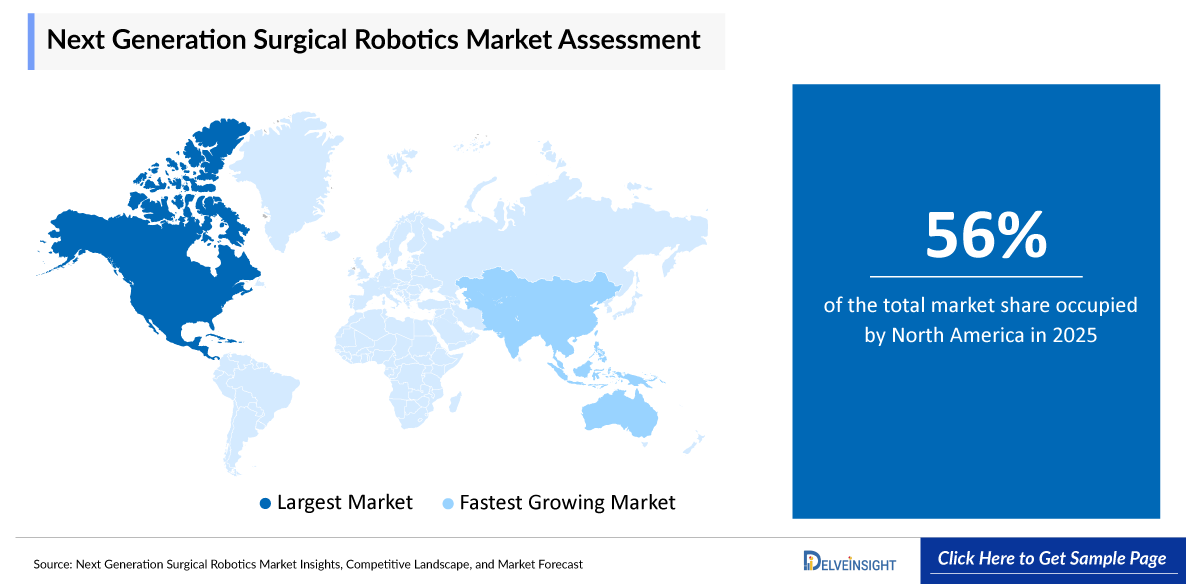
Next Generation Surgical Robotics Market Region Analysis
-
Dominant Region: North America
North America accounted for 56% of the global Next Generation Surgical Robotics market revenue in 2025, representing the highest regional market share globally. The region's dominance reflects the world's highest robotic surgery adoption, advanced healthcare infrastructure, strong reimbursement, high surgical volumes, and the concentration of leading manufacturers, particularly in the United States. North America hosts the headquarters and primary markets of Intuitive Surgical, Medtronic, Johnson & Johnson MedTech, Stryker, and Zimmer Biomet, ensuring strong training, support, and instrument supply.
The region benefits from a wave of FDA clearances, including Medtronic's Hugo, CMR Surgical's Versius Plus, and Distalmotion's Dexter, and from a Medicare reimbursement change effective in 2026 that accelerates the movement of procedures into ambulatory surgical centers. Intuitive Surgical's large installed base and continued investment, including manufacturing and training expansion, anchor regional leadership. Deep clinical expertise, supportive regulation, and strong investment sustain North America's continued leadership across the forecast period.
Dominant: North America ~ 56% (Largest)
-
Fastest Growing Region: Asia-Pacific
Asia-Pacific is the fastest-growing region in the Next Generation Surgical Robotics market. The region's elevated CAGR is driven by a large and aging population, rising cancer and chronic-disease burden, expanding healthcare access, and strong government support for medical robotics across China, Japan, India, South Korea, and Australia. China's national strategies have fueled investment in domestic surgical robotics, and Chinese manufacturers are developing cost-effective platforms that narrow performance gaps, while India expands access through hospital partnerships and training programs in tier-two and tier-three cities.
Rising surgical volumes, growing medical tourism, and increasing affordability of robotic systems accelerate adoption across the region. Local innovation, lower-cost platforms, and government initiatives position Asia-Pacific as the principal source of incremental growth over the forecast period.
Next Generation Surgical Robotics Regional Commentary
- North America
North America accounted for 56% of the global Next Generation Surgical Robotics market revenue in 2025. The United States dominates on the strength of the world's highest robotic surgery adoption, a dense base of manufacturers, strong reimbursement, high surgical volumes, FDA clearance momentum, and a 2026 reimbursement change accelerating outpatient robotic surgery, while Canada contributes through hospital adoption and provincial programs.
- Europe
Europe is a large and advanced regional market, led by Germany, the United Kingdom, France, Italy, and Spain. Growth is supported by strong healthcare systems, government hospital-digitalization funding such as Germany's Hospital Future Act and France's health-innovation strategy, and a robust manufacturer base including CMR Surgical, Distalmotion, KARL STORZ, and Smith & Nephew, while national health-technology assessment shapes adoption.
- Asia-Pacific
Asia-Pacific is the fastest-growing region, propelled by a large aging population, rising cancer and chronic-disease burden, expanding healthcare access, and strong government support for medical robotics across China, Japan, India, South Korea, and Australia. Domestic manufacturers scale cost-effective platforms, while hospital partnerships, training centers, and medical tourism broaden access.
- Rest of World
The Rest of World region, spanning Latin America, the Middle East, and Africa, is an emerging growth frontier. A rising burden of cancer and chronic disease, expanding hospital infrastructure, and growing demand for minimally invasive surgery are increasing adoption, while partnerships, training programs, lower-cost platforms, and robot-as-a-service models are gradually extending access to surgical robotics across these markets.
Next Generation Surgical Robotics Market Competitive Landscape
The Next Generation Surgical Robotics Market is classified as Consolidated. Intuitive Surgical holds a dominant position in soft-tissue robotics through its da Vinci platform, with the top players collectively controlling the large majority of revenue, followed by Medtronic, Johnson & Johnson MedTech, Stryker, and Zimmer Biomet across soft-tissue and orthopedic robotics. A rapidly expanding field of challengers, including CMR Surgical, Distalmotion, Moon Surgical, PROCEPT BioRobotics, and SS Innovations, is intensifying competition as new platforms reach the market, particularly in ambulatory and cost-sensitive segments.
The Next Generation Surgical Robotics competitive landscape can be evaluated across the following dimensions:
- Market concentration: Consolidated, with Intuitive Surgical dominant in soft-tissue robotics and high barriers to entry from capital, clinical evidence, and installed-base lock-in.
- Leading players: Intuitive Surgical, Medtronic, Johnson & Johnson MedTech, Stryker, and Zimmer Biomet anchor the top tier.
- Geographic reach: Leaders operate global commercial, training, and service networks, with rapid expansion programs targeting Asia-Pacific and emerging markets.
- Product portfolio strength: Top players offer integrated portfolios spanning soft-tissue and orthopedic robots, instruments, and digital-surgery software.
- Pipeline strength: Active pipelines in single-port, modular, and outpatient platforms, force feedback, autonomy features, and new specialty indications.
- Strategic partnerships: Collaborations with computing, imaging, and health-technology partners, and hospital training programs, extend reach and capability.
- M&A activity: Consolidation continues, including KARL STORZ's acquisition of Asensus Surgical and Johnson & Johnson's earlier acquisition of Auris Health.
- Manufacturing capabilities: Scale manufacturing of systems and instruments and large installed bases are key competitive moats and supply-chain considerations.
- Innovation focus: AI and force feedback, modular and portable platforms for ambulatory care, robot-as-a-service models, and digital-surgery ecosystems.
Next Generation Surgical Robotics Market Recent Developmental Activities
- In December 2025, Medtronic plc, received FDA clearance of the Hugo robotic-assisted surgery system for urologic procedures, supported by the Expand URO study, becoming the first large medtech company to introduce a soft-tissue surgical robot in the United States since the da Vinci. Strategic significance: Establishes a major competitor to Intuitive Surgical and expands hospital choice in soft-tissue robotics.
- In December 2025, CMR Surgical Ltd., received FDA 510(k) clearance for its Versius Plus system to perform cholecystectomy and posted nine-figure financing to support United States commercialization. Strategic significance: Adds a modular, portable robotic platform and broadens access beyond academic medical centers.
- In December 2025, Distalmotion SA, received FDA De Novo clearance for its Dexter robotic system for outpatient inguinal hernia repair and posted nine-figure financing. Strategic significance: Targets the ambulatory surgical center opportunity with a compact, fast-setup platform designed for outpatient workflows.
- In 2026, Johnson & Johnson MedTech, advanced its Ottava soft-tissue surgical robot toward an FDA submission, following first United States clinical cases in 2025 and reported positive pivotal study results. Strategic significance: Positions a major competitor with operating-table-integrated robotic arms to enter the soft-tissue robotics market.
- In 2025, Intuitive Surgical, Inc., expanded the international rollout of its da Vinci 5 system, which introduced force feedback and enhanced AI with over 150 upgrades, and reported over 2.68 million da Vinci procedures performed in 2024. Strategic significance: Reinforces market leadership and raises the performance benchmark amid intensifying competition.
- In April 2025, Medtronic plc, reported that its Expand URO investigational device exemption study, the largest of its kind for robotic-assisted urologic surgery, met its primary safety and effectiveness endpoints. Strategic significance: Provided the clinical foundation for the Hugo system's United States clearance and broader indication expansion.
- In May 2025, SS Innovations International, Inc., announced plans to submit a De Novo classification request to the FDA for its SSi Mantra surgical robotic system, positioned for affordability and broader global access. Strategic significance: Advances a low-cost robotic platform aimed at expanding access in cost-sensitive markets.
- In March 2024, Intuitive Surgical, Inc., received FDA clearance for the da Vinci 5, its fifth-generation multiport system featuring force feedback and enhanced AI, following over a decade of development. Strategic significance: Sets a new performance benchmark and defends Intuitive's leadership in soft-tissue robotics.
- In 2024, KARL STORZ SE & Co. KG, completed its acquisition of Asensus Surgical, adding the Senhance and LUNA digital and performance-guided surgery platforms to its portfolio. Strategic significance: Brings a major endoscopy company into surgical robotics and accelerates digital, performance-guided platforms.
- In April 2024, Medtronic plc, introduced new AI-driven algorithms for its Touch Surgery Performance Insights platform and launched Touch Surgery Live Stream for remote observation and training. Strategic significance: Strengthens Medtronic's digital-surgery ecosystem and supports surgeon training and workflow optimization.
- In February 2024, CMR Surgical Ltd., launched vLimeLite imaging for fluorescence visualization as part of its Versius Plus system. Strategic significance: Enhances intraoperative visualization and strengthens the competitiveness of the Versius platform.
- In October 2024, Intuitive Surgical, Inc. (with KIMS Hospitals), partnered to launch 25 robotic surgery programs with da Vinci systems across multiple Indian states, expanding access in tier-two and tier-three cities. Strategic significance: Accelerates emerging-market adoption and broadens access to minimally invasive robotic surgery.
Next Generation Surgical Robotics Market Segmentation
-
Next Generation Surgical Robotics Market by Component
- Instruments and Accessories
- Robotic Systems and Hardware
- Services and Software
-
Next Generation Surgical Robotics Market by Application
- General Surgery
- Urology
- Gynecology
- Orthopedics
- Neurosurgery
- Cardiovascular and Others
-
Next Generation Surgical Robotics Market by Technology
- AI-Assisted Robotic Systems
- Semi-Autonomous Systems
- Autonomous Systems
-
Next Generation Surgical Robotics Market by End User
- Hospitals
- Ambulatory Surgical Centers
- Specialty Clinics and Others
Next Generation Surgical Robotics Market by Geography
-
North America Next Generation Surgical Robotics Market
- United States Next Generation Surgical Robotics Market Size in USD million (2023-2034)
- Canada Next Generation Surgical Robotics Market Size in USD million (2023-2034)
- Mexico Next Generation Surgical Robotics Market Size in USD million (2023-2034)
-
Europe Next Generation Surgical Robotics Market
- Germany Next Generation Surgical Robotics Market Size in USD million (2023-2034)
- United Kingdom Next Generation Surgical Robotics Market Size in USD million (2023-2034)
- France Next Generation Surgical Robotics Market Size in USD million (2023-2034)
- Italy Next Generation Surgical Robotics Market Size in USD million (2023-2034)
- Spain Next Generation Surgical Robotics Market Size in USD million (2023-2034)
- Rest of Europe Next Generation Surgical Robotics Market Size in USD million (2023-2034)
-
Asia-Pacific Next Generation Surgical Robotics Market
- China Next Generation Surgical Robotics Market Size in USD million (2023-2034)
- Japan Next Generation Surgical Robotics Market Size in USD million (2023-2034)
- India Next Generation Surgical Robotics Market Size in USD million (2023-2034)
- Australia Next Generation Surgical Robotics Market Size in USD million (2023-2034)
- South Korea Next Generation Surgical Robotics Market Size in USD million (2023-2034)
- Rest of Asia-Pacific Next Generation Surgical Robotics Market Size in USD million (2023-2034)
-
Rest of the World (RoW) Next Generation Surgical Robotics Market
- Middle East Next Generation Surgical Robotics Market Size in USD million (2023-2034)
- Africa Next Generation Surgical Robotics Market Size in USD million (2023-2034)
- South America Next Generation Surgical Robotics Market Size in USD million (2023-2034)
Next Generation Surgical Robotics Market Recent Industry Trends and Milestones (2023-2026)
|
Category |
Key Developments |
|
Next Generation Surgical Robotics Market Product Approval |
Regulatory momentum reshaped the competitive landscape. Intuitive Surgical received FDA clearance for the force-feedback da Vinci 5 (March 2024). Medtronic's Hugo robotic-assisted surgery system was cleared for urologic procedures (December 2025), supported by the Expand URO study, becoming the first large-medtech soft-tissue robot cleared in the United States since the da Vinci. CMR Surgical's Versius Plus was cleared for cholecystectomy and Distalmotion's Dexter received De Novo clearance for outpatient hernia repair (December 2025). Johnson & Johnson advanced its Ottava platform toward an FDA submission, and SS Innovations filed for its SSi Mantra system. |
|
Next Generation Surgical Robotics Market Product Expansion |
Manufacturers expanded platforms, indications, and settings. Multi-port, single-port, modular, and portable systems broadened across urology, gynecology, general surgery, and orthopedics, while compact platforms such as Dexter and Moon Surgical's Maestro targeted ambulatory surgical centers. A 2026 Medicare reimbursement change is shifting procedures to outpatient settings. Force feedback, AI navigation, digital-surgery analytics, and robot-as-a-service models broadened the addressable market, and emerging endoluminal, endovascular, and single-use systems, such as Microbot's Liberty, opened new specialties. |
|
Next Generation Surgical Robotics Market Investment |
Capital and consolidation intensified. CMR Surgical and Distalmotion each posted nine-figure financing rounds to support United States expansion, and CMR's total raised exceeds USD 1 billion. KARL STORZ acquired Asensus Surgical to enter surgical robotics, and Intuitive Surgical announced a USD 400 million investment to expand manufacturing and training. Venture capital flowed into compact, AI-enabled, and cost-effective platforms from Moon Surgical, PROCEPT BioRobotics, SS Innovations, and others, while major players deepened investment in digital surgery, AI, and emerging-market access. |
|
Company Strategy |
Intuitive Surgical, Inc.: Soft-tissue leadership through da Vinci 5 with force feedback and AI, plus emerging-market expansion. Medtronic plc: Hugo robotic surgery and Touch Surgery digital ecosystem. Johnson & Johnson MedTech: Ottava platform with operating-table-integrated arms. Stryker Corporation and Zimmer Biomet Holdings, Inc.: Orthopedic and spine robotics leadership through Mako and ROSA. Smith & Nephew plc, Globus Medical, Inc., and Accuray Incorporated: Orthopedic, spine, and radiosurgery platforms. CMR Surgical, Distalmotion, and Moon Surgical: Modular and portable systems for ambulatory and cost-sensitive settings. |
|
Emerging Technologies |
Force feedback, AI-driven imaging and navigation, and digital-surgery analytics are becoming standard, improving precision, outcomes, and training. Modular, portable, and single-port platforms target ambulatory surgical centers, while robot-as-a-service and leasing models lower capital barriers. Semi-autonomous subtask execution is advancing in orthopedics, and fully autonomous surgery remains investigational, supported by research funding. Single-use, palm-sized, and endovascular and endoluminal robots, augmented and virtual reality, digital twins, telesurgery, and cloud-connected ecosystems are extending capability across specialties and care settings. |
Next Generation Surgical Robotics Market Startup Funding and Investment Trends
Investment in the Next Generation Surgical Robotics ecosystem has concentrated on modular and portable platforms for ambulatory care, AI-enabled and cost-effective systems, and emerging single-use and specialty robots. The following companies illustrate recent funding and investment activity and technology focus.
Company |
Total Funding |
Funding Stage |
Main Product |
Core Technology |
|
CMR Surgical Ltd. |
USD 1 billion and above |
Late-stage venture |
Versius and Versius Plus |
Modular soft-tissue robotics |
|
Distalmotion SA |
USD 150 million and above |
Late-stage venture |
Dexter |
Portable outpatient robotics |
|
Request to unlock the report on the @ Next Generation Surgical Robotics Market | ||||
Capital is flowing toward developers that make robotic surgery more accessible, portable, and affordable. CMR Surgical has raised over USD 1 billion to commercialize its modular Versius platform and expand into the United States, while Distalmotion and Moon Surgical advance compact systems designed for ambulatory surgical centers, each having posted significant financing. PROCEPT BioRobotics scales aquablation robotic therapy for urology, and SS Innovations pursues affordable robotics for cost-sensitive markets.
Major Next Generation Surgical Robotics Companies are also investing heavily, with Intuitive Surgical committing USD 400 million to manufacturing and training expansion. Collectively, these investments signal conviction that portable, AI-enabled, outpatient-ready, and cost-effective platforms will define the next phase of competitive advantage in the global Next Generation Surgical Robotics market.
Key Takeaways from the Next Generation Surgical Robotics Market Report Study
- Next Generation Surgical Robotics Market Size analysis for the current Market Size (2025) and market forecast for 9 years (2026 to 2034).
- Top key product/technology developments, mergers, acquisitions, partnerships, and joint ventures that happened over the last 3 years.
- Key companies dominating the Global Next Generation Surgical Robotics Market.
- Various opportunities available for competitors in the next-generation surgical robotics market space.
- What are the top-performing segments in 2025? How will these segments perform in 2034?
- Which are the top-performing regions and countries in the current next-generation surgical robotics market scenario?
- Which are the regions and countries where companies should concentrate their opportunities for next generation surgical robotics market growth in the future?
Target audience who can benefit from this Next Generation Surgical Robotics Market Report Study
- Next Generation Surgical Robotics product providers
- Research organizations and consulting Next Generation Surgical Robotics Companies
- Next Generation Surgical Robotics-related organizations, associations, forums, and other alliances
- Government and corporate offices
- Start-up companies, venture capitalists, and private equity firms
- Distributors and traders dealing in next generation surgical robotics
- Various end-users who want to know more about the next generation surgical robotics market and the latest technological developments in the next generation surgical robotics market.
Stay updated with us for Recent Articles @ New DelveInsight Blogs

